

New Mexico’s Groundwater Reality and the Urgent Need for Action
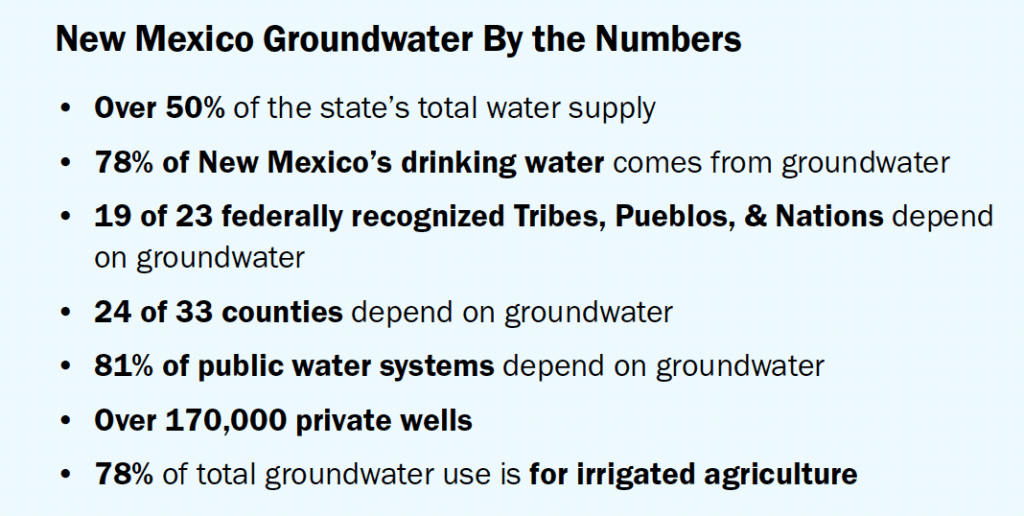
Groundwater is the backbone of New Mexico’s water supply. It provides more than half of all water used statewide, supplies drinking water for most communities, and sustains agriculture, industry, and ecosystems across large areas of the state. Yet in many regions, groundwater pumping has vastly exceeded natural recharge. Climate change is intensifying the risks.
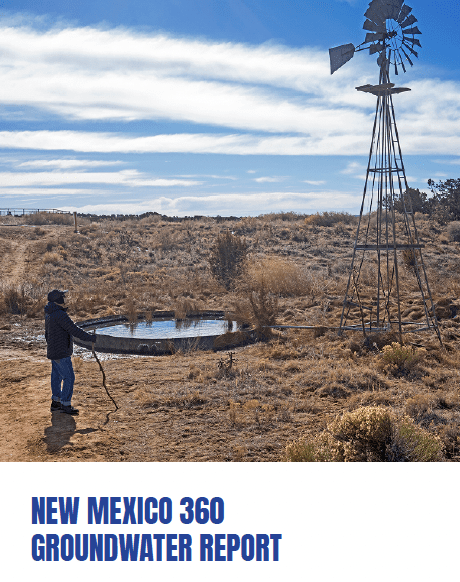 The January 2026 New Mexico 360 Groundwater Report offers the most comprehensive, statewide synthesis to date of New Mexico’s groundwater conditions, management tools, and future challenges. Prepared by the New Mexico Groundwater Alliance with contributions from scientists, legal experts, and water managers, the report integrates data, experience, and case studies to make sound recommendations.
The authors document a clear and troubling trend: as surface-water supplies decline due to warming temperatures and prolonged drought, dependence on groundwater is increasing. In many New Mexico basins, withdrawals vastly exceed recharge year after year, resulting in falling groundwater levels, higher pumping costs, and degraded water quality. Excessive pumping from aquifers interconnected with rivers depletes the rivers and interferes with meeting interstate compact obligations. The authors also identify persistent data and governance gaps—limited metering, uneven monitoring, and incomplete aquifer characterization.
The report identifies serious gaps in aquifer characterization and monitoring that must be addressed to support durable groundwater management. It does not suggest waiting to act; it underscores that continued inaction—under the guise of needing more data—will only accelerate depletion and foreclose future options.
Practical Steps New Mexico Must Implement
The report does not stop at diagnosis. It identifies practical, New Mexico–specific pathways forward. The authors present case studies from the Pecos Valley, the Lower Rio Grande, the Southern High Plains, and other regions to demonstrate that locally driven groundwater management—when supported by state policy, reliable data, and sustained investment—can slow depletion and improve long-term resilience. The report emphasizes treating aquifers as critical infrastructure that provides irreplaceable services to water users. The report urges accelerating aquifer mapping and monitoring, expanding groundwater metering, and fully integrating groundwater into regional water security planning.
These findings are directly relevant to decisions now facing New Mexico policymakers, water managers, and communities, including implementing the 2023 Water Security Planning Act and confronting unanswered needs for groundwater governance and enforcement.
A Water Advocates Perspective
New Mexico still lacks aquifer-based limits on groundwater depletion. The report points out that the State Engineer has the authority, but has not acted. At the 2023 Water Leaders Conference, a state legislator asked a basic question: does the State Engineer manage groundwater pumping based on how much water remains in an aquifer, or the rate at which it is declining? The panelists didn’t provide the factual answer, which is neither of those.
New Mexico water law and State Engineer permits allow pumping up to the paper right regardless of aquifer condition, even where declines are severe and well-documented, as the Clovis and Portales groundwater supply crisis demonstrates,
True management of New Mexico groundwater resources for longevity and security does not exist, except for one New Mexico artesian aquifer where pumping is controlled by the Pecos Valley Artesian Conservancy District. The District, managed by a report co-author, was initially created by a Roswell district judge’s order in January 1932. That’s because the impacts of uncontrolled uses were quite obvious. Non-artesian aquifers impacts of uncontrolled uses are generally not observed until wells run dry.
The growing number of New Mexico households hauling water because their wells have gone dry is direct evidence that aquifers are being depleted. Last fall, a Clovis-area irrigator—who is also an elected state legislator and a member of the Water and Natural Resources Committee—informed the committee that he has invested in new technology. He stated that its purpose is to fully exhaust the groundwater beneath his land.
How Other Western States Are Managing Their Groundwater
The New Mexico Groundwater Alliance news release included a supplemental document reviewing the groundwater management frameworks of other Western states. While none has solved groundwater depletion everywhere, many have established recognizable systems—defined basin goals, monitoring tied to aquifer conditions, enforceable limits, and clear triggers for action when withdrawals exceed supply.
New Mexico has not. This absence is reinforced by current budget decisions. The State Engineer’s FY27 special appropriations and program expansion requests focus on compact compliance, settlements, and enforcement, but the word groundwater or any description of the need for groundwater programs does not appear.
Preregister to Hear From the Report’s Principal Author
At 6:30 pm on February 19, Santa Fe native Gretel Follingstad, Ph.D., the report’s principal author and an outstanding presenter, will discuss what the data show, what remains uncertain, and what New Mexico must do next to address the ever-worsening groundwater crisis. The disconnect between hydrologic reality and administration is precisely why this report matters—and why this presentation should not be missed.
The State’s choices are not serving New Mexico’s water future. Continuing to allow groundwater to be mined until it is gone will end poorly—for communities, local economies, and the State.