Stay informed about the latest legislative actions and policy developments related to water management in New Mexico, including bills, hearings, and advocacy efforts.
Everyone seems to agree that New Mexico has problems — poverty, unemployment, education, healthcare, childcare, crime rates, etc.
Political candidates and current office holders talk endlessly about these. Each claims to have a solution.
However, those politicians inadequately address the invisible Elephant in the room. That Elephant is the growing scarcity of water across the state, and He is huge.
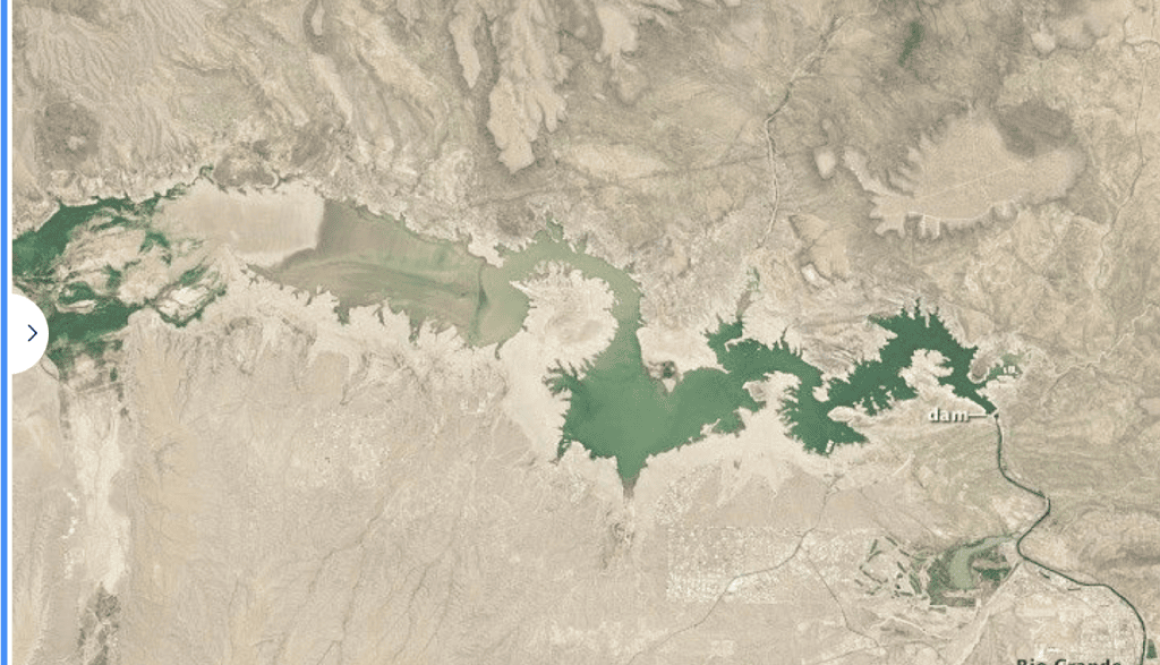
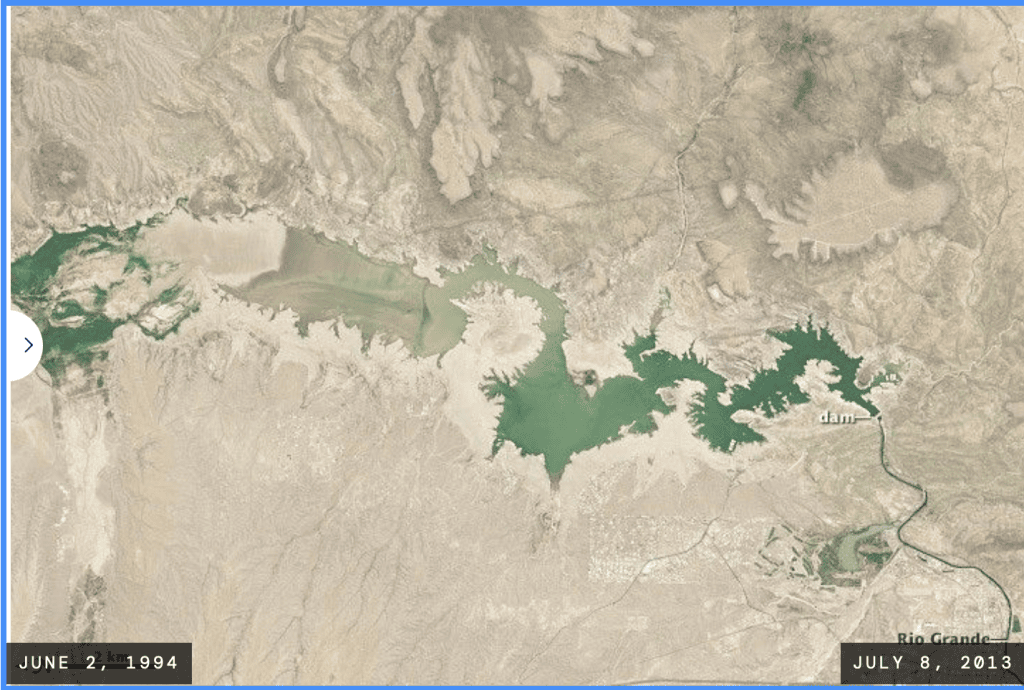
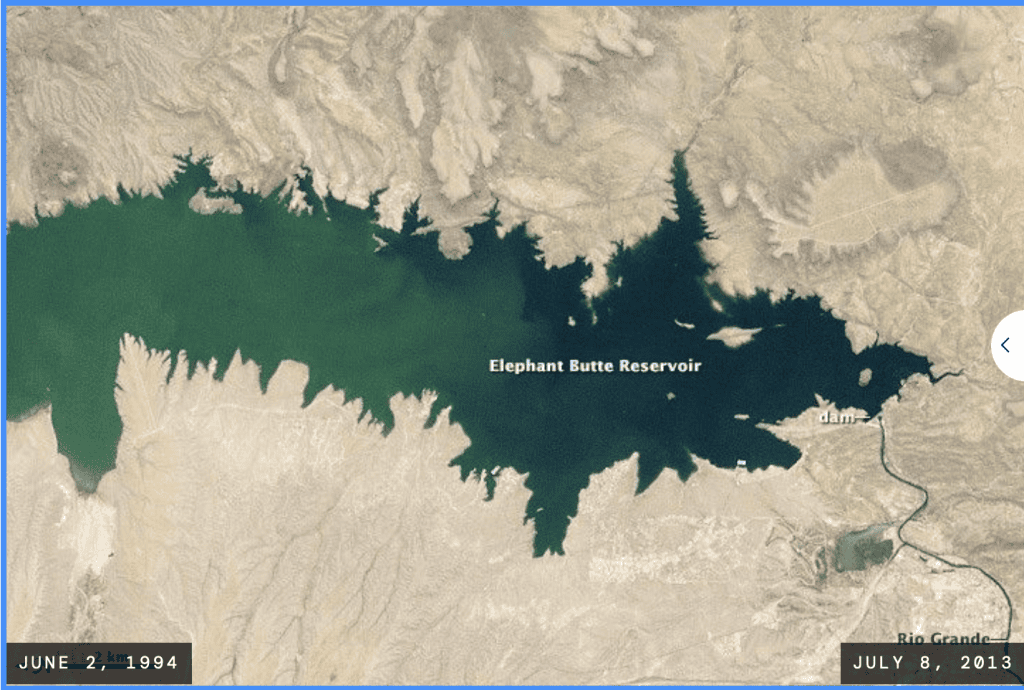
NASA photographs of Elephant Butte Reservoir in 1994 (it filled and spilled in 1995) and 2013. This major reservoir holds less water now (45,000 acre-feet) than in 2013, 2021, 2022, and 2025, the driest years this century. https://science.nasa.gov/earth/earth-observatory/on-this-day-in-2013-elephant-butte-reservoir-151549/
Depending upon where you live, water scarcity shows itself in different ways and with different urgencies. Examples:
In the Clovis area, you know that the Ogallala aquifer is running very low (in part from Texas’ minimal groundwater regulations). The Ute pipeline, several years away, may help but is certainly not a permanent solution.
In the rapidly expanding Rio Rancho area, you are dependent upon recycled or reused water, but, more, upon groundwater pumped from an aquifer that is minimally recharged.
In the Lower Rio Grande valley (south of Elephant Butte to the Texas state line) you are legally subject to a recent US Supreme Court decree. That Rio Grande Compact lawsuit took 13 years and cost the state well over $100 million to litigate – and lose. The decree requires the region to use significantly less groundwater annually, enough less to fill a football field to a depth of 3½ miles.
In Las Vegas, you are already in Stage II drought restrictions and are subject to regularly increasing rates of river evaporation.
In the Albuquerque East Mountains and Estancia Basin, you’re dependent on a groundwater aquifer that is regularly being drawn down with minimal recharge.
In the northwest corner of New Mexico, you are subject to regulations and restrictions based on the annually diminishing flows in the Colorado River.
In the Placitas Village, your available domestic and irrigation water is dependent each year on the previous winter’s Sandia snowpack. And snowpacks have been regularly diminishing.
In the Middle Rio Grande (Los Alamos highway bridge to Elephant Butte), your area is racing toward another Compact violation, yielding another Texas lawsuit because of regular overuse and under-delivery of water.
A few politicians have suggested that we could solve our water problems by obtaining “new” water. They variously cite purified “produced” water from oil and gas wells, desalinated brackish groundwater, and imported water pumped into the state from elsewhere. Each of these suggestions carries some serious baggage:
Purifying produced water is extremely expensive and can leave unknown substances in the water.
Mining treatable brackish water is limited in quantity, and the energy intensive process of desalination creates substantial waste products needing safe disposal.
Imported water requires finding a willing exporter/seller, as well as substantial piping and delivery costs.
However, all is not yet lost. The 2023 New Mexico Water Security Planning Act (72-14A NMSA) provides an opportunity for each region in the state to understand the specifics of its regional water situation, to identify the values important to the region, and to design a negotiated plan with policies and projects that, when implemented, would make for improved water longevity or sustainability.
Fulfilling that Act, of course, would require the politicians in Santa Fe to acknowledge the enormity of the Elephant, the severity of the problems, and provide funds needed for the regions to conduct their planning. While planning is hard and often contentious, failing to do so mortgages our future.
The future of New Mexico depends upon water. For New Mexico’s economic future, please coax your legislator to fund the state agencies to do the jobs and implement the laws the Legislature has assigned them.
February 18, 2025. Despite worsening scarcity, compact obligations, illegal water overuse, and the requirement to implement binding settlements, the Senate Finance Committee reduced funding for the Office of the State Engineer and Interstate Stream Commission — the only agencies with authority to manage the state’s water.
State Water Institutions Left Underfunded as Crisis Deepens
The Senate Finance Committee amended next fiscal year’s state budget in a manner that fails to provide the Office of the State Engineer (OSE) and Interstate Stream Commission (ISC) with the resources needed to confront New Mexico’s escalating water crisis. These agencies are the State’s primary institutions for managing water rights, ensuring interstate compact compliance, implementing settlements, protecting river systems, and planning future supply — functions no other entity has legal authority to perform.
Budget Decisions Disregard New Mexico’s Inability to Manage Its Water
The House-approved committee substitute budget already fell far short of what OSE/ISC identified as necessary to address mounting water governance failures, including compact compliance risks, groundwater depletion, and settlement obligations. The agencies requested approximately $132.78 million in special appropriations and program expansions, while the House-passed committee substitute provided about $73.05 million. The Senate Finance Committee authorized seven additional staff but without the $150,000 requested for office space and removed an additional $4.55 million from the House total. The cuts reject the State’s need to carry out essential statutory duties — enforcing water rights, reducing unlawful depletions, implementing the Lower Rio Grande Settlement, replacing the mission-critical water rights database software, and planning for worsening scarcity. The Senate also cut the aquifer mapping program appropriation from the $22.5 million to $10 million.
Committee Chair George Muñoz publicly acknowledged that key budget decisions were shaped through committee members’ rolling discussions outside public hearings and were changed at the last minute. The resulting proposal — including the unexpected removal of a 1% pay increase for teachers and state employees — surprised legislators and highlighted concerns about a back rooms process that also produced major funding decisions affecting the State’s ability to manage its water crisis.
To be frank, it’s our opinion that Sen. Muñoz’s arrogant disregard of New Mexico’s water crises in creating “his” budget is worse than mere fiscal malpractice. Fiscal malpractice means failing to meet State obligations now at the cost of enormous risk and exorbitant future costs. Senator Muñoz is doing more than mismanaging a budget—he is actively undermining the water security of every community in this state.
Evidence of the Senate Finance Committee’s arbitrary decision-making is revealed in the answers to Senator Soules’ (D-Las Cruces) questions of Chairman Muñoz. See the February 16 recording of the Senate Floor debate. The recording can be found here. Senator Soules’ questions begin at 12:26:25. Other Senators also objected to the process and the outcome.
The Outcome For Water
The table linked here provides the Water Advocates’ detailed analysis of the Office of the State Engineer and Interstate Stream Commission’s funding requests and the Legislature’s revisions, comparing the agencies’ original line-item requests with the Executive Budget, the House-approved committee substitute, and subsequent Senate changes.
Without sufficient funding and institutional capacity, OSE and ISC cannot enforce water rights at the scale required, implement interstate and tribal water settlements, reduce depletions, modernize critical data systems, or conduct the long-term planning needed to adapt to declining supplies. These responsibilities cannot be shifted to local governments or private actors; they rest solely with the State.
The funding shortfalls represent a failure to support the institutions responsible for protecting New Mexico’s water future at a time of intensifying drought, climate heating, and chronic overuse of rivers and aquifers. New Mexico cannot manage 21st-century water realities with 20th-century institutional processes, information technology, and thinking.
The funding shortfalls represent a failure to support the institutions responsible for protecting New Mexico’s water future at a time of intensifying drought, climate heating, and chronic overuse of rivers and aquifers. New Mexico cannot manage 21st-century water realities with 20th-century institutional processes, information technology, and thinking.
The 2026 Legislature has once again failed to strengthen the State’s water management system while there is still time, allowing underfunding to compound risks and invite Texas and the U.S. Supreme Court to determine how New Mexico manages the Middle Rio Grande.
The Lower Rio Grande settlement imposes onerous requirements, firm deadlines, and new Texas state-line delivery violation penalties promptly payable in actual water deliveries.
Statewide groundwater overuse — including along the Rio Grande — must be reduced, or New Mexico will suffer permanent and irreversible damage.
Corrections: edited Feb. 19 at 10:40 am to conform to this table included in today’s Interstate Stream Commission staff report that Director Riseley-White presented to the Commission this morning. She said the State Engineer did get seven new positions to administer water in accordance with several Indian Water Rights Settlements and in the Middle Rio Grande to prevent a Rio Grande Compact violation. The ISC Staff Report is online and can be found clicking here and drilling down three layers.
Feb 20, 2026. Added the italicized last sentence of the second paragraph. The Senate Finance Committee also cut that appropriation to less than half the amount approved by the house.
The Senate Must Act—Now—to Prevent a Deepening Water Crisis
New Mexico’s water future now rests with the Senate Finance Committee.
HB2, as sent from the House, funds less than half of the State Engineer’s urgently needed requests to carry out existing statutory duties. These are not new programs. They are the core responsibilities the Legislature has already assigned to the Office of the State Engineer and the Interstate Stream Commission—responsibilities tied directly to interstate obligations, Indian water-rights settlements, and protection of the public welfare. The Senate is now the last line of defense against compounding legal, financial, and operational risk.
New Mexico is legally bound to comply with the Rio Grande Compact, implement federally approved Indian water-rights settlements, enforce existing water rights, and carry out laws the Legislature has already enacted. Underfunding does not make those obligations disappear. It postpones action, raises exposure to litigation, and dramatically increases long-term costs.
The Senate Finance Committee must confront this reality directly.
Where HB2 Falls Critically Short
Rio Grande Compact Compliance The State Engineer requested $50 million to implement the Lower Rio Grande settlement, reduce ongoing Middle and Lower Rio Grande depletions, and ensure water reaches Elephant Butte Reservoir and the new El Paso compact gage. HB2 provides less than half that amount. Partial funding delays corrective action and sharply increases the risk of Compact violation—now projected within two to three years in the Middle Rio Grande.
Indian Water-Rights Settlements The State’s cost share unlocks several billion dollars in federal settlement funding and implements agreed-upon projects that benefit both Tribal and non-Tribal water users. HB2 provides only $10 million of the $35 million request, despite this being an ongoing, binding obligation.
Water Security Planning and Modernization The Legislature unanimously enacted the Water Security Planning Act in 2023. HB2 cuts the funding needed to implement that law and denies FY27 funding to continue replacement of a fragile, 30-year-old water-rights database that is at risk of failure.
River Conveyance and Core Staffing HB2 eliminates funding for extraordinary Middle Rio Grande channel improvements—even though 2025 demonstrated that preventable conveyance losses directly undermine Compact deliveries. It also zeroes out critical field and settlement staff needed for enforcement, wet-water administration, and compliance—functions no other entity can perform.
The Cost of Delay Is Not Abstract
Failure to act now threatens communities, agriculture, Tribal settlements, interstate relations, and New Mexico’s economy. Deferring action guarantees higher costs later—financially, legally, and operationally.
Call to Action
The Senate Finance Committee must provide full funding for the State Engineer’s requested water resources management special appropriations and expansions that the House left out of HB2.
If you care about New Mexico’s future, contact Committee members today and demand the Senate fully fund these core State water management responsibilities. Only the State has the authority and resources to comply with the law by carrying them out. Committee members are listed here.
HAFC Final Decisions Undercut New Mexico’s Ability to Manage Its Water Crisis
House Budget Reported Out of Finance Committee Cuts Planning, Modernization, Staffing, and River Maintenance
The House Appropriations and Finance Committee (HAFC) took a step forward by improving funding for the Office of the State Engineer and Interstate Stream Commission. But the committee’s final decisions amount to fiscal malpractice—leaving dangerous gaps in water management and failing to fund actions now that will cost New Mexico multiples more later. Those costs escalate sharply if continued underdeliveries to Elephant Butte trigger a new Rio Grande Compact violation. This table summarizes all the special appropriations to the State Engineer/Interstate Stream Commission that are in the Committee Substitute for HB2, available at nmlegis.gov
Major Rio Grande Crises
The State Engineer requested $50 million to reduce Lower Rio Grande depletions and implement the interstate settlement. That amount remains essential. After hearing the State Engineer’s budget presentation on November 20, 2025, HAFC Chair Nathan Small said the request “sounds right to me.” Deferring or cutting this funding does not avoid costs—it postpones action until the consequences are far more expensive to fix, particularly if continued underdeliveries to Elephant Butte trigger enforcement, emergency measures, or renewed interstate litigation. Anything less increases New Mexico’s legal exposure and financial risk down the road.
Water Planning and Modernization
HAFC also cut in half the OSE/ISC $5 million request for water planning, agency modernization, and work on the Governor’s 50-Year Water Action Plan. That reduction will delay implementation of the unanimously passed 2023 regional Water Security Planning Act. Not only will that postpone deployment of planning needed to seek well-informed regional solutions, but it continues the Legislature’s pattern of failing to fund the good water laws it has passed this century.
Middle Rio Grande River Channel Maintenance
More troubling, HAFC’s decision to eliminate all funding for essential Middle Rio Grande river channel maintenance is foolhardy. In November and December, the river channel absorbed roughly half of unusually large non-irrigation-season flows, including a major pulse of unused Pueblo water. Failing to maintain conveyance guarantees preventable losses that otherwise would improve deliveries to Elephant Butte.
Supporting Institutional Capacity
Finally, HAFC refused to fund the six additional State Engineer staff needed to administer wet water in the Middle and Lower Rio Grande and to implement three Indian water rights settlements. These are core state responsibilities: Section 72-2-9.1 NMSA 1978 directs the State Engineer to act in recognition that interstate stream compact compliance is imperative, and settlement implementation is work only the State has authority to perform. Failing to fund these functions risks serious legal, financial, and water-supply consequences for New Mexicans statewide.
As the new year begins, New Mexico’s water challenges are clear, but the State’s responses remain unsettled. The questions now confronting New Mexico are not about whether scarcity exists or whether legal authority is lacking, but about how effectively decisions are being made and why all meaningful discussions to tackle the problems are occurring behind closed doors. Year-end Rio Grande Compact compliance, the implementation of recent state water laws, agency priorities and capacity, and the Governor’s and Legislative Finance Committee’s budget choices together frame the current state of the State’s water—and the water governance choices now facing New Mexico.
New Mexico has the legal tools, but has not mustered the political will or built the management systems to stop excessive and illegal water uses. That will change. The consequences of continued neglect are unbearable.
I. Rio Grande Compact Compliance Emergencies as Indicators
Water uses in the Middle Rio Grande have consistently over-depleted the Middle Rio Grande’s share, shorting the Lower Rio Grande. Similarly, excessive water uses in New Mexico downstream of Elephant Butte Dam are shorting Texas. Both situations have persisted for many years and are now entangled but distinct emergencies.
Our State is required by the Lower Rio Grande settlement and consent decree now pending U.S. Supreme Court approval to,
substantially reduce New Mexico groundwater pumping,
maintain a sufficiently high groundwater table that the river can function, and
comply with a new annual water delivery requirement to El Paso.
Meeting the new mandatory compliance requirements will be very expensive and demanding. Penalties built into the pending settlement remove noncompliance as an option.
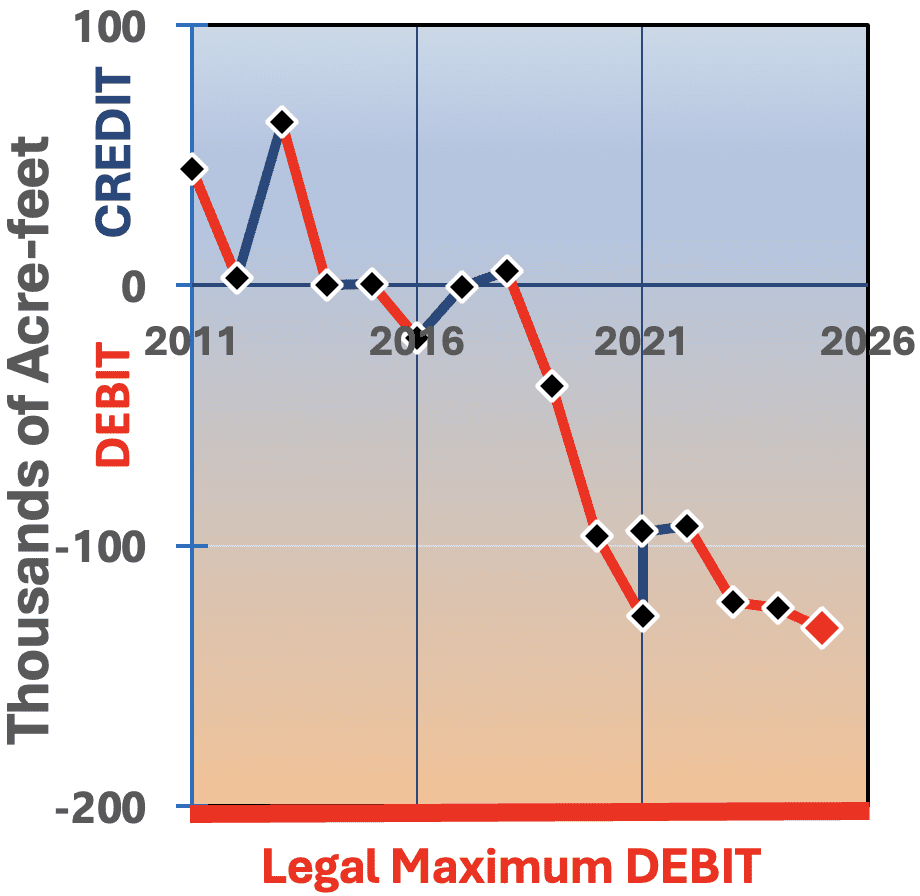
Separately, chronic overuse of water in the Middle Rio Grande has caused New Mexico’s water delivery debt to Elephant Butte Reservoir to increase from a net credit in 2018 to -131,900 acre-feet at the end of 2025. [This preliminary result is from the Bureau of Reclamation. The official result will be determined by the Rio Grande Compact Commission this spring.] New Mexico will violate the Rio Grande Compact if New Mexico allows the cumulative water delivery debt to reach 200,000 acre-feet. Texas, being Texas, will sue, as is their custom, culture, and tradition.
The author’s recent public records requests reveal recent private meetings between the agencies and the two major state-created water purveyors in the Middle Rio Grande. The progress at this time is apparently limited to initial discussions of the participants positions.
Both compact problems reflect that New Mexico’s water management institutions are not doing their jobs to regulate illegal water overuse. The results of this neglect are:
huge taxpayer burdens,
legal jeopardy for the State,
danger for water users, and
disregard for the river and species who depend on it.
The State Engineer and the Interstate Stream Commission are not prepared and don’t have the capacity or budget to deal with either Compact compliance emergency.
II. Legal Authority Is Not the Limiting Factor
The Legislature passed a new water law in 2003 that had been drafted and proposed by the NM Attorney General. The Governor signed it. It declares,
[T]he adjudication process is slow, the need for water administration is urgent, compliance with interstate compacts is imperative and the state engineer has authority to administer water allocations in accordance with the water right priorities recorded with or declared or otherwise available to the state engineer. Section 72-2-9.1 NMSA 1978.
In 2004, State Engineer John D’Antonio put rules in place to implement this new law. Following eight years of litigation, the New Mexico Supreme Court in 2012 unanimously upheld these rules. None of the five State Engineers that have held that office since 2012 has implemented the Active Water Resources Management program created by these rules. The fact of having five State Engineers in office since 2012 is part of the problem.
CENTER-PIVOT IRRIGATION CURRY COUNTY RANCH, NOW ABANDONED – PHOTO CREDIT DANNY FISH
Similarly, the 2019 Water Data Act, the 2023 Water Security Planning Act, and the 2006 Aquifer Mapping Program have languished. The Office of the State Engineer over decades has allowed virtually complete depletion of the Ogallala Aquifer in New Mexico for irrigation, leaving New Mexico communities that depend solely on that aquifer in jeopardy. Similar outcomes are in progress elsewhere across New Mexico.
Although inadequate funding and capacity are a big part of the problem, other overarching reasons include the Governor’s and Legislature’s lack of political will to see the State’s water is effectively managed as an essential scarce resource. We don’t even measure water uses, much less manage them. The management and culture of the agencies is a problem also. Their actions are tentative and cautious. They are slow to make decisions, take initiative, and effectively manage projects to timely completion.
III. Agency Capacity: Signs of Progress and Persistent Gaps
The New Mexico Bureau of Geology is our water science agency. Its scientists do first class work. They hit the ground running this fiscal year, utilizing a $7.5 million appropriation this year (the Governor recommended $29 million) to accelerate the Aquifer Mapping Program. Their progress report and budget needs presentation to the Legislature in November included a detailed briefing on the high-tech groundwater assessment technology and work already completed.
In contrast, the Interstate Stream Commission has not yet put required rules in place to implement the 2023 Water Security Planning Act. Those rules will become effective more than three years after this landmark law passed unanimously. The Office of the State Engineer desperately needs to begin enforcing against illegal water use, and modernizing its business processes and its obsolete information technology.
The OSE didn’t even request funding from the 2026 Legislature to continue building a new real-time water use data and reporting system that the 2025 Legislature funded at one-sixth of the OSE’s requested amount. Control of ruinous groundwater depletion like the Ogallala in other locations that depend on fossil groundwater doesn’t appear to be a priority. A Clovis area legislator and irrigator said technology now allows essentially all the water to be extracted. He said he is doing exactly that.
IV. Budgets as the State’s Policy Signal
State budgets are choices, not merely accounting. The OSE/ISC requested $130 million in extraordinary appropriations and six new positions for FY27. The Governor’s budget recommendation included most of the $130 million but not the new positions. The Legislative Finance Committee’s water resources management budget recommendation is unresponsive to the crises. Why do the State’s top elected leaders pass good laws unanimously but choose not to see them implemented?
V. 2026 Is a Test
The year ahead will determine:
Whether authority is exercised,
Whether transparency improves,
Whether elected state leaders equip the water agencies to manage scarcity, and
How well and responsively the agencies’ appointed leaders will manage their agencies’ work.
New Mexico’s water crises are certain. Whether the State responds effectively remains the open question.
1/12/25 – 2/5/26 from Carlsbad, NM to the State Capitol in Santa Fe, NM on Climate Action Day – 320 miles, 12,425 ft./elevation, 25 days
This Sacred & Moral Pilgrimage is an offering of bodies & feet of 3 Interfaith Power & Light (IPL) Leaders who will walk 7-9 miles a day to witness communities who suffer from effects of fossil fuel extraction through polluted air and water. The pilgrims will be fueled by the prayers and voices of many New Mexicans calling for a livable & sustainable climate for all New Mexicans now & in the future. You can follow their progress at https://www.nm-ipl.org .
This trek echoes that of the father of George Munoz, Chair of the NM Senate Finance Committee, who walked to the Capitol in 1989. As mayor of Gallup, he was furious that his concerns about addiction in his beloved community were not being addressed. Now George Munoz, his son, has not taken seriously the concerns of New Mexican communities who need healthier air, land & waters. Walking this path is a call to address needs of New Mexicans living with extraction caused air & water pollution health problems, as well as water shortages.
The IPL pilgrims, honoring centuries of spiritual earth stewardship by NM Native & Hispanic ancestors, walk now to uplift the urgent need for a livable climate and a flourishing future all New Mexicans. As they walk, they will be wrapped in prayers of many, confessing through faith, complicity in greed, waste, exploitation & extraction of their Creator’s Earth. They walk, hoping we, the public & lawmakers, will acknowledge & understand the interdependent nature of our lives within all Creation. They pray that this will guide us in repairing & healing Earth’s wounds to support resiliency of all life of Earth’s creatures, plants, waters, land, & air .
Goals of this pilgrimage are to:
to secure a stable climate and livable future for all,
act boldly for a just transition from fossil fuels to cleaner energy,
hold industry accountable for pollution & waste, &
This pilgrimage is both confessional & prophetic; a call to act with courage, integrity & love for our shared home. It is a journey of hope, learning & work as a community, & witnessing a more just & sustainable future taking root.
The focus of this call to action for legislators is to join with climate coalition advocates in supporting the 2026 Clear Horizons Act to codify NM’s ambitious greenhouse gas reduction targets into law; establish a Community Benefit Fund for climate investments; & create an Innovation in Government Act for climate solutions.
NM/El Paso Interfaith Power & Light invites all New Mexicans & legislators to follow their pilgrimage in the Event Section of their website for details and registration for events. All are invited to join in the dinner at the start of their pilgrimage at United Methodist Church in Carlsbad and later with different stages of their journey’s end to the point of arrival at the NM State Capitol on Climate Change Day, where there will be tabling and speeches in the Rotunda of the NM Roundhouse.
Desperate Need for State Leadership and Political Will
New Mexico’s water problems are not chronic conditions to be managed incrementally. They are acute crises, unfolding simultaneously across the state, with immediate water supply, public welfare, legal, and financial consequences. State elected leadership’s lack of political will to confront and manage them is a fundamental failure that will alter our lives and history.
Governor Lujan Grisham has one remaining opportunity to exert meaningful water-governance leadership. She must insist the 2026 Legislature fund the state’s water-resources agencies’ budgets as she recommended. The initiatives the Governor has recommended are essential to prepare New Mexico for what must be done. The Legislative Finance Committee’s parallel recommendation would leave these critical needs largely unfunded.
State elected leadership’s lack of political will to confront and manage New Mexico’s water crises is a chronic and potentially existential failure.
Rio Grande Compact compliance, groundwater administration, water rights enforcement, accounting, and institutional capacity must be funded and staffed. The consequences and the costs of continued delay are rising rapidly.
I. The OSE/ISC Budget Request to the Governor Is a Cry for Help
The September 2, 2025, budget request submitted to the Governor’s Office by the Office of the State Engineer and the Interstate Stream Commission[1] reads as an institutional warning and a cry for help. Taken as a whole, the funding request is an acknowledgment by the state agencies responsible for water governance that the State does not have capacity to manage the State’s physical “wet” water and avoid escalating legal and financial risk and consequences.
The combined tone of the agencies’ budget narratives was unmistakably defensive, reflecting an operating environment defined by an overwhelming workload, deadlines, penalties, and diminishing discretion. The non-recurring funding is intended to begin addressing—but not solve—New Mexico’s present and future water-supply problems.
The water-resource agencies’ budget request is shaped by relentless litigation, looming deadlines, and diminishing discretion—not optimism. The agencies face these difficult tasks:
Complying with the costly requirements and near-term deadlines of the pending Lower Rio Grande SCOTUS settlement;
Preventing a new Rio Grande Compact violation driven by the Middle Rio Grande’s chronic use of water owed to the Lower Rio Grande;
Preventing groundwater mining that destroys aquifer services and leaves communities without water;
Meeting fiduciary responsibilities to manage large cash flows, contracts, and state funding transactions; and
Modernizing the agencies’ business practices and information technology to improve productivity.
Assuming the OSE/ISC’s FY27 budget request reflects their priorities, the agencies are deprioritizing items #3 and #5 from the list above.
II. The Governor’s Budget Recommendation: Necessary, but Not Sufficient
The Governor approved much or most of the non-recurring funding requested by the Office of the State Engineer and the Interstate Stream Commission, implicitly acknowledging the seriousness of the agencies’ missions and needs. That recognition matters. However, the Governor’s budget stopped short of improving the increased institutional capacity the agencies requested to respond more effectively to Middle Rio Grande water management imperatives and Indian water rights settlement implementation.
The need for this capacity is overwhelming and time-sensitive. Without it, enforcement against illegal water use, financial administration, and technical oversight will remain constrained at a moment of expanding workloads and agency expenditures and grants, shrinking supplies, and diminishing discretion.
At the same time, the State has placed increasing emphasis on treating oil field fracking waste and brackish groundwater as “new water” to support industrial development. While such efforts may facilitate specific economic projects, the costs will be prohibitively expensive for most uses. As a result, these “new water” approaches are not a feasible way to resolve Rio Grande Compact compliance, stabilize groundwater levels, or protect most New Mexico communities from shortages.
III. The Legislative Finance Committee Budget: Acute Water Crises Ignored
The Legislative Finance Committee’s budget recommendation widens the gap between New Mexico’s acute water-resource crises and the State’s capacity to confront and manage them. Only the State has the power to close that gap, but the LFC continues to deny funding. The LFC budget recommendation would generously fund speculative “new water” initiatives while providing almost nothing to address immediate statewide water-management crises and imperatives.
The LFC budget does not fund the ongoing water rights database modernization project despite the essential nature of water rights information. It provides no meaningful funding for either of New Mexico’s two Rio Grande Compact crises:
Meeting New Mexico’s costly and demanding requirements under the pending Lower Rio Grande U.S. Supreme Court settlement, including deadlines and penalties; and
Preventing a new, separate compact violation that would trigger renewed U.S. Supreme Court litigation, driven by the Middle Rio Grande’s water-delivery debt rapidly accrued since 2018.
IV. Lower Rio Grande Compact Compliance: Immediate, Enforceable Obligations
The pending Lower Rio Grande settlement is ending more than a decade of costly U.S. Supreme Court litigation with Texas, joined against New Mexico by the United States. The settlement’s specific, enforceable water delivery accounting and requirements will be in immediate effect after Court approval expected in 2026.
The settlement imposes specific requirements with near-term deadlines and penalties for excessive cumulative under deliveries. New Mexico must deliver water to pay the onerous penalties and remedy the under deliveries quickly.
New Mexico shall purchase from willing sellers and retire 9,100 acre-feet per year of active groundwater pumping (that undermines the river’s flows) within five years and a total of 18,200 acre-feet per year in 10 years. That will be insufficient to meet new requirements for El Paso deliveries during sustained dry climatic conditions.
The settlement requires a plan for adhering to El Paso delivery requirements that is in legal accordance with the facts and hydrologic reality. The vast majority of municipal and industrial groundwater rights in the Lower Rio Grande are junior to the adjudicated 1903 priority date of EBID farmers’ rights to a full supply. In future dry years—such as 2025, and what 2026 appears to be bringing—Elephant Butte Irrigation District farmers will have insufficient supply to meet their 1903 senior rights because pumping a full supply would illegally deplete the river. They must cut back to meet El Paso delivery requirements.
Under those circumstances, all junior uses will be out of priority, though judges likely will refuse to cut off water for schools, hospitals, and humans’ basic needs. The settlement authorizes EBID’s water to be used to meet needs other than irrigation but also depends on transactions with EBID’s willing sellers or leases.
The State is required to figure all of that out. It has started to do so, but behind closed doors. Within two years, the State must produce a comprehensive work plan for permanent groundwater retirements, replacement supplies, accounting, enforcement, and impacts to junior users.
V. Middle Rio Grande: Preventing an Imminent Compact Violation
The Middle Rio Grande now presents a separate and immediate compact compliance emergency that demands decisive state action. Recent chronic overuse there of surface water and hydrologically connected groundwater is depleting Texas’s share of the total annual flows entering the Middle Rio Grande. Cumulative annual delivery deficits that have occurred since 2018 have placed New Mexico at near-term danger of a new Rio Grande Compact violation, within one to three years.
Violation of specific limits on the Middle Rio Grande’s accrued water debt will breach the barrier the Rio Grande Compact creates between the Lower and Middle Rio Grande regions. The result would be what Sen. Pat Woods publicly said he feared: “the Hatfields and the McCoys.”[2]
Preventing this outcome requires active water resources management now: substantial ongoing reductions in Middle Rio Grande depletions, curtailment of illegal uses, improved metering and measurement of water uses, driven by sustained state effort. Preventing a second compact crisis is essential—and failure to act is a grave and avoidable error.
VI. Groundwater: Preserving Aquifer Function Where No Alternatives Exist
New Mexico has only one managed aquifer. Yet in large areas of the state, groundwater is the only available water supply, supporting communities, agriculture, and local economies. New Mexico depends on groundwater more than any other state. Many New Mexico aquifers have been pumped for more than a century but today we have only a limited understanding of how much water is left and how fast it is being depleted.
New Mexicans deserve to know how much groundwater remains, how fast it is being depleted, and what levels of use are sustainable if aquifers are to continue serving future generations. That information does not yet exist at the scale or resolution required for responsible governance. Without it, continued pumping risks the economic consequence of running low or out of water.
New Mexico must accelerate its long-standing but underfunded aquifer mapping program and a new groundwater resilience and security planning effort equal in importance to surface-water compact compliance. Managing groundwater to preserve aquifer function is not a discretionary environmental goal—it is essential infrastructure planning for regions with no other water supply. Continued delay guarantees avoidable loss and future crisis.
Conclusion: Political Will, Governance, and a Closing Window
The water crises confronting New Mexico are not the result of uncertainty or lack of knowledge. They reflect political avoidance—resistance to regulation and enforcement, refusal to acknowledge limits, and chronic underinvestment in the institutions responsible for governing scarcity. That avoidance is no longer tenable.
Every region of the state is using more water than can be sustained. Compact compliance risks are immediate in both the Lower and Middle Rio Grande, groundwater depletion threatens communities with no alternative supply, and governance systems are falling further behind reality. Delay now increases costs, legal exposure, and the likelihood that the Courts will impose their decisions consistent with Texas’ arguments and damage claims.
The Governor and legislative leadership must act while discretion remains. That means funding institutions, not just projects; restoring enforcement credibility and administrative capacity; and implementing enforceable reductions and compliance with the law. The choice is between governing now or paying far more later, with fewer options.
[1] The author obtained the OSE/ISC’s FY27 Budget Request Submitted to the Governor’s Office in response to his [date] public records request. A Bureau of Geology and Mineral Resources public flyer summaries its request for the aquifer mapping program and other important program.
[2] Sen. Pat Woods was the last member of the LFC Water Subcommittee to speak following the OSE/ISC’s budget presentation the afternoon of November 20, 2025. He understood the basics.
We’re Asking the Governor & Legislature to Fund State Water Agencies to Secure A Better Water Future
Senator Liz Stefanics, Chair of both the Legislature’s Water and Natural Resources Committee and the Senate Conservation Committee, asked water advocates to identify financial resources needed to confront New Mexico’s deepening water crisis. The New Mexico Water Advocates responded with three essential programs: Rio GrandeCompact Compliance, Water Data infrastructure, and Regional Water Security Planning.
These are not long-term wish-list items. They were recommended specifically by the 2022 New Mexico Water Policy and Infrastructure Task Force. They are well-vetted and justified emergency responses to New Mexico’s water crisis that is already destabilizing communities and ecosystems and threatening our economy. New Mexico is over-using its renewable water supplies while climate heating drives aridification and the decline of both groundwater and surface water resources. The State must improve its ability to comply with the Rio Grande Compact, to track and manage actual water use, and to plan realistically for a more resilient water future that is now in jeopardy.
These three programs are designed to meet the crisis and bring it under control. Together they build the State’s essential capacity to enforce water rights, meet New Mexico’s Rio Grande Compact obligations, generate and share reliable water data, and empower regional planning councils to act on that information. Only the State of New Mexico, through its agencies and technical institutions, has the authority and responsibility to do these essential jobs. With adequate funding to begin multi-year efforts this session, the State can start stabilizing the crisis and lay the foundation for science-based, transparent, and durable water governance. Without funding, New Mexico will remain in emergency mode—reacting to shortages, assuming the enormous risk and costs that a compact violation unleashes, and defending against new Texas litigation—instead of preventing or managing to mitigate them.
Rio Grande Compact Accrued Debit/Credit History
1) Rio Grande Compact Compliance
New Mexico must meet its delivery obligations to Texas and the United States while protecting communities and ecosystems in the Middle Rio Grande. We recommend:
$10 million (one-time) to the Office of the State Engineer (OSE) to implement the Lower Rio Grande settlement and prevent a new Rio Grande Compact violation due to Middle Rio Grande water overuse. At the current trend, we have only two years and perhaps only one to prevent new Texas v. New Mexico litigation. An emergency clause is needed to provide funding as early in 2026 as possible.
$1 million (recurring) for enforcement capacity—staff, office space, vehicles, and equipment—so the OSE can enforce Lower and Middle Rio Grande water rights.
Pass the Water Rights Enforcement bill, the 2025 measure to modernize an outdated statute that stalled on the Senate floor awaiting a final vote. The State Engineer needs workable administrative enforcement authority to stop illegal water uses without having to sue the user.
Why it matters: The Lower Rio Grande settlement requires New Mexico’s detailed plan in two years to substantially reduce Lower Rio Grande water use and full compliance in 10 years. At the present trend, Middle Rio Grande illegal water overuse will cause a compact violation in two years.
2) Water Data to Support Planning & Management
New Mexico’s water decisions are only as good as the data behind them. We recommend:
$7 million (one-time) to the OSE to replace the outdated water-rights database and application, build a real-time water-use database and application, and implement a modern management information system.
$3 million (one-time) to NM Tech for the Bureau of Geology & Mineral Resources (NMBGMR) to contract with Water Data Act directing agencies to publish priority datasets to the state water data catalogue. These datasets will be selected in consultation with the Interstate Stream Commission (ISC) to help ensure regional water planning councils have the best available science, data, and models.
$21.5 million (one-time) to NM Tech for NMBGMR to accelerate the statewide Aquifer Mapping Program—geophysics, new characterization and monitoring wells, and term staff—to illuminate where, how fast, and why groundwater conditions are changing.
Why it matters: You cannot manage what you don’t measure. These investments give local water managers, planners, and the public the transparent, timely information demanded by aridification, warming, and overuse.
3) Regional Water Security Planning
To make the Water Security Planning Act work on the ground, regions must organize credible councils and set pragmatic work plans. We recommend:
$4.8 million (one-time) to the OSE for the ISC to make grants to nine regional entities to stand up councils and develop work plans for Commission approval. The appropriation includes 6% for ISC administrative costs at $300,000.
Why it matters: Durable solutions are local and data driven. Funding regional councils to organize and plan with the best data available creates a transparent path from facts to decisions.
Bottom line: New Mexico is overusing declining renewable water supplies in a warming climate. The responsible fix is not slogans or one-off projects. It is steady, statewide capacity in water law enforcement, water data, aquifer science, and regional planning. Please urge your legislators to fund these requests and pass the enforcement bill this session. It’s the most cost-effective way to protect communities, economies, and rivers—not just this year, but for decades.
Water and Natural Resources Committee of the NM Legislature
Public Comment Letter: Confronting Water Planning and Governance Neglect
Executive Summary
New Mexico faces escalating water crises—including aquifer depletion, unsustainable surface water use, unsettled tribal water rights, and the likelihood of a Rio Grande Compact violation by 2026. Yet the State lacks the capacity to respond effectively. The Office of the State Engineer and Interstate Stream Commission do not have sufficient resources to fulfill their mandates.
The 2023 Water Security Planning Act requires a decentralized regional planning program. Regions cannot succeed until they are funded. The ISC’s centralized, consultant-driven approach is causing delays and undercutting regional council formation.
False promises of game-changing amounts of “new water” have diverted legislative attention and resources from urgently needed investments in protecting our good water.
Key Recommendations to the Legislature’s Water and Natural Resources Committee:
Modernize and fund core state water agencies through one-time, multi-year appropriations tied to accountable progress toward outcomes.
Ensure near-term implementation of the Water Security Planning Act by holding ISC accountable for timely implementation of the Act’s decentralization mandate and offering grant funding for all Regional Water Planning areas to initiate self-organization in FY26.
Address the imminent new Compact violation risk due to Middle Rio Grande water overuse by providing the State Engineer with the practical enforcement authority and resources to administer diversions.
Meet New Mexico’s water needs by investing in water planning and management. Stop the neglect.
These actions align with the Committee’s 2025 work plan and are essential to restoring trust, resilience, and legal compliance in New Mexico’s water future.



 Committee Chair George Muñoz


 Water uses in the Middle Rio Grande have consistently over-depleted the Middle Rio Grande’s share, shorting the Lower Rio Grande. Similarly, excessive water uses in New Mexico downstream of Elephant Butte Dam are shorting Texas. Both situations have persisted for many years and are now entangled but distinct emergencies.


 This trek echoes that of the father of George Munoz, Chair of the NM Senate Finance Committee, who walked to the Capitol in 1989. As mayor of Gallup, he was furious that his concerns about addiction in his beloved community were not being addressed. Now George Munoz, his son, has not taken seriously the concerns of New Mexican communities who need healthier air, land & waters. Walking this path is a call to address needs of New Mexicans living with extraction caused air & water pollution health problems, as well as water shortages.


