Insights from the leadership of Water Advocates of New Mexico on critical water issues facing our state. This collection of articles from President Norm Gaume provides updates on Water Advocates’ activities and priorities, policy analysis, and more.
NM Water Advocates Workshop Review, March 19, 2026
Hannah Riseley-White, Director of the NM Interstate Stream Commission, and Nat Chakeres, the State Engineer’s General Counsel, deserve our thanks as public servants and State leaders with authority and responsibility to govern New Mexico’s waters, which are the public’s. They made an admirably frank and thoughtful presentation, supported by informative slides, at the Water Advocates’ Middle Rio Grande Compact Crisis evening workshop. The prior evening, they had left their agencies’ Open House event at Elephant Butte at 8:00 pm to drive home to Santa Fe. They have big jobs, a large state, and lots of water problems demanding their leadership and judgment.
They presented honestly, using their own data to document the rapidly advancing crisis the Water Advocates have been describing. Hannah called the situation dire. Nat acknowledged the metering order said to be coming almost a year ago is not yet ready. Hannah called it overdue. Nat said plainly, “we will be the bad guy when we have to be.” We are grateful for state leaders willing to engage this directly and this publicly.
The Numbers Aren’t Waiting
But gratitude and concern can coexist.
What makes the case more forceful is not the numbers themselves. It is that top State water officials presented them. That is what carries authority. New Mexico currently sits at -132,000 acre-feet of compact debt. A compact violation occurs at -200,000 acre-feet. The average annual trajectory over the last decade is -19,800 acre-feet per year. Since 2018, only one year has not increased the cumulative debt. The 2021 apparent improvement was due to a paper accounting adjustment — not wet water arriving at Elephant Butte. Nat put it plainly: “we have been trying to turn the ship.” The ship has much inertia. The currents are strong. The ship has not yet turned.
The ship has much inertia. The currents are strong. The ship has not yet turned.
At the current trajectory, a compact violation is three years away. Hannah showed snowpack at the 0th percentile on the evening of the workshop. That means this year’s snowpack holds less water on this date than ever recorded. The runoff is coming down and will be essentially over in April, when recent peak runoff has been around Memorial Day. EBID’s surface water allotment this year is four inches. Hannah put it plainly: we are in uncharted territory.
A Collection of Parts and Hopes
Against that backdrop, the state’s goal to maintain compact compliance remains a collection of parts and hopes. One hope they expressed without a visible plan is that a negotiation — with whom? — will find a voluntary, timely solution. Are the incentives for cooperation and shared sacrifice greater than the incentives to litigate? “A goal without a plan is just a wish.”[1]
Nat rejected leading with an administrative approach, emphasizing that voluntary efforts must be given a chance. He also said agency staff are actively working, as their professional responsibility, on how to administer the Middle Rio Grande. The reality is the State Engineer is not ready. Some legislators say the leaders are not acting with the urgency demanded to prevent the compact violation.
The State Engineer’s 2004 General Rules for Active Water Resources Management, including a framework for shortage sharing agreements, was upheld by the NM Supreme Court in 2012. Under these rules, as step one, the State Engineer establishes the Middle Rio Grande Water Master District. Step two, the State Engineer issues a metering order. Step three, the State Engineer promulgates additional rules specific to the Middle Rio Grande. The State Engineer has yet to take the first two foundational steps.
Nat and Hannah emphasized that getting more water to Elephant Butte requires Middle Rio Grande water uses — human and natural — to deplete less, but that alone is insufficient. The river must efficiently transport the Lower Rio Grande’s legal share of inflows to Elephant Butte Reservoir where deliveries are accounted. The Middle Rio Grande’s southern end, below Socorro, has a failed engineered channel constructed decades ago. The river now is perched between levees on an elevated bed of sediment. The conveyance losses in this reach are high, regardless of the season and flow.
Hannah cited the genuine work underway — $55M in state channel investments across four legislative sessions, applying the Strategic Water Reserve to purchase water rights, deploying the Active Water Resources Management framework including issuing the forthcoming metering order, and making regional water security planning functional and effective.
But the metering order is being polished instead of issued. Regional planning councils under the 2023 Water Security Planning Act are not yet formed, much less funded, with drafting still underway for the binding guidelines that will set forth how everything is to work. A state regulatory approach is contemplated. That’s important because the adverse outcomes of rigid priority administration will motivate earnest negotiations for better outcomes. Negotiated outcomes are a goal of the Active Water Resources Management Program, but they take motivation and lots of time. Do we have enough time, with the three years to a violation trajectory?
Notably, the Interstate Stream Commission, the State agency created and given strong powers by statute, has never, not once, deliberated this Middle Rio Grande compact compliance crisis nor the approach and policies the Commission should apply.
One audience member asked a technical question about leveraging New Mexico’s stranded accumulated “relinquishment credits” to store water or for some other advantage. That brought a smile to Nat’s face; he replied he has been thinking about this. He again emphasized our situation is unprecedented, and that a Bureau of Reclamation official told him nothing should be off the table. Plainly, however, there is no water to store, and conveyance losses for water stored in spring and released the following winter for delivery to Elephant Butte Reservoir are too high.
Naming the Problem
Although both Hannah and Nat acknowledged our situation is aridification, Hannah used the word “drought” and announced the ISC is preparing a “Drought Toolkit” as a resource for communities. We raise this as a concern that has consequences, not a quibble. Hannah’s message describing our situation as “drought” reflects the notion of temporary — the implicit message that better times lie ahead — without any rational support for that reassurance. To her credit, Hannah stated the overriding plain truth: solving any water resources problem first requires understanding the hydrology and investigating different future conditions. The plain truth the Water Advocates see is that climate heating is permanently reducing and increasing the rate of depletion of New Mexico’s renewable water supplies — bad too soon.
A problem misnamed is a problem misframed. Shouldn’t we plan for the worst and hope for the best?
Norm Gaume opened the workshop challenging the state officials to recognize we are experiencing aridification caused by climate heating. Droughts end. Aridification does not. The data presented that same evening confirmed it — conditions now are worse than projected for 2070. The five warmest summers on record have all occurred in the last eight years, and snowpack is at its lowest in recorded history.
A problem misnamed is a problem misframed. Shouldn’t we plan for the worst and hope for the best? We will soon find the Middle Rio Grande in water bankruptcy if we don’t.
What Comes Next?
We left the evening more resolved. The legal framework exists. Some of the right people are engaged and speaking honestly. The ship must be turned, modernized, and the capacity created to take those essential water management decisions and actions that only the sovereign State of New Mexico has the authority to take. The moment requires the translation of acknowledged urgency into a specific, timed, and accountable action plan.
The State Engineer’s creation of the Water Master District and requiring meters on all significant wells are the first two steps. When will we see them?
Legislators were in the room that evening — we encourage every Water Advocates subscriber to follow our moderator’s advice and invite yours for coffee. When asked how people can help, Nat noted that nobody shows up at the legislature to advocate for essential agency modernization and IT systems funding. Water resources management needs champions.
The river has a lot of sand to deal with, as Nat said in explaining the river’s chronic conveyance problems and losses. As New Mexicans who want the best for New Mexico, in balance with hydrologic reality, we see a lot of sand in the machinery of responsible and responsive State and local water resources governance, too. We are running out of time to move it.
[1] Antoine de Saint-Exupéry, author of The Little Prince (1943). Saint-Exupéry was also a pioneering aviator who navigated by maps and instruments — a man who understood viscerally that aspiration without method is insufficient.
This is shaping up to be one of the driest years on record. Snowpack across the Rio Grande basin is near record lows. Elephant Butte Reservoir is very low; Elephant Butte Irrigation District farmers are expecting a four-inch 2026 irrigation allotment. Increased river flows from a big October headwaters storm, combined with the end of the Middle Rio Grande irrigation season and a large December block release from Rio Chama Reservoirs, significantly improved the Middle Rio Grande’s end-of-year compact deliveries — yet more than a fourth of that water was lost in conveyance before reaching the reservoir pool. Middle Rio Grande cumulative water delivery debt is now approaching the Rio Grande Compact’s legal cap. Texas will certainly sue when that debt limit is exceeded, if not before, bringing new U.S. Supreme Court litigation to the Middle Rio Grande.
The Middle Rio Grande Compact Crisis
The State Engineer and Interstate Stream Commission Director have named the Middle Rio Grande compact compliance situation as a crisis. The Middle Rio Grande is on a trajectory to violate the Compact within two or three years. State Engineer Elizabeth Anderson will violate state water law at Section 72-2-9.1 NMSA 1978 if her continued inaction allows that to occur. The ISC will fail to meet its mission to do everything within its broad powers to conserve and protect New Mexico water.
Join Us March 19 — Hear the State’s Plan
That is why our March 19 workshop Middle Rio Grande Compact Crisis is a must-attend event for every Middle Rio Grande resident. State Engineer General Counsel Nat Chakeres and ISC Director Hannah Riseley-White will present the State’s current hydrologic picture, including New Mexico’s Rio Grande Compact status and what it means for Tribal, agricultural, and municipal water users. The State is pursuing conservation, conveyance improvements, and expanded administration — and as Hannah writes, “working closely with major water users to develop creative solutions to meet needs while maintaining compliance with our legal obligations.” Join us. Register here.
What the Lower Rio Grande Tells Us
The featured article from our March 2026 News was written by Beth Bardwell from Las Cruces and this author to examine the Lower Rio Grande situation at the beginning of its post-litigation water management stage. Water use in the LRG has barely been affected to date by the litigation but water users there will soon dramatically feel the depth of the litigation consequences if the dry climate continues. The lessons for the Middle Rio Grande are neither abstract nor comfortable. Read the long-form article Drinking Water, Taxpayers, Pecans, and the Lower Rio Grande Settlement.
Groundwater Momentum Continues in March
Last month’s February 19 groundwater workshop with Dr. Gretel Follingstad and Dr. Maurice Hall was outstanding — the turnout, the depth of the conversation, and the community engagement it generated were exactly what New Mexico needs more of. Continue that momentum this month with two free webinars hosted by the New Mexico Groundwater Alliance. Details and registration links are in our article, Groundwater Is in Crisis — And the Experts Are Back to Talk Solutions.
The water and the consequences we will pay for ignoring its growing scarcity and our water sharing obligations are not waiting. We must stop waiting, too.
Middle Rio Grande Compact Violation Looms as Water Use Outpaces Legal Limits
I joined a small group of Santa Feans concerned about New Mexico’s water future at their June 3rd monthly breakfast meeting. I appreciated the invitation from Denise Fort, who organizes these and the chance to speak directly with folks who care deeply about our state’s most pressing water issues.
Tragedy of the commons: each user of a common pool resource pursues their own needs with only self-imposed limits, but the cumulative result is system-wide overuse
We had an animated conversation about New Mexico’s almost silent, almost unknowing drift to the brink of a brand-new Rio Grande Compact violation. In the Middle Rio Grande, we are living the tragedy of the commons: each user pursues their own needs within self-imposed limits, but the cumulative result is a system-wide overuse that exceeds our legal share under the Compact. Our surface water supply this year is near record lows, yet our demands continue—pushing groundwater pumping to unsustainable levels. We prepared the graphics below to illustrate the situation demanding New Mexico’s and the Middle Valley’s adaptation.
When 2025 began, New Mexico had a 76,000 acre-feet margin before violating the Compact’s 200,000 acre-feet cumulative under-delivery limit. But by my calculations, as of the end of May we’ve delivered only 39% of the Otowi Index Flow—when we should have delivered 57%. That puts us 38,000 acre-feet behind on required deliveries already this year, using up half of our remaining margin in just five months.
Without a strong monsoon, we risk triggering a new lawsuit from Texas in the U.S. Supreme Court. Former ISC Director Rolf Schmidt-Petersen and I agree: without a strong monsoon, New Mexico is at risk to violate the Rio Grande Compact under-delivery limit this year, and if not this year, in 2026.
The group discussion raised hard questions: Who knows? Who cares? Why must New Mexico’s water overuse, even that that creates shortages for other New Mexicans, be managed retroactively by judicial order rather than proactively by our elected and appointed officials?
It’s worth noting: the only prolific aquifer in the state that provides water to many irrigators and is well-managed against overuse got its governance start with a New Mexico judicial order about 90 years ago. (If you know which one, you’re paying attention. Hint: it’s in southeast NM)
A Presentation Worth Watching
A welcomed bright spot came at our May 15 Water Advocates workshop, where Nat Chakeres gave the most accessible and well-organized presentation I’ve seen on the Middle Rio Grande compact situation. Nat, General Counsel to the New Mexico State Engineer, not only explained the problem—he presented a new, bold policy approach to confronting it.
Thanks to Nat for his candor, clarity, and courage—and to State Engineer Liz Anderson, whose leadership made these strategic shifts possible. State Engineer Anderson represents a new generation of leadership. The NM Senate confirmed her appointment during the 2025 Legislature. We look forward to hearing the details and timing of her strategy to rein in unsustainable water overuse in the Middle Rio Grande and prevent more U.S. Supreme Court litigation with Texas.
Upcoming: Basin Study Community Organizations Sector
The Rio Grande Basin Study is entering its next phase—modeling how different climate storylines affect water supply and demand and testing strategies for adaptation. Compact compliance will be a hard constraint for an acceptable adaptation approach.
The Bureau of Reclamation invited the Water Advocates to convene a Community Organizations committee to formally participate. We did in 2021, but the effort was premature. We’re restarting that effort now that the timing is right. A virtual meeting is set for June 24 at 10:30 a.m. Community organizations from the headwaters to Elephant Butte Dam are welcome. If you represent one and are interested in participating, please contact me directly. We will all learn a lot, from the modeling and from each other.
Reclamation staff will join us on June 24 to present and answer questions. Reclamation’s Rio Grande Basin Study is fully funded and will proceed to completion in another two to three years, unless the national Basin Study program is terminated. If completed, it will help show us what we must do to adapt to living with far less water.
Meanwhile, at the Capitol
After the breakfast, I attended the organizing meeting of the Water and Natural Resources Interim Committee. There were more legislators present than the dais and tables set in front of the dais could accommodate in one of the large Capitol committee rooms. The pending Middle Rio Grande Compact violation and risk of litigation was not among the priority topics identified by legislators for committee evaluation—at least while I was there. In contrast, the Lower Rio Grande litigation, desalination, aquifer mapping, and regional water security planning were named priorities by multiple legislators.
I offered a brief public comment about the urgent compact situation. Senator Larry Scott followed me out and asked for clarification—he had not been aware of the Compact risk or the potential for new US Supreme Court Texas v. New Mexico case. I report this only to say this is a criticism of our state water agencies and the Executive. The failure to communicate is on them.
Let Us All Do Our Part
This isn’t just about lawsuits or water law. It’s about protecting our home—now and for future generations. We must summon the courage to acknowledge what’s happening and adapt to living with less water.
In your own way, pray for New Mexico’s water leadership—those already engaged and those who are emerging. Pray for the monsoon. And pray for New Mexico, our querencia, so precious, so close to Texas.
New Mexico is not confronting a legal and water management crisis in the Middle Rio Grande. Public conversations are missing, including at the 2025 Legislature. The central question:
What actions are being taken—or not taken—to change our trajectory toward violating the Rio Grande Compact due to chronic annual depletion in the Middle Rio Grande of large volumes of the Lower Rio Grande’s water?
Nine interrelated facts together define this perilous situation—one that remains largely unacknowledged and without an adequate response.
1. 2025 is shaping up to be a record-dry year.
The Bureau of Reclamation’s February Annual Operating Plan projects dry river conditions across the Middle Rio Grande from May through August. Hydrographs show stretches of the river drying for months. “Central” refers to the gage at the Central Ave bridge in Albuquerque. San Acacia Floodway refers to the flow in the river downstream from the San Acacia diversion dam located north of Socorro.
2. Snowpack collapse is historic.
The Rio Chama snowpack recently has set record daily lows: zero percentile snow water equivalent!
Rio Grande Colorado headwaters: 5th percentile.
The Upper Rio Grande snowpack in New Mexico: 4th percentile.
Upper San Juan: 5th percentile
2025 San Juan–Chama Project deliveries in 2025 at record low: projected to be 46% of the 1990s “firm yield” used in regional supply planning, including the Albuquerque Water Authority’s 100-year plan.
3. Rio Chama runoff may not meet critical obligations.
At the March 20 ISC meeting, Director Hannah Riseley-White warned that total Rio Chama runoff may not meet the federal storage target for Pueblo prior and paramount water. Federal agencies plan to store record volumes of Rio Chama to ensure the Pueblos’ water supply.
4. Compact compliance requires delivery of 57% of native flow entering the Middle Valley to Elephant Butte.
Flow entering the Middle Valley includes the Rio Chama. If Chama runoff is dedicated to meet the Pueblos’ prior and paramount water rights, is it possible for the State to meet the 57% delivery requirement to Elephant Butte?
5. Compact delivery debt is dangerously high.
Since 2018, the Middle Rio Grande has depleted 155,800 acre-feet of the Lower Rio Grande’s water. As of January 1, 2025, New Mexico’s Middle Rio Grande cumulative water delivery debit stands at -124,000 acre-feet. Another 76,000 acre-feet of water debt will violate the Compact. Annual water delivery debts have exceeded 76,000 acre-feet in five of 85 years, historically.
Such a violation is certain to trigger Texas to file a new United States Supreme Court lawsuit, compounding the ongoing Lower Rio Grande litigation and exposing the state and the Middle Rio Grande to legal, economic, and political risk. Half of New Mexico’s population and economy resides in the Middle Rio Grande zone of chronic water overuse—and imminent legal exposure.
6. The State Engineer has issued clear warnings.
A fact sheet prepared for the 2025 Legislature stated:
“A compact violation could trigger curtailment and/or costly litigation that may result in severe and unpredictable shocks to the economy and water supply for agricultural and municipal users in the middle and lower Rio Grande.”
7. The Legislature did not fund prevention efforts.
The 2025 Legislature rejected the Governor’s proposed $500,000 increase for State Engineer compact compliance staff.
8. Enforcement legislation failed again.
For the second year, lawmakers declined to pass legislation that would authorize the State Engineer to take effective administrative enforcement against illegal water use.
9. Active Water Resource Management is missing in action.
Despite the New Mexico Supreme Court’s 2012 unanimous opinion approval upholding the statute and detailed General Rules in 2012, district-specific rules for the Middle Rio Grande have not been adopted.
New State Engineer Liz Anderson may move ahead to ensure compliance with the AWRM law, Section 72-2-9.1 NMSA 1978, which states,
“A. The legislature recognizes that the adjudication process is slow, the need for water administration is urgent, compliance with interstate compacts is imperative and the state engineer has authority to administer water allocations in accordance with the water right priorities recorded with or declared or otherwise available to the state engineer.
B. The state engineer shall adopt rules for priority administration to ensure that authority is exercised: … “
Ask Yourself
Why have New Mexico elected leaders not responded to this preventable crisis?
Do they and we realize we’re enabling or participating in a tragedy of the commons?
Why aren’t we implementing and enforcing the present state water laws designed to prevent that?
Are our decision-makers—and the public—adequately informed?
Ask our leaders and water institutions, besides praying for monsoons, what are we doing?
A Call to Action
The 2025 Legislature is over, but this crisis can’t wait until the Legislature reconvenes in January 2026. Two critical avenues remain.
1. Engage the Legislative Interim Committees
Interim committees shape next year’s legislation. We must:
Urge committee chairs—especially Legislative Finance and Water and Natural Resources—to hold hearings on compact compliance.
Provide clear presentations connecting snowpack and flow data to our legal obligations.
Emphasize the stakes and costs of not confronting the crisis.
Engaging legislators and interim committees is how we build understanding and momentum for action in the 2026 Legislature. Reinstating the compact compliance staff cut from the Governor’s 2025 budget request must be a top priority. The State Engineer cannot meet this challenge without them.
2. Press State Agencies to Act Now
The Interstate Stream Commission and Office of the State Engineer already have:
Statutory authority to confront and manage this crisis,
Clear legal obligations to deliver compact water and enforce priorities, and
Substantial human and budget resources.
They must immediately:
Declare an emergency.
Declare compact compliance a top priority.
Publicly assess delivery risk and publish a response plan.
Communicate and coordinate with all water users to reduce depletions.
Implement the Active Water Resource Management framework now.
These are not new ideas. They are long-standing obligations. What’s missing is action.
We still have a chance to avert this avoidable disaster. The time to act is now.
The Tragedy of the Commons: A Lesson from an 8th Grader
Why do we struggle to act on problems we know are urgent? An 8th-grade Santa Fe girl’s January 28, 2025, public comment in support of passing Senate Bill 4 to comprehensively limit greenhouse gas emissions defines the problem and a simple solution.
“I have learned about the Tragedy of the Commons, which occurs when each well-meaning individual takes or uses only what they need, but the total is greater than the resource available. In the case of our environment, this plays out in small emissions that total more than our atmosphere can handle. … One of the best things we can do is impose regulations that cap resource use at a level that is sustainable for a long period of time.”
The concept applies to our water. The total of our individual, well-meaning uses are more than our water supplies can handle. As the Water Advocates explain in Our Water Crisis, overuse is causing growing New Mexico water supply security deficits for many communities. Opportunities are lost as time passes without action.
Water in New Mexico: Sacred Resource or Commodity?
We know that water is sacred, essential for all life. But we also see it as a mineral resource to be mined. The New Mexico Bureau of Geology and Mineral Resources, after all, is New Mexico’s (top quality) water science agency. We have been using groundwater as a mineral resource, mining it across New Mexico for more than a century, Vast volumes have been removed. We don’t know in any dependable way how much groundwater remains, nor how fast our collective overuse is using up what is left.
New Mexico has many ghost towns, vibrant places until the minerals were mined out.
The Consequences of Inaction
Some aquifers don’t recharge at all or very much. Water users who depend on such aquifers have two choices. One is to mine the water until it’s gone and suffer the consequences, including more ghost towns. The other is to reduce and stop unsustainable high-volume mining to leave enough water to meet the relatively small water needs of local communities long into the future. The sooner that step is taken, the more water remains for all future uses.
For example, the Ogallala aquifer is New Mexico’s first large-scale case of mining the water until it’s virtually gone, until municipal wells have faltered or run dry. Think of the people in Portales who are saying, “if only I had known.”
Think of Deming and the surrounding Mimbres Basin farming community, which formerly grew fruit and vegetables from accumulated groundwater in this closed basin, back when farm labor from Mexico was available. Now, the farmers mine groundwater to grow hay for mechanized harvest. Surely running out of water is a bad outcome. Inaction will surely deliver that outcome to Luna County. We don’t know when.
Pumping groundwater from aquifers interconnected with rivers is more complex because the aquifers do recharge from their rivers. Pumping groundwater takes water from the river, but days to decades in the future, depending on the hydrologic connection.
Diversions from the river, wells, and ditches by well-meaning individual Middle Rio Grande water users and institutions together take more water than the Middle Rio Grande’s share of of the river. The water delivery debt accrued since 2019 is dangerously close to the maximum allowed.
Make no mistake. This overuse will stop, not because the water runs out but because we are using water that belongs to others downstream. Most of that water is allocated to Elephant Butte Irrigation District, for New Mexico farms.
Recent Interstate Stream Commission staff reports document official state estimates of current Rio Grande overuse: 17,000 to 18,000 acre-feet/year in the Lower Rio Grande and about 26,000 acre-feet/year in the Middle Rio Grande. It will take resources and political will to rein in that overuse.
The Challenge of Human Attention to Long-Term Problems
Human beings naturally struggle to focus on long-term issues like water security. Evolution has wired us to prioritize immediate threats over distant risks and to seek immediate rewards. This cognitive bias, known as present bias, causes us to underestimate future dangers and delay action until it is too late. Complex, slow-moving problems like growing water scarcity lack the urgency of immediate disasters, making them easier to ignore.
Another bias, normalcy bias, leads us to assume that the future will be much like the past, blinding us to the signs of an impending crisis. This is why, even as wells run dry and rivers shrink, many fail to recognize the urgency of sustainable water management.
However, this tendency can be overcome. Societal change often begins with heightened awareness, followed by collective action. When informed citizens demand accountability, leaders are compelled to act. Recognizing the slow-moving nature of water crises is the first step in shifting public consciousness and, ultimately, policy.
The Role of Political Will and Citizen Action
The primary barrier to effective water management is not technical expertise or scientific knowledge—it is political will. Politicians operate in environments driven by immediate demands, often prioritizing short-term issues over long-term sustainability. This is not a failure of leadership but a reflection of where public pressure is applied.
Citizens have the power to change this dynamic. By:
Raising Awareness: Talk about water issues in your community, with friends, and on social media.
Engaging with Leaders: Contact your legislators, attend public meetings, and demand that water security is prioritized.
Supporting Advocacy Groups: Collaborate with organizations working to influence water policy.
When citizens speak with a unified voice, leaders listen. Creating political will is not just about holding leaders accountable—it’s about giving them the mandate and public support they need to act boldly on long-term challenges.
The Call to Action
The 2025 Legislature faces a clear choice:
Continue to underfund essential water management functions, risking avoidable crises; or
Invest wisely in the future of New Mexico’s water security, ensuring resilience for generations to come.
This is not about optional programs; it’s about the fundamentals that determine whether our communities thrive or face preventable water crises.
New Mexico must finish what it has started, with adequate funding for water data, agency modernization, enforcement against illegal water use, and building the scientific understanding that supports sound decisions. The primary barrier is not technical; it’s political will. Let 2025 be the year we overcome that barrier. Citizens, your voices matter—now is the time to use them to secure our water future.
P.S. Don’t just read about the water crisis—understand it. The Water Advocates’ new website is your go-to resource for learning about the challenges facing our state. Explore the site, learn more, and share this and other vital articles with your friends and family. Our water future depends on it.
This essay criticizes the New Mexico Governor’s “Strategic Water Supply” concept and the deceptive ‘feasibility study’ draft prepared by Eastern Research Group, Inc. (ERG). The Governor’s concept is fundamentally flawed. The ‘feasibility study’ fails to disclose key challenges, such as the massive energy and carbon footprint required to desalinate Permian Basin produced water to meet the Governor’s goal of 100,000 acre-feet of new water by 2028.
Desalination would require the energy output of multiple San Juan Generating Station-sized power plants to produce much less new water than the Governor’s arbitrary goal of 100,000 acre-feet per year of new water by 2028, while also producing an equal volume of highly concentrated waste requiring safe disposal. The feasibility study merely hints at the energy and carbon footprints . It omits critical analysis of the great difficulty and expense of the infrastructure that would be required to extract large volumes of water, brackish or not, from deep aquifers below 2500 feet. The study merely assumes the voluminous concentrated waste can be safety disposed forever.
The essay highlights concerns about the lack of transparency and potential conflicts of interest surrounding the ERG’s $1 million sole-source contract, as well as the political origins of the project. Drawing parallels with the Gila Diversion Project boondoggle, the essay illustrates how political motives and self-interest override ethical behavior and honest determination of feasibility, resulting in wasted public funds and resources.
The NM Produced Water Research Consortium since its 2019 creation by the Environment Department and New Mexico State University has not yet begun a scientific research program of field pilot testing. Environment Department experts testified in August 2024 that NMED has no produced water field testing results yet from the Consortium and that its database contains not a single produced water data characterization data point. The feasibility study ignores that without data, the Environment Department and Water Quality Control Commission have no basis for the effluent and discharge standards and the regulation of all off-oil-field existence and use of treated or untreated produced water and its byproducts. Permits for off-oil-field transportation, handling, storage, and use are based on regulations, which are based on scientific standards.
The essay underscores the opportunity costs and ethical considerations of focusing on desalination over more urgent water management issues, such as full implementation of the 2019 Water Data Act and the 2023 Water Security Planning Act, coming into compliance with Rio Grande Compact water depletion legal limits routinely exceeded in the Middle and Lower Rio Grande, and providing incentives to slow New Mexico’s ruinous overuse of groundwater. The author argues that the Governor’s plan diverts legislative and agency attention from these pressing matters, thereby jeopardizing the long-term water and economic security of New Mexicans and the needs of future generations.
Introduction: A Fatally Flawed Concept
The so-called ‘Strategic Water Supply’ concept is fundamentally flawed. The evidence is clear and compelling, but you won’t find it in the New Mexico Strategic Water Supply Feasibility Study Review Draft, released by New Mexico Environment Department (NMED) Cabinet Secretary James Kenney at the September 18, 2024, Legislative Finance Committee meeting. The Governor’s explicit goal is to treat produced water and deep brackish groundwater to produce 100,000 acre-feet of “new water” by 2028 for new high water use factories.
You won’t learn from the Feasibility Study Review Draft that desalination of Permian Basin fracking wastewater, the explicit 2028 goal of the Governor’s 50-Year Water Action Plan, would require all the energy from multiple San Juan Generating Station-sized power plants to produce a maximum of 65,000 acre-feet of treated water and an equal amount of concentrated, hazardous waste. You also won’t learn that desalination of 100,000 acre-feet per year of deep brackish water would require the equivalent of building three and a third El Paso Kay Bailey Hutchison desalination projects. According to the Review Draft, the El Paso project is the largest inland desalination plant in the world. Its capacity is 30,000 acre-feet per year. The source water in the Hueco Bolson, is in near-surface aquifers, not the unknown deep brackish aquifers below 2500 feet.
The Draft Review Report is not a Feasibility Study
The draft review report was prepared by Eastern Research Group, Inc. (ERG) following its eyebrow-raising $1 million sole-source contract award by James Kenney. The report cover says, “Developed By: New Mexico Environment Department (&) Eastern Research Group, Inc.” It’s unlikely this report was written or edited by NMED’s top five experts on produced water. Their science and opinions are conspicuously absent from the draft review report. I have read all their sworn written testimony and listened in-person to their oral testimony, including days of their cross-examination at the Water Quality Control Commission produced water reuse rules hearing, May 13-16, 2024.
The ERG report fails to tell the whole truth or provide any critical review of the evidence. Readers will find some true statements in the report, but the evidence is presented without objective evaluation. The section on deep brackish water aquifers is either embarrassingly misinformed and uncritical or intentionally misinforms. Other critical issues are completely omitted, such as the energy requirements for desalination of produced water and its significant carbon footprint.
My opinion of the ERG report changed as the one month review period was ending. The report didn’t analyze or quantify energy requirements and the carbon footprint. Using identical language in three places, the report implies the emissions would be large enough to conflict with the State’s carbon emissions goals. I decided to investigate.
The Energy Reality of Desalination: What the ERG Report Doesn’t Tell You
I spent an afternoon the day before public comments were due estimating the energy required to desalinate 100,000 acre-feet per year of Permian Basin produced water using ‘thermal methods.’ Think of ‘thermal methods’ as fancy methods of distillation. First, I calculated the latent heat of vaporization of 100,000 acre-feet of water at atmospheric boiling temperature as an estimate of the energy required for atmospheric distillation. As an alternate approach, I calculated the energy required to heat the water under very high pressure to around 650 degrees Fahrenheit, where the latent heat of vaporization becomes very small. I dug further into references and checked and rechecked my calculations. My rough bracketing estimates, based on equations and constants of physics and thermodynamics, didn’t change.
Before going public with my conclusion of immense energy requirements, I verified it by calling an expert in New Mexico produced water issues who is NOT a member of the Water Quality Control Commission. Because its produced water rules decisions are pending; ex parte communications with Commissioners is forbidden until the case is over. The expert I called was already aware of the issue and readily agreed with my conclusion: desalinating the Permian Basin produced water that has been pumped down saltwater disposal wells annually in New Mexico, one billion barrels a year, would require as much energy as multiple San Juan Generating Station-sized base load power plants.
Desalinating all the produced water pumped down saltwater disposal wells annually since 2019, one billion barrels a year (alternate units of 159,000,000,000 liters per year or 129,000 acre-feet per year) would only yield 64,400 acre-feet of treated water while producing an equal amount of concentrated, extremely hazardous waste. That’s because the expected maximum possible recovery is 50%.
Disinformation and Omission: Manipulation in the Report
Given the number and importance of striking errors and omissions, an informed reader of the ERG draft review report must conclude that the authors are either lacking expertise or deliberately omitting key information. Given the report’s tone, half-truths, and other evidence, I believe the latter is more likely.
This is disinformation, as defined in the Scientific American September 2019 issue, “Truth, Lies, and Uncertainty.” Disinformation is the deliberate spread of false information with the intent to harm.
From Scientific American September 2019 issue entitled “Truth, Lies, and Uncertainty”, in this article: https://www.scientificamerican.com/article/misinformation-has-created-a-new-world-disorder/
The Gila Diversion Project: Wasteful Largess That Legislative Leadership Remembers
In that vein, the ERG draft review report resembles the New Mexico Interstate Stream Commission/Bureau of Reclamation’s fraudulent draft Environmental Impact Statement for the Gila Diversion Project, formally known as the New Mexico Unit of the Central Arizona Project. The Gila Diversion Project wasted over $17 million in state funds and soaked up scarce human resources over more than a decade, all while avoiding a feasibility study or full disclosure of data and models. An honest feasibility study at the outset would have prevented years of waste and profiteering by consultants, lawyers, and revolving door state agency executives, who fed at this project’s public money trough.
It’s important to note that the “New Mexico Unit” was authorized through a Washington, D.C., political horse trade in 1968 and then revived by a similar deal in 2004. New Mexico Senator Pete V. Domenici was the NM 2004 dealmaker, and his son, Pete V., Jr., made about half a million dollars keeping this fraudulent project alive as attorney for local project boosters, funded by the Interstate Stream Commission (ISC) from 2014 through 2020. The ISC finally ceased wasting money on the Gila Diversion Project in 2020 after my colleague Peter Coha and I exposed that the draft Environmental Impact Statement materially misrepresented and omitted what Reclamation’s computer model simulations showed, and that the model itself was intentionally biased. He and I later published this NM Water Resources Research Institute annual conference poster which summarized the facts, our work, and our irrefutable conclusions.
Now we have the Governor’s ‘Strategic Water Supply.’ Like the Gila Diversion, its,
origins are political and politically declared goals are unvetted,
powerful proponents are deceptive,
feasibility is an important initial question, but is not fairly addressed,
contractors tailor their work to support their customers desires, and
proffered data and contractor explanations are not trustworthy.
The Consortium Won’t Address Feasibility
The NMSU Board of Regents and the Environment Department have repeatedly agreed by their signatures in 2019, 2021 and 2022 that the New Mexico Produced Water Research Consortium, as their joint creation, will use the framework of Module 3: Produced Water Reuse and Research Needs Outside Oil and Gas Operations of the Groundwater Protection Council’s authoritative and peer reviewed Produced Water Report Regulations, Current Practices and Research Needs. This manual of best practices recommends starting with a feasibility study. Module 3 begins as follows:
“The phases of the framework include:
Phase I: Preliminary assessment of the proposed program to determine whether the reuse scenario is likely to be feasible and if additional analysis is worth investment. A basic screening compares known characteristics of the produced water to expected water quality needs and reviews practical considerations such as public perception, regulation, logistics, economics, and benefits, to decide whether the program merits further in-depth analysis.”
NMED’s produced water webpage links to three letters instructing and warning the Consortium that any discharge of produced water, treated or not, is forbidden. The letters are increasingly blunt. The 2019 and 2022 versions of the NMED and NMSU Board of Regions agreements linked on the NMED produced water webpage have a totally different tone, with the last signed version requiring explicit steps and corrections by NMSU.
What we have instead of a feasibility study from the Consortium is documentation of the Consortium’s systematic failures from the until-recently-secret NMSU Independent Review Committee’s scathing report. NMED expert witnesses’ and the Consortium Director’s sworn testimony at the May 13-17, 2024, produced water reuse rules hearing confirmed that the Consortium has provided NMED no reliable data on produced water sampling and analysis. Scientifically valid field pilot testing has not begun. The testimony also revealed that the Consortium has not responded to the NMSU Independent Review Committee’s corrective recommendations.
The record shows that the NMSU Independent Review Committee, a highly qualified group of three, was commissioned by a written agreement between NMED Secretary Kenney and the NMSU Board of Regents and given its mission to address NMED’s core concerns. The ERG Review Draft either ignores or is wrong about the core issues identified by the Independent Review Committee. The committee’s December 23, 2022, report says the Consortium is not doing what it was created to do: conduct the research to show the treated water is safe and require stringent quality control of all research conducted by the public-private organization to establish credibility and support sound regulations and public trust.
“Some don’t appreciate the difficulty that NMED will have regulating this. Produced water is a contentious issue. The public will complain no matter what NMED does, so they (NMED) have to have air-tight science with chain-of-custody, peer review, no conflicts of interest, etc., to back up the regulatory process.”
This report that falsely calls itself a feasibility study is rife with errors and omissions. The report’s coy hint regarding energy and carbon footprint is ERG’s admission they know about energy and carbon footprint problems but chose to overlook them. NMED’s actions raise distrust. Why did NMED commission ERG to produce this report? Why is the report’s theme essentially the opposite of the internal review committee’s expert observations and advice that the regulators strive for credibility. Why does the report ignore recent sworn testimony before the Water Quality Control Commission about NMED’s proposed produced water reuse rule that revealed the status quo of statutory prerequisites?
The Role of Eastern Research Group: Questions of Influence and Ethics
The Eastern Research Group has unusual credentials and influence, raising questions about how it came to write the report and if its report supports public trust. After the 2023 Legislature, former Deputy Secretary of the Environment Department Rebecca Roose resigned from state employment and was later hired or contracted by ERG. Shortly afterward, Governor Lujan Grisham appointed Roose as her water policy advisor and infrastructure program director.
Roose, an attorney, wrote the Governor’s 50-Year Water Action Plan. She and Secretary Kenney were the Governor’s key spokespeople throughout the 2024 Legislature for the Governor’s demand that the Strategic Water Supply be authorized to borrow $500,000,000. A last-minute “dummy” bill SB294 to fund the Strategic Water Supply appeared, died, was resurrected, and died again in the final two days of the session, reportedly motivated by the Governor threat to veto all capital outlay funding unless her funding bill was heard. I attended that hearing, and a do-over the next day. I was appalled by Kenney’s and Roose’s presentations and answers to Committee members questions. That month, Kenney signed a no-bid $1 million sole-source contract with ERG.
This history raises ethical concerns. Why is the NMED sole-source contractor, Eastern Research Group, writing a report that misinforms New Mexicans and contradicts what our state’s own experts know? What makes ERG so uniquely qualified to win a $1 million no-bid contract? Why does their so-called feasibility study cover up the most critical facts?
[At the time this essay was in final review and editing, I received a copy of the ERG million dollar agreement signed in February 2024. The scope of work description in ERG’s contract is to help NMED establish the New Mexico’s surface water wastewater effluent discharge permit system. It does not include the preparation of the feasibility study ERG wrote for NMED. This emphasizes concerns about ERG’s sole-source services procurement, and illustrates dilution of needed effort to pursue this boondoggle.]
The Governor’s 50-Year Water Plan Dances Around Core Issues
To be fair, the Governor’s 50-Year Water Action Plan does include two essential focus areas: conservation and watershed health, both of which are crucial for the state. However, these alone are insufficient. What’s missing are strong initiatives that are prerequisites to or essential for wet water management, such as the full implementation of the 2019 Water Data Act and the 2023 Water Security Planning Act, and New Mexico’s compliance with the Rio Grande Compact.
It doesn’t call for action to limit depletions in the Middle Rio Grande, which should be among the State’s highest water priorities. The State Engineer’s ongoing lack of wet water administration in the Middle Rio Grande leaves the state vulnerable to another lawsuit from Texas for new violations that with emergency attention now can be avoided. Such a suit could begin, without immediate state action to limit diversions in the Middle Rio Grande, while the 2012 Texas lawsuit pertaining to New Mexico’s groundwater overuse in the Lower Rio Grande remains undecided. The United States Supreme Court has original jurisdiction. That is an ugly scenario neglected by the Governor’s “50-Year” priorities.
Another critical gap in the Governor’s plan is not addressing overuse of groundwater, which leads to drained aquifers like the Ogallala Aquifer. Conservation efforts alone will not reverse this trend. To illustrate where this issue stands, a legislator asked if New Mexico administers groundwater according to the volume of water remaining in the aquifer or to not allow pumping below a certain depth. The answer is neither. We don’t even know the volumes of groundwater remaining after more than a century of use. Existing groundwater policy is in reality, first in time is first in right; if you’ve pumped, you can keep pumping that amount, and pump it till it’s gone. No state law protects aquifer remnants from any type of use except the 1930s law that protected the Roswell artesian aquifer system. Legislators then knew that overuse and waste would ruin the artesian aquifer. What they didn’t know, but we do now, is that unregulated waste and overuse will ruin any aquifer, especially where recharge is minimal or none.
Opportunity Costs: The Real Impact of the Governor’s Badwater Emphasis
One thing is clear: the Governor’s “new water” emphasis, announced at the 2023 Dubai climate conference, is based on uninformed or misinformed opinions. Her ideas are causing significant opportunity costs by diverting scarce legislative attention and agency resources from addressing the most critical water laws, policies, and actions that will have long-lasting positive impacts on New Mexico’s water future.
The opportunity cost of the Governor’s misplaced priorities is that these critical needs are not being addressed quickly enough. Her plan consumes too much of the Legislature’s limited capacity to address water governance and does not prioritize essential actions to adapt to New Mexico’s growing aridity. Furthermore, the plan fails to modernize and equip state water agencies with essential capacity including providing agency staff with modern business practices and information systems and computer tools capacity that would dramatically improve their efficiency and the quality of their work.
Additionally, scarce NMED resources are being diverted from essential tasks, such as implementing a state surface water discharge pollution prevention permitting system, which is urgently needed after the US Supreme Court ruled that many of New Mexico’s rivers and streams are no longer subject to federal protection.
These opportunity costs will ultimately lead to water and economic insecurity if left unaddressed. The current path, if continued, sets New Mexico on a course toward a future of increasing vulnerability. The state has time to correct its course, but every year that passes without action reduces what would be possible if we acted now. Phil King, a NM water resources expert, retired NMSU civil engineering professor for 31 years, and now senior advisor to the Office of the State Engineer and Interstate Stream Commission, says we face boundless opportunity. What he means, is if we tried as hard as we could, we couldn’t take all the positive steps available. Worse, he points out, our opportunities diminish each year the status quo continues. Thus, the opportunity cost of this political initiative is a forever-lost part of New Mexico’s more resilient water future.
Ethics
The Water Security Planning Act requires scientific integrity in water regional water planning. New Mexico needs that legal requirement to apply to all state-funded water planning and water projects. The Legislature should require vetting of concepts including a rational and honest showing of feasibility and a realistic plan of any concept requiring the state’s massive funding.
The people deserve the whole truth ethically delivered from their Environment Department Secretary and other top water officials.
The Legislature must prioritize scientific rigor and integrity of decision-making over unfounded assumptions without rational plans in its water policy and water program funding decisions.
The Legislature should have the integrity to fund implementation of recent badly needed and great laws that it has passed or authorized. In my view, these include,
active administration of wet water on the Rio Grande (2003 law compiled at Section 72-2-9.1 that is the statutory authority for Active Water Resources Administration, General Rules unanimously upheld by the NM Supreme Court, 2012),
water data from every state-funded endeavor is available publicly with metadata (2019 Water Data Act),
water planning regions throughout NM must understand their region’s water future without action and determine what they want their region’s water future to be, and prioritize the vetted programs, policies and infrastructure projects to get there (2023 Water Security Planning Act).
It is these priorities that are missing from the Governor’s priorities. The ‘Strategic Water Supply’ emphasis as I have reported it it here I believe is unethical. The neglect of providing the resources necessary for good progress toward goals already set and authorized is not right. The false feasibility study and the neglect of the basic fundamentals of better wet water governance require legislative leadership and members’ attention.
Closing
These are my professional conclusions and opinions and I alone am responsibile for them. This essay summarizes my detailed public comments submitted on October 18, 2024, regarding the ERG draft review report. I sent them via the NMED webpage and directly by email to Secretary Kenney, since the webpage didn’t confirm receipt. Secretary Kenney acknowledged receipt before 6 a.m. on October 19, for which I thank him. I look forward to the Environment Department’s response.
/s/ Norm Gaume, P.E. (ret.), Licensed Water Engineer, President, New Mexico Water Advocates.
Glossary (Alphabetical Order)
Acre-Foot: A unit of volume commonly used in the United States to measure large-scale water resources, particularly in agriculture and water management. One acre-foot equals approximately 325,851 gallons (1,233 cubic meters) and represents the amount of water needed to cover one acre of land to a depth of one foot.
Badwater: As used in this essay, badwater means oilfield produced water or deep brackish groundwater below 2500 feet.
Brine: A highly concentrated solution of salt in water. Brine management is a major environmental challenge in desalination.
Concentrated Waste Streams: The byproduct of treating produced water or brackish water during desalination and other purification processes. These waste streams contain high levels of hazardous contaminants that require special handling and disposal.
Desalination: The process of removing salts from brackish or seawater. Desalinating highly saline produced water from the Permian Basin requires extensive additional treatment before and after desalination to produce safe water.
Disinformation: The intentional spread of false or misleading information to deceive or harm.
Eastern Research Group (ERG): A private multidisciplinary consulting firm headquartered in Massachusetts.
Energy Footprint: The total amount of energy consumed by a process or system. In the context of desalination, the energy footprint refers to the amount of energy required to treat water.
Groundwater Protection Council: A nonprofit organization that brings together state groundwater regulatory agencies across the U.S.
Latent Heat of Vaporization: The amount of energy required to convert water from a liquid at its boiling point to a gas.
Kay Bailey Hutchison Desalination Plant: The world’s largest inland desalination plant, located in El Paso, Texas.
NM Produced Water Research Consortium: A Public/Private partnership established by a 2019 agreement between NMED and the New Mexico State University Board of Regents to perform and report research to serve as the scientific basis for produced water reuse standards, regulations, and permits.
NMED (New Mexico Environment Department): The New Mexico Environment Department is a state regulatory agency responsible for overseeing pollution prevention and environmental quality regulations.
NMSU Independent Review Committee: An committee of three national laboratory and academic experts formed by a November 10, 2022, agreement between NMED and the NMSU Board of Regents to evaluate the effectiveness of the New Mexico Produced Water Research Consortium,reports its findings, and disband.
Ogallala Aquifer: One of the largest aquifers in the world, underlying parts of several U.S. states, including eastern New Mexico. The aquifer has been mined to the point that Eastern New Mexico municipalities and Eastern New Mexico University have run short of water.
Permian Basin: A large oil-producing region in the southwestern United States relying on unconventional wells to produce over 98% of New Mexico’s oil and produced water.
Produced Water: Contaminated, saline water brought to the surface during oil and gas extraction processes. Permian Basin produced water is highly saline and heavily contaminated with hydrocarbons salts, chemicals, and other pollutants, known and unknown, with dangerous concentrations of acutely toxic carcinogens and radionuclides.
Reverse Osmosis (RO): A common desalination technology that uses a membrane to remove ions, molecules, and larger particles from water by applying pressure to the water on one side of the membrane. RO is often used for lower-salinity brackish water and seawater desalination.
Rio Grande Compact: An interstate agreement governing water allocation from the Rio Grande among Colorado, New Mexico, Texas, and the United States for delivery to Mexico. It requires sharing shortages and allocates water in years of plenty. The agreement is enforced by the US Supreme Court, where 2012 litigation brought against New Mexico by Texas and the USA continues.
San Juan Generating Station: A coal-fired power plant in New Mexico with 850-megaWatt capacity, .
Strategic Water Supply: A concept used by the New Mexico Governor’s 50-Year Water Action Plan, referring to desalinating deep brackish groundwater or treating fracking wastewater for use by high tech, water intensive factories like chip factories, solar cell manufacturing, and data centers.
Thermal Desalination: A process used to remove salts from water by heating it to produce water vapor, which is then condensed to form freshwater. Thermal desalination is energy intensive. Thermal desalination of produced water requires extensive pre- and post-treatment and produces a concentrated waste stream.
Vacuum Membrane Distillation (VMD): A desalination technique where water is heated, and the vapor is passed through a membrane under vacuum conditions. This method is often used for highly saline or contaminated water and is more energy-efficient compared to traditional distillation, although still energy-intensive compared to other processes like reverse osmosis.
The Politics of Building Water Resilience versus Water Neglect
We face a multifaceted water crisis – overuse, dwindling aquifers, insufficient political action – all exacerbated by a warming climate.
Introduction
Building water supply resilience throughout New Mexico demands prompt effective leadership. While growing public awareness and initial state actions to adapt to a hotter climate are encouraging, political inertia is a major barrier. This essay emphasizes the urgent need for responsive political leadership to address our state’s hydrologic realities.
Growing Public Awareness and Political Realities
Paraphrasing NM water expert Dr. Phil King, “we have boundless opportunity” because our situation is so dire and we are doing so little to timely adapt. The good news is that there is increasing public awareness, supported by hardworking state water agency staff. However, NM’s political reality is far from responsive to climate and unsustainable water use challenges. New Mexico lawmakers must support effective water resilience improvement initiatives across the state if New Mexico is to survive. ¡Sin agua no hay nada!
Issues and Political Challenges
A few state and local elected politicians understand the consequences of failing to adapt, the urgency of New Mexico’s water crisis, and are taking action. Others, including our Governor, either do not recognize the crisis or find it politically unacceptable to address. We are long on neglect and disinformation. We are short on legislative appropriations and gubernatorial leadership to accelerate state government fulfillment of its critical, unique role in water management and governance, and helping local governments identify, develop, and implement theirs.
Dress for Success; Minimize Opportunity Costs
What is needed for success? We must focus our efforts on stewardship of the irreplaceable resources we have: Surface Water, Groundwater, and appropriate Flood Management. We must build effective collaboration among many and diverse stakeholders, ensure permanent and adequate staffing to do the necessary work, and lobby to secure funding sufficient to the task.
The concept of treating fracking wastewater and transporting it for use as a water supply is a dangerous fantasy marketed to the public with industry and official disinformation. Desalination of brackish groundwater may be needed but is feasible only where 1) large volumes of readily extracted brackish or saline water resources exist, 2) disposal of the concentrated brine is feasible, and 3) water users can afford or secure subsidies for expensive water.
Remember, New Mexico hasn’t done its homework. We don’t know how much good quality groundwater we have left, and know less about New Mexico’s brackish aquifers.
The State of New Mexico instead must focus on stewardship of the good water that we have. We deserve to know how much good groundwater we have left and how fast it is declining. Implementing the 2022 New Mexico Water Policy and Infrastructure Task Force vetted consensus recommendations is a great place to start. Increased state and local capacity to do this work requires State funding.
Legislative Finance Committee’s Role
Those in charge of the Legislative Finance Committee wield the real power and are a real barrier. LFC leaders and members ignore and even mock the legislature’s Water and Natural Resources Committee that focuses on water and natural resources policy in between legislative sessions. The question is whether LFC voting members and leaders have adequate knowledge of the crisis but find it politically inconvenient to address, or choose the status quo knowing the consequences, or if they lack adequate knowledge.
Bottom line: The Legislative Finance Committee and the Senate and House Finance Committees are budgeting for water as if it were a nuisance problem, rather than a full blown, slow rolling, crunching crisis. The State Engineer/Interstate Stream Commission’s June 28, 2024 letter to the Middle Rio Grande Conservancy District demonstrates one example of New Mexico’s jeopardy. The crisis of Portales, other municipalities and rural regions, and Eastern New Mexico University running out of Ogallala water is another.
Increases in the personnel budgets were allowed for NMED and OSE/ISC in the current fiscal year. NMED chose to use the extra funding to competitively pay its existing staff. The OSE/ISC chose to fund new positions. I have now heard both agencies discuss their reasons. My question is this: Why are the bean counters requiring this choice?
Both agencies require more staff to do the agencies’ work. Neither can attract and retain talented staff if the pay is not competitive. Why, can’t they have both? And why can’t our public employees have modern information technology? The Governor and the Legislature have the money. Do they lack knowledge? They certainly lack political will to lead us appropriately given the consequences of inaction.
Water can’t wait. A resilient and sustainable water future requires our state water agencies to have adequate numbers of qualified staff and tools to maximize the staff’s productivity given the magnitude of what they and our local governments must do if New Mexico is to achieve water resilience for the long-haul. Why, when funding is plentiful and the water future looks dire are we failing to recognize its importance in state budgets? If New Mexico doesn’t take care of its water, many of our children and grandchildren will not find their future in New Mexico because to use up our water really means we are using up what makes our lives possible.
LFC Water Subcommittee Members and Witnesses, Carlsbad, NM, June 11, 2024
Beginning with the End in Mind
During an engaging conversation with a Legislative Finance Committee staff budget analyst, I was challenged to identify the five most crucial goals New Mexico must strive to meet in the next decade to secure its water future amid increasing aridity. This approach, inspired by Stephen Covey’s principle of “beginning with the end in mind,” and discussion within the Water Advocates led me to these draft goals.
Five Water Governance Goals for 2035 – Draft for Discussion and Refinement
Aquifer Resilience: Sustainable groundwater programs are in place across New Mexico pursuant to law. Areas in crisis, such as the region served by the Ogallala Aquifer, have fully implemented their programs to protect municipal and institutional water supplies.
Modernization for Resilience: State water agencies have utilized reliable levels of funding/staffing to build their capacities to manage water effectively. They have modernized their business processes, data collection and verification, and information technology. The 2019 Water Data Act has been fully implemented. All state-funded water data is being made available online.
Regional Water Planning: Each region is implementing their regional water security plans, prepared and approved in accordance with the 2023 Water Security Planning Act. in. All regions have received effective state support to secure federal and state matching funds to implement their prioritized programs, policies, and projects.
Interstate Streams Compacts Compliance: Active Water Resources Management has been implemented in the Lower and Middle Rio Grande with Alternative Administration plans for conjunctive use of surface water and groundwater. The plans were developed regionally and approved by the State Engineer.
Water Workforce Development: A skilled water workforce development program is in place. It has produced initial cohorts of graduates bolstering local capacity as water systems governing board members, operators, managers, planners, engineers.
The Water Advocates will present the final version of the five 2035 goals, with interim 2030 goals and the year 1 and year 2 authorization and funding needs at the LFC water subcommittee’s September 17-19, 2024, meeting, if allowed, and to the Water and Natural Resources Committee.
Conclusion
By setting a few high-level water governance outcomes needed by 2035, we can then focus on the first steps to get there, beginning with the end in mind. The Water Advocates seek a much more resilient water and economic future for New Mexico. The Governor and the Legislature must, but have not, recognized that achieving water and economic security requires transformative change.
Your thoughts and recommendations for refining these goals are welcome. The Water Advocates seek opportunities to present them to interim committees in September, in time for budgeting and bill drafting.
Take Action
Demand that the candidates for the NM Legislature, that are running to represent you, recognize New Mexico’s water crisis and pledge to make sustainable water management a priority. Write the Governor and ask her to get serious about water, as she has promised in writing. Learn more by attending our monthly workshops and bringing a friend. Speak up, speak out.
Glossary
Alternative Administration Plans: Strategies for managing water resources in response to changing conditions, optimizing surface and groundwater use.
Aquifer: An underground layer of water-bearing rock or materials from which groundwater can be extracted.
Aquifer Resilience: Sustainable management and planning of regions’ use of groundwater resources.
Badwater Treatment: Treating fracking wastewater, or water that is contaminated by industrial processes or naturally occurring high mineral content.
Conjunctive Use of Surface Water and Groundwater: Coordinated use of both surface water and groundwater to maximize water supply reliability and sustainability.
Elephant Butte Dam: A federal dam on the Rio Grande in southern New Mexico that provides essential water storage, irrigation supplies, flood control, and deliveries to the New Mexicans, Texans, and the Republic of Mexico downstream. It is the boundary between the Middle and Lower Rio Grande segments.
Fracking Wastewater, aka Produced Water. The highly saline, oily ancient water released by the Oil and Gas Industry’s hydraulically fracturing rocks for oil and gas with unconventional wells the rate of four to seven barrels of fracking waste for every barrel of oil. It contains toxins, carcinogens, mutagens, radionuclides, and potent poisons that originate in the oily water and the trade secret fracking additives. Ninety-eight percent of NM produced water is from the Permian Basin. It is 10 to 20% salt, more saline than ocean water.
Interstate Streams Compacts: Agreements between states and the USA to share the water of a river or stream to ensure fair distribution and prevent conflicts.
Middle Rio Grande: A segment of the Rio Grande Basin through central New Mexico from the highway bridge to Los Alamos to Elephant Butte Dam.
Regional Water Security Plans: Comprehensive plans ensuring long-term water resource availability and quality, continuously adapted and updated, per the 2023 Water Security Planning Act.
Water Data Act (2019): Legislation intended to transform the collection, management, reliability, and accessibility of New Mexico water data.
Water Policy and Infrastructure Task Force: A group of 9 state officials and 20 diverse public members appointed by the State Engineer that developed a comprehensive set of water policy and action recommendations in 2022.
Water Workforce Development: Initiatives for training professionals in water infrastructure and management roles.
The New Mexico Bureau of Geology and Mineral Resources (NMBGMR) is recognized nationally as a leading state geological and water science agency, and is responsible by law for multiple essential missions leading New Mexico’s historical and contemporary water science. The NMBGMR has consistently excelled despite constrained resources.
The 2019 Legislature directed the Bureau to spearhead implementation of the New Mexico Water Data Act. Overwhelming interest in the May 10, 2024, annual New Mexico Water Data Workshop, with a full day of events from 8 AM to 5 PM, featuring parallel tracks with a multitude of speakers in the afternoon is evidence of success. The workshop is at capacity.
At this year’s workshop, I will address an ongoing issue during the morning plenary: the systematic underfunding of New Mexico’s water agencies by the Executive and Legislature. Despite the complete backing of the State’s Department of Higher Education for the NMBGMR’s budget expansion, which is vital to provide the foundation of science-based water management plans, the Governor’s Office and the 2024 Legislature approved exactly half of the Bureau’s request to do the essential work of providing data for water management and planning.
Chronic underfunding underscores a disregard by the Legislative Finance Committee and the House Appropriations and Finance Committee to fund water governance for the 21st Century. The legislature’s various finance committees and professional budget staff don’t work with the Legislature’s water committees, while the Governor’s office prioritized investments in badwater reclamation over managing and being stewards of our vital water resources. Such neglect demonstrates a profound lack of understanding, much less commitment, to the principles of effective water governance. Transformative change is essential for the health, safety, and welfare of living and future generations of New Mexicans.
The 2023 Water Security Planning Act explicitly links the implementation of the 2019 Water Data Act to regional water planning, yet both the Executive and the 2024 Legislature have failed to provide necessary funding, continuing a trend of ignoring the financial needs for implementing state water laws.
The 2019 Water Data Act mandates that all state-acquired water data be publicly available and managed properly. Unfortunately, this has not been a priority, with the Energy, Minerals, and Natural Resources Department being the only one of four Water Data Act “Directing Agencies” to cite its obligations under the Act in its fiscal year 2025 budget request.
The “Directing Agencies” collect, process, use, and own water data. Their 2019 Water Data Act roles include making their data internally and publicly available so it can be used! I am not familiar with the NMED efforts to comply with the Act, if any. The Office of the State Engineer and the Interstate Stream Commission may be making progress with the resources departing State Engineer Mike Hamman has succeeded in getting, but they face major problems. Their staff doesn’t essential infrastructure like adequate computer hardware, which is currently limiting their productivity. My guess is a finance person somewhere decided to prohibit the agencies from even requesting what they needed during the most recent budget cycle.
Office of the State Engineer (OSE) and the Interstate Stream Commission (ISC) have these glaring opportunities to improve compliance with the Water Data Act but the hardworking professional staff don’t have the resources or management direction to accomplish them and are frustrated by the wholly inadequate resources requested by the Governor’s budget and appropriated by the 2024 Legislature.
The OSE is heavily investing in water metering and data collection in the Lower Rio Grande, which is crucial for a pending SCOTUS decree. However, the OSE does not make the resulting data accessible as mandated by the Water Data Act.
OSE public data is not dependable. The OSE maintains water data without adequate quality control. Due to public demand, the OSE has made some of its data available on-line. Some of the on-line data are very poor quality but are made available without appropriate metadata and caveats.
Water use data are critical to water planning. The OSE still publishes its once-every five years “water use report” as it has done for decades. The report that will poorly document water use from 2016 through 2020 is not yet available. Data users don’t find these reports very useful. Staff responsible for these reports defend the outdated methodologies adopted in the last century used to prepare them in the absence of reliable hard data. The reports consider consumptive and non-consumptive water uses together, which becomes the basis of misleading graphics and interpretations by others, including internal users who prepare public presentations.
OSE and ISC professional staff laborious assemble essential water data and maintain it in spreadsheets accessible only to themselves. Agency policies and managers do not encourage them to make their data available on-line where it would be accessible internally and outside the agencies.
The ISC interstate stream compact data are essential for water management and planning. This specific case is an example of #4. The 2019 Water Data Act requires these and all other state-funded water data to be online and accessible through the New Mexico Water Data Catalogue.
Vital water data mismanagement due to lack of sufficient Directing Agencies’ executive support and Executive and Legislature negligence and disregard of true priorities will continue to hamper effective water governance planning and management long after adequate funding to really tackle this essential task is first and then annually thereafter made available..
New Mexico is at a crossroads. Without a significant shift towards a water governance framework that recognizes and integrates hydrologic and climate realities with actionable data informing and motivating real action, parts of the state risk becoming uninhabitable.
This shift requires a departure from the Legislature’s practice of passing laws without funding their implementation. It is imperative that the Governor’s Office and the Legislature fully commit to funding the necessary changes outlined in the 2019 Water Data Act and the 2023 Water Security Planning Act. Only through such transformative changes can New Mexico hope to secure a sustainable water future for all its regions and residents.
On April 9, 2024, I witnessed amazing progress in local governments’ approaches to water policies crucial for New Mexico’s future. Bernalillo County elected officials and staff clearly acknowledged in new amendments to a draft high-level plan that New Mexico and the Middle Rio Grande are in an acute water crisis and that water is a Bernalillo County land use constraint. This marks the first official acknowledgment of hydrologic reality in Bernalillo County in a long time.
The County’s sustainability director emphasized the importance of rural communities, farms, and public green spaces as core Bernalillo County values that are crucial to sustainability. Three elected County Commissioners voiced their active support and encouragement.
This progress is significant. I believe the April 9 hearing may mark a tipping point for the Middle Rio Grande’s progress to face its water future.
The Governor and the Legislature Step Back. However, our Governor diverted the attention of the 2024 Legislature in facing New Mexico’s water future. She demanded they authorizing borrowing half a billion dollars to support a private sector badwater treatment scheme. This move, supported by the House Appropriations and Finance Committee chair and vice-chair, failed. The 2024 Legislature stopped the water policy and actions momentum that they created by passing the 2023 Water Security Planning Act. This year, Legislative Finance Committee staff were justifying not recommending funding to implement this landmark new law by saying the work done under the old 1987 law was unproductive. It felt like one step forward and two steps back.
Despite having billions of dollars available, the 2024 Legislature allocated less funding to the Interstate Stream Commission’s water planning program than in 2023. It also appropriated only half of the funds requested to implement the 2019 Water Data Act and nothing to fund drilling aquifer research and monitoring wells allowing us to leverage available federal funding that will soon expire.
Neglected Priorities. Recently, I learned that valued State Engineer professional staff were considering quitting because they lack basic computer hardware capable of running sophisticated hydrology software models and tools. Office of the State Engineer computer servers are incapable of handling the staff’s routine work and are a serious hinderance to their productivity.
Their request for computers didn’t make it into the Governor’s budget, indicating that someone, undoubtedly a budget official, denied it. Who made this decision? Why? My diagnosis: New Mexico State finance officials do not know what they do not know – that water has become an acute problem demanding a solution if our descendants are to have water for their future lives in New Mexico. The bean counters apparently think our water problems are only squabbles. In fact, growing aridity and gross water overuse threatens New Mexico’s existence as home for the young and future generations of New Mexicans.
It’s up to us, as water advocates, to support Bernalillo County’s work and demand that the State of New Mexico do what is right based on the science and data in the authoritative reports previously cited. The perspectives publicly expressed by Bernalillo County elected officials and staff are essential for a thriving future in the Middle Rio Grande. However, the Governor and legislative finance committees’ pursuit of funding for flashy projects while denying state staff the basic tools they require to do their jobs is wrong.
Progress, Momentum and Tipping Points
Despite my disappointment with the 2024 Legislature’s water budget failure and Executive branch’s disinformation, I draw encouragement from Bernalillo County’s responsiveness to truth and data as described above.
Portales officials disregarded the same groundwater research that caused Clovis officials to act.
Building Local Solutions. We must learn from the successes of NM Water Ambassador Dr. Ladona Clayton’s remarkable achievements over the last decade leading the Ogallala Land & Water Conservancy, created by Curry County and the City of Clovis to secure water for their economy by gaining the willing cooperation of many large groundwater pumpers. We need to learn from Portales and Eastern New Mexico University running out of water in 2023 and facing a very grim, water short summer of 2024 and forever, because Portales officials disregarded the same groundwater research that caused Clovis officials to act.
Please thank Senate President Pro Tem Mimi Stewart for insisting on and funding the New Mexico Bureau of Geology and Mineral Resources at NM Tech to resume their great water education program for legislators. This highly successful program of the early 2000s is now reestablished, after our former Governor Susanna Martinez stopped it in 2011. Senator Stewart is a fully aware top state elected official. I hope she will demand more attention during the Interim Committee to our water crisis, which will lead to adequate water funding and new or revised statutes identified by the Water Policy and Infrastructure Task Force as state water policy priorities.
Most State Elected Leaders Are Unaware of New Mexico’s Water Crisis. I recently asked a candidate running for reelection to the New Mexico State Senate if they planned to attend the Water Leaders Workshop funded at Ghost Ranch on May 22-24. I have followed their good work as a New Mexico legislator for several terms. They said they did not understand the nuances. To us it is just basic facts of New Mexico’s crisis, such as gross water overuse everywhere and Portales running out of water in 2023, that that they do not know. They committed to attend.
Take Action. I implore everyone to amplify this message. Contact your State Senator and State Representative to urge them to educate themselves about New Mexico’s water challenges by attending the Ghost Ranch workshop.
Additionally, reach out to Legislative Finance Committee/House Appropriation and Finance Committee Chair Nathan Small and Vice-Chair Meredith Dixon. Tell them to fund water basics and to recognize the urgency of the crisis we face. Water cannot wait. The House Appropriations and Finance Committee’s and the Legislative Finance Committee’s long-standing refusals to fund water management and planning and their denial of New Mexico’s acute water crisis must stop.
Sweetwater is better than Badwater. As a grade school kid living ½ block from the main US highway from El Paso to Los Angeles as Interstate 10 was being built to bypass Deming, I remember being curious about places named Badwater or Sweetwater, sour water wash and gypsum draw. Google Maps shows three Sweetwater Streets in Albuquerque and Santa Fe today. Many places are named that across the West. Sweetwater is a generic goods and services brand, too.
The sweet waters of New Mexico are necessary for all life in our beloved state, in all our home places, our querencias. An acerbic senior ISC water engineer told me 25 years ago that we know where New Mexico’s water is. It is where we live, irrigate, water livestock, hunt and fish, and enjoy our heritage. He didn’t need to say “sweetwater.”
New Mexico’s sweetwater overuse and increasing scarcity not a State of New Mexico priority. New Mexico is in a water crisis. It is a crisis that begs for our actions this year, not next, which is simply not the way New Mexico’s elected leaders behave because they do not know. The crisis will be realized gradually on the human time scale of years and decades. Intentional informed action today will make tomorrow as good as it can be. Continued neglect will destroy New Mexico’s future, as we watch 40 years of water stewardship neglect continuing with little concern from the top.
Water can’t wait. Water scarcity is increasing. Pumps are everywhere without any control of pumping other than the permit to drill them. Surface water right owners do not have enough, and are granted state permits to pump out-of-sight, out-of-mind groundwater that is always there, accelerating groundwater overuse.
The only realistic opportunity to meet our needs and create a livable New Mexico with water for future generations of New Mexicans is much better stewardship of our remaining sweetwater. Someone reminded me of an adage that could have come from a southern NM uncle: if you are digging a hole and begin to wonder if you can get out or it will cave in on you, stop digging.
Why are we digging until all we have left is badwater?
New Mexico is pumping irreplaceable groundwater and has been at it for a century without an eye to the future. This summer, Portales ran out of water. Through neglect, that historic New Mexico community, home to Eastern New Mexico University, the pride of many east-side legislators, ran out of water.
What will the City fathers and the State do to keep Portales from becoming a ghost town, like others across New Mexico that dried up and blew away after exhausting resources? Where has the water gone, the scarcity of which threatens Portales’ very survival? Not for the greater good or the public welfare of the region, or of the State.
Public welfare of the state is the measure of state law for discretionary state engineer decisions. Public welfare of the region is a new legal term created by the House Floor Amendment prior to the 2023 Legislature’s unanimous approval of the Water Security Planning Act. We are the state most dependent on groundwater. We are mining it out, and when it’s gone, it’s gone forever. Since water is life, and without water, there is nothing, so will we. What is the public welfare of the state, and the public welfare of the region, in that light?
Formerly gushing wells are dribbling and well drillers can’t begin to meet the burgeoning demand for new and replacement wells. We are blowing off Rio Grande interstate water sharing agreements despite the clear trend toward a brand new decade-long lawsuit brought by the Texas. How much longer will we chase the water?
The New Mexico default answer is, until the rivers are all sand and the aquifers are empty. By their actions, our elected leaders show that water security, which requires stopping grossly unsustainable and low benefit water depletions, is not on their minds.
Badwater investment. Planned badwater treatment for use may be part of a future vetted water resources management portfolio but has no place in a wise water management strategy that begins with the end in mind, a livable future for New Mexicans throughout our state. And puts first things first.
Tremendous opportunity costs. Meanwhile, none seemed to recognize the dispute between the Legislature and the Governor was blocking state funding for State water agency work essential to New Mexico’s survival. This essential, foundation work would, after sufficient investment, tell us how much groundwater we have left and how fast we are using it up. We will wait to rev that effort up until a future day when we have more money? What?
Opportunity cost examples. No funding was provided for expanding the groundwater science staff at the NM Bureau of Geology and Mineral Resources nor drilling aquifer characterization monitoring wells to tell us how much water we have left, and the years remaining. New Mexicans deserve to know that.
The Governor proposed a few large appropriations of federal funds for water infrastructure, like drilling the monitoring wells and for an Indian Water Rights Settlement Fund. None survived the 2024 Legislature. One casualty was $4.5 million in federal ARPA funding allocated to begin a planned 10-year program to systematically drill and equip aquifer research and monitoring wells.
Failing to fund accelerated implementation of the 2019 Water Data Act is in my view the most egregious failure of the Executive and the Legislature to put first things first. The data required for all state funded regional water planning must come from full implementation of the NM Water Data Initiative. §72-14A-4 (7) NMSA 1978
Problems with the Legislature. Concurrently, Legislative Finance Committee staff reportedly were justifying not funding implementation of the 2023 Water Security Planning Act with their own internal longstanding misinformation blaming the ISC and regional water planners for producing shelf reports, shamelessly or without knowledge that shelf reports were exactly what was authorized by the “not-planning, not intended for implementation” statute passed in 1987.
The 2023 Water Security Planning Act replaced the narrow, useless 1987 statute. The Legislature’s appropriators again did not adequately funding implementation of that planning law passed unanimously last year commensurate with the urgent need. Their staff based this neglect on irrelevant uninformed criticism of the law that was. Who can explain this? I can. They simply don’t know what they don’t know about New Mexico’s water crisis.
Problems with the Executive. After recovering from my shock and anger witnessing the Senate Conservation Committee hearing of “dummy bill” SB294 approximately 50 hours before the 2024 Legislature ended, I asked myself if I was hearing misinformation or disinformation.
The Executive’s principal spokespersons for the badwater, so-called strategic water supply during the session, that emerged at the 11th hour as SB294, are knowledgeable, sophisticated professionals, one a professional engineer, the other a lawyer. Their facts and inferences were not reasonable or true, from my perspective. Their arguments were not rational. Did they intend harm through disruptive out-in-front support for an ocean idea imported to the high desert withholding all judgment as to feasibility and priority? Intention to harm is the criterion distinguishing disinformation from misinformation. Regardless, the initiative they were leading as the faces of the Executive created harm.
Produced water treatment was removed from the SB294 before introduction. The Governor put it back. Follow the money. Our state’s reins are held by oil and gas.
Parallel of the Gila Diversion Project modus operandi. The Executive pitch to date for the Governor’s badwater project shares characteristics with the New Mexico Interstate Stream Commission’s wasteful attempt to develop the known-to-be-infeasible Gila Diversion Project from 2004 to 2020. The parallels I see:
Throw money at the problem while avoiding a feasibility study
Facts are not favorable so are secret or immaterial
Disinformationpaints a fantasy word picture of an unfeasible outcome
Opacity hides the fatal flaws of the proposed project, its data, technology, costs, benefits, beneficiaries, and the self-serving participation of key players
Known Unknowns. I admired Senator Harold Pope, Jr.’s thoughtful critique of the dummy badwater project bill SB294 at the Senate Conservation Committee hearing about 50 hours before the session ended. The legislature’s streamed video recording is available here. Senator Pope observed we need answers to the many known unknowns about the project before it is fully funded.
Everything is unknown, including the basic feasibility and any assurance this project will be assessed to any reasonable public standard. It is ironic that the law imposes stringent proper planning, vetting and prioritization requirements on anything proposed by a regional water planning entity, but the same doesn’t apply to the so-called strategic water supply.
We can see the opportunity costs as described above. We can’t assess unintended consequences of the proposal because nothing is known.
South American public policy scholars. My thinking went back to the cohort of South American Fulbright Scholars I was privileged to work with at the University of New Mexico in June 2023. They loved getting to know New Mexico and learning about the Middle Rio Grande and our water. Water policy is not something they had considered previously because their federal government manages their country’s water resources and uses with more equity, appropriate prioritization, and realism.
After three weeks at UNM with international academic scholars and Peace Engineering leaders, the scholars’ water policy case study diagnosis and remedy get right to the point. Regular type is theirs; italicized is mine.
Research continues to find problems and propose solutions that don’t reach the people
New Mexico legislators are people.
Water is a community-problem. Community problems require community-driven solutions.
The only way to generate sustainable solutions is to understand water as a collective action problem and empower the people to take action
What concerns me most is that consequences on New Mexico of the fundamental hydrologic and climate reality we face are an unknown, unknown to most NM legislators
When Senator Pope talked about the known unknowns of a not-even-located desal or oilfield toxic wastewater treatment for reuse plant or any high tech, high energy required solutions, my mind went to the highly inconvenient truths of our hydrologic and climate reality that most NM Legislators do not know, or even know that they don’t know.
The Fulbright Scholars participated in meetings with VIPs, including local and state elected officials, the University of New Mexico Global Studies program had previously arranged. One aspect of New Mexico’s water problem is social, a public lack of awareness of the water crisis known to water science but unknown and unconsidered by almost all. A late 2021 Thornburg Foundation/Water Foundation-sponsored water attitudes poll questioned a cross section of urban, suburban, and rural New Mexico voters across New Mexico.
I included the poll interpretation and data in the scholars initial Middle Rio Grande case study orientation and suggested they consider using that approach in their prearranged meetings. They asked the VIPs about New Mexico’s most important problems. None volunteered that water is a most important problem. The scholars asked, what about water? All VIPs agreed it was important. None knew much about it. Most indicated someone else is working on it.
The poll report explains that was the public reaction to the pollster. But once asked what about water, look what they said:
The truth is that many scientists and state staffers are working on water without adequate resources in this time of crisis but huge budget surplus. Few lawmakers are. No state appropriators are commensurate with the crisis. The Governor is a little in, mostly out,
Unless addressed, New Mexico water problems are terminal across New Mexico. If our people and our leaders don’t learn, understand what we must face and deal with, we are going to evaporate our people and economy.
I remember a meeting not that long ago with David Abbey, the legislative key financial staffer who presided at the right hand of Senator John Arthur Smith. This was around 2019, when the Water Advocates tried to get regional water planning reform legislation passed.
Abbey said New Mexico’s water problems are chronic. What I argued, and he would not accept, was that while water is indeed a chronic problem, hydrologic reality is catching up with us and severe global warming has overtaken us. What may appear chronic to a budget expert with little knowledge of water is actually a worsening full-blown crisis enveloping us right now. Failure to recognize the crisis and act to mitigate it and adapt has consequences. Just look around at the scarcity emerging. This is not drought. This is permanent.
Phil King recently observed that as a species, humans have failed miserably for four decades to ignore the warnings of expert scientists that we must mitigate greenhouse gasses. Similarly, now we have no choice but to adapt to having much less water now or see our descendants as climate refugees. When we overpump our groundwater, we are eating our seed corn.
Sweetwater Bright Spots to Close.
Dr. Phil King also observes opportunities for effective action abound. We can do this. We have to start. We have to go big. We love New Mexico and its people. We love our home places. We will take action.
State Engineer Mike Hamman in 2024 broke the Governor’s and Legislature’s essential lock on agency staff capacity. He won 27 of the 31 new positions he openly requested, all associated with general categories of endeavor.
The Legislature funded priorities and projects of New Mexico’s environmental values community represented by the Water Task Force workgroup addressing river stewardship and watershed health but not aquifer health. The Legislature also funded communities and community infrastructure.
Two Legislators provided allocations of their junior money to water. Senator McKenna allocated $200,000 to the State Engineer to fund OSE implementation of the 2019 Water Data Act. Rep. Marian Mathews allocated $160,000 for implementation of the 2023 Water Security Planning Act, the only appropriations by the Legislature for those named purposes. Thank you to Senator McKenna and to Rep. Marian Mathews.
The NM Bureau of Geology and Mineral Resources at NM Tech received half of what the New Mexico Department of Higher Education requested to provide reliable actionable data and information for New Mexico’s more resilient water future. Emerita Director Nelia Dunbar, also a NM Water Ambassador, reported last week the NMBGMR would fully fund the water education program for Legislators. The Bureau of Geology will ask again in 2025 for aquifer monitoring and mapping staff and capital money to drill the wells to provide the data that will cause us to wake up and decide to act.
Now, to all our readers. Please! Write your Senator and your Representative and ask that they fully participate in all the Water Education for Legislators programs during the 2024 Interim. We must change course or perish. They Governor and Legislators need to learn about our water crisis and provide resources to the water agencies and the people to find the transformative change New Mexico’s survival requires.


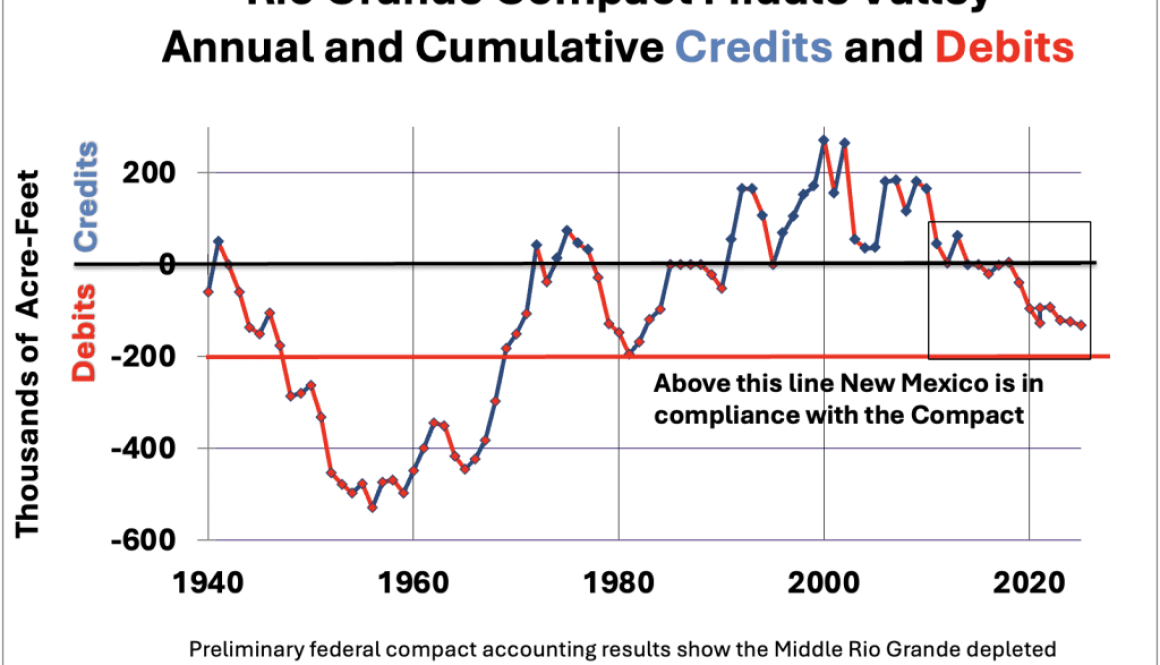
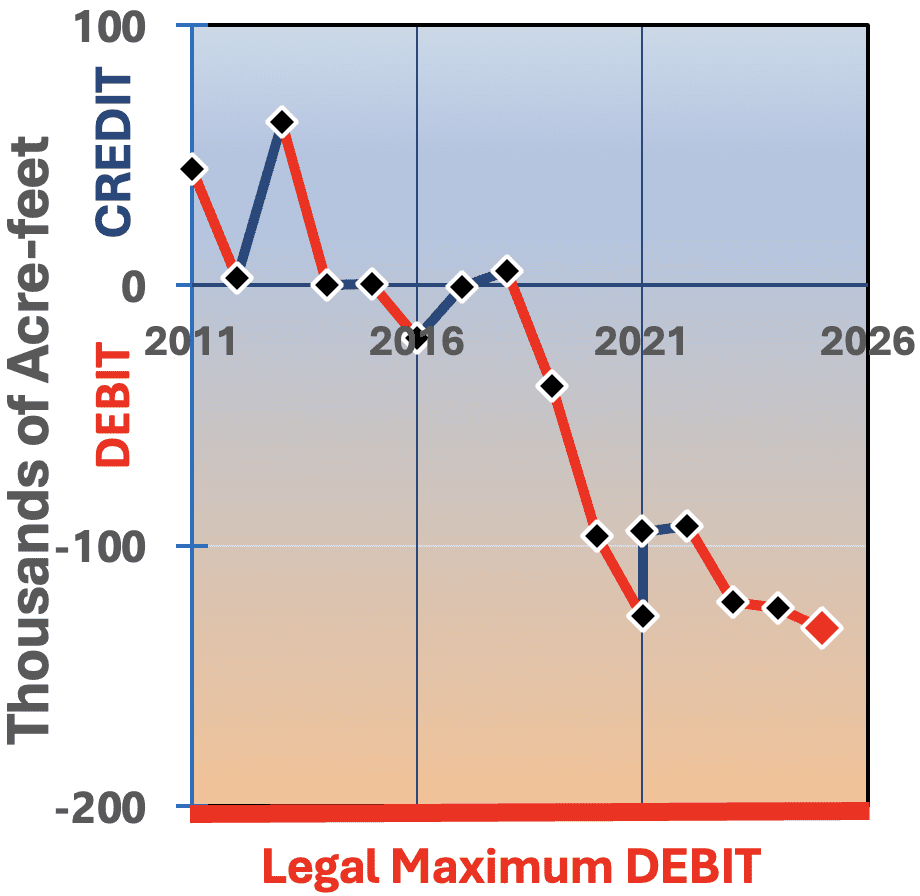 The average annual trajectory over the last decade is -19,800 acre-feet per year. Since 2018, only one year has not increased the cumulative debt. The 2021 apparent improvement was due to a paper accounting adjustment — not wet water arriving at Elephant Butte. Nat put it plainly: “we have been trying to turn the ship.” The ship has much inertia. The currents are strong. The ship has not yet turned.


 We had an animated conversation about New Mexico’s almost silent, almost unknowing drift to the brink of a brand-new Rio Grande Compact violation. In the Middle Rio Grande, we are living the tragedy of the commons: each user pursues their own needs within self-imposed limits, but the cumulative result is a system-wide overuse that exceeds our legal share under the Compact. Our surface water supply this year is near record lows, yet our demands continue—pushing groundwater pumping to unsustainable levels. We prepared the graphics below to illustrate the situation demanding New Mexico’s and the Middle Valley’s adaptation.


