Norm Gaume is a retired water engineer, former water resources manager for the City of Albuquerque, and former director of the New Mexico Interstate Stream Commission. He is President of the New Mexico Water Advocates. His articles posted at nmwateradvocates.org illustrate the depth and breadth of his expertise.
New Mexico Water Dialogue:
Persistent Themes and a Unified Direction
Join the New Mexico Water Dialogue for the 31th Annual Meeting at the Indian Pueblo Cultural Center in Albuquerque. Shared themes of New Mexicans concerned about water and Persistent New Mexico themes over time and across the state and the need for a unified direction are the focus. Thoughtful presentations will cover diverse aspects of regional water planning. Afternoon breakout groups will discuss how the groundwater management framework offered in the New Mexico 360 Groundwater Report “fits into regional water planning.” We hope to see you there!
The United Nations has a name for what is happening to Albuquerque’s water supply. In January 2026, the UN’s think tank on water published a report concluding that the world has entered an era of global water bankruptcy. New Mexico is not exempt. The term was formally defined this year to be more precise and descriptive than the generalized term “water crisis.” Water bankruptcy is a state in which a human-water system has spent beyond its hydrological means for so long that it can no longer satisfy the claims upon it.
New Mexico Water Advocates submitted a White Paper to the Authority Board at its April 22 meeting requesting six actions to prevent Albuquerque’s pending water bankruptcy.
The first step in preventing water bankruptcy and adapting accordingly is to recognize the problem; that is, face the facts. In the late 1980s and 1990s, Albuquerque discovered and faced the relevant facts of the aquifer underneath it that was its sole water supply source. Now, reduced river flows of the Rio Grande and the three headwater streams since the turn of the century demonstrate the 1990s assumptions, which were also the Water 2120 assumptions, are invalid, overtaken by climate change. Albuquerque must again face the facts and adapt. As the 1997 Albuquerque Water Resources Management Strategy explicitly called for, Albuquerque should also help its neighbors.
Water 2120 Doesn’t Work with Climate Heating and Aridification
In 2016, the Authority adopted Water 2120, a 100-year water plan, concluding a major effort by Water Authority staff and several consultants. Water 2120 authors assumed that future water supplies would resemble the past — a condition water planners call stationarity. That assumption was visibly failing by the time Water 2120 was approved. It is now visible as dry riverbed sand and cracked mud in Valencia County. The river will dry at Albuquerque in May until drenching monsoon rains arrive, if they do.
Water 2120’s water supply strategy depends on the federal San Juan-Chama Project, which delivers water from the Colorado River basin through Heron Reservoir to augment municipal and irrigation water supplies in the Middle Rio Grande. The Authority has perpetual contract rights to half of the Project’s annual yield.
Direct drinking water use of the Authority’s share has two requirements. Both are failing simultaneously. Heron Reservoir ended 2025 at 7% of capacity, a record low. The absence of winter snowpack resulted in this year’s inflows to the reservoir also setting a record low. Runoff is over. Native Rio Grande flows are so low that the Water Authority’s river water treatment plant shut down on April 24 due to lack of sufficient streamflow to allow its diversions to continue. Since 2020, the drinking water plant has been unable to treat water for a sufficient number of days per year to meet its annual drinking water production targets.
The Rio Grande Compact Clock Is Running
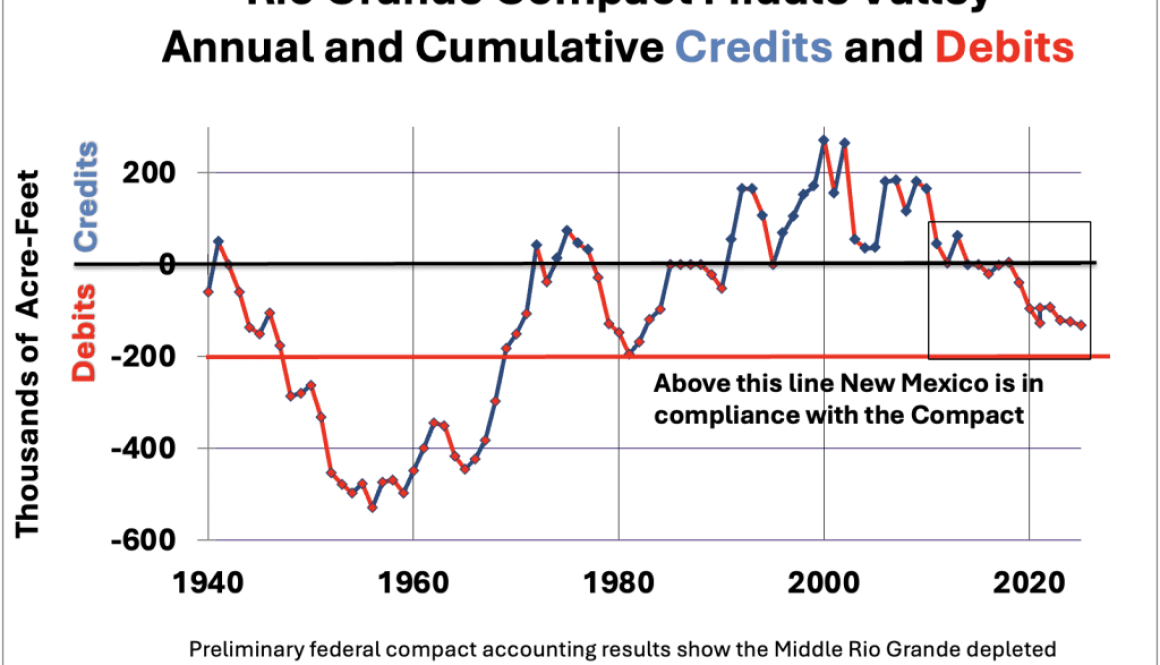
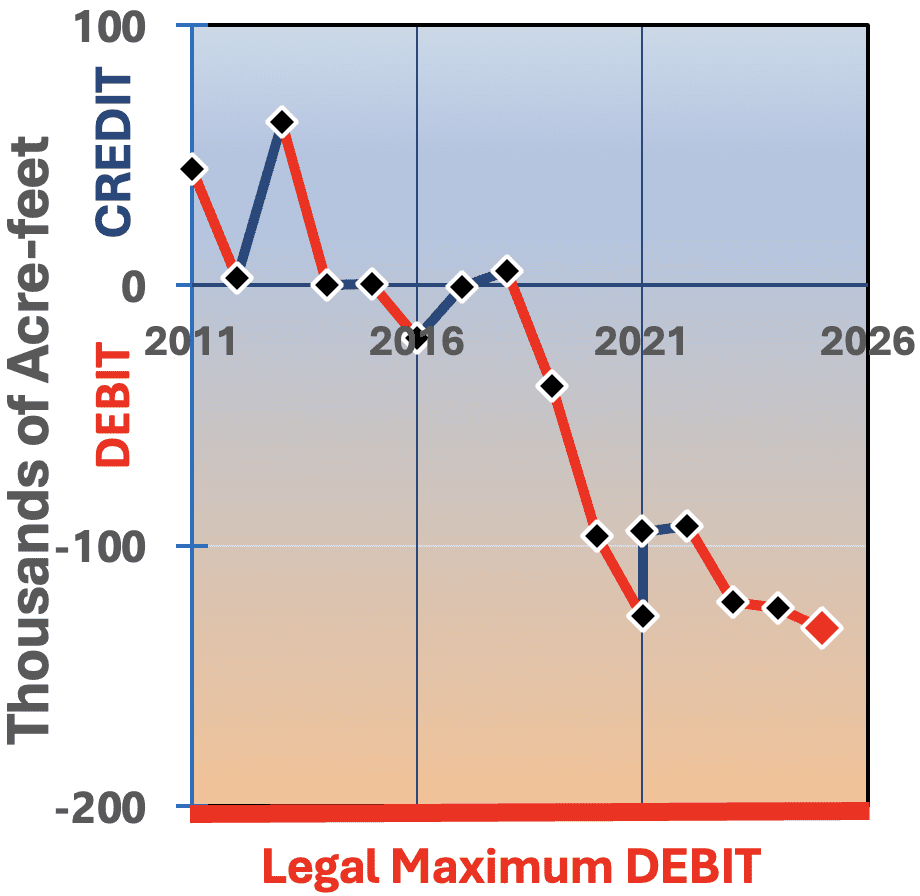
New Mexico currently carries a cumulative Rio Grande Compact debt of 132,000 acre-feet, accruing at roughly 20,000 acre-feet per year. A plain-terms Compact violation occurs at 200,000 acre-feet. At the current rate, that is three years away.
A Middle Rio Grande Compact violation will cause another Texas lawsuit heard by the United States Supreme Court. The Supreme Court again will become New Mexico’s water bankruptcy judge and Texas will have its full say.
The Rio Grande Compact obligates New Mexico to deliver water to Elephant Butte Reservoir for the Lower Rio Grande’s water users. Every Middle Rio Grande diversion from the river, every pumping well, and increased evapotranspiration from the river and riparian corridor draws against a common Middle Rio Grande legally available water supply that is smaller than the total demand. In retrospect, this trend has been visible for many years.
The Water Authority contributes a relatively small fraction of the Middle Valley’s total depletions. However, a compact violation is extremely risky and will bring big problems for the Water Authority. Water 2120 doesn’t recognize the overarching compact limits on total depletions or the effects of Water Authority planning decisions and operations on compact compliance.
The Water Authority Board Must Act
The Water Authority’s executive director has made recent public representations that the Authority can serve new high-water-use industrial customers. The Authority plans to consume more of its treated wastewater for non-potable irrigation that will increase its net depletions of the river. These public representations and plans to consume more and more of the Authority’s return flows for irrigation are contradicted by the Authority’s 2026 Operating Plan that recognizes the severe constraints of this year’s hydrology and the requirement for unsustainable groundwater pumping. Staff reported to the Board that fewer wells are currently in operating condition and that two old high production wells had recently collapsed and were ruined.
The Authority also faces a growing gap between revenue and expenses, a substantial backlog of deferred facility rehabilitation, and over $140 million in unexpended rehabilitation appropriations while costly failures divert resources from planned work. The Authority’s financial advisors are recommending new fixed monthly customer fees and increased debt financing at a time when debt service is already the Authority’s largest annual expense. The Authority’s revenue model depends on water and sewer commodity sales — creating a structural conflict between the conservation the situation demands and the revenue the Authority needs to pay its bills.
Water 2120’s foundational assumptions have failed. The Board has the White Paper. The NM Water Advocates look forward to the Authority’s response.
What We Are Asking — And What You Can Do
The New Mexico Water Advocates’ White Paper requests six actions by the Water Authority board:
a formal, transparent reassessment of Water 2120;
an inclusive stakeholder process to revise planning assumptions;
a suspension of the Authority’s representations about serving new high-water-use industrial customers until future Authority water supply adequacy is publicly assessed;
a reassessment of the current Drought Stage designations and the responses each stage requires;
a conservation focus on high water users and non-functional turf; and
a policy of cooperation and mutual sacrifice to prevent a Compact violation.
The New Mexico Water Advocates are asking elected and appointed leaders at every level to engage honestly with what the data show.
We are asking you to make your voice heard — with the Authority Board, with your elected representatives, and in your community. The Middle Rio Grande’s water future will be decided in the next few years. The choice to adapt to prevent water bankruptcy is still available. The time to act is now.
NM Water Advocates Workshop Review, March 19, 2026
Hannah Riseley-White, Director of the NM Interstate Stream Commission, and Nat Chakeres, the State Engineer’s General Counsel, deserve our thanks as public servants and State leaders with authority and responsibility to govern New Mexico’s waters, which are the public’s. They made an admirably frank and thoughtful presentation, supported by informative slides, at the Water Advocates’ Middle Rio Grande Compact Crisis evening workshop. The prior evening, they had left their agencies’ Open House event at Elephant Butte at 8:00 pm to drive home to Santa Fe. They have big jobs, a large state, and lots of water problems demanding their leadership and judgment.
They presented honestly, using their own data to document the rapidly advancing crisis the Water Advocates have been describing. Hannah called the situation dire. Nat acknowledged the metering order said to be coming almost a year ago is not yet ready. Hannah called it overdue. Nat said plainly, “we will be the bad guy when we have to be.” We are grateful for state leaders willing to engage this directly and this publicly.
The Numbers Aren’t Waiting
But gratitude and concern can coexist.
What makes the case more forceful is not the numbers themselves. It is that top State water officials presented them. That is what carries authority. New Mexico currently sits at -132,000 acre-feet of compact debt. A compact violation occurs at -200,000 acre-feet. The average annual trajectory over the last decade is -19,800 acre-feet per year. Since 2018, only one year has not increased the cumulative debt. The 2021 apparent improvement was due to a paper accounting adjustment — not wet water arriving at Elephant Butte. Nat put it plainly: “we have been trying to turn the ship.” The ship has much inertia. The currents are strong. The ship has not yet turned.
The ship has much inertia. The currents are strong. The ship has not yet turned.
At the current trajectory, a compact violation is three years away. Hannah showed snowpack at the 0th percentile on the evening of the workshop. That means this year’s snowpack holds less water on this date than ever recorded. The runoff is coming down and will be essentially over in April, when recent peak runoff has been around Memorial Day. EBID’s surface water allotment this year is four inches. Hannah put it plainly: we are in uncharted territory.
A Collection of Parts and Hopes
Against that backdrop, the state’s goal to maintain compact compliance remains a collection of parts and hopes. One hope they expressed without a visible plan is that a negotiation — with whom? — will find a voluntary, timely solution. Are the incentives for cooperation and shared sacrifice greater than the incentives to litigate? “A goal without a plan is just a wish.”[1]
Nat rejected leading with an administrative approach, emphasizing that voluntary efforts must be given a chance. He also said agency staff are actively working, as their professional responsibility, on how to administer the Middle Rio Grande. The reality is the State Engineer is not ready. Some legislators say the leaders are not acting with the urgency demanded to prevent the compact violation.
The State Engineer’s 2004 General Rules for Active Water Resources Management, including a framework for shortage sharing agreements, was upheld by the NM Supreme Court in 2012. Under these rules, as step one, the State Engineer establishes the Middle Rio Grande Water Master District. Step two, the State Engineer issues a metering order. Step three, the State Engineer promulgates additional rules specific to the Middle Rio Grande. The State Engineer has yet to take the first two foundational steps.
Nat and Hannah emphasized that getting more water to Elephant Butte requires Middle Rio Grande water uses — human and natural — to deplete less, but that alone is insufficient. The river must efficiently transport the Lower Rio Grande’s legal share of inflows to Elephant Butte Reservoir where deliveries are accounted. The Middle Rio Grande’s southern end, below Socorro, has a failed engineered channel constructed decades ago. The river now is perched between levees on an elevated bed of sediment. The conveyance losses in this reach are high, regardless of the season and flow.
Hannah cited the genuine work underway — $55M in state channel investments across four legislative sessions, applying the Strategic Water Reserve to purchase water rights, deploying the Active Water Resources Management framework including issuing the forthcoming metering order, and making regional water security planning functional and effective.
But the metering order is being polished instead of issued. Regional planning councils under the 2023 Water Security Planning Act are not yet formed, much less funded, with drafting still underway for the binding guidelines that will set forth how everything is to work. A state regulatory approach is contemplated. That’s important because the adverse outcomes of rigid priority administration will motivate earnest negotiations for better outcomes. Negotiated outcomes are a goal of the Active Water Resources Management Program, but they take motivation and lots of time. Do we have enough time, with the three years to a violation trajectory?
Notably, the Interstate Stream Commission, the State agency created and given strong powers by statute, has never, not once, deliberated this Middle Rio Grande compact compliance crisis nor the approach and policies the Commission should apply.
One audience member asked a technical question about leveraging New Mexico’s stranded accumulated “relinquishment credits” to store water or for some other advantage. That brought a smile to Nat’s face; he replied he has been thinking about this. He again emphasized our situation is unprecedented, and that a Bureau of Reclamation official told him nothing should be off the table. Plainly, however, there is no water to store, and conveyance losses for water stored in spring and released the following winter for delivery to Elephant Butte Reservoir are too high.
Naming the Problem
Although both Hannah and Nat acknowledged our situation is aridification, Hannah used the word “drought” and announced the ISC is preparing a “Drought Toolkit” as a resource for communities. We raise this as a concern that has consequences, not a quibble. Hannah’s message describing our situation as “drought” reflects the notion of temporary — the implicit message that better times lie ahead — without any rational support for that reassurance. To her credit, Hannah stated the overriding plain truth: solving any water resources problem first requires understanding the hydrology and investigating different future conditions. The plain truth the Water Advocates see is that climate heating is permanently reducing and increasing the rate of depletion of New Mexico’s renewable water supplies — bad too soon.
A problem misnamed is a problem misframed. Shouldn’t we plan for the worst and hope for the best?
Norm Gaume opened the workshop challenging the state officials to recognize we are experiencing aridification caused by climate heating. Droughts end. Aridification does not. The data presented that same evening confirmed it — conditions now are worse than projected for 2070. The five warmest summers on record have all occurred in the last eight years, and snowpack is at its lowest in recorded history.
A problem misnamed is a problem misframed. Shouldn’t we plan for the worst and hope for the best? We will soon find the Middle Rio Grande in water bankruptcy if we don’t.
What Comes Next?
We left the evening more resolved. The legal framework exists. Some of the right people are engaged and speaking honestly. The ship must be turned, modernized, and the capacity created to take those essential water management decisions and actions that only the sovereign State of New Mexico has the authority to take. The moment requires the translation of acknowledged urgency into a specific, timed, and accountable action plan.
The State Engineer’s creation of the Water Master District and requiring meters on all significant wells are the first two steps. When will we see them?
Legislators were in the room that evening — we encourage every Water Advocates subscriber to follow our moderator’s advice and invite yours for coffee. When asked how people can help, Nat noted that nobody shows up at the legislature to advocate for essential agency modernization and IT systems funding. Water resources management needs champions.
The river has a lot of sand to deal with, as Nat said in explaining the river’s chronic conveyance problems and losses. As New Mexicans who want the best for New Mexico, in balance with hydrologic reality, we see a lot of sand in the machinery of responsible and responsive State and local water resources governance, too. We are running out of time to move it.
[1] Antoine de Saint-Exupéry, author of The Little Prince (1943). Saint-Exupéry was also a pioneering aviator who navigated by maps and instruments — a man who understood viscerally that aspiration without method is insufficient.
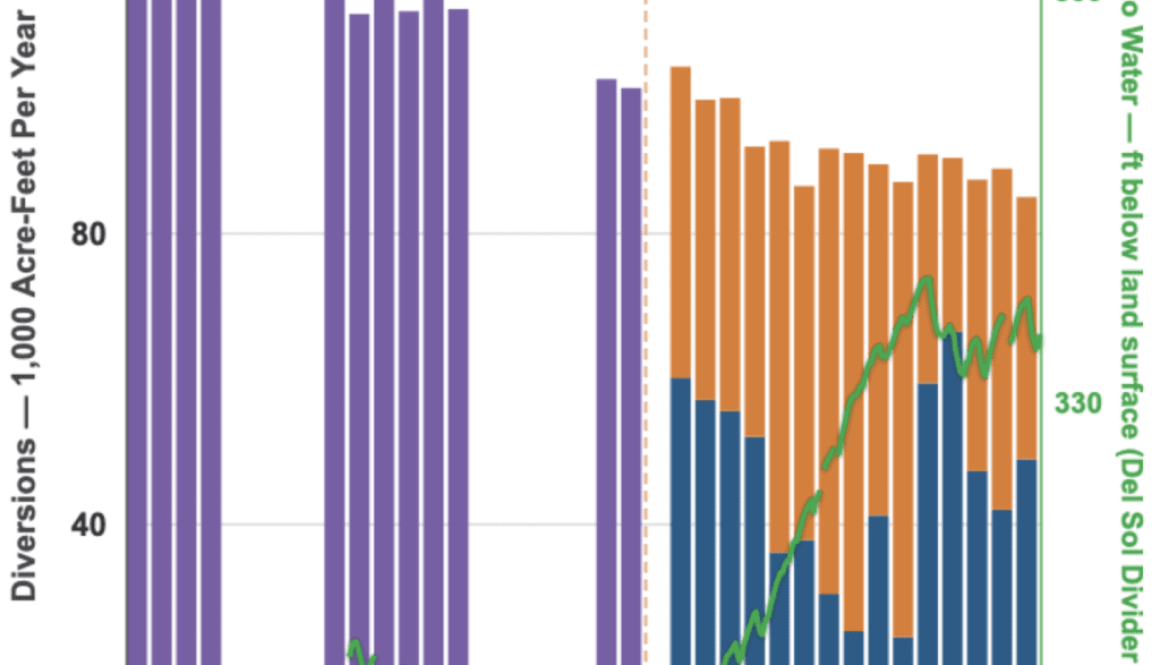
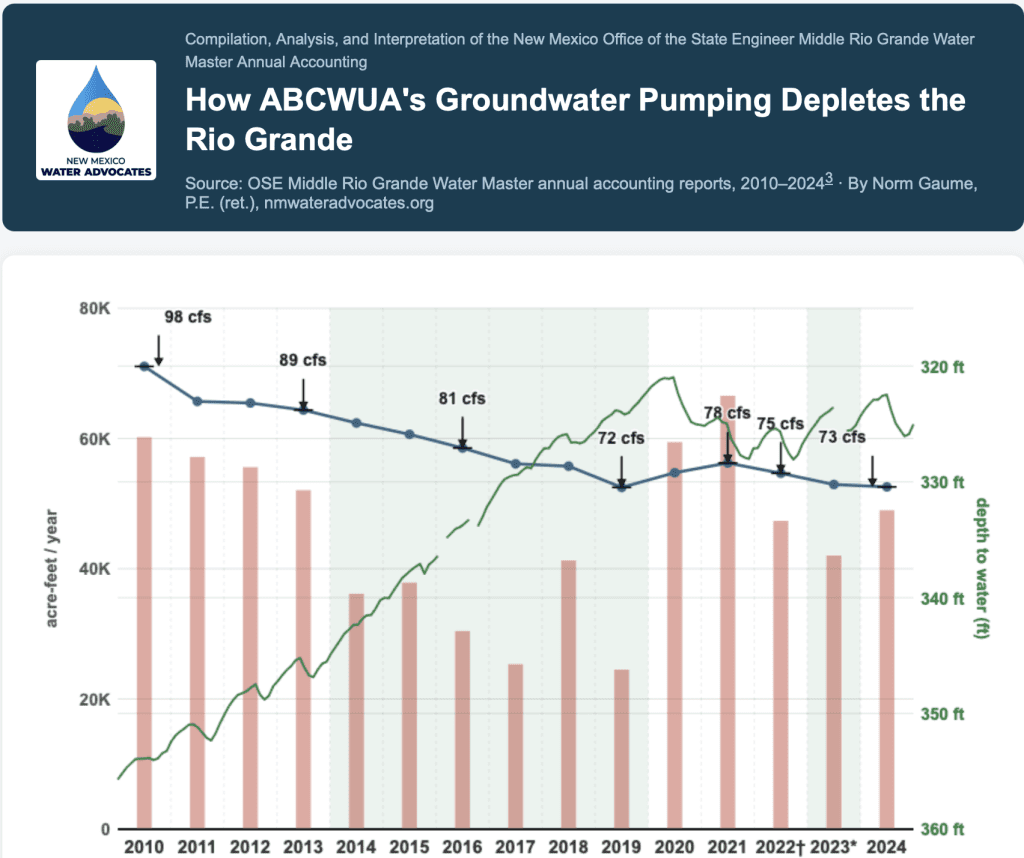
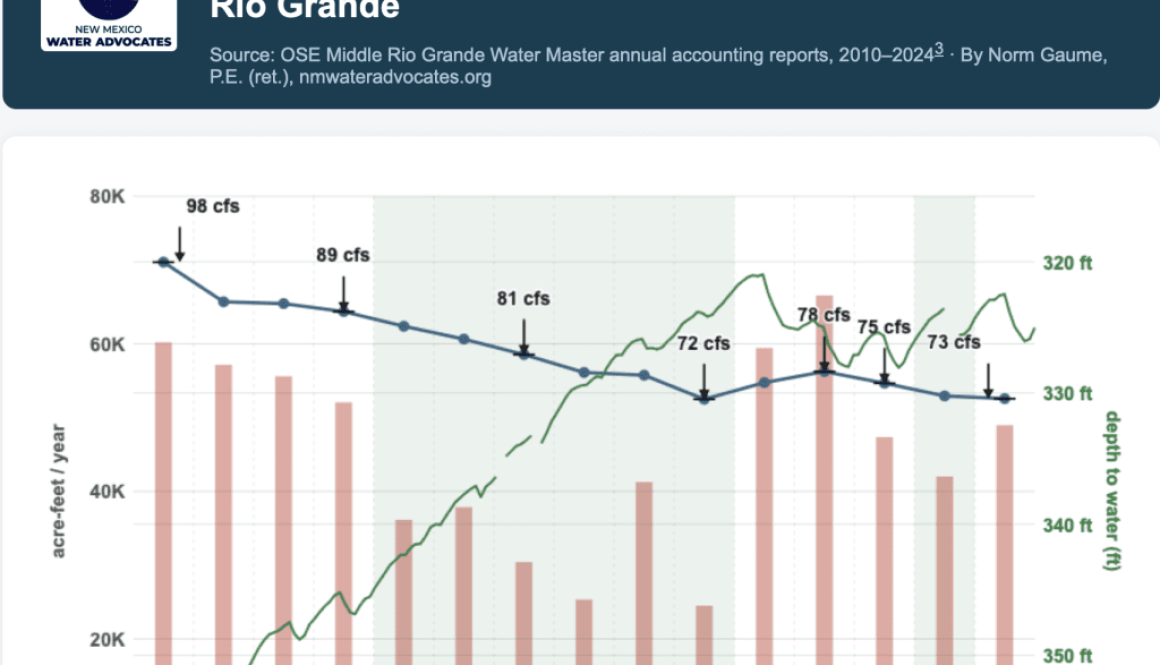
Fifteen years of annual water diversions and water rights accounting data prepared by the Office of the State Engineer Middle Rio Grande Water Master illustrate the outcomes of a remarkable but now threatened story of local water resources management. This chart shows how Albuquerque Bernalillo County Water Utility Authority (ABCWUA or Authority) groundwater pumping changes (red bars) caused groundwater levels to recover and reverse (green line), with a 25% reduction in the annual volume that ABCWUA current pumping and the residual of historical pumping depletes the Rio Grande (blue line).
This chart demonstrates the complex relationships among these annual variables:
ABCWUA total water demand, minus
ABCWUA Drinking Water Project treated surface water production
Determines the volume of ABCWUA groundwater pumping,
Which causes changes in the aquifer system, which in turn,
Determines the annual volume of Rio Grande water depleted by gravity pulling a portion of the streamflow into the aquifer to refill the merged cones-of-depression caused by groundwater pumping.
Groundwater Pumping
The red columns show the annual groundwater pumped by ABCWUA under its primary permit no. RG-960 that authorizes pumping from all ABCWUA water supply wells except the Corrales Trunk wells. Annual groundwater pumping dropped considerably from 2010 through 2019 as the Drinking Water Project ramped up production of treated river water. The diversions were the volume of San Juan-Chama imported water that the Authority had arranged to be in the river available for diversion plus an equal amount of native Rio Grande water required to be replaced downstream in real time with treated municipal wastewater.
Prior to the Drinking Water Project start-up in 2009, local groundwater was the sole water supply source.
From 2014 to 2019, treated river water supplied half or more of total demand, with ABCWUA pumping groundwater to make up the remainder. Starting in 2020, declining availability of the sustained Rio Grande flows needed for long seasonal operation of the Drinking Water Project has reduced the number of days it can operate, cutting the hours of treated surface water production thereby forcing higher groundwater pumping.
Aquifer Response to Changes in Groundwater Pumping
The green line in the chart above represents the mean monthly depth to groundwater measured from the middle depth of three USGS dedicated monitoring wells located in a neighborhood park on Albuquerque’s near east mesa. The location was selected to be as far as possible from adjacent well fields.
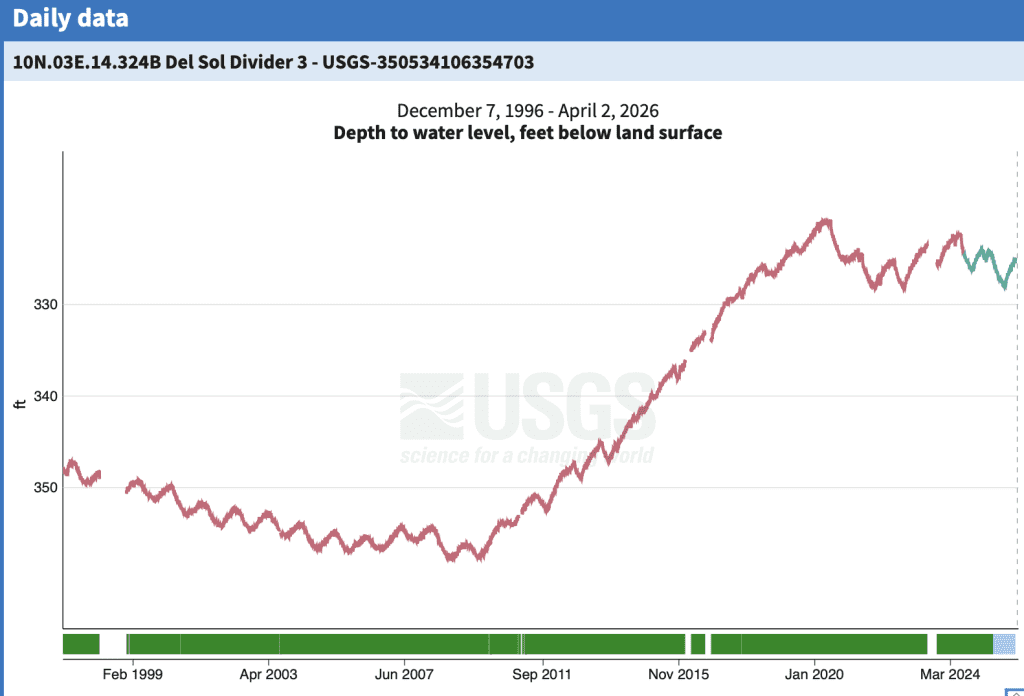
The USGS Del Sol Divider groundwater level data collection started in 1996 and has produced 30 years of record, illustrated in the chart below. The line shows the depth from the ground surface to the well water level. The USGS online chart below shows the continuous measurements. The maximum occurs in late winter; the minimum is observed at the end of hot weather and the irrigation season. Comparing the late-season minimum from one year to the next reveals whether the water table is recovering or declining
USGS Del Sol Divider #3 — site 350534106354703. Depth to water level, feet below land surface, Dec. 7, 1996 – Apr. 2, 2026.
The groundwater level dropped annually until about 2005 when the downward trend became less prominent, probably due to ABCWUA’s effective water conservation program. Then in 2010, with the Drinking Water Project start-up and production of 42,800 acre-feet of water from the river, the groundwater level didn’t decline with the summer pumping. The groundwater level recovered more than 30 feet between 2010 and 2020. The gains were more pronounced during the six consecutive years when the river provided half or more of ABCWUA’s annual drinking water supply.
Aquifer Recovery Stalled — 2020 to Present
Groundwater pumping shot back up in 2020 due to the lack of sustained Rio Grande flows needed to transport ABCWUA’s San Juan-Chama water to the Drinking Water Project intake. Conditions worsened: 2021, 2022, and 2025 were among the five driest years this century for Rio Grande water availability.1 The Rio Grande at Albuquerque dried for extended periods during the summers of 2024 and 2025 — part of the driest 17-year era ever recorded under Rio Grande Compact accounting — the first drying at Albuquerque in four decades.2 The Del Sol Divider water levels shown at the right side of the charts reflect this worsening of surface water availability through 2024.
How Much Aquifer Recharge from the River to ABCWUA Groundwater Pumping Cause?
After the USGS drilled a substantial number of monitoring wells throughout the Albuquerque area in a three dimensional arrangement and interpreted the aquifer’s complex, faulted geologic structure, the next step was to develop a three-dimensional computer simulation model linking the various layers of the aquifer, the river in the top alluvial layer, and deeper adjacent groundwater pumping from individual wells throughout metropolitan Albuquerque. The first USGS model was published in 1994. Many successive versions by the USGS and other modelers have followed, refined by installation of additional monitoring well nests and a lengthening history of measurements.
This monitoring shows the Albuquerque Basin groundwater flow system responds slowly to changes in annual pumping volumes. The induced recharge of the aquifer from the Rio Grande responds even more slowly to changes in pumping.
Historical pumping by the City of Albuquerque and successor ABCWUA removed vast volumes of water from groundwater storage. This pumping created a giant cone-of-depression, formed by the merging of the cones-of-depression of individual wells. The giant cone was broadly centered across the Albuquerque Uptown area and was 160 feet below predevelopment groundwater levels near the Sandia Mountain front.
The Office of the State Engineer developed an improved version of the USGS model and operates it annually, after the year has passed, to calculate how water flowed from the river to the groundwater system that year in response to pumping in the current year and historically.
The blue line in the main chart shows the modeled depletion of the Rio Grande caused by the most recent years and all historical pumping from ABCWUA system wells. For example, in 2010, 71,100 acre-feet flowed from the river to the groundwater system, which corresponds to a continuous flow of 98 cubic feet per second. The total groundwater pumping was 60,200 acre-feet and the Del Sol Divider’s monitoring well showed the water level was 354 feet below the surface.
Contrast that with 2019, the 10th full year of Drinking Water Project operations prior to the worsening water scarcity of the 2020s. Groundwater pumping was only 24,500 acre-feet. The Del Sol Divider water level had risen more than 30 feet. The induced flow from the river to the aquifer was down 25% to 72 cfs. That’s significant river and stored groundwater conservation.
Recent extreme surface water scarcity has caused this early progress to falter. Further substantial declines in the Del Sol Divider groundwater level are expected as aridification takes hold.
Conclusions
Aridification has invalidated major assumptions about the availability of surface water for the Drinking Water Project and its ability to permanently and reliably supply more than half of total demand — thereby substantially reducing ABCWUA’s dependence on local groundwater. These assumptions were central to both the planning that produced the Drinking Water Project and to the 2017 100-year water plan.
A 10-year update to that plan is due next year. This analysis makes clear that the situation requires a fundamental overhaul, not merely a routine update. Additional imperatives not discussed in this article concern the adequacy of ABCWUA’s water rights portfolio and ABCWUA’s obligations relative to other major water users under any Middle Rio Grande compact compliance framework.
Endnotes
1. 2021, 2022, and 2025 were three of the five driest years this century for New Mexico’s Rio Grande water availability. Data for the last 26 years were screened for the lowest annual volumes measured at the Otowi stream gage and below Elephant Butte Dam. The other driest years were 2002 and 2013. See also: Bardwell & Gaume, “Lower Rio Grande Water Settlement — New Mexico Water Advocates” (nmwateradvocates.org/lower-rio-grande-water-settlement-drinking-water-taxpayers-pecans/). For a broader aridification context based on 85 years of Rio Grande Compact accounting at the Otowi gauge, see: Gaume, “The Rio Grande at Its Driest: What 85 Years of Compact Data Show” (nmwateradvocates.org/rio-grande-driest-era-compact-history-otowi/).
2. Based on USGS stream gage 08330000, Rio Grande at Albuquerque. Consecutive zero-flow days were recorded in summers of 2024 and 2025 — the first such occurrences since the early 1980s. Channel drying downstream worsened with distance.
3. The OSE Middle Rio Grande Water Master annual accounting reports are not posted online. The Water Master provided digital copies for individual years. The author compiled them in the linked Excel workbook that was the basis of all analysis.
4. Per the ABCWUA Water Resources Management Strategy, the 100-year plan is subject to a 10-year update cycle. The 2017 plan update is due in 2027. ABCWUA is currently working on the revision. There are no mechanisms for public comment except the Board’s normal acceptance of comments at all public meetings.
This article and the main graphic are accurate within the limits of the input data. Graphic prepared using AI tools by Norm Gaume, P.E. (ret.), NM License No. 6969, retired New Mexico water resources engineer and President, New Mexico Water Advocates. April 6, 2026
The Rio Grande at Its Driest: What 85 Years of Compact Data Show
Every year since 1940, federal and state water managers have accounted for the Rio Grande waters flowing past the Otowi highway bridge to Los Alamos. That annual volume determines how the river’s flow is allocated under the Rio Grande Compact — which is federal and state law that governs water sharing among Colorado, New Mexico, and Texas. The amount of water New Mexico must deliver for all uses downstream of Elephant Butte Reservoir — in New Mexico, Texas, and Mexico — depends directly on how much water arrives at Otowi. The gauge is, in the most literal sense, where the Middle Rio Grande’s annual water entitlement and delivery obligations are set.
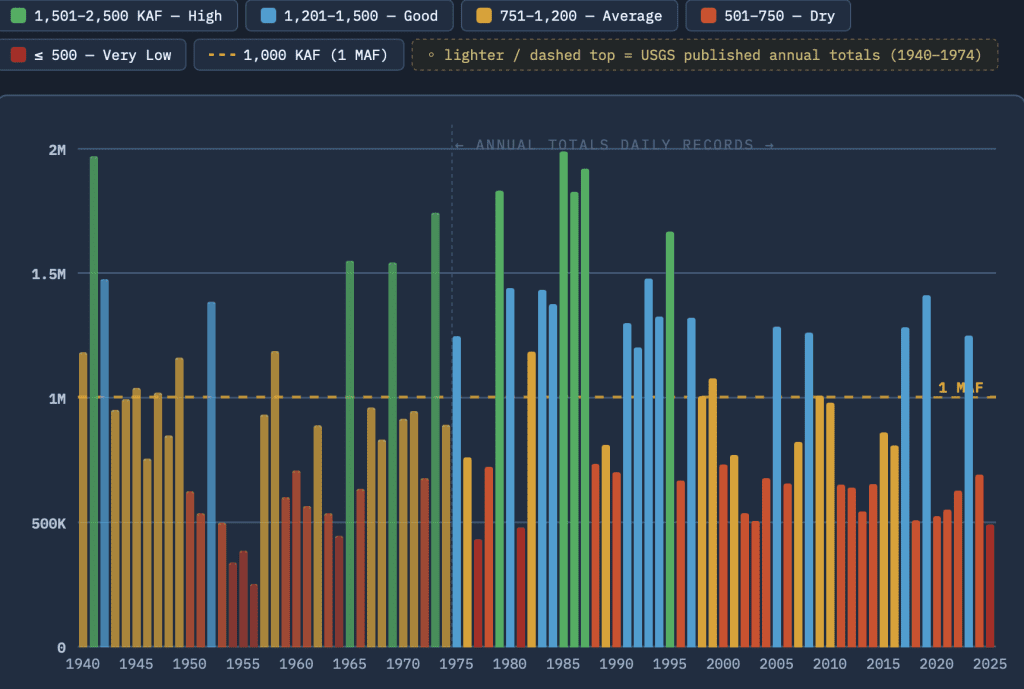
Each of the three graphics below reveals important facts that are not well known.
The current drought is not without precedent — the infamous drought of the 1950s was comparably severe
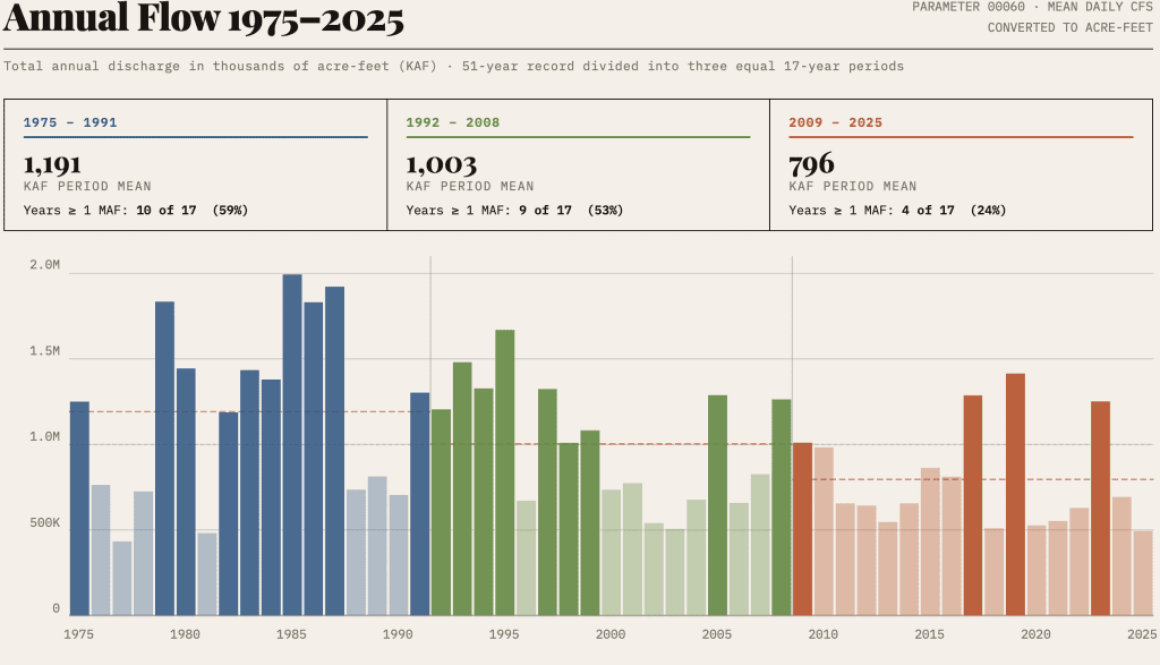
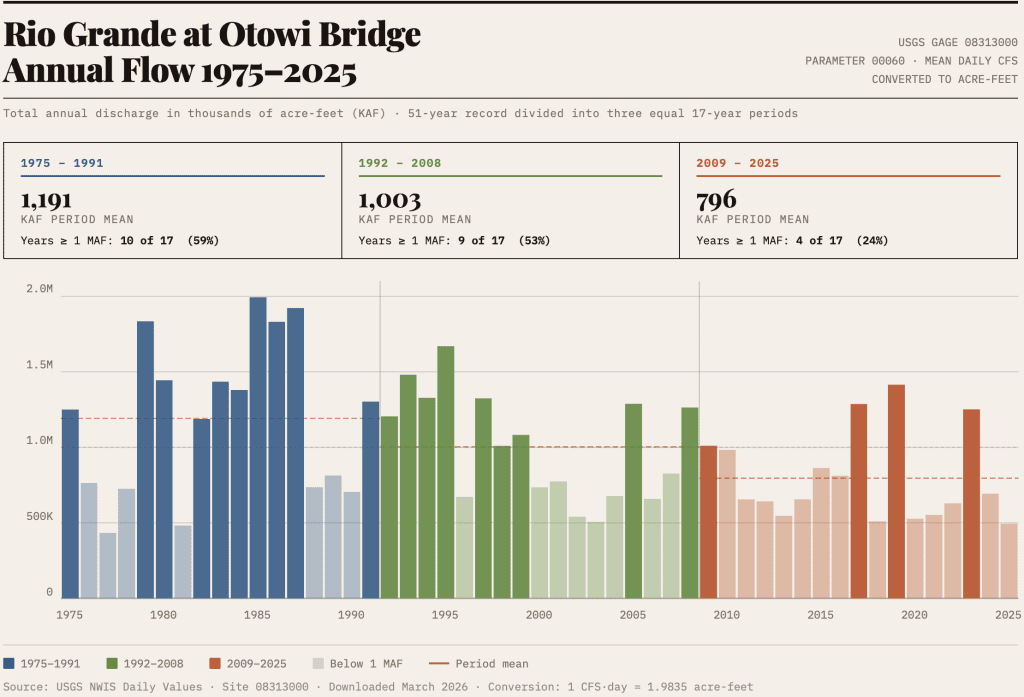
The first graphic spans the complete Compact era from 1940 to the present. It shows that the current drought is not without precedent — the infamous drought of the 1950s was comparably severe.
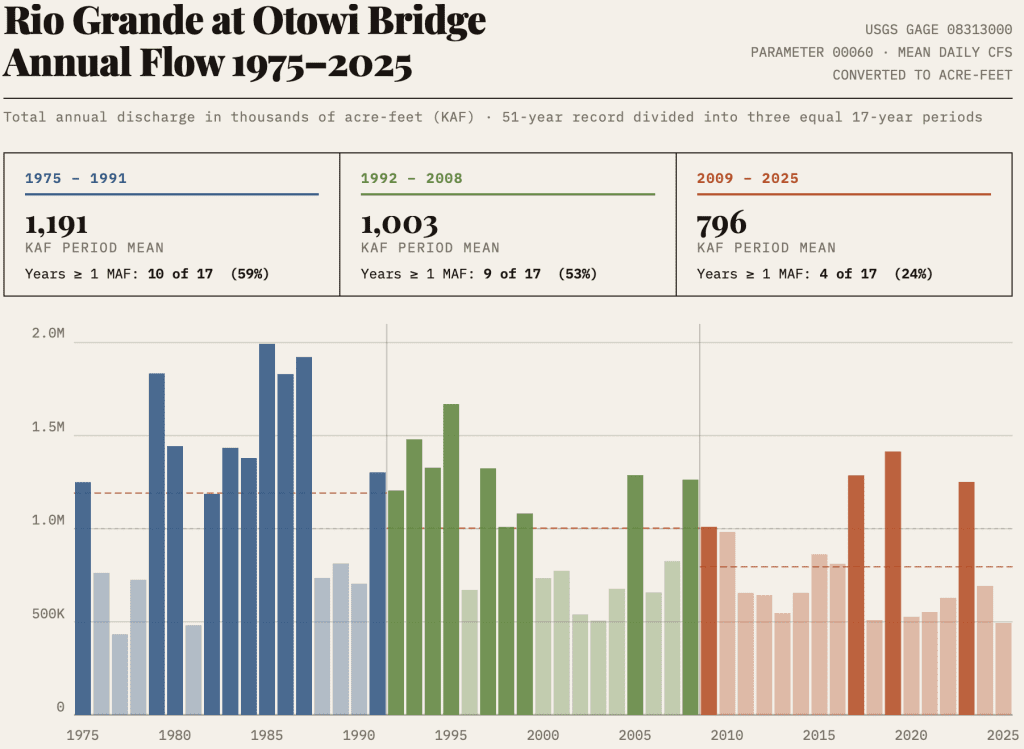
New Mexico has lost roughly one third of its Rio Grande water supply over the past fifty years
The second graphic examines the most recent five decades and reveals an alarming fact: New Mexico has lost roughly one third of its Rio Grande water supply over the past fifty years. The 1980s and 1990s were anomalously wet — a period that filled reservoirs and fostered a false sense of the river’s water supply blessings. Since then the basin has trended sharply dryer. El Vado and Elephant Butte Reservoirs have been essentially emptied, and Abiquiu Reservoir has been drawn down by roughly half — all in an effort to sustain water supplies and meet new federal endangered species requirements.
It has not been enough. New Mexico entered the current dry era holding substantial accrued delivery credits under the Compact. All credits have been consumed. Since 2018, New Mexico’s cumulative delivery deficit has risen to -132,000 acre-feet. This is a legally binding State of New Mexico water debt to Lower Rio Grande that has accrued over the last seven years.
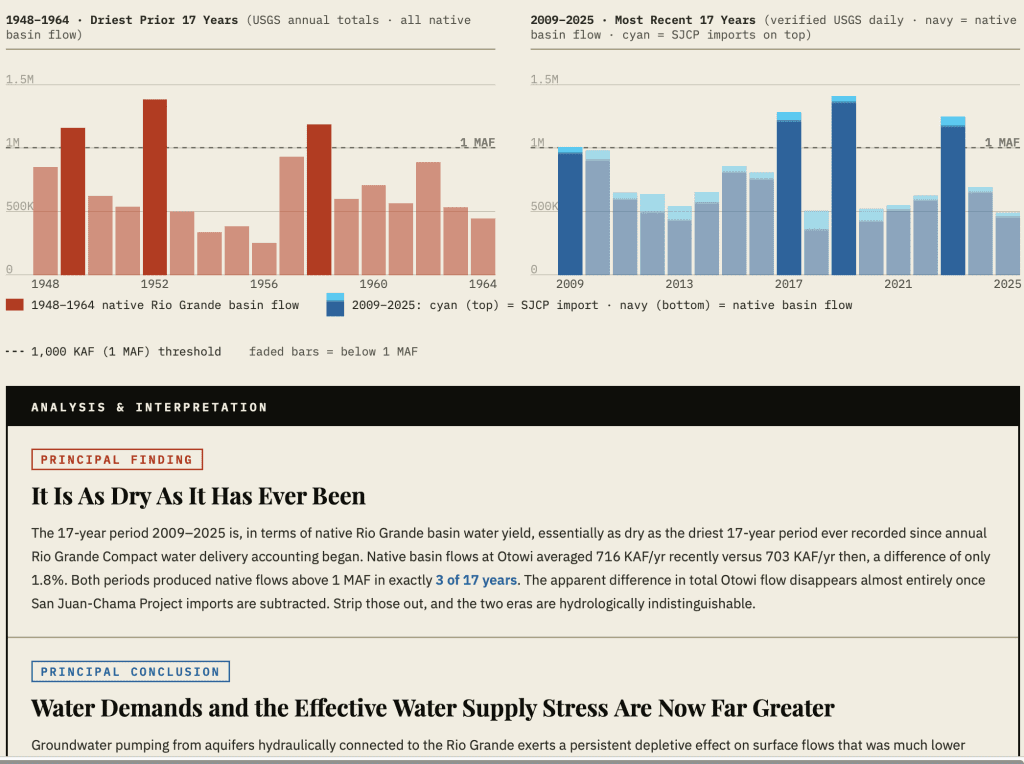
The third graphic completes the analysis by placing the most recent 17 years in direct comparison with the driest 17-year period previously recorded under the Compact, with full accounting of San Juan-Chama Project imports, contractor entitlements, and the graphically alarming storage history of Heron Reservoir.
The data support two conclusions that the third graphic documents in detail.
Principal Finding:
The 17-year period 2009–2025 is, in terms of native Rio Grande basin water yield, as dry as the driest 17-year period ever recorded since annual Rio Grande Compact water delivery accounting began. Native basin flows at Otowi averaged 716,000 acre-feet per year over the recent period versus 703,000 acre-feet per year from 1948–1964 — a difference of only 1.8%. Both periods produced native flows above one million acre-feet in exactly three of seventeen years. Strip out San Juan-Chama Project imports, and the two eras are hydrologically indistinguishable.
Principal Conclusion
The effective water-supply stress today is far greater than the raw Otowi flow numbers suggest, or than it has ever been
Groundwater pumping from aquifers hydraulically connected to the Rio Grande exerts a persistent depletive effect on surface flows that was much lower during 1948–1964 historic dry period, making the effective water-supply stress today far greater than the raw Otowi flow numbers suggest or than it has ever been.
During the 1948–1964 historical driest period, the Middle Rio Grande corridor had far fewer people and cities were much smaller: Albuquerque’s population in 1950 was roughly 97,000; today the metropolitan area exceeds 900,000. Municipal, industrial, agricultural, and riparian water demands are dramatically greater today, and rising temperatures have increased evapotranspiration throughout the basin. Decades of heavy pumping from the hydraulically connected shallow alluvial aquifer and the underlying Santa Fe Group aquifer have drawn down water tables along certain reaches of the Middle Rio Grande, causing greater losses from the river.
The third graphic is the most important. It presents this evaluation’s bottom line findings and conclusions, including the stark storage history of the San Juan Chama Project and the recent diminishment of its annual contributions to a reliable Middle Rio Grande water supply.
Please click each graphic in sequence to see the situation and pay particular attention to the third.
Please be sure to click this thumbnail for the principal finding and conclusion including an alarming graphic pertaining to the reliability of San Juan Chama Project imported water supplies.
If analyses similar to this one are publicly available, I am unaware, so I invested the time to laboriously assemble the data. One element of the third graphic, for example, required specific data from the second page of 17 Rio Grande Compact annual accounting sheets posted as PDF images on the OSE/ISC website. The same documents are available as images from Colorado and Texas institutions.
No compact state, or the Bureau of Reclamation, or the Rio Grande Compact Commission has produced a digital dataset suitable for analysis of this rich data set. Note that the Interstate Stream Commission’s 2019 Water Data Act responsibilities would have the agency assemble all the pertinent annual terms for historical Rio Grande Compact accounting into a digital data set.
Comments and questions are welcomed.
Certification
I produced this short essay and the three HTML graphic web pages for public information using AI tools. I believe this essay and the HTML graphics presented herein are entirely accurate.
This is shaping up to be one of the driest years on record. Snowpack across the Rio Grande basin is near record lows. Elephant Butte Reservoir is very low; Elephant Butte Irrigation District farmers are expecting a four-inch 2026 irrigation allotment. Increased river flows from a big October headwaters storm, combined with the end of the Middle Rio Grande irrigation season and a large December block release from Rio Chama Reservoirs, significantly improved the Middle Rio Grande’s end-of-year compact deliveries — yet more than a fourth of that water was lost in conveyance before reaching the reservoir pool. Middle Rio Grande cumulative water delivery debt is now approaching the Rio Grande Compact’s legal cap. Texas will certainly sue when that debt limit is exceeded, if not before, bringing new U.S. Supreme Court litigation to the Middle Rio Grande.
The Middle Rio Grande Compact Crisis
The State Engineer and Interstate Stream Commission Director have named the Middle Rio Grande compact compliance situation as a crisis. The Middle Rio Grande is on a trajectory to violate the Compact within two or three years. State Engineer Elizabeth Anderson will violate state water law at Section 72-2-9.1 NMSA 1978 if her continued inaction allows that to occur. The ISC will fail to meet its mission to do everything within its broad powers to conserve and protect New Mexico water.
Join Us March 19 — Hear the State’s Plan
That is why our March 19 workshop Middle Rio Grande Compact Crisis is a must-attend event for every Middle Rio Grande resident. State Engineer General Counsel Nat Chakeres and ISC Director Hannah Riseley-White will present the State’s current hydrologic picture, including New Mexico’s Rio Grande Compact status and what it means for Tribal, agricultural, and municipal water users. The State is pursuing conservation, conveyance improvements, and expanded administration — and as Hannah writes, “working closely with major water users to develop creative solutions to meet needs while maintaining compliance with our legal obligations.” Join us. Register here.
What the Lower Rio Grande Tells Us
The featured article from our March 2026 News was written by Beth Bardwell from Las Cruces and this author to examine the Lower Rio Grande situation at the beginning of its post-litigation water management stage. Water use in the LRG has barely been affected to date by the litigation but water users there will soon dramatically feel the depth of the litigation consequences if the dry climate continues. The lessons for the Middle Rio Grande are neither abstract nor comfortable. Read the long-form article Drinking Water, Taxpayers, Pecans, and the Lower Rio Grande Settlement.
Groundwater Momentum Continues in March
Last month’s February 19 groundwater workshop with Dr. Gretel Follingstad and Dr. Maurice Hall was outstanding — the turnout, the depth of the conversation, and the community engagement it generated were exactly what New Mexico needs more of. Continue that momentum this month with two free webinars hosted by the New Mexico Groundwater Alliance. Details and registration links are in our article, Groundwater Is in Crisis — And the Experts Are Back to Talk Solutions.
The water and the consequences we will pay for ignoring its growing scarcity and our water sharing obligations are not waiting. We must stop waiting, too.
HAFC Final Decisions Undercut New Mexico’s Ability to Manage Its Water Crisis
House Budget Reported Out of Finance Committee Cuts Planning, Modernization, Staffing, and River Maintenance
The House Appropriations and Finance Committee (HAFC) took a step forward by improving funding for the Office of the State Engineer and Interstate Stream Commission. But the committee’s final decisions amount to fiscal malpractice—leaving dangerous gaps in water management and failing to fund actions now that will cost New Mexico multiples more later. Those costs escalate sharply if continued underdeliveries to Elephant Butte trigger a new Rio Grande Compact violation. This table summarizes all the special appropriations to the State Engineer/Interstate Stream Commission that are in the Committee Substitute for HB2, available at nmlegis.gov
Major Rio Grande Crises
The State Engineer requested $50 million to reduce Lower Rio Grande depletions and implement the interstate settlement. That amount remains essential. After hearing the State Engineer’s budget presentation on November 20, 2025, HAFC Chair Nathan Small said the request “sounds right to me.” Deferring or cutting this funding does not avoid costs—it postpones action until the consequences are far more expensive to fix, particularly if continued underdeliveries to Elephant Butte trigger enforcement, emergency measures, or renewed interstate litigation. Anything less increases New Mexico’s legal exposure and financial risk down the road.
Water Planning and Modernization
HAFC also cut in half the OSE/ISC $5 million request for water planning, agency modernization, and work on the Governor’s 50-Year Water Action Plan. That reduction will delay implementation of the unanimously passed 2023 regional Water Security Planning Act. Not only will that postpone deployment of planning needed to seek well-informed regional solutions, but it continues the Legislature’s pattern of failing to fund the good water laws it has passed this century.
Middle Rio Grande River Channel Maintenance
More troubling, HAFC’s decision to eliminate all funding for essential Middle Rio Grande river channel maintenance is foolhardy. In November and December, the river channel absorbed roughly half of unusually large non-irrigation-season flows, including a major pulse of unused Pueblo water. Failing to maintain conveyance guarantees preventable losses that otherwise would improve deliveries to Elephant Butte.
Supporting Institutional Capacity
Finally, HAFC refused to fund the six additional State Engineer staff needed to administer wet water in the Middle and Lower Rio Grande and to implement three Indian water rights settlements. These are core state responsibilities: Section 72-2-9.1 NMSA 1978 directs the State Engineer to act in recognition that interstate stream compact compliance is imperative, and settlement implementation is work only the State has authority to perform. Failing to fund these functions risks serious legal, financial, and water-supply consequences for New Mexicans statewide.
This is a long-form reference article. It documents what recent science shows about groundwater depletion in the Rio Grande–Bravo Basin and explains why New Mexico’s groundwater crisis is no longer a matter of insufficient data, authority, or technical capacity, but of governance. What follows provides the supporting evidence, context, and institutional history behind this conclusion.
What the Science Now Shows
In the first comprehensive basin-wide assessment of consumptive water use and replenishment, the study Overconsumption Gravely Threatens Water Security in the Rio Grande–Bravo Basin quantifies unsustainable use at sub-basin scales (smaller, localized areas) from the San Luis Valley in Colorado, through New Mexico, and on both sides of the international border to the river’s terminus at the Gulf of Mexico. A November New Mexico Water Advocates article first directed readers to this research. This article reports on its findings and explains their implications for water management decisions in New Mexico and across the basin. Together with prior reporting by New Mexico Water Advocates, the study provides a documented scientific foundation for examining why groundwater governance in New Mexico has failed to keep pace with what is already known.
The study authors’ basin-wide accounting of water use in the Rio Grande–Bravo Basin concludes that more than half (about 52 %) of all water consumed in the basin is unsustainable, meaning it is withdrawn faster than it can be replenished. The study finds that irrigated agriculture accounts for roughly 87 % of all direct consumptive water use, making it by far the dominant driver of depletion. Within that agricultural use, forage crops grown primarily for livestock feed—especially alfalfa and other hays—account for approximately half of total agricultural consumption, far exceeding the water use of food crops for direct human consumption. This pattern of overconsumption threatens long-term water security for millions of people who depend on the Rio Grande and its connected aquifers.
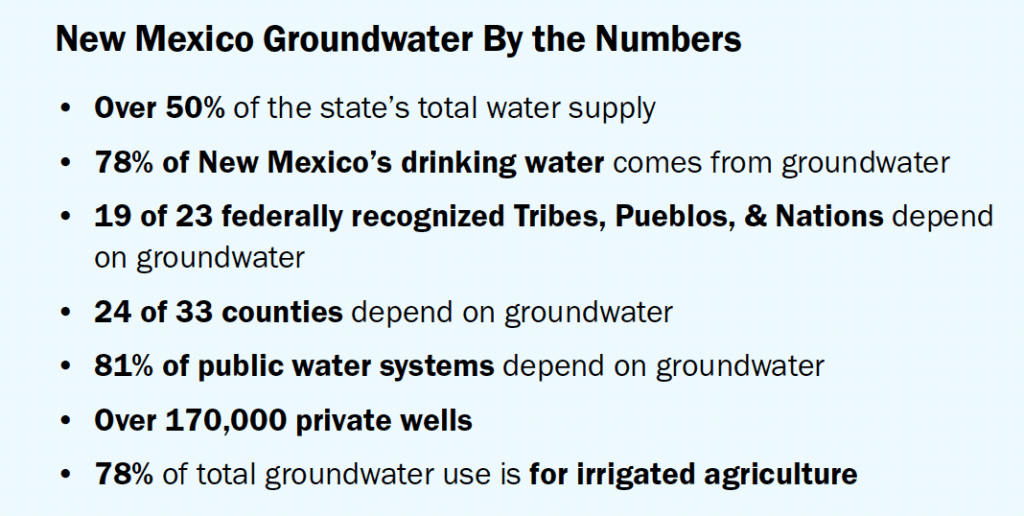
The New Mexico context for the report’s basin-wide findings is provided by the Office of the State Engineer’s 2020 Water Use by Categoriesreport, which estimates that irrigated agriculture accounted for approximately 78 percent of total statewide water withdrawals in 2020.[i] New Mexico facts are consistent with the Rio Grande–Bravo Basin finding that irrigated agriculture is the dominant driver of water demand and depletion. These facts reinforce the conclusion that New Mexico’s groundwater challenges are structural and governance-related rather than informational.
While municipal and industrial uses account for a comparatively small share of consumptive demand, hundreds of thousands of acres of irrigated hay and forage, much of it supplied solely from groundwater, are a primary contributor to agricultural consumptive use in the state. This state-level pattern mirrors the basin-wide findings and reinforces that unsustainable groundwater depletion in New Mexico is already well documented. The biggest challenge is not scientific uncertainty, but the willingness and capacity to govern groundwater use for greater longevity and security.
What This Means for Groundwater Governance
This scientific clarity matters. It demonstrates that we now have sufficient information to begin governing New Mexico groundwater use responsibly, rather than waiting for better information and complete characterization of every aquifer.
This point corrects a common misconception. Groundwater management does not require complete scientific certainty before action can begin. Basin-wide water balance and depletion trends are already documented at scales relevant to governance. The science and the Office of the State Engineer’s water use reports define the problem; the primary challenge is the Office of the State Engineer’s institutional follow-through.
The Role of the New Mexico Bureau of Geology and State Water Resources Agencies
Ongoing hydrogeologic investigations by the New Mexico Bureau of Geology and Mineral Resources remain essential. The Aquifer Mapping Program is far more than mapping. With meaningful funding in the current fiscal year,[ii] the Bureau has already flown aerial resistivity surveys over critical aquifers, generating data that inform where wells should—and should not—be drilled. The Bureau will oversee drilling and instrumentation of permanent characterization and monitoring wells to define vertical aquifer structure, discrete water quality zones, faults, and other barriers to groundwater flow. This drilling will also help determine the volume and potential yields of deeper brackish and saline formations beneath freshwater zones. Together, these efforts provide the foundation for systematic, long-term groundwater monitoring that will steadily reduce uncertainty about aquifer behavior and define both the possibilities and limits of brackish water development.
The Office of the State Engineer and the Interstate Stream Commission are the agencies legally responsible for administering water rights, enforcing limits, and planning for sustainable water use. Scientific programs strengthen their technical foundation, but the desire for more complete science should not be a reason to forego initiating governance actions. The current agency approach appears to defer meaningful groundwater governance until regional water security planning recommendations are completed, even in areas where community water supplies are already threatened by continued agricultural pumping. Deferring enforceable limits under these conditions is a decision to allow ongoing aquifer depletion to continue unchecked, increasing the likelihood of irreversible impacts to local communities, higher costs, and accelerated decline.
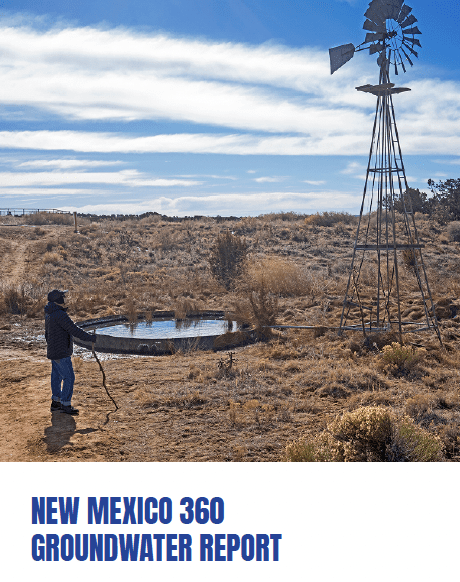
The January 2026 New Mexico 360 Groundwater Report, published by the New Mexico Groundwater Alliance, makes clear that the State Engineer already has legal authority to preserve groundwater supplies by limiting pumping. That authority includes conditioning, limiting, or denying groundwater permits; regulating pumping in fully appropriated and mined basins; requiring metering and reporting; and managing groundwater pumping to protect connected surface waters and meet interstate compact obligations.
The regional water security planning program, unanimously authorized by the 2023 Legislature, has yet to gain traction through formally adopted rules. The Interstate Stream Commission will promulgate the rules and must then issue guidelines. After that, it can make state funding grants to regions, which must form regional councils to organize themselves to oversee preparation of their region’s plan. Plans won’t be drafted, approved by the councils and subsequently by the ISC, and funded for implementation for many years. This makes the promise of water planning an insufficient basis for delaying near-term groundwater governance, given that aquifers are already being drained by agricultural pumping to the detriment of communities.
The Real Bottleneck: Chronic Governance Incapacity
New Mexico’s experience demonstrates that groundwater can be managed effectively when the State or local institutions choose to do so—but that such management has been applied unevenly, episodically, and without being institutionalized statewide. Almost all groundwater management has been reactive to crises. For example:
Pecos Valley Artesian Conservancy District – The clearest example of long-standing active groundwater management is the Pecos Valley Artesian Conservancy District (PVACD), created in 1932 in response to catastrophic loss of artesian pressure in the Pecos Valley around Roswell and Artesia. There, groundwater use has been actively regulated for decades to prevent collapse of the aquifer system. That experience shows that sustained groundwater governance is possible in New Mexico when depletion is undeniable and consequences are unavoidable.
Pecos River – Pecos River water management now seems routine, but it has been difficult, costly to taxpayers, and entirely reactive. Farmers went to jail for sabotaging the operation of water meters required by court order. New Mexico lost a Texas lawsuit in the U.S. Supreme Court and is now subject to a Pecos River Compact 1987 Amended Decree that it came extremely close to violating annually for more than a decade. A State-driven collaboratively developed solution became state law in 2001. It required arrangements to get more water through the last dam in New Mexico and pause farming on productive farmland in the Carlsbad Irrigation District and the PVACD. It succeeded, but increasing water scarcity driven by global warming may require action beyond the settlement.
Lower Rio Grande – A second form of groundwater management is now emerging in the Lower Rio Grande as a result of a 2013 Texas lawsuit before the U.S. Supreme Court. The pending Consent Decree and Settlement agreements focus squarely on New Mexico’s groundwater pumping from the irrigated valley floor’s alluvial aquifer, which is well connected to the Rio Grande. The Settlement requires that the State of New Mexico maintain groundwater levels adjacent to and beneath the river high enough to prevent the portion of the river’s flow legally allocated to Texas and the United States from instead sinking into the New Mexico riverbed. The State must meet mandatory downstream delivery obligations under tight compliance deadlines.
Notably, drinking water purveyors (community water utilities) depend on rights that the state water rights adjudication court has determined are junior to the irrigators’ 1903 priority rights to a full supply, whether from the river or groundwater. In recent years, the New Mexico share of Caballo Dam releases has not enough to satisfy the irrigators’ senior rights to a full supply. The State Engineer will be compelled to administer water in the Lower Rio Grande to prevent illegal underdelivery of water to El Paso as required by the Settlement.
Middle Rio Grande – The Middle Rio Grande presents an even more complex picture. The Albuquerque Bernalillo County Water Utility Authority proactively prevented a groundwater-overdraft disaster from the excellent aquifer it’s built over. The solution was implementing direct use of its imported surface-water rights. Groundwater levels underneath Albuquerque partially recovered and stabilized, stopping the risk of aquifer compaction that would cause differential subsidence across faults that traverse the city. Albuquerque’s achievement matters—and it contradicts the notion that New Mexico acts only after collapse.
This was a local utility response, not basin-wide governance. Conjunctive-use benefits projected in the Authority’s 100-year plan have not materialized as assumed. The volume of available surface water treated and delivered to customers is far below the plan’s assumptions. Current Middle Rio Grande surface and groundwater uses will cause a new Rio Grande Compact violation in two to three years, while the ABCWUA says publicly it will supply new high-water use industry that the State and the City of Albuquerque are recruiting. The effective ABCWUA position is that it is preferable to be upstream with junior deep wells than downstream with senior surface water rights. Santa Fe also implemented a direct river diversion for drinking water, but its motivation was to prevent running out of water. Los Lunas has been and is recruiting high water use industry to fully use their water rights, and now seeks to transfer additional water rights that may be legally abandoned into their wells. Former State Engineer Mike Hamman clearly recognized the necessity of basin-scale conjunctive management in the Middle Rio Grande, but several years later, no progress is apparent.
Taken together, these examples show that New Mexico’s groundwater management successes are isolated, situational, and non-systemic. The problem is not scientific uncertainty, lack of authority, or technical infeasibility. The problem is the failure to institutionalize groundwater governance before crisis, litigation, or compulsion makes inaction untenable.
The State’s Water Resources Management Imperatives
New Mexico’s groundwater crisis is not the result of scientific uncertainty or the absence of legal authority. It is the result of governance failure—decisions by elected and appointed leaders to defer action even as the consequences become unavoidable.
The scientific paper by Richter et al. reinforces what has been understood for decades: aquifers are finite, groundwater depletion is measurable, and continued overpumping leads to permanent losses of water supply, water quality, and economic security. These are physical limits. They do not yield to delay, political convenience, or administrative caution.
New Mexico already has the legal authority to manage groundwater use. Under existing law, the State Engineer can condition, limit, or deny groundwater permits; regulate pumping in fully appropriated and mined basins; require metering and reporting; and manage groundwater pumping to protect connected surface waters and interstate compact obligations. No new statutory authority is required to begin managing groundwater based on aquifer conditions.
Gaps in aquifer characterization and monitoring remain real and must be addressed. But neither the science nor the law supports using those gaps as an excuse to postpone management. Data development and management must proceed together. Waiting for perfect information while aquifers decline only increases costs and reduces or eliminates future options.
Despite this, New Mexico continues to rely on administration that is largely disconnected from aquifer conditions. Groundwater permits are issued and administered without enforceable limits tied to aquifer longevity, even where declines are severe and well documented. Outside the one managed basin, groundwater governance remains the exception rather than the rule.
What Is at Stake—and Who Is Responsible
New Mexico’s groundwater crisis persists not because the State lacks financial resources, but because the Legislature has repeatedly chosen not to appropriate them at the scale required. The legal authority to manage groundwater exists. What is missing is the sustained investment needed to build and maintain the institutional capacity to use that authority effectively.
Across state government, funding for water resources planning, groundwater science, monitoring, enforcement, and long-term management remains inadequate. Agencies are expected to address widespread aquifer depletion with fragmented data systems, insufficient staffing, and short-term appropriations that fall far short of the problem’s scope. This chronic underfunding ensures continued incapacity, regardless of statutory authority.
That incapacity is not accidental. It reflects legislative choices. Year after year, the Governor recommends and the House and Senate Finance Committees set budgets that do not provide the resources necessary for groundwater management.
More fundamentally, New Mexico has not been willing to explicitly acknowledge groundwater management as a core governing responsibility that requires a defined program and durable capacity. Without naming groundwater management as a priority, the Legislature avoids the obligation to fund it, and agencies are left unable to deliver it.
The consequences of this failure are already visible. Households are hauling water because wells have gone dry. Communities dependent on groundwater face rising costs, declining water quality, and increasing long-term risk. New Mexico has many ghost towns—once viable communities that declined when the resources they depended on were exhausted. Groundwater-dependent communities face the same risk if groundwater depletion for irrigation continues unchecked.
Preventing that outcome is a matter of choice. The constraint is not science, not legal authority, and not the absence of money. It is the absence of political will to name groundwater management as a governing responsibility—and to fund the capacity required to carry it out. New Mexico’s future requires top elected and appointed officials to name and describe our groundwater sustainability crises, face the sacrifices required to increase groundwater longevity, and build the state institutional capacity needed to confront and solve those crises.
[i] Office of the State Engineer / Interstate Stream Commission, 2020 Water Use by Categories, summarized at mainstreamnm.org , “How data can inspire action: A closer look at the Water Use by Categories report” (Jan. 2025). The report estimates approximately 2.97 million acre-feet of withdrawals for irrigated agriculture out of roughly 3.81 million acre-feet of total statewide withdrawals in 2020 (≈ 78 percent). Irrigation withdrawals are not directly metered in most areas and are estimated using crop acreage, irrigation requirements, and other standard water-use accounting methods. The report presents withdrawals, not consumptive use.
[ii] The Bureau of Geology requested $29 million for this year and the next two to initiate their planned $175 million aquifer characterization plan, but the Governor, the House Appropriations and Finance Committee, and the Senate Finance Committee successively reduced their appropriation to $7.5 million. The Bureau may receive a $22.5 million budget this year, having demonstrated strong performance.
New Mexico’s Groundwater Reality and the Urgent Need for Action
Groundwater is the backbone of New Mexico’s water supply. It provides more than half of all water used statewide, supplies drinking water for most communities, and sustains agriculture, industry, and ecosystems across large areas of the state. Yet in many regions, groundwater pumping has vastly exceeded natural recharge. Climate change is intensifying the risks.
The January 2026 New Mexico 360 Groundwater Reportoffers the most comprehensive, statewide synthesis to date of New Mexico’s groundwater conditions, management tools, and future challenges. Prepared by the New Mexico Groundwater Alliance with contributions from scientists, legal experts, and water managers, the report integrates data, experience, and case studies to make sound recommendations.
The authors document a clear and troubling trend: as surface-water supplies decline due to warming temperatures and prolonged drought, dependence on groundwater is increasing. In many New Mexico basins, withdrawals vastly exceed recharge year after year, resulting in falling groundwater levels, higher pumping costs, and degraded water quality. Excessive pumping from aquifers interconnected with rivers depletes the rivers and interferes with meeting interstate compact obligations. The authors also identify persistent data and governance gaps—limited metering, uneven monitoring, and incomplete aquifer characterization.
The report identifies serious gaps in aquifer characterization and monitoring that must be addressed to support durable groundwater management. It does not suggest waiting to act; it underscores that continued inaction—under the guise of needing more data—will only accelerate depletion and foreclose future options.
Practical Steps New Mexico Must Implement
The report does not stop at diagnosis. It identifies practical, New Mexico–specific pathways forward. The authors present case studies from the Pecos Valley, the Lower Rio Grande, the Southern High Plains, and other regions to demonstrate that locally driven groundwater management—when supported by state policy, reliable data, and sustained investment—can slow depletion and improve long-term resilience. The report emphasizes treating aquifers as critical infrastructure that provides irreplaceable services to water users. The report urges accelerating aquifer mapping and monitoring, expanding groundwater metering, and fully integrating groundwater into regional water security planning.
These findings are directly relevant to decisions now facing New Mexico policymakers, water managers, and communities, including implementing the 2023 Water Security Planning Act and confronting unanswered needs for groundwater governance and enforcement.
A Water Advocates Perspective
New Mexico still lacks aquifer-based limits on groundwater depletion. The report points out that the State Engineer has the authority, but has not acted. At the 2023 Water Leaders Conference, a state legislator asked a basic question: does the State Engineer manage groundwater pumping based on how much water remains in an aquifer, or the rate at which it is declining? The panelists didn’t provide the factual answer, which is neither of those.
New Mexico water law and State Engineer permits allow pumping up to the paper right regardless of aquifer condition, even where declines are severe and well-documented, as the Clovis and Portales groundwater supply crisis demonstrates,
True management of New Mexico groundwater resources for longevity and security does not exist, except for one New Mexico artesian aquifer where pumping is controlled by the Pecos Valley Artesian Conservancy District. The District, managed by a report co-author, was initially created by a Roswell district judge’s order in January 1932. That’s because the impacts of uncontrolled uses were quite obvious. Non-artesian aquifers impacts of uncontrolled uses are generally not observed until wells run dry.
The growing number of New Mexico households hauling water because their wells have gone dry is direct evidence that aquifers are being depleted. Last fall, a Clovis-area irrigator—who is also an elected state legislator and a member of the Water and Natural Resources Committee—informed the committee that he has invested in new technology. He stated that its purpose is to fully exhaust the groundwater beneath his land.
How Other Western States Are Managing Their Groundwater
The New Mexico Groundwater Alliance news release included a supplemental document reviewing the groundwater management frameworks of other Western states. While none has solved groundwater depletion everywhere, many have established recognizable systems—defined basin goals, monitoring tied to aquifer conditions, enforceable limits, and clear triggers for action when withdrawals exceed supply.
New Mexico has not. This absence is reinforced by current budget decisions. The State Engineer’s FY27 special appropriations and program expansion requests focus on compact compliance, settlements, and enforcement, but the word groundwater or any description of the need for groundwater programs does not appear.
Preregister to Hear From the Report’s Principal Author
At 6:30 pm on February 19, Santa Fe native Gretel Follingstad, Ph.D., the report’s principal author and an outstanding presenter, will discuss what the data show, what remains uncertain, and what New Mexico must do next to address the ever-worsening groundwater crisis. The disconnect between hydrologic reality and administration is precisely why this report matters—and why this presentation should not be missed.
The State’s choices are not serving New Mexico’s water future. Continuing to allow groundwater to be mined until it is gone will end poorly—for communities, local economies, and the State.
As the new year begins, New Mexico’s water challenges are clear, but the State’s responses remain unsettled. The questions now confronting New Mexico are not about whether scarcity exists or whether legal authority is lacking, but about how effectively decisions are being made and why all meaningful discussions to tackle the problems are occurring behind closed doors. Year-end Rio Grande Compact compliance, the implementation of recent state water laws, agency priorities and capacity, and the Governor’s and Legislative Finance Committee’s budget choices together frame the current state of the State’s water—and the water governance choices now facing New Mexico.
New Mexico has the legal tools, but has not mustered the political will or built the management systems to stop excessive and illegal water uses. That will change. The consequences of continued neglect are unbearable.
I. Rio Grande Compact Compliance Emergencies as Indicators
Water uses in the Middle Rio Grande have consistently over-depleted the Middle Rio Grande’s share, shorting the Lower Rio Grande. Similarly, excessive water uses in New Mexico downstream of Elephant Butte Dam are shorting Texas. Both situations have persisted for many years and are now entangled but distinct emergencies.
Our State is required by the Lower Rio Grande settlement and consent decree now pending U.S. Supreme Court approval to,
substantially reduce New Mexico groundwater pumping,
maintain a sufficiently high groundwater table that the river can function, and
comply with a new annual water delivery requirement to El Paso.
Meeting the new mandatory compliance requirements will be very expensive and demanding. Penalties built into the pending settlement remove noncompliance as an option.
Separately, chronic overuse of water in the Middle Rio Grande has caused New Mexico’s water delivery debt to Elephant Butte Reservoir to increase from a net credit in 2018 to -131,900 acre-feet at the end of 2025. [This preliminary result is from the Bureau of Reclamation. The official result will be determined by the Rio Grande Compact Commission this spring.] New Mexico will violate the Rio Grande Compact if New Mexico allows the cumulative water delivery debt to reach 200,000 acre-feet. Texas, being Texas, will sue, as is their custom, culture, and tradition.
The author’s recent public records requests reveal recent private meetings between the agencies and the two major state-created water purveyors in the Middle Rio Grande. The progress at this time is apparently limited to initial discussions of the participants positions.
Both compact problems reflect that New Mexico’s water management institutions are not doing their jobs to regulate illegal water overuse. The results of this neglect are:
huge taxpayer burdens,
legal jeopardy for the State,
danger for water users, and
disregard for the river and species who depend on it.
The State Engineer and the Interstate Stream Commission are not prepared and don’t have the capacity or budget to deal with either Compact compliance emergency.
II. Legal Authority Is Not the Limiting Factor
The Legislature passed a new water law in 2003 that had been drafted and proposed by the NM Attorney General. The Governor signed it. It declares,
[T]he adjudication process is slow, the need for water administration is urgent, compliance with interstate compacts is imperative and the state engineer has authority to administer water allocations in accordance with the water right priorities recorded with or declared or otherwise available to the state engineer. Section 72-2-9.1 NMSA 1978.
In 2004, State Engineer John D’Antonio put rules in place to implement this new law. Following eight years of litigation, the New Mexico Supreme Court in 2012 unanimously upheld these rules. None of the five State Engineers that have held that office since 2012 has implemented the Active Water Resources Management program created by these rules. The fact of having five State Engineers in office since 2012 is part of the problem.
CENTER-PIVOT IRRIGATION CURRY COUNTY RANCH, NOW ABANDONED – PHOTO CREDIT DANNY FISH
Similarly, the 2019 Water Data Act, the 2023 Water Security Planning Act, and the 2006 Aquifer Mapping Program have languished. The Office of the State Engineer over decades has allowed virtually complete depletion of the Ogallala Aquifer in New Mexico for irrigation, leaving New Mexico communities that depend solely on that aquifer in jeopardy. Similar outcomes are in progress elsewhere across New Mexico.
Although inadequate funding and capacity are a big part of the problem, other overarching reasons include the Governor’s and Legislature’s lack of political will to see the State’s water is effectively managed as an essential scarce resource. We don’t even measure water uses, much less manage them. The management and culture of the agencies is a problem also. Their actions are tentative and cautious. They are slow to make decisions, take initiative, and effectively manage projects to timely completion.
III. Agency Capacity: Signs of Progress and Persistent Gaps
The New Mexico Bureau of Geology is our water science agency. Its scientists do first class work. They hit the ground running this fiscal year, utilizing a $7.5 million appropriation this year (the Governor recommended $29 million) to accelerate the Aquifer Mapping Program. Their progress report and budget needs presentation to the Legislature in November included a detailed briefing on the high-tech groundwater assessment technology and work already completed.
In contrast, the Interstate Stream Commission has not yet put required rules in place to implement the 2023 Water Security Planning Act. Those rules will become effective more than three years after this landmark law passed unanimously. The Office of the State Engineer desperately needs to begin enforcing against illegal water use, and modernizing its business processes and its obsolete information technology.
The OSE didn’t even request funding from the 2026 Legislature to continue building a new real-time water use data and reporting system that the 2025 Legislature funded at one-sixth of the OSE’s requested amount. Control of ruinous groundwater depletion like the Ogallala in other locations that depend on fossil groundwater doesn’t appear to be a priority. A Clovis area legislator and irrigator said technology now allows essentially all the water to be extracted. He said he is doing exactly that.
IV. Budgets as the State’s Policy Signal
State budgets are choices, not merely accounting. The OSE/ISC requested $130 million in extraordinary appropriations and six new positions for FY27. The Governor’s budget recommendation included most of the $130 million but not the new positions. The Legislative Finance Committee’s water resources management budget recommendation is unresponsive to the crises. Why do the State’s top elected leaders pass good laws unanimously but choose not to see them implemented?
V. 2026 Is a Test
The year ahead will determine:
Whether authority is exercised,
Whether transparency improves,
Whether elected state leaders equip the water agencies to manage scarcity, and
How well and responsively the agencies’ appointed leaders will manage their agencies’ work.
New Mexico’s water crises are certain. Whether the State responds effectively remains the open question.