

The State Climate Adaptation and Resilience Plan Omits Water Supply! That’s Unacceptable, It Must Be Fixed, and Here’s Why.
New Mexico is spending federal and state dollars to finish a Climate Adaptation and Resilience Plan — due for publication in February 2027 — that manages to largely miss the point. The state is drying up. Not temporarily. Not cyclically. Permanently. And the plan that is supposed to prepare New Mexico for its climate future, to guide New Mexico’s adaptation, treats that fact as a footnote.
A Plan in Name Only
The June 2024 draft plan is being finished by the Energy, Minerals and Natural Resources Department this year. The draft is not without merit. It acknowledges extreme heat, wildfire risk, and flooding. It uses acceptable language about equity and vulnerable communities. What it conspicuously, inexcusably fails to do is face the central reality of climate change in New Mexico. We are consuming far more water than our rivers and aquifers can sustain, and that gap is growing wider every year. The word “adaptation” appears in the plan’s title. The concept is almost entirely absent from its water chapter, which focuses community water infrastructure needs and ignores our shrinking water supplies.
Important Numbers and Facts Ignored
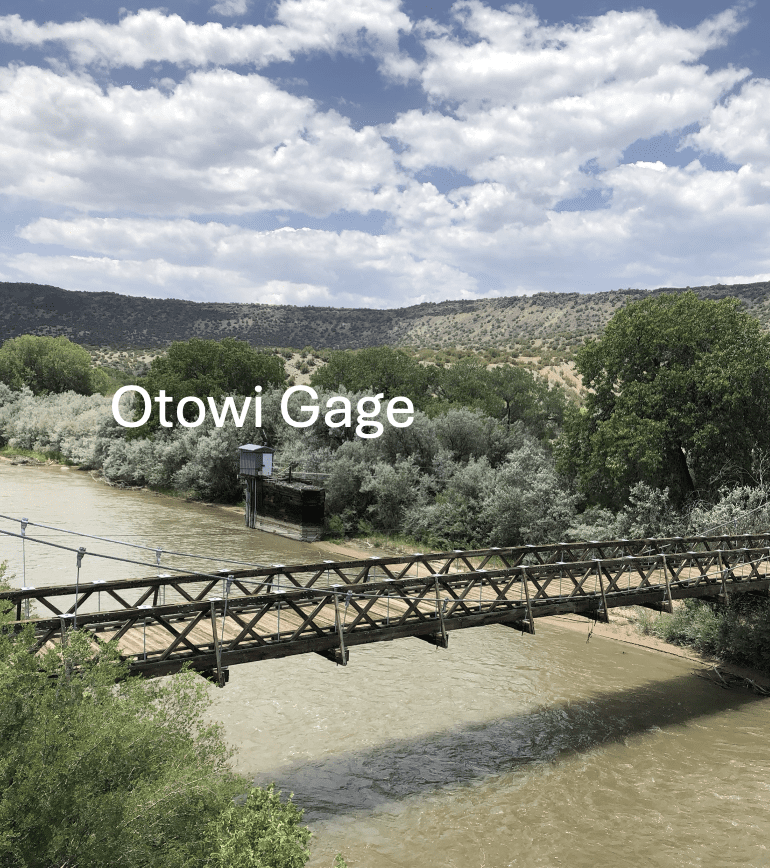
The Rio Grande at Otowi Bridge averaged slightly more than a million acre-feet per year from 1992 to 2008. From 2009 to 2025, the average annual volume was 796,000, a 20% loss. The river provided less than 500,000 acre-feet in 2025. Four of the last seventeen years produced more than one million acre-feet, compared to nine of the seventeen years before that. Everybody downstream depends on this water.
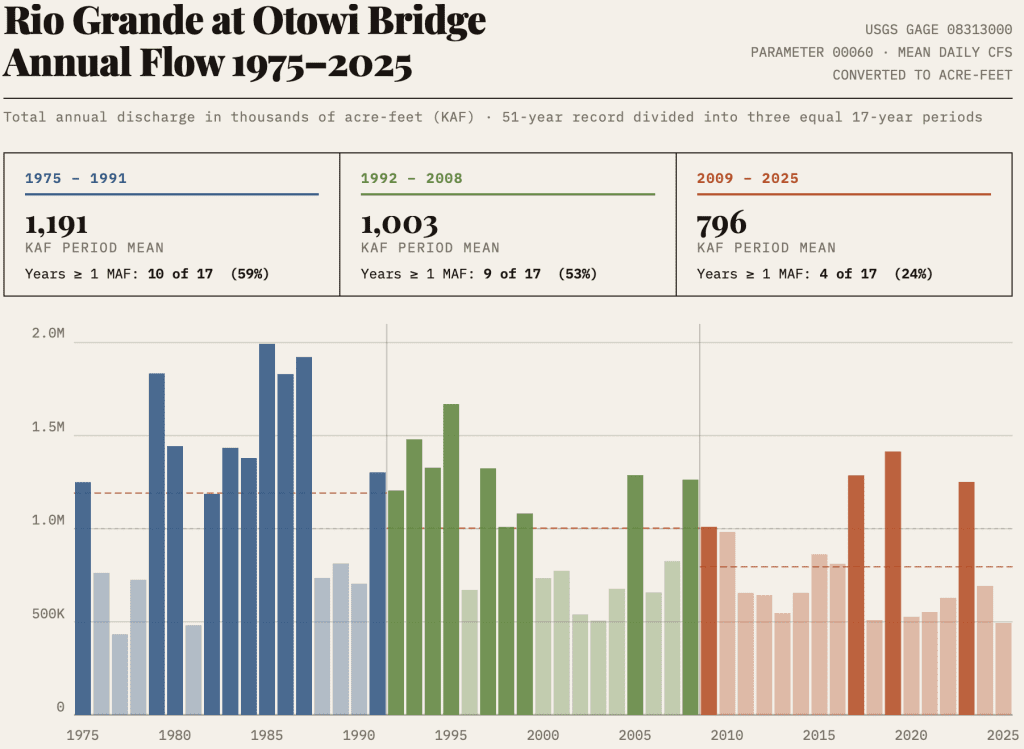
Clovis and Portales are out of water. Irrigators across the state who pump huge amounts of non-renewable groundwater to grow forage don’t know how much is left. The Lower Rio Grande Settlement will severely curtail groundwater pumping so the Texas share of Rio Grande flows will reach the state line. The river flow downstream from Caballo Dam this year and last isn’t enough to irrigate the 40,000 acres of pecans New Mexico farmers grow there. Because the Settlement is not in effect yet, the pecan farmers will continue to pump in 2026, adding to the big hole in the groundwater that the Settlement requires the State partially refill by cutting pumping.
This is Not Drought
This is not drought. Droughts end. New Mexico is undergoing aridification — a permanent, worsening shift in the hydrologic baseline driven by climate heating. The CARP uses the word “drought” throughout, as though winter snowpack will dependably return and rivers will gush again. A problem misnamed is a problem misframed.
The plan acknowledges research by New Mexico’s experts brought together by NM Tech. The experts volunteered their time because the State couldn’t pay them to write their excellent, prize-winning report! Those experts’ scientific evidence supports their conclusion that the state will lose 25% of its groundwater recharge and streamflow by 2070. But the plain truth is that we have lost half the historical amounts that flowed into Cochiti Reservoir as renewable water supply for all New Mexicans living along the Rio Grande plus the Texas share.
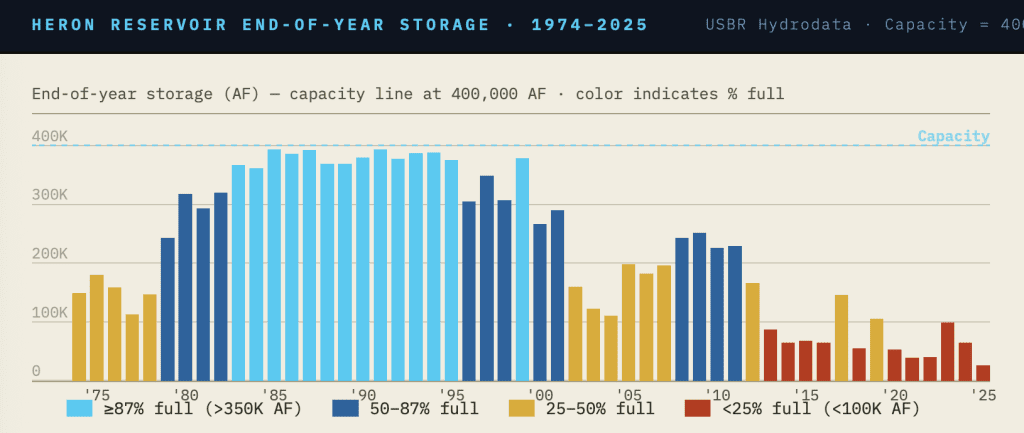
The San Juan-Chama Project is failing, producing only 39% of its “firm yield” in 2025. This year will be worse. The column chart below tracks San Juan-Chama water stored in Heron Reservoir at the end of every year since it began filling in 1978. The direction is unmistakable. Rio Grande headwaters snowpack for the 2025-2026 winter was the lowest since measurements began. It melted out before May. Historically, Rio Chama and Rio Grande peak spring flows were around Memorial Day.
Malign Neglect
The Middle Rio Grande is approaching a compact violation with severe legal and economic consequences. The Lower Rio Grande is in water bankruptcy, as are many regions of the state that depend on groundwater but have already exhausted most of it. That crisis does not appear in the CARP with anything approaching appropriate urgency.
Active Water Resource Management authority has not been applied to the Rio Grande — the river that motivated it — even though the New Mexico Supreme Court upheld the State Engineer’s rules in 2012. The 2019 Water Data Act directing agencies are not getting their data online and available to all as that law requires. The 2023 Water Security Planning Act is in its fourth year of agency preparations to start the regional water planning program, with no funds for the regional councils that are yet to be formed to do the work. Water planning requires compiled data and computer simulation models. The data are not compiled; the models are not updated and ready.
Water agencies have many competent, hard working staff but don’t have the capacity or the modern information tools they need. The failure is not the staff’s. The Governor ignores the gap between supply and demand and touts “new water” as the answer. Legislative appropriators deny funding to implement the very laws they and their colleagues passed unanimously. Is the Climate Adaptation and Resilience Plan allowed to honestly address water scarcity when the Governor and her Economic Development Department are actively recruiting new high water use industries to locate here?
The State Engineer is appointed by the Governor. She is New Mexico’s top water official with broad powers to govern New Mexico’s water. Hers is the authoritative public voice on New Mexico water, but she has not found the courage or demonstrated the leadership and public clarity the moment demands. The Interstate Stream Commission, a policy making body appointed by the Governor, has never once taken up the Middle Rio Grande compact compliance emergency in a public meeting.
This is malign neglect.
The Governor’s False Solutions
When New Mexico Water Advocates raised these failures directly with EMNRD staff, we were told the department relies on the Office of the State Engineer and Interstate Stream Commission for water policy. The staff response was sympathetic but constrained — these problems, they acknowledged, are beyond their control. True, but woefully insufficient.
Governor Michelle Lujan Grisham leaves office in January 2027. The CARP is scheduled to be published the following month. The CARP reflects her administration’s bias against tackling the combination of shrinking water supplies and our ruinous overuse of them. The Governor’s sole priority for water supply has been “new water” — reclaimed brackish groundwater and oilfield wastewater — sources that cannot close the gap we face even if the oil and gas companies’ rhetoric were true.
The Plain Truth
Meanwhile, the truth about unsustainable water use and increasing water scarcity goes unanswered by this administration. An adaptation plan that ignores our water supplies will not make New Mexico resilient.
Without water there is nothing. Adaptation to water scarcity is not optional. It is the precondition for everything else.
New Mexico deserves better — and barely enough time remains to demand it.
Articles authored by the New Mexico Water Advocates Operating Committee state the organization’s position.