

We Must Adapt to Stop Overdrawing New Mexico’s Water Future
Two Forces Behind New Mexico’s Driest Winter on Record
Our past winter had 70 and 80 degree temperatures in February and March. The southern Rocky Mountains had little snow that melted quite early. This has been the warmest winter in the state’s 130-plus years of record. These conditions have diminished and dried New Mexico’s rivers. Two simultaneous conditions have produced this. First, we have learned from scientific monitoring and modeling that the Earth’s atmosphere is warming at an apparently accelerating rate. Second, a La Niña pattern developed in the Pacific Ocean that pushed the prevailing east flow of the jet stream, with its carried storms, northward to the Pacific Northwest and east from there. That produced historically record-dry conditions to persist across New Mexico and the Southwest.
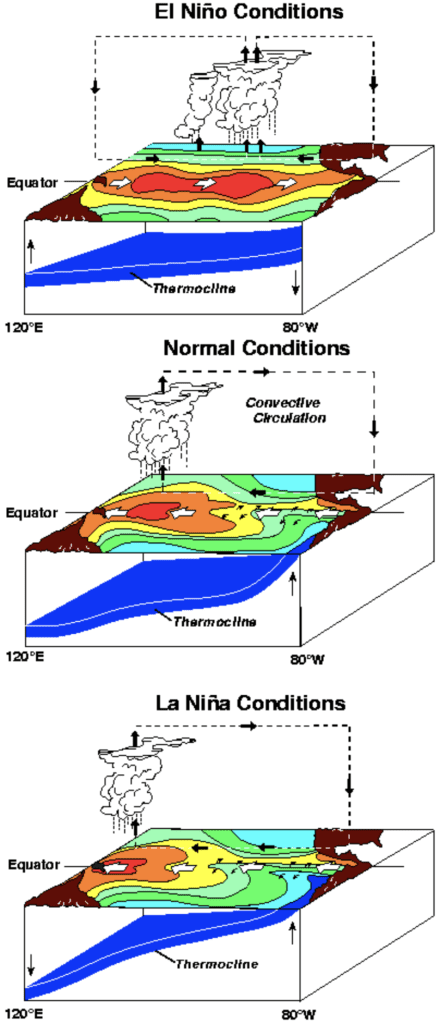 La Niña is the term for that part of a repeating cycle of cooling and warming of ocean waters in the east-central tropical Pacific that repeats every few years. La Niña patterns occur when the water is coolest, alternating with El Niño patterns that develop in the warmest years of this cycle. Historically, the global climate changes caused by La Niña conditions typically include reductions in rainfall across the Southwest during its traditional summer monsoon season. An El Niño can increase later summer and fall monsoons for the Southwest. Of major significance, an El Niño generally leads to significantly greater snow packs in the southern Rockies. Such changes also accompany increasing drought conditions for the northern Rockies and much of the Northwest, Midwest, and East.
Currently, climate monitoring and major climate models both indicate that a rare, record-breaking “super” El Niño is spreading eastward across the tropical Pacific Ocean toward South America. The Increasing ocean temperatures could push ocean temperatures three degrees Celsius (5.4 degrees Fahrenheit) above average. This ocean heating is projected to be larger than the previous record occurring during the super El Niño of 1886-88. That El Niño resulted in global crop failures and deaths of an estimated 50 million people due to drought and starvation. Such massive impacts are not expected to happen with this new super El Niño because our understanding of such effect has expanded, allowing for any such impacts to be better mitigated. That is not to say that regional droughts will not develop and related lesser magnitude human impacts will not result.
El Niño May Bring Temporary Relief, But Not a Solution
Seldom does a single wet season or two fully erase accumulated long-term water supply deficits.
Assuming El Niño persists for the next year or two and is not significantly disrupted by accelerating climate warming, and assuming the historical pattern of increased precipitation in the Southwest and snow packs in the southern Rocky Mountains holds, then the ongoing pattern of increased aridity across New Mexico and the Southwest could get a temporary reprieve. Forecasters warn, however, that seldom does a single wet season or two fully erase accumulated long-term water supply deficits.
Here, it is also important to remember that the Earth’s climate is also projected to continually warm. As such, we must continue to recognize that we in the Southwest are not ending a temporary drought. Nevertheless, we should expect that some folks will falsely claim “our water supply crisis is over.” Rains must not be allowed to dampen the growing political urgency around the fact that water uses across New Mexico substantially exceed the sustainable water supply.
New Mexico and the Southwest, as is also true for the global climate, are projected to be in an ongoing and perhaps never ending period of climate warming, with an increasing long-term, gradual shift of our region to a drier climate (i.e., increased aridification or even desertification, as we have discussed previously). In fact, this 2026 El Nino is projected to bump global temperatures up by three degrees Fahrenheit. Also remember, as this El Niño warming part of the southern Pacific cycle ends the next cooling part of the La Niña cycle will return drying conditions to our region.
We Must Act Before the Window Closes
We must use this time wisely to better focus and activate urgently needed water supply management for New Mexico and the Middle Rio Grande region — before our longer-term water crisis becomes water bankruptcy.
Assuming that the Southwest gets a temporary reprieve from increasing drying, we must use this time wisely to better focus and activate urgently needed water supply management for New Mexico and the Middle Rio Grande region before our longer term water crisis becomes water bankruptcy.
The New Mexico Water Advocates will continue to advocate for a balanced, equitable, and resilient water future for New Mexico through public education and civic engagement. Thank you for engaging with the Water Advocates and joining your voice to urge our state and local governments to act with the urgency the moment calls for.
Everyone must do their part. We must insist the State must do more of its part, better and faster.
Additional Reading
Gaume, N. 2026. The ABQ Water Authority’s 100-Year Plan Leads to Water Bankruptcy. https://nmwateradvocates.org/albuquerque-water-2120-water-bankruptcy-adapt/
Marcus, M. 2025. New Mexico Drought, Aridification & Desertification. https://nmwateradvocates.org/new-mexicos-water-crisis-drought-aridification-desertification/
Marcus, M. 2026. Albuquerque’s Aquifer Must Be Protected from Water Bankruptcy That’s Headed Our Way. https://nmwateradvocates.org/new-mexico-groundwater-data-albuquerque-basin-water-bankruptcy/
National Oceanic and Atmospheric Administration. 2026, What are El Niño and La Niña? https://oceanservice.noaa.gov/facts/ninonina.html
National Weather Service. 2026. El Niño and New Mexico Precipitation. https://www.weather.gov/abq/clifeature_elninoprecip
Noll, Ben. 2026. A super El Niño wiped out millions of people in 1877. Are we better prepared now? https://www.washingtonpost.com/weather/2026/05/12/super-el-nino-1877-population-impacts/
UNM Department of Earth and Planetary Sciences. 2026. University of New Mexico professor explains unusually warm, dry Southwest winter. https://news.unm.edu/news/university-of-new-mexico-professor-explains-unusually-warm-dry-southwest-winter
August 19, 2026 @ 9:25 pm
What can individuals do or even state politicians do to help ?
What are the solutions to help alleviate the terrible drought conditions here in my home state of New Mexico ?I am already pretty conservative considering water usage.