

Middle Rio Grande Depletions Are Pushing New Mexico Toward a Compact Violation
May 15, 2026
Written Public Comments to the ISC for its May 21 meeting.
Dear Chairman Sanchez, Vice-Chair Timmons, Secretary Anderson, Commission Members, and Director Riseley-White,
New Mexico’s Top Priority Water Resources Management Problem
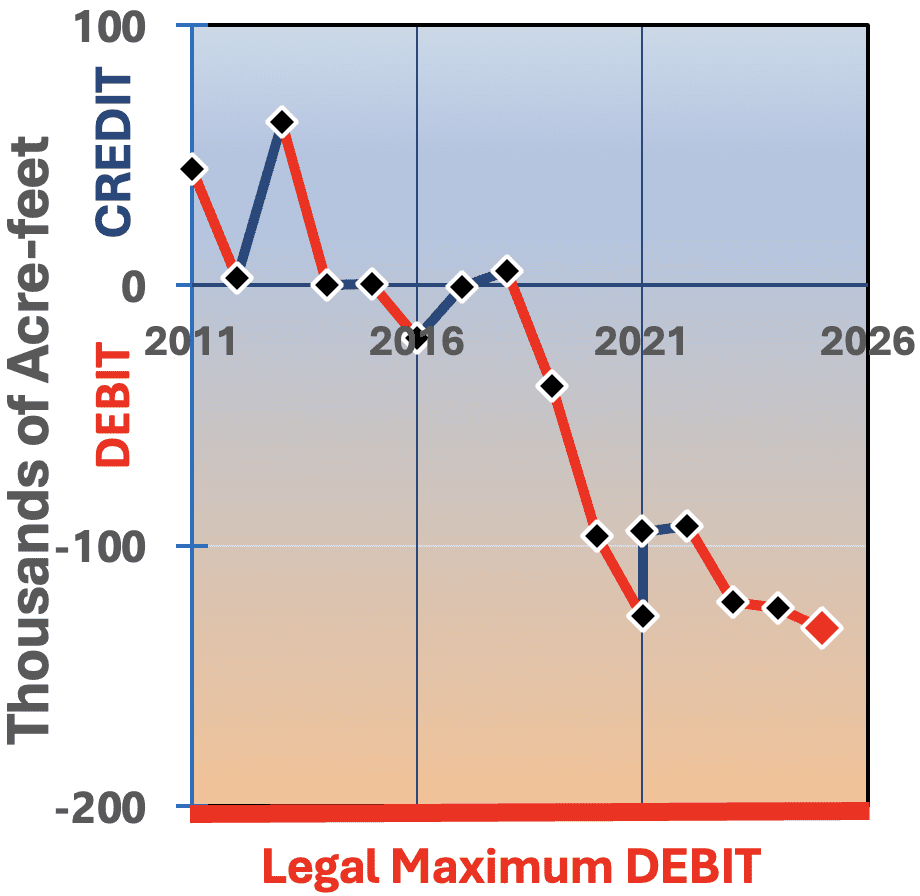
The facts are not in dispute. ISC Director Hannah Riseley-White and State Engineer General Counsel Nat Chakeres presented them plainly as invited speakers at the Water Advocates’ March 19, 2026, workshop. New Mexico carries an accrued compact debit of -132,000 acre-feet. The average annual debit is -19,800 acre-feet per year. The accrued debit limit is -200,000 acre-feet. New Mexico will violate that limit in three years if the trend continues or after one bad year.
New Mexico still has the ability to prevent a compact violation — but only through strong, proactive water resources management, and only if that management begins now. New Mexicans are far better off reordering their own affairs than drifting into a compact violation with the certainty that Texas will have its say at U.S. Supreme Court water bankruptcy proceedings.
The Middle Rio Grande is home to about half of the State’s economy and population and has the highest regional diversity. The State’s two water resources management agencies must protect the water supply that the compact provides for the economy and residents while also protecting the Middle Rio Grande and the State from the risks of Supreme Court litigation for using too much of the Lower Rio Grande’s water for too long.
The Rio Grande Compact is a perfect barrier protecting the Middle Rio Grande from the water demands of the Lower Rio Grande. A New Mexico compact violation opens the door.
The Interstate Stream Commission, A State Water-Policy-Making Body, Should Publicly Consider New Mexico’s Top Water Resources Management Problem
We are grateful that Director Riseley-White and OSE General Counsel Nat Chakeres spoke frankly about this problem at our March 19 workshop. We now urge you as a State Commission with purview over this emergency to take up the problem formally.
The Interstate Stream Commission is a State water resources planning and management policy-making body. It holds statutory authority and responsibility for compact compliance performance monitoring and is graded on Rio Grande Compact Compliance accrued debit status by a Legislative Finance Committee performance measure. That performance measure scale should now be deep in the red. The ISC also has a physical role and substantial funding to reduce Middle Rio Grande conveyance losses that annually worsen New Mexico’s compact deliveries.
This Commission Should Be Briefed, Deliberate, and Take Action.
We request that deliberations consider public comment before choosing or endorsing the State’s approach to prevent the dangerously close compact violation.
The State is quite late in addressing this problem. Because OSE and ISC are late, ISC Commissioners should consider whether resources should be marshalled for a more active compliance program — especially given that Director Riseley-White and State Engineer General Counsel Chakeres announced in March that staff would proceed slowly, through voluntary negotiations, with no metering order forthcoming until late in the year.
Several ISC Commissioners have openly expressed a preference for priority administration, yet the Commission has never been briefed on whether or how it could apply here, what the alternatives are, or what the consequences of each path might be.
We are convinced that water users will not consider the necessary sacrifices they must make Rto prevent a compact violation unless they are motivated by a potentially worse outcome in the absence of their participation, such as cutting off all non-essential uses for a period of time to make compact deliveries.
The Active Water Resources Management program provides a NM Supreme Court-approved legal framework. The Commission must take actions now to protect the Middle Rio Grande water supply in accordance with its statutory mission and broad powers “to protect and to do any and all other things necessary to protect, conserve and develop the waters and stream systems of this state.” Section 72-14-3 NMSA 1978.
Requested ISC Actions
New Mexico Water Advocates calls on the Interstate Stream Commission to take the following steps without further delay:
First, schedule a formal public briefing at the next Commission meeting on the state of compact compliance — the debt, the trend, the trajectory to violation, and the consequences of failure.
Second, deliberate and take a position on the management alternatives available to prevent a violation, including the regulatory authorities the State Engineer holds and has not yet exercised.
Third, direct staff to report publicly and on a regular schedule on progress — or the lack of it.
Fourth, become transparent about this problem in the name of advancing public education and public understanding of the issues, choices, and consequences and the quantity of depletions that must be stopped or prevented to maintain compliance.
The compact violation now in view would bring severe legal and economic consequences to New Mexico — consequences New Mexicans would live with for decades, administered by a federal court that does not forgive debt. This Commission has the authority, the responsibility, and the obligation to the public to address that threat openly. This problem must have a solution framework. ISC must lead its development.
The moment demands it.
Sincerely,
/s/
New Mexico Water Advocates
May 19, 2026 @ 6:21 pm
As a relatively ignorant citizen, I find a great deal of useful information and excellent research at this site. IMO, however, I would appreciate more specifics concerning the consequences of violating the compact debit limit of 200 K acre-feet and subsequent Supreme Court litigation.
I have found one example: “cutting off all non-essential uses for a period of time to make compact deliveries.” But even with this example, I do not understand what that would entail. For instance, for citizens of Santa Fe or Albuquerque what are the non-essential uses that would be forbidden? All watering of outside plants? Car washing? For farmers, what would be non-essential uses? For businesses? For well owners?
I would appreciate any assistance in understanding the consequences of inaction. Perhaps someone can suggest relevant studies or other sources.
Thank you all for the excellent work you do.
May 19, 2026 @ 5:11 pm
The shortage of water in this region is historical, predictable and dire! The lack of news coverage of this prominent crisis is serious, as the public’s awareness of this ecological danger could produce beneficial collaboration between citizen involvement and state agencies ready to ameliorate this old issue!
May 18, 2026 @ 12:55 pm
With direction by the ISC, New Mexicans can protect our livelihood and our communities. We all need to work together and give a little!
May 18, 2026 @ 12:51 pm
For the sake of the families and those that cannot move away, keep our communities intact by bringing a thoughtful plan to save water and prevent disaster to New Mexico. Help New Mexico to help itself now!
May 18, 2026 @ 11:09 am
New Mexico is unique in so many ways but our overuse and abuse of water in a very dry area can and will create a shortage that would be untenable in the near future. We must take the appropriate action to protect our water supply and do it within the purview of the state so that we can keep decisions and control in the state of New Mexico, where such decisions belong.