

As the new year begins, New Mexico’s water challenges are clear, but the State’s responses remain unsettled. The questions now confronting New Mexico are not about whether scarcity exists or whether legal authority is lacking, but about how effectively decisions are being made and why all meaningful discussions to tackle the problems are occurring behind closed doors. Year-end Rio Grande Compact compliance, the implementation of recent state water laws, agency priorities and capacity, and the Governor’s and Legislative Finance Committee’s budget choices together frame the current state of the State’s water—and the water governance choices now facing New Mexico.
New Mexico has the legal tools, but has not mustered the political will or built the management systems to stop excessive and illegal water uses. That will change. The consequences of continued neglect are unbearable.
I. Rio Grande Compact Compliance Emergencies as Indicators
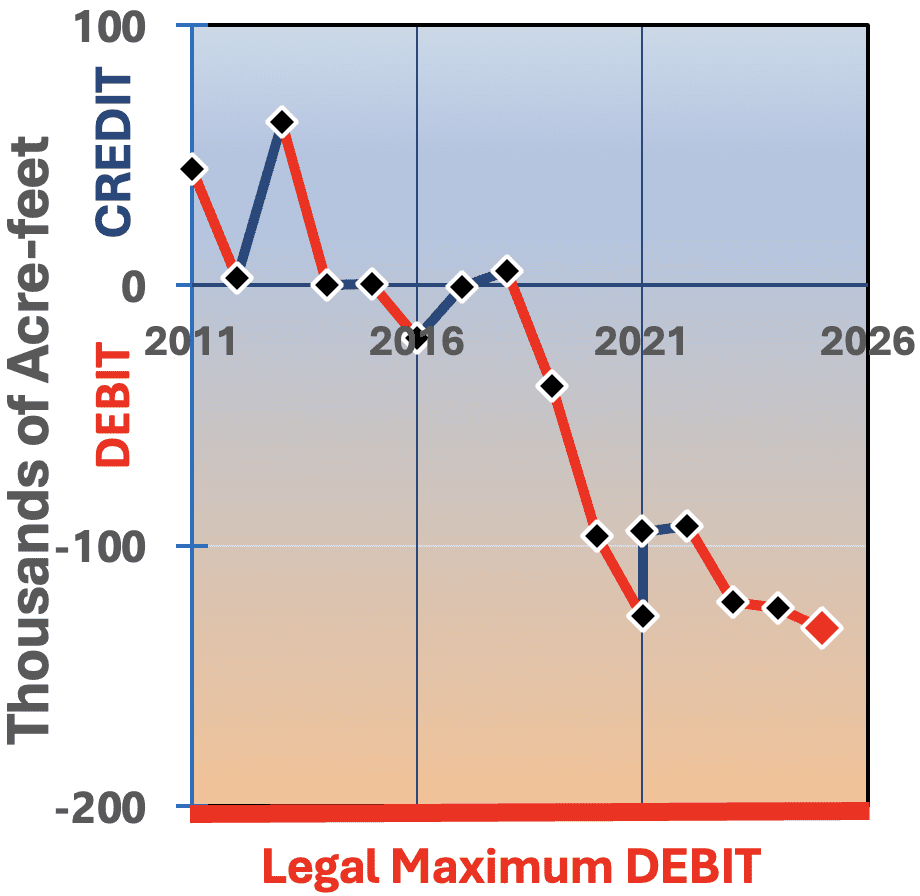 Water uses in the Middle Rio Grande have consistently over-depleted the Middle Rio Grande’s share, shorting the Lower Rio Grande. Similarly, excessive water uses in New Mexico downstream of Elephant Butte Dam are shorting Texas. Both situations have persisted for many years and are now entangled but distinct emergencies.
Our State is required by the Lower Rio Grande settlement and consent decree now pending U.S. Supreme Court approval to,
- substantially reduce New Mexico groundwater pumping,
- maintain a sufficiently high groundwater table that the river can function, and
- comply with a new annual water delivery requirement to El Paso.
Meeting the new mandatory compliance requirements will be very expensive and demanding. Penalties built into the pending settlement remove noncompliance as an option.

Separately, chronic overuse of water in the Middle Rio Grande has caused New Mexico’s water delivery debt to Elephant Butte Reservoir to increase from a net credit in 2018 to -131,900 acre-feet at the end of 2025. [This preliminary result is from the Bureau of Reclamation. The official result will be determined by the Rio Grande Compact Commission this spring.] New Mexico will violate the Rio Grande Compact if New Mexico allows the cumulative water delivery debt to reach 200,000 acre-feet. Texas, being Texas, will sue, as is their custom, culture, and tradition.
The author’s recent public records requests reveal recent private meetings between the agencies and the two major state-created water purveyors in the Middle Rio Grande. The progress at this time is apparently limited to initial discussions of the participants positions.
Both compact problems reflect that New Mexico’s water management institutions are not doing their jobs to regulate illegal water overuse. The results of this neglect are:
- huge taxpayer burdens,
- legal jeopardy for the State,
- danger for water users, and
- disregard for the river and species who depend on it.
The State Engineer and the Interstate Stream Commission are not prepared and don’t have the capacity or budget to deal with either Compact compliance emergency.
II. Legal Authority Is Not the Limiting Factor
The Legislature passed a new water law in 2003 that had been drafted and proposed by the NM Attorney General. The Governor signed it. It declares,
[T]he adjudication process is slow, the need for water administration is urgent, compliance with interstate compacts is imperative and the state engineer has authority to administer water allocations in accordance with the water right priorities recorded with or declared or otherwise available to the state engineer. Section 72-2-9.1 NMSA 1978.
In 2004, State Engineer John D’Antonio put rules in place to implement this new law. Following eight years of litigation, the New Mexico Supreme Court in 2012 unanimously upheld these rules. None of the five State Engineers that have held that office since 2012 has implemented the Active Water Resources Management program created by these rules. The fact of having five State Engineers in office since 2012 is part of the problem.

Similarly, the 2019 Water Data Act, the 2023 Water Security Planning Act, and the 2006 Aquifer Mapping Program have languished. The Office of the State Engineer over decades has allowed virtually complete depletion of the Ogallala Aquifer in New Mexico for irrigation, leaving New Mexico communities that depend solely on that aquifer in jeopardy. Similar outcomes are in progress elsewhere across New Mexico.
Although inadequate funding and capacity are a big part of the problem, other overarching reasons include the Governor’s and Legislature’s lack of political will to see the State’s water is effectively managed as an essential scarce resource. We don’t even measure water uses, much less manage them. The management and culture of the agencies is a problem also. Their actions are tentative and cautious. They are slow to make decisions, take initiative, and effectively manage projects to timely completion.
III. Agency Capacity: Signs of Progress and Persistent Gaps
The New Mexico Bureau of Geology is our water science agency. Its scientists do first class work. They hit the ground running this fiscal year, utilizing a $7.5 million appropriation this year (the Governor recommended $29 million) to accelerate the Aquifer Mapping Program. Their progress report and budget needs presentation to the Legislature in November included a detailed briefing on the high-tech groundwater assessment technology and work already completed.
In contrast, the Interstate Stream Commission has not yet put required rules in place to implement the 2023 Water Security Planning Act. Those rules will become effective more than three years after this landmark law passed unanimously. The Office of the State Engineer desperately needs to begin enforcing against illegal water use, and modernizing its business processes and its obsolete information technology.
The OSE didn’t even request funding from the 2026 Legislature to continue building a new real-time water use data and reporting system that the 2025 Legislature funded at one-sixth of the OSE’s requested amount. Control of ruinous groundwater depletion like the Ogallala in other locations that depend on fossil groundwater doesn’t appear to be a priority. A Clovis area legislator and irrigator said technology now allows essentially all the water to be extracted. He said he is doing exactly that.
IV. Budgets as the State’s Policy Signal
State budgets are choices, not merely accounting. The OSE/ISC requested $130 million in extraordinary appropriations and six new positions for FY27. The Governor’s budget recommendation included most of the $130 million but not the new positions. The Legislative Finance Committee’s water resources management budget recommendation is unresponsive to the crises. Why do the State’s top elected leaders pass good laws unanimously but choose not to see them implemented?
V. 2026 Is a Test
The year ahead will determine:
- Whether authority is exercised,
- Whether transparency improves,
- Whether elected state leaders equip the water agencies to manage scarcity, and
- How well and responsively the agencies’ appointed leaders will manage their agencies’ work.
New Mexico’s water crises are certain. Whether the State responds effectively remains the open question.
January 14, 2026 @ 11:52 am
INQUIRING MINDS….
Is there, in your view, any means to engage key parties in early conversations NOT TO RESOLVE THE PROBLEMS, but to EXPLORE fair and effective means* to do so? Focus on the process, not the problem?
Even just to ask the State Engineer’s Office if they would receive a proposal to consider the possibility?
I know that you know that unskillful process – traditional, positional, win/lose strategies – is wholly inadequate to address and resolve the complex water problems we are facing.
“Always be fully trust worthy, but not fully trusting.”
* e.g., Interest -based negotiation / mutual gains bargaining