The 2024 New Mexico Climate Adaptation and Resilience Plan (CARP) is under revision for publication in February 2027. The 2024 version and an early draft of the revised version treat New Mexico’s permanent drying out as a footnote. A state climate adaptation plan in the desert southwest that does not address water supply has a fundamental failure to live up to its name. The CARP’s “Water Systems” theme addresses only built infrastructure — pipes, treatment facilities, delivery systems. It does not address the present and future condition of the water supplies those systems depend on.
New Mexico Water Advocates was invited in 2025 to join the New Mexico Community Resilience Group (CRG), an advisory forum convened by the state Energy, Minerals and Natural Resources Department (EMNRD) to strengthen coordination between state and local climate resilience efforts and to help ensure that community priorities are reflected in the revised CARP. New Mexico Water Advocates participates in that group. From that vantage the plan’s treatment of water supply is woefully inadequate.
Many New Mexico communities are in or approaching water bankruptcy — a condition in which their water demands structurally and chronically exceed available renewable or long-term supply and a return to the previously normal water supply is impossible. Water bankruptcy in New Mexico is driven by decades of groundwater mining. It is created by routine upstream depletion of river water owned by downstream users. Water bankruptcy is not a future risk to be managed; for many regions and communities it is the present reality requiring adaptation now to prevent very bad outcomes including collapse. A New Mexico climate adaptation plan that does not name increasing water scarcity or prescribe a response to it is fundamentally incomplete.
The Lower Rio Grande is in water bankruptcy, and is now subject to the “Settlement,” which is really a negotiated bankruptcy recovery plan that the U.S. Supreme Court accepted, issued as a decree, and will enforce. The Governor has lauded the end of litigation, saying that it brings certainty to Lower Rio Grande communities and farmers. In reality, the water supply future for Las Cruces, NMSU, and all other municipal and self-supplied industrial and commercial water users is now extremely uncertain. Certainties include great constraints on total water use and substantial cutbacks in groundwater pumping. Compliance will cause major disruptions.
Communities across New Mexico who rely on mined groundwater as their sole source of water supply also are in water bankruptcy, including Clovis, Portales, and Cannon Air Force Base. Other communities are not yet at the end of their water supplies but are well on the way, and the community and economic consequences are being disregarded.
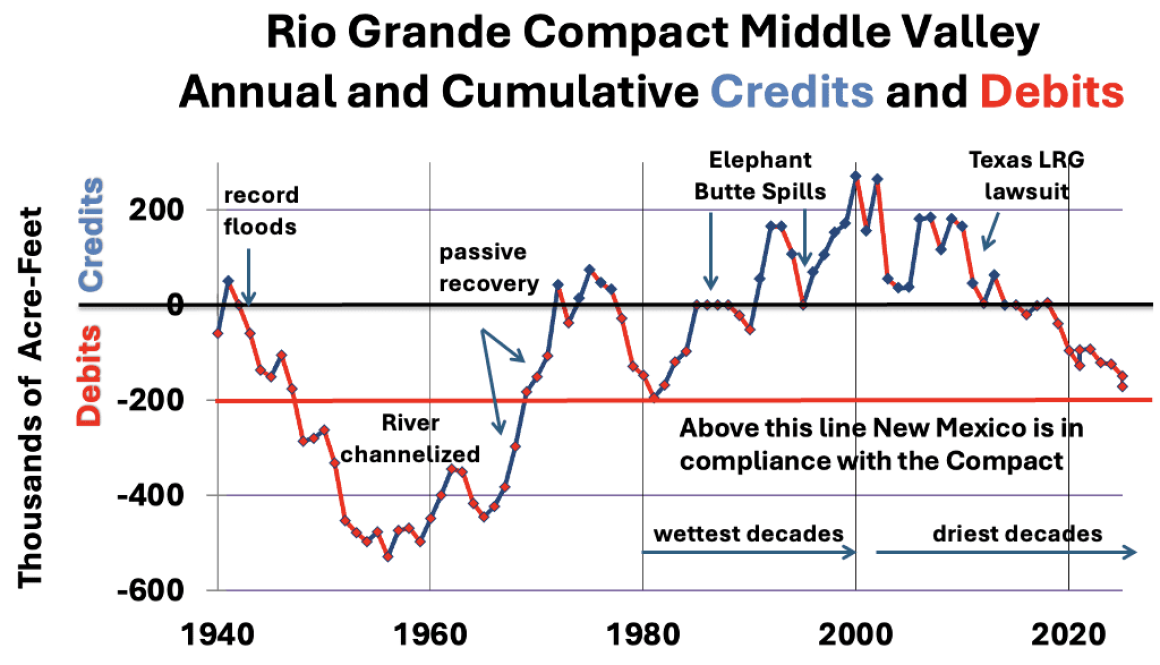
The Albuquerque Metro area and entire Middle Rio Grande are approaching water bankruptcy in the form of an explicit violation of the Rio Grande Compact due to unsustainable uses of the river and the aquifers beneath and beside it. If the State doesn’t act quickly and decisively to prevent that violation, the U.S. Supreme Court will eventually issue the Middle Rio Grande’s tough water bankruptcy recovery plan and enforce it.
The 2024 CARP’s failure to address water supply originates from Governor Lujan Grisham’s focus on developing “new” water and not working toward solutions to living within our means. The CARP is silent on the 2022 State Engineer’s Water Policy and Infrastructure Task Force’s unanimous water management and planning recommendations — while quoting Task Force water infrastructure recommendations.
New Mexico Water Advocates asks the EMNRD staff responsible for the CARP revision to address the following, working closely with the Office of the State Engineer and the Interstate Stream Commission:
Recognition that present and projected water supply deficits in the Middle and Lower Rio Grande basins and in regions depending exclusively on mined groundwater require adaptation now.
Integration of the Water Task Force’s eight water management and planning recommendations, unanimously adopted by the 2022 Task Force and subsequently neglected by the State, as the CARP’s omissions demonstrate.
Without changes to recognize the realities of New Mexico’s historical unsustainable water withdrawals, increasing aridification, and our existential requirement to adapt to water supply scarcity, New Mexico’s economy and quality of life will not survive.
Thank you to all who attended the workshop on June 16, 2026, “Middle Rio Grande Emergency: Confronting the Crisis Together”. We had so many wonderful questions during the presentation but unfortunately we did not have time during the workshop to get them all answered. Below you find written answers to the questions that we did not get to ask during the presentation.
Question: Will you or are you working with the county assessor for those who participated in the fallowing program, as good water stewards, and now have lost their agricultural exemption. As an example, this means the property owner property taxes go from ~$2k per year to ~$18k per year. In addition, let’s say the individual is ~70 years old with a limited income and must now sell their family property. There is no way the individual can make the property tax payments. Because of the loss of the agricultural status, individuals must sell their property and those close to the property being sold may have their property taxes increase because of comparable property taxes. Veronica Lopez –
MRGCD Response: The MRGCD has taken steps to engage with the county assessor for each of the four counties that we operate in (Sandoval / Bernalillo / Valencia / Socorro) to express our concern over changes in ag status for tracks of land that are fallow due to drought. The results have been mixed. We have had strong support for our fallowing program and the protection of those lands enrolled in Socorro, Valencia, and Bernalillo County. However, we have not found the same support in Sandoval County. MRGCD is continuing to look for ways to support our irrigators and farmers when they decide to conserve water during drought by fallowing at both the local and state level.
Question: Regarding replanting trees after fires in the Bosque, are cottonwoods considered native? Are there better deciduous trees we might plant instead? Christine Smith
MRGCD Response: Yes, cottonwoods are considered a native species to the Middle Rio Grande and are part of the restoration portfolio. That being said, the District is also looking at other trees to help provide habitat and benefit such a black willow, new Mexico olive, narrow leaf cottonwood and others. We are estimating some native recruitment of trees in our restoration plans and thus we don’t replant on a 1-1 of what was lost or even desired for each acre of a fire. The more important site element for us to consider is depth to groundwater.
Question: Who is tracking the success or failures of wildlife diversity after the MRGCD treatments? Is there data available to the public that will back up your comments?
MRGCD Response: MRGCD performs site monitoring of our projects to understand the response and success of our efforts. Additional surveys take place annually by federal agencies such as Reclamation / Army Corp / and US Fish and Wildlife who largely focus on endangered species. The collective survey efforts provide a strong data set . MRGCD is working on a bosque stewardship dashboard which will show all of the treatments that have occurred.
Question: So, will lining ABQ Main Canal with cement help conserve water?
MRGCD Response: Lining a main canal such as the ABQ Main will allow MRGCD to “charge” the system faster. Seepage that would otherwise have occurred is eliminated and you are only losing water to evaporation.
Question: Is Bosque Del Apache and other wet land areas restricted or expected to use less water so farmers and ranchers can survive? Jo Quintero
MRGCD Response: Bosque del Apache is a federal wildlife refuge with legitimate water rights. The same goes for state run wildlife management areas like Bernardo and La Joya. MRGCD works closely with these entities to try and accommodate their water needs while matching their supply and “sharing the shortage” with the rest of the valley. During drought, it is expected that these properties will reduce their water use just as farmers and ranchers are forced to do the same.
Question: How will MRGCD and ABCWUA lead the needed regional effort to reduce depletions? Elaine Hebard
MRGCD Response: I believe the joint presentation we provided during this event lays out the strategy pretty well for both entities. We are continuing to look for savings where possible at the individual user level while planning and design of macro water efficiency and conservation projects continue to move forward. It will have to be a balanced approach that calls on all water uses to be reduced. That includes what people use and what we allow the bosque to use. If we simply conserve in Ag, Municipal and Industrial but fail to shepherd that water south through an overgrown and thirty bosque then we will find ourselves in largely the same place that we are now, in debt to Texas with no ability to supplement supply through storage.
Question: How can the State allow municipalities like Los Lunas and Las Cruces to enter into agreements with corporations to take huge amounts of water from the aquifer?
MRGCD Response: This question is best answered by the State (OSE/ISC).
Question: As we look at voluntary compliance to meet CURRENT needs, how do we identify and evaluate NEW industries like DATA Centers that want to come that will be putting additional pressure on water demands?
MRGCD Response: Ensuring that new industry is not just offering one-time projects but actually investing in long-term stewardship of our natural resources and in particular our fresh water is a priority for MRGCD and we encourage industry to consider how they can play a role in supporting water conservation, habitat development, agricultural efficiency, or some combination if they decide to invest in the Middle Rio Grande Valley.
Question: How do water transfers from surface to groundwater impact consumption and alter ecology in the green belt?
MRGCD Response: When you transfer surface rights to groundwater several things happen. The consumptive use portion of that water right can now be fully developed and used in a year where natural conditions and water supply might have naturally shorted that same right in a surface diversion. If enough surface rights go to ground water and get fully utilized without proper management of those resources, the pumping will start to impact surface flows and further impact surface supplies. If a cone of depression develops or extensive drying occurs, the riparian vegetation that has evolved to tap into relatively shallow groundwater will be impacted.
Other New Mexico Aquifers Are in Post-Crisis Failure
We keep reading and hearing that the Rio Grande is facing a water crisis. So are other rivers in New Mexico, across the southwest, and around the globe. But, as pointed out in a 2026 article from a United Nations water institute,[1] “Water crisis has become the default label for almost any episode of water stress, from short-lived droughts to decades-long overuse of rivers and aquifers.” The UN author contends that many times the conditions frequently described are not a “crisis” but actually represent a “post-crisis failure state”: their critical water supplies have been depleted beyond their sustainable hydrological budgets.
For such conditions, the UN author proposes that instead of saying “water crisis” a more appropriate term for such declines in an aquifer is Water Bankruptcy. He equates consuming surface water supplies with making withdrawals from checking accounts, whereas using water supplied from aquifers as making withdrawals from savings accounts. Thus, when continued groundwater pumping trends toward depleting the available aquifer supplies, that condition is equivalent to approaching bankruptcy, a post-crisis failure state.
Climate Warming and the NM Water Supply
First, why should we be concerned about the future of the water supplies along the Rio Grande and elsewhere across NM and the SW? Clearly, as we read, the climate around the globe is warming at an increasing rate. As described elsewhere,[2] this is producing changes in our atmosphere’s global circulation patterns that are projected to make NM air temperatures much warmer, as we are now experiencing in 2026, with later winter and early spring feeling much like summer.
In 2022, a New Mexico Bureau of Geology and Mineral Resources (NMBGMR) report projected that[3], “Over the next half century, profound changes in New Mexico’s climate will affect water resources all across the state. All evidence suggests that surface temperature will continue to rise throughout New Mexico over the next 50 years. Most projections of statewide annual mean temperature are from 3°F to 7°F warmer than the late 20th century, and some high-end models predict even more warming.” That is bad news.
But even worse, a recent analysis[4] of “really good” weather data for seven-day periods in Albuquerque going back to the 1930s, found that “no seven-day period” in any year has come anywhere close to the National Weather Service’s determination that March 19 to 25, 2026 is about 28oF above any seven-day average. That is more than four times outside the normal range of variation in Albuquerque’s air temperature for any seven-day period. This points to the likelihood of even greater and earlier effects to NM water resources due to climate warming than anticipated in the NMBGMR assessment. Thus, we should be very, very concerned about the future water supplies along the Rio Grande, as well as across NM and the SW!
Groundwater Mapping and Monitoring in NM
Applying the concept introduced by that UN proposed terminology to NM we might ask, is the Rio Grande or other groundwater basins in New Mexico heading toward bankruptcy? To approach this question, information available online from the New Mexico Groundwater Dashboard (NMGD) can be helpful.
NMBGMR is New Mexico’s non-regulatory water science agency. It produced the NMGD to provide public access to a relatively comprehensive long-term set of groundwater mapping and monitoring data. As the site’s welcome message emphasizes, “Wells are our window into the otherwise unseen realm of groundwater. In addition to producing water, groundwater-level data can also be obtained from water wells that can help us manage New Mexico’s groundwater resources.”
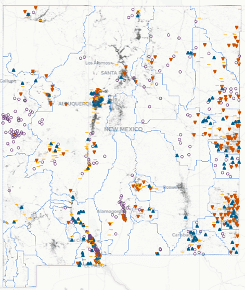
Figure 1: Groundwater Monitoring and Mapping in New Mexico, image of the NM Groundwater Dashboard
That site’s interactive map shows the locations of all of NM’s known groundwater wells and indicates for the wells that are monitored, which wells have trends of water level increases (green), decreases (red), or unchanged (yellow, Figure 1). Of the 268,405 wells located on that map, 2,323 have monitoring data. The site also reports that many of these wells are not specifically designed for monitoring; instead they are active production wells that also provide less accurate information on water level trends. The information on this site’s map comes from multiple sources, including monitoring data from the NM Bureau of Geology and Mineral Resources and the United States Geological Survey as well as the well locations from the NM State Engineer permit files.
Figure 1 shows that the greatest density of monitored wells along the Rio Grande is around the Albuquerque-Santa Fe reach and along the southern Rio Grande. Also, a considerable density of monitored wells (and particularly red icon wells representing declining water levels) occur in the eastern part of the state. Proportionally fewer wells and monitoring information comes from the area west of the Rio Grande drainage, with relatively fewer monitoring wells with red icons.
Clicking a colored icon on the dashboard brings up specific information for that well with additional options to display a graphic for the well’s aquifer water level over time and another graphic displaying the deviation (gain or loss) of these levels from the average for the well’s available data. An additional option is available to display the water level data measured for the well that were used to make the two graphics. Of note, groundwater depth information is not necessarily collected every year and some years have more than one measurement recorded. A few wells have continuous monitoring, including the intentionally installed three-dimensional network in metropolitan Albuquerque.
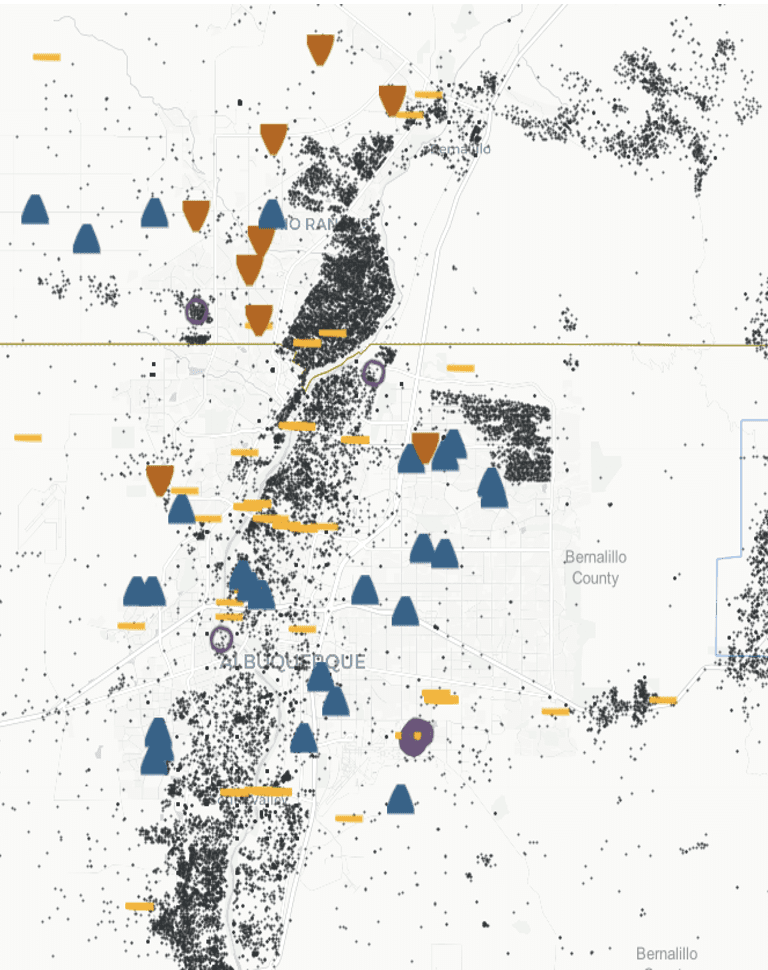
Figure 2: The Main Dashboard Map Zoomed into the Albuquerque metropolitan area.
Zooming in on the NMGD map (Figure 2) shows the actual density and locations of both monitored wells with colored icons and the density of black permitted well surrounding the Rio Grande and Albuquerque areas. Most of the icons in this area are blue or yellow indicating that the aquifer accessed by these wells is gaining or remaining largely unchanged based on the well’s monitoring data. There are relatively fewer monitoring wells with red icons.
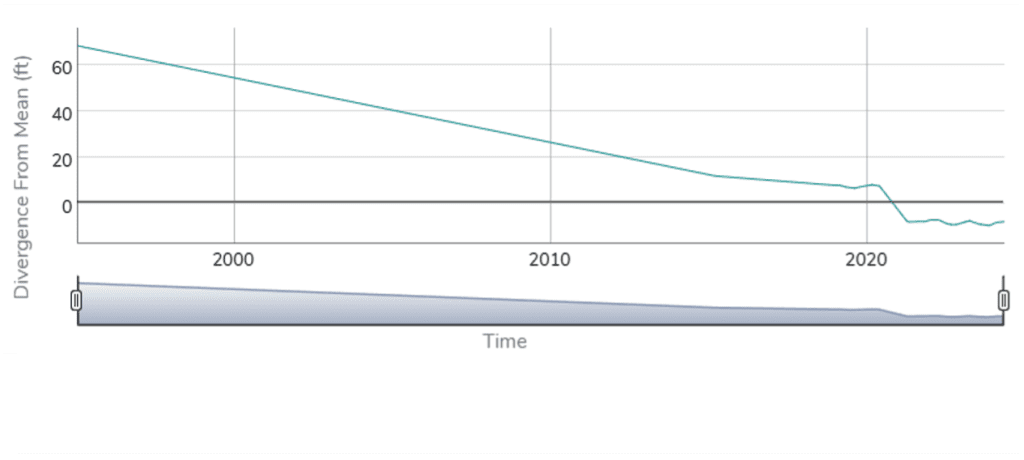
Figure 3. Water divergence from mean for the aquifer at a site north of Albuquerque.
Clicking on the red icon on the NMGD site for the well at the top of Figure 2, we learn it is a USGS monitoring well located in a remote area (GPS: 13N03E.21.3124). From 1978 to 2025, its aquifer has decreased to a current depth to water of 446.8 feet. That water level is 7.8 feet below the average water depth for the site (Figure 3). That suggests that the aquifer in this area is perhaps heading toward or is in bankruptcy under the UN defined term.
The Albuquerque Area Aquifer
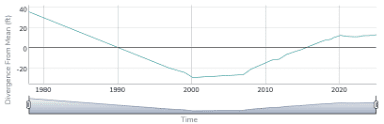
Figure 4. Water divergence from mean for the aquifer at a site in east Albuquerque.
Clicking on the blue icon on the NMGD site for the eastmost well in Figure 2 we learn that it is located 11N.04E.28.131 WKR 4, which is near the intersection of Academy and Eubank. This USGS monitoring well currently has a groundwater increasing trend, with a current depth to water of 714.83 feet that is 13.17 feet above average (Figure 4). Of note, however, the data for this well shows that from the 1970s to 2000 this aquifer had a continual trend of declining aquifer depth. In 2000 it started having a slow increase in water depth that started a more rapid rise in aquifer depth starting about 2017-2018 then leveled in 2020 through the following monitoring years in this data set.
From this brief review of the NMGD site data for these two sites and information from other monitoring well sites included in Figure 2 reviewed but not characterized here, it is reasonable to conclude that, at the present time, the Middle Rio Grande aquifer overall would not be appropriately characterized as in bankruptcy.
For some areas in the north and to the west (along the edges of the Middle Rio Grande aquifer), however, such a characterization would appear to be at or approaching appropriate. Plus, the fact that other parts of this aquifer displayed earlier periods of decline followed by periods of increase. That indicates the overall middle Rio Grande aquifer is of considerable risk of moving to bankruptcy should the current trends for climate warming and winter snowpack reductions, with early runoff, continue to decrease surface water supplies to the Rio Grande.
In fact, with the ongoing federal approach of viewing climate warming to be a hoax, not worth addressing, even greater threats of declining water supplies across the Southwest are increasingly likely. This argues that the regions along the Rio Grande require State water resource agencies to actively manage uses. Local governments must cooperate and take ownership of leading their constituents as soon as possible to conserve necessary long-term water availability for existing uses, including low water use economic development.
The High Plains Aquifer
In contrast, the preponderance of monitoring wells in eastern NM with red icons, indicating this region’s declining aquifer water levels, strongly suggests that these are aquifers in bankruptcy. The New Mexico State Engineer decided about a century ago that the State would allocate the water to use it for a reasonable time, which is essentially over. Groundwater expert Maurice Hall argues that the least we should do is plan for “graceful failure.” More than that is needed.
Without implementing active water management for regional water supplies, NM is likely to become characterized as having declining economic promise, perhaps with consequential depopulation trends. Alternatively, The State could wait for NM to somehow deliver one of its enchanted solutions for climate warming and our declining aquifers.
Needing more information?
Additional information on NM’s ground water resources is available from the NM Aquifer Mapping and Monitoring Program (AMMP) of the NMBGMR.[5] The information provided through this site establishes that, “By mapping aquifers and establishing a long-term monitoring network, the program generates essential insights into how groundwater moves, where it’s stored, and how it changes over time. Through the ongoing philanthropic support of the Healy Foundation, AMMP created the Collaborative Groundwater Monitoring Network. This network provides critical, baseline information on groundwater trends through collaborative data collection and regular measurements of depth to water across the state. State funding will enable this program to drill new monitoring wells in strategic locations, addressing questions about water quality, water depth, and filling critical gaps in subsurface knowledge.” The dashboard also presents additional information about this network including showing location of its sites across NM.
Unfortunately, software and security problems have caused the NMBGMR to post that its network of monitoring data for specific well locations currently are not generally available. That signals more need for state investments to improve, modernize, and secure water agencies’ data systems.
This is shaping up to be one of the driest years on record. Snowpack across the Rio Grande basin is near record lows. Elephant Butte Reservoir is very low; Elephant Butte Irrigation District farmers are expecting a four-inch 2026 irrigation allotment. Increased river flows from a big October headwaters storm, combined with the end of the Middle Rio Grande irrigation season and a large December block release from Rio Chama Reservoirs, significantly improved the Middle Rio Grande’s end-of-year compact deliveries — yet more than a fourth of that water was lost in conveyance before reaching the reservoir pool. Middle Rio Grande cumulative water delivery debt is now approaching the Rio Grande Compact’s legal cap. Texas will certainly sue when that debt limit is exceeded, if not before, bringing new U.S. Supreme Court litigation to the Middle Rio Grande.
The Middle Rio Grande Compact Crisis
The State Engineer and Interstate Stream Commission Director have named the Middle Rio Grande compact compliance situation as a crisis. The Middle Rio Grande is on a trajectory to violate the Compact within two or three years. State Engineer Elizabeth Anderson will violate state water law at Section 72-2-9.1 NMSA 1978 if her continued inaction allows that to occur. The ISC will fail to meet its mission to do everything within its broad powers to conserve and protect New Mexico water.
Join Us March 19 — Hear the State’s Plan
That is why our March 19 workshop Middle Rio Grande Compact Crisis is a must-attend event for every Middle Rio Grande resident. State Engineer General Counsel Nat Chakeres and ISC Director Hannah Riseley-White will present the State’s current hydrologic picture, including New Mexico’s Rio Grande Compact status and what it means for Tribal, agricultural, and municipal water users. The State is pursuing conservation, conveyance improvements, and expanded administration — and as Hannah writes, “working closely with major water users to develop creative solutions to meet needs while maintaining compliance with our legal obligations.” Join us. Register here.
What the Lower Rio Grande Tells Us
The featured article from our March 2026 News was written by Beth Bardwell from Las Cruces and this author to examine the Lower Rio Grande situation at the beginning of its post-litigation water management stage. Water use in the LRG has barely been affected to date by the litigation but water users there will soon dramatically feel the depth of the litigation consequences if the dry climate continues. The lessons for the Middle Rio Grande are neither abstract nor comfortable. Read the long-form article Drinking Water, Taxpayers, Pecans, and the Lower Rio Grande Settlement.
Groundwater Momentum Continues in March
Last month’s February 19 groundwater workshop with Dr. Gretel Follingstad and Dr. Maurice Hall was outstanding — the turnout, the depth of the conversation, and the community engagement it generated were exactly what New Mexico needs more of. Continue that momentum this month with two free webinars hosted by the New Mexico Groundwater Alliance. Details and registration links are in our article, Groundwater Is in Crisis — And the Experts Are Back to Talk Solutions.
The water and the consequences we will pay for ignoring its growing scarcity and our water sharing obligations are not waiting. We must stop waiting, too.
A landmark court settlement will force dramatic reductions in New Mexico groundwater pumping — and reshape who pays for water in the desert Southwest.
By Beth Bardwell and Norm Gaume
A Settlement That Changes Everything
For generations, Southern New Mexico residents and farmers have enjoyed cheap, seemingly unlimited water. That era is ending. A complex legal settlement between New Mexico, Texas, the United States, and the two major irrigation districts is expected to receive U.S. Supreme Court approval before this summer. If approved, it will become immediately effective. The consequences will be felt in every water bill, every farming operation, and every municipal water plan across the region.
The settlement resolves a lawsuit Texas filed in 2013, claiming that New Mexico groundwater users were pumping so aggressively that they depleted surface water flows legally owed to Texas. The United States joined Texas. The case wound through the courts for over a decade. New Mexico has agreed to substantially reduce groundwater pumping in the Lower Rio Grande basin — a region that has, for years, been drawing far more water than is sustainable.
The years of cheap water are over.
The Hidden Aquifer Problem: Why Most Residents Don’t See It Coming
Freshwater has always been something of an illusion in the Chihuahuan Desert. The sole source of water for drinking, cooking, bathing, and daily life is underground. Unlike a reservoir, you can’t look at an aquifer and see how much is left, or how quickly it is dropping. Water flows from the tap. It is relatively cheap. The population is growing. Outwardly, everything appears fine.
N Gaume photo Nov 2025
Meanwhile, the Rio Grande — New Mexico’s major river — runs dry through most of southern New Mexico’s cities and towns. Over the last 25 years (2000–2025), the Bureau of Reclamation and farmers have released streamflow into the river below Caballo Reservoir for less than six months on average each year. The 2026 irrigation season will be worse, with EBID farmers expecting just a four-inch allotment of surface water due to very low storage in Elephant Butte Reservoir and extremely low snowpack in the Rio Grande headwaters.
Many Southern New Mexicans do not realize that Lower Rio Grande streamflow and the Rincon and Mesilla valleys’ underground aquifers are directly connected. When too much groundwater is pumped, it intercepts water that would otherwise flow downstream. That is precisely what Texas argued and what the scientific and litigation record demonstrates.
How We Got Here: The Pecan Boom and a Policy Decision That Shaped the Crisis
To understand the depth of the problem, you have to understand what grows in the valley — and why.
Historically, Lower Rio Grande farmers grew hay, vegetables, and row crops. These are seasonal crops with moderate water demands that could be fully satisfied by a full Rio Grande Project surface water supply of about three acre-feet of water per acre. Over the past several decades, that changed dramatically. Today, more than half of the acreage within Elephant Butte Irrigation District (EBID) — approximately 40,000 acres — is planted in pecans. Pecans are a permanent, high-water-use crop. Unlike seasonal crops, they cannot be fallowed during drought years. They require full irrigation every single year.
Pecan orchard irrigation requirements are staggering. Growing a single pecan requires more than eight gallons of water. A mature pecan orchard produces roughly 187,900 pecans per acre and consumes almost five feet of water annually — nearly twice the allotment of surface water EBID farmers can expect in a full supply year.
It takes more than eight gallons of water to grow a single pecan.
Pecan acreage had been climbing for years, but it took a dramatic leap in the early 2000s following a specific policy decision. The late Governor Bill Richardson[1] directed then-State Engineer John D’Antonio to recognize a special water right for pecan orchards — nearly five feet per acre per year. That administrative determination was subsequently affirmed in the State District Court’s ongoing Lower Rio Grande water rights adjudication, locking it in. This crop-specific water right is unique due to its political origin and because it departs from New Mexico’s previously uniform practice of adjudicating a single water right amount for all farmers in an irrigated region, based on the total crop mix.
The question that now hangs over the settlement is an uncomfortable one: farmers on the Lower Rio Grande dramatically expanded production of a permanent, high-water-use crop during a period of documented drought, declining reservoirs, and growing interstate water obligations. Was that a poor investment decision — or a calculated bet that, at the end of the day, public taxpayers would absorb the cost? See Jeremy Miller’s “The Rio Grande’s Pecan Problem: How Big Ag Is Threatening New Mexico’s Water Supply,” High Country News, September 2025.
By the Numbers: How Much Has Been Pumped
The scale of groundwater extraction in the Lower Rio Grande basin is significant. During the three years ending in 2024, groundwater users pumped an average of 281,000 acre-feet per year from the basin’s shallow alluvial aquifer and the deeper Santa Fe Group basin-fill sediments. EBID farmers account for 83% of that total — approximately 235,000 acre-feet per year. Municipal, domestic, commercial, and industrial (MDCI) users represent the second-largest share at 14%, or roughly 40,000 acre-feet per year. Dairy farms account for 2.3%. These figures come from this table in the State Engineer’s Lower Rio Grande Water Master Report for 2024.
The cumulative impact of this extraction is substantial. State Engineer experts estimate that approximately 250,000 acre-feet have been drained from the shallow alluvial aquifer that underlies the valley floor. Another 1,000,000 acre-feet have been removed from the deeper Santa Fe Group aquifer system. The voids left by this pumping are being partially refilled by gravity flow from the Rio Grande itself — meaning the river is being pulled underground rather than flowing to Texas.
To offset the drawdown’s effect on Rio Grande streamflow, estimates suggest New Mexico would need to replenish approximately 750,000 acre-feet into its combined aquifers. That is roughly equivalent to three full years of current total groundwater diversions across the entire Lower Rio Grande basin.
On the municipal side, proactive conservation programs have kept MDCI pumping relatively stable despite population growth — a meaningful achievement that stands in notable contrast to the dramatic expansion of agricultural pumping. The State Engineer chart below illustrates the divergence between agricultural and municipal pumping trends over time.
Office of the State Engineer slide showing total agricultural and lumped non-agricultural groundwater pumping trends
Aquifer conditions and groundwater pumping levels, 1951–2021. Green lines reflects irrigation pumping; black lines reflects municipal, domestic, commercial, and industrial (MDCI) pumping. The lowest irrigation pumping was in 1985, less than 25,000 acre-feet. 2021 irrigation pumping was 280,000 acre-feet. Source: NM State Engineer.
What the Settlement Requires: Four Consequences for Southern New Mexico
The settlement is nearly finalized. When the Supreme Court approves it, four major changes will follow.
New Mexico Must Retire Groundwater Rights
The Settlement requires New Mexico to purchase and retire 18,200 acre-feet of actively used groundwater rights from willing sellers. The State must acquire half of those rights by 2030; the remainder by 2035. This represents approximately 5–7% of current total groundwater pumping in the Lower Rio Grande — the equivalent of retiring roughly 9,240 groundwater-irrigated acres within EBID, or 83% of the City of Las Cruces’s annual groundwater pumping.
These retirements are a starting point, not a finish line. Achieving full compact compliance will ultimately require groundwater pumping reductions well beyond this to meet other specific settlement requirements.
New Mexico Taxpayers Will Foot a $150 Million Bill
The State Engineer estimates that implementing the settlement will cost New Mexico taxpayers more than $150 million. Approximately $27 million in additional public funds is being spent this year and the following two years paying EBID farmers to fallow their fields — leaving irrigated land unplanted to reduce pumping.
There are legitimate arguments on both sides of using public funds to compensate private agricultural operations for adjusting their water use. What is harder to defend is that the conditions requiring this expenditure — a pecan-dominated landscape in a water-constrained desert, during a documented period of drought and compact obligation — were foreseeable, and in some respects policy-enabled.
Water Will Cost More — for Everyone
Southern New Mexico residents are facing higher water bills regardless of whether they live in a city or run a business. Farmers will suffer shortages. The reason is rooted in water rights priority.
The settlement formally recognizes a 1903 priority date for EBID’s surface and groundwater rights of 3.024 acre-feet per acre. That portion of EBID farmers’ total diversion rights is senior to almost all others. Under New Mexico’s constitution and water law, junior groundwater rights — including those held by the City of Las Cruces and New Mexico State University — cannot legally impair senior rights.
The settlement requires New Mexico, EBID, and the United States to negotiate with the City of Las Cruces and New Mexico State University — the affected water users participating as amici — to develop an alternative administration plan that would replace strict priority administration. That deadline is October 2026.[2] If those negotiations fail, strict priority water law prevails: junior municipal users get cut before a single senior agricultural right is touched. The negotiations are not open to the public.
In dry years such as 2021, 2022, and 2025, fully satisfying EBID’s senior rights would require more water than New Mexico’s total share of Caballo Dam releases, meaning agricultural groundwater pumping may need to be partially curtailed. In better years, EBID rights will claim all the water. As a consequence, cities may need to pay EBID farmers to reduce their pumping or develop alternative water supplies — none of which are inexpensive.
Possible alternatives include more aggressive municipal conservation, importing groundwater from outside the basin, reuse of treated wastewater effluent, and desalination of brackish water. All of these approaches are in active use in El Paso. All of them cost significantly more than the groundwater Southern New Mexico currently relies on.
More Rio Grande Streamflow — But Perhaps Not for Wildlife
One potential benefit of the settlement is that Southern New Mexico residents and wildlife may see more water flowing in the Rio Grande as New Mexico works to meet its delivery obligations to Texas. The 105-mile stretch of river that has run bone-dry for six months of most recent years could see more sustained flows.
However, even this outcome may be more limited than it appears. The Bureau of Reclamation and the NM Interstate Stream Commission are investing millions of dollars helping EBID improve operational efficiency and capture “surplus” stormwater — the wild water once allowed to flow freely in the Lower Rio Grande. This water, which once supported riparian habitat and downstream ecosystems, will be systematically captured for groundwater recharge. The environmental benefits of increased streamflow may be largely offset before the water ever reaches wildlife.
What This Means for You
The Lower Rio Grande Settlement is not an abstract legal proceeding. It is a turning point in how water is managed, priced, and prioritized across Southern New Mexico. The aquifer that supplies drinking water to Las Cruces, Doña Ana County, and dozens of smaller communities is connected to the same system that has been heavily drawn down for decades. The bill for that drawdown is now coming due — in court-mandated pumping reductions, in taxpayer-funded buyouts, and in the rising cost of water for every household in the region.
Southern New Mexico has long operated under the assumption that water from the ground is reliable, cheap, and essentially unlimited. The Settlement forces a reckoning with a different reality: that the desert’s water supply was never inexhaustible, that decisions made over the past two decades have accelerated its depletion, and that state taxpayers and Lower Rio Grande water users will broadly share the costs of those decisions.
Beth Bardwell is a water policy researcher and writer focusing on the Rio Grande basin. Her work appears in publications covering water law, environmental policy, and Southwestern water management.
Norm Gaume is a retired water engineer and former director of the New Mexico Interstate Stream Commission.
[1] The State Engineer’s offers in the Lower Rio Grande water rights adjudication recognized a unique, crop-specific diversion right of nearly five acre-feet per acre for pecan orchards — a significant departure from New Mexico’s historic practice of recognizing a single water right amount for all farmers in an irrigated region based on the total crop mix. Among all adjudications statewide, the pecan offer stands as the outlier. This crop-specific right emerged during the Richardson administration. The political origins of the pecan crop water right in the Lower Rio Grande remain incompletely documented in the public record. The Salopek family, operators of one of the largest pecan farming operations in the region, were prominent stakeholders during this period. Co-author Norm Gaume has firsthand knowledge of these events from his work with the Office of the State Engineer during this time, including a contemporaneous conversation with the late Mark Salopek in which Salopek described the political origins of the water right.
Last month’s New Mexico Water Advocates workshop drew strong interest and attendance when Gretel Follingstad, PhD, and Maurice Hall, PhD, of the Environmental Defense Fund delivered a clear-eyed, compelling look at the New Mexico 360 Groundwater Report — and the urgency behind it. If you missed it, the video recording and presentation slides are available here.
The bottom line: groundwater supplies more than three-quarters of New Mexico’s drinking water, yet aquifers across the state are being depleted faster than they recharge — and another dry winter makes that reality harder to ignore.
The conversation continues in March. The New Mexico Groundwater Alliance is hosting two free webinars featuring additional report co-authors.
Thursday, March 5 | 12:30 PM MTNM Groundwater Data, Science & Administration Tools Featuring Adrian Oglesby, JD (Utton Transboundary Resources Center, UNM) and Stacy Timmons (NM Bureau of Geology & Mineral Resources), moderated by Gretel Follingstad, PhD. 👉 Register here
Monday, March 23 | 5:00 PM MTNM Case Studies of Groundwater Management Featuring Ladona Clayton (Ogallala Land & Water Conservancy), Dr. Phil King (King Engineering & Associates), Ramón Lucero (RCAC), and Aron Balok (Pecos Valley Artesian Conservancy District), moderated by Gretel Follingstad, PhD. 👉 Register here
Authors: By Gretel Follingstad and Maurice Hall, Environmental Defense Fund
In New Mexico, like most western states, drought and climate change coupled with increasing water demands have pushed an invisible, yet vitally important natural resource — groundwater — into a crisis.
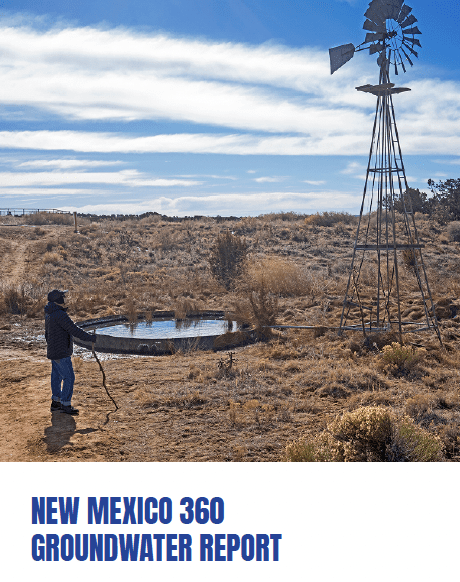
The New Mexico Groundwater Alliance recently released the New Mexico 360 Groundwater Report to elevate the urgency of the groundwater crisis facing New Mexico. The Alliance seeks to build long-term, multistakeholder collaboration to co-create resilient statewide groundwater management solutions.
The NM 360 Groundwater Report details significant data gaps, challenges and opportunities to protect the state’s declining groundwater supply.
On Feb. 19, Gretel Follingstad and Maurice Hall, both from Environmental Defense Fund, will join the New Mexico Water Advocates monthly workshop to discuss the New Mexico 360 Groundwater Report. Here’s a sneak peek at the most important points and priorities about groundwater in New Mexico from the report.
1. Groundwater is a lifeline for New Mexico’s communities and economies, serving as a critical source of water for drinking and irrigated agriculture.
More than three-quarters of New Mexico’s drinking water comes from groundwater. It’s a critical water source for community water systems, most of which are located in small rural communities. Sustainable groundwater management requires monitoring these vital underground water systems that support hundreds of communities and thousands of private domestic wells. Groundwater also underpins rural economies and agriculture, which is the largest groundwater consumer in New Mexico.
2. Better groundwater data is needed to ensure we have enough water to sustain New Mexico’s communities, economies and the environment for generations to come.
New Mexico’s high dependence on groundwater makes closing groundwater data gaps a top priority for communities, economies and the environment. Aquifer studies provide the foundational understanding of the state’s groundwater aquifers, the extensive natural infrastructure that stores and delivers our groundwater. These studies are critical for clarifying rates of groundwater depletion and shaping management responses.
The New Mexico Bureau of Geology and Mineral Resources (NMGMR) conducts the state’s groundwater mapping and characterization studies. These studies are extensive and cost a lot of money. The good news is state legislators look poised to approve $22 million for NMGMR to continue these essential studies. This funding would be a big step in the right direction for sustainable groundwater management in New Mexico.
In groundwater-dependent areas like the High Plains (Ogallala Aquifer), we know there is an urgent crisis. Recent analysis by the Ogallala Land and Water Conservancy showed their groundwater supplies may only last 5 to 10 years without large reductions in use. Many other areas share stories of dropping water tables, declining water quality, wells going dry, and need for infrastructure improvements to meet water demands.
3. More groundwater metering is needed for better demand management.
The most accurate way to measure groundwater use is with meters installed on wells that pump groundwater. This is critical data for knowing how much water is pumped out of our aquifers. Without this information, the ability to effectively manage shared groundwater supplies is limited.
Currently, the majority of New Mexico’s wells are not metered. In the areas of New Mexico that are metered, such as the Pecos Valley Artesian Conservation District in Chaves and Eddy counties, groundwater pumping measurements provide essential information to meet legal obligations downstream. While metering was not popular with landowners initially, they eventually they this tool for ensuring everyone was playing by the same rules.
A recent op-ed co-authored by New Mexico Groundwater Alliance members Ladona Clayton, Aron Balock and Phil King, highlights the many benefits and positive outcomes from metered groundwater use, noting the whole state would benefit from metering to better inform local management decisions.
4. Native Nations, Tribes and Pueblos have valued water in New Mexico for time immemorial, and they have valuable knowledge to share about sustainable water management.
Climate change and water depletions are impacting New Mexico’s Tribal communities. For time immemorial, New Mexico’s 23 Native Nations, Tribes, and Pueblos have valued and recognized water as central to the existence, maintenance, and continuity of their cultural identity and physical well-being, as highlighted in the 2022 New Mexico Tribal Water Report.
“Tribes developed resilient water strategies and technologies in response to unpredictable changes in the physical, social, and cultural environment. Many Tribes developed broad systems of water management engineering, specifically for subsistence agriculture and other regenerative uses,” the report notes.
The report recommends the state of New Mexico issue formal recognition of Indigenous Traditional Ecological Knowledge (ITEK) as contributing to the scientific, technical, social, and economic advancements of the state and to our collective understanding of our environment. The report also recommends the state work with the NM Indian Affairs Department to develop guidance for State agencies on consultation and application of ITEK.”
Improving groundwater management in New Mexico will require partnership, collaboration and coordination with New Mexico’s Nations, Tribes, and Pueblos to advance alternative, specific solutions as each Tribal Nation deems effective.
5. Groundwater supports the health of our rivers, streams and springs.
Groundwater is largely unseen, but it plays a vital role in the health of surface water flows throughout New Mexico.
Groundwater and surface water are often thought of as separate systems, but in river corridors they are interconnected. Depending on the physical setting and drought conditions, stream flow may be recharging groundwater or groundwater may be discharging to rivers and streams.
When groundwater is over-pumped in these interconnected systems, river flows decline, which impacts the river’s ecology, harming fish and wildlife and affecting the availability of water in the river. Consequently, in areas where groundwater and surface water are interconnected, they must be managed together.
As a fifth-generation New Mexican (Gretel) and recent transplant (Maurice), we cherish New Mexico’s majestic landscapes, from the high alpine mountains to river corridors and prairies and managing New Mexico’s precious water resources above and below ground, is essential to sustaining these landscapes, our communities, cultures, and economies, for future generations.
But our water supplies are at risk. New Mexico’s drought-fueled groundwater pumping has spiraled into a statewide crisis, amplified by climate change and population growth. We hope the New Mexico 360 Groundwater Report serves as a call to action for collaborative and proactive development of statewide groundwater management co-created with Native Tribes, rural communities, municipal water managers, agricultural producers, industry, and state legislators. We all must come together to protect this vital underground resource we depend upon, before it’s too late.
The Senate Must Act—Now—to Prevent a Deepening Water Crisis
New Mexico’s water future now rests with the Senate Finance Committee.
HB2, as sent from the House, funds less than half of the State Engineer’s urgently needed requests to carry out existing statutory duties. These are not new programs. They are the core responsibilities the Legislature has already assigned to the Office of the State Engineer and the Interstate Stream Commission—responsibilities tied directly to interstate obligations, Indian water-rights settlements, and protection of the public welfare. The Senate is now the last line of defense against compounding legal, financial, and operational risk.
New Mexico is legally bound to comply with the Rio Grande Compact, implement federally approved Indian water-rights settlements, enforce existing water rights, and carry out laws the Legislature has already enacted. Underfunding does not make those obligations disappear. It postpones action, raises exposure to litigation, and dramatically increases long-term costs.
The Senate Finance Committee must confront this reality directly.
Where HB2 Falls Critically Short
Rio Grande Compact Compliance The State Engineer requested $50 million to implement the Lower Rio Grande settlement, reduce ongoing Middle and Lower Rio Grande depletions, and ensure water reaches Elephant Butte Reservoir and the new El Paso compact gage. HB2 provides less than half that amount. Partial funding delays corrective action and sharply increases the risk of Compact violation—now projected within two to three years in the Middle Rio Grande.
Indian Water-Rights Settlements The State’s cost share unlocks several billion dollars in federal settlement funding and implements agreed-upon projects that benefit both Tribal and non-Tribal water users. HB2 provides only $10 million of the $35 million request, despite this being an ongoing, binding obligation.
Water Security Planning and Modernization The Legislature unanimously enacted the Water Security Planning Act in 2023. HB2 cuts the funding needed to implement that law and denies FY27 funding to continue replacement of a fragile, 30-year-old water-rights database that is at risk of failure.
River Conveyance and Core Staffing HB2 eliminates funding for extraordinary Middle Rio Grande channel improvements—even though 2025 demonstrated that preventable conveyance losses directly undermine Compact deliveries. It also zeroes out critical field and settlement staff needed for enforcement, wet-water administration, and compliance—functions no other entity can perform.
The Cost of Delay Is Not Abstract
Failure to act now threatens communities, agriculture, Tribal settlements, interstate relations, and New Mexico’s economy. Deferring action guarantees higher costs later—financially, legally, and operationally.
Call to Action
The Senate Finance Committee must provide full funding for the State Engineer’s requested water resources management special appropriations and expansions that the House left out of HB2.
If you care about New Mexico’s future, contact Committee members today and demand the Senate fully fund these core State water management responsibilities. Only the State has the authority and resources to comply with the law by carrying them out. Committee members are listed here.
HAFC Final Decisions Undercut New Mexico’s Ability to Manage Its Water Crisis
House Budget Reported Out of Finance Committee Cuts Planning, Modernization, Staffing, and River Maintenance
The House Appropriations and Finance Committee (HAFC) took a step forward by improving funding for the Office of the State Engineer and Interstate Stream Commission. But the committee’s final decisions amount to fiscal malpractice—leaving dangerous gaps in water management and failing to fund actions now that will cost New Mexico multiples more later. Those costs escalate sharply if continued underdeliveries to Elephant Butte trigger a new Rio Grande Compact violation. This table summarizes all the special appropriations to the State Engineer/Interstate Stream Commission that are in the Committee Substitute for HB2, available at nmlegis.gov
Major Rio Grande Crises
The State Engineer requested $50 million to reduce Lower Rio Grande depletions and implement the interstate settlement. That amount remains essential. After hearing the State Engineer’s budget presentation on November 20, 2025, HAFC Chair Nathan Small said the request “sounds right to me.” Deferring or cutting this funding does not avoid costs—it postpones action until the consequences are far more expensive to fix, particularly if continued underdeliveries to Elephant Butte trigger enforcement, emergency measures, or renewed interstate litigation. Anything less increases New Mexico’s legal exposure and financial risk down the road.
Water Planning and Modernization
HAFC also cut in half the OSE/ISC $5 million request for water planning, agency modernization, and work on the Governor’s 50-Year Water Action Plan. That reduction will delay implementation of the unanimously passed 2023 regional Water Security Planning Act. Not only will that postpone deployment of planning needed to seek well-informed regional solutions, but it continues the Legislature’s pattern of failing to fund the good water laws it has passed this century.
Middle Rio Grande River Channel Maintenance
More troubling, HAFC’s decision to eliminate all funding for essential Middle Rio Grande river channel maintenance is foolhardy. In November and December, the river channel absorbed roughly half of unusually large non-irrigation-season flows, including a major pulse of unused Pueblo water. Failing to maintain conveyance guarantees preventable losses that otherwise would improve deliveries to Elephant Butte.
Supporting Institutional Capacity
Finally, HAFC refused to fund the six additional State Engineer staff needed to administer wet water in the Middle and Lower Rio Grande and to implement three Indian water rights settlements. These are core state responsibilities: Section 72-2-9.1 NMSA 1978 directs the State Engineer to act in recognition that interstate stream compact compliance is imperative, and settlement implementation is work only the State has authority to perform. Failing to fund these functions risks serious legal, financial, and water-supply consequences for New Mexicans statewide.
This is a long-form reference article. It documents what recent science shows about groundwater depletion in the Rio Grande–Bravo Basin and explains why New Mexico’s groundwater crisis is no longer a matter of insufficient data, authority, or technical capacity, but of governance. What follows provides the supporting evidence, context, and institutional history behind this conclusion.
What the Science Now Shows
In the first comprehensive basin-wide assessment of consumptive water use and replenishment, the study Overconsumption Gravely Threatens Water Security in the Rio Grande–Bravo Basin quantifies unsustainable use at sub-basin scales (smaller, localized areas) from the San Luis Valley in Colorado, through New Mexico, and on both sides of the international border to the river’s terminus at the Gulf of Mexico. A November New Mexico Water Advocates article first directed readers to this research. This article reports on its findings and explains their implications for water management decisions in New Mexico and across the basin. Together with prior reporting by New Mexico Water Advocates, the study provides a documented scientific foundation for examining why groundwater governance in New Mexico has failed to keep pace with what is already known.
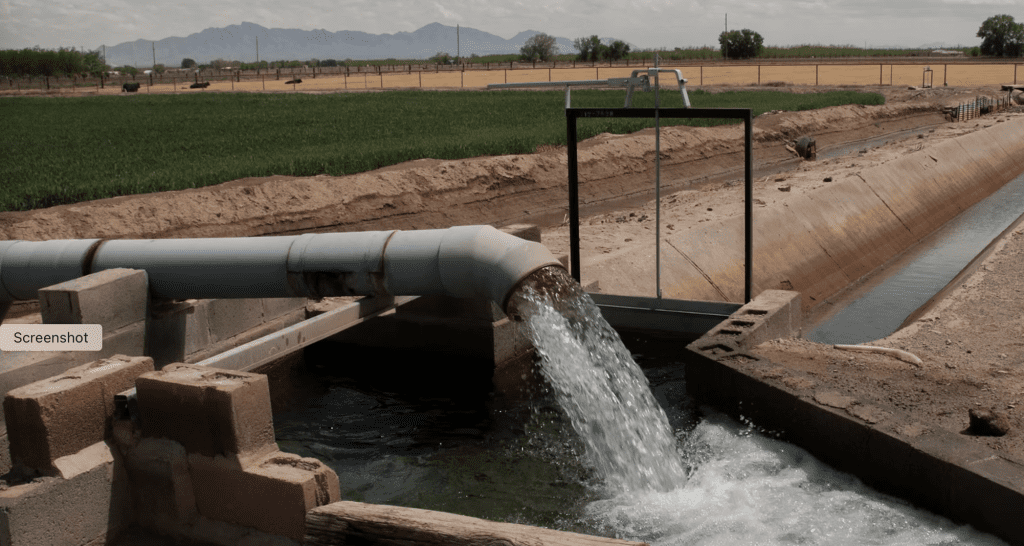
The study authors’ basin-wide accounting of water use in the Rio Grande–Bravo Basin concludes that more than half (about 52 %) of all water consumed in the basin is unsustainable, meaning it is withdrawn faster than it can be replenished. The study finds that irrigated agriculture accounts for roughly 87 % of all direct consumptive water use, making it by far the dominant driver of depletion. Within that agricultural use, forage crops grown primarily for livestock feed—especially alfalfa and other hays—account for approximately half of total agricultural consumption, far exceeding the water use of food crops for direct human consumption. This pattern of overconsumption threatens long-term water security for millions of people who depend on the Rio Grande and its connected aquifers.
The New Mexico context for the report’s basin-wide findings is provided by the Office of the State Engineer’s 2020 Water Use by Categoriesreport, which estimates that irrigated agriculture accounted for approximately 78 percent of total statewide water withdrawals in 2020.[i] New Mexico facts are consistent with the Rio Grande–Bravo Basin finding that irrigated agriculture is the dominant driver of water demand and depletion. These facts reinforce the conclusion that New Mexico’s groundwater challenges are structural and governance-related rather than informational.
While municipal and industrial uses account for a comparatively small share of consumptive demand, hundreds of thousands of acres of irrigated hay and forage, much of it supplied solely from groundwater, are a primary contributor to agricultural consumptive use in the state. This state-level pattern mirrors the basin-wide findings and reinforces that unsustainable groundwater depletion in New Mexico is already well documented. The biggest challenge is not scientific uncertainty, but the willingness and capacity to govern groundwater use for greater longevity and security.
What This Means for Groundwater Governance
This scientific clarity matters. It demonstrates that we now have sufficient information to begin governing New Mexico groundwater use responsibly, rather than waiting for better information and complete characterization of every aquifer.
This point corrects a common misconception. Groundwater management does not require complete scientific certainty before action can begin. Basin-wide water balance and depletion trends are already documented at scales relevant to governance. The science and the Office of the State Engineer’s water use reports define the problem; the primary challenge is the Office of the State Engineer’s institutional follow-through.
The Role of the New Mexico Bureau of Geology and State Water Resources Agencies
Ongoing hydrogeologic investigations by the New Mexico Bureau of Geology and Mineral Resources remain essential. The Aquifer Mapping Program is far more than mapping. With meaningful funding in the current fiscal year,[ii] the Bureau has already flown aerial resistivity surveys over critical aquifers, generating data that inform where wells should—and should not—be drilled. The Bureau will oversee drilling and instrumentation of permanent characterization and monitoring wells to define vertical aquifer structure, discrete water quality zones, faults, and other barriers to groundwater flow. This drilling will also help determine the volume and potential yields of deeper brackish and saline formations beneath freshwater zones. Together, these efforts provide the foundation for systematic, long-term groundwater monitoring that will steadily reduce uncertainty about aquifer behavior and define both the possibilities and limits of brackish water development.
The Office of the State Engineer and the Interstate Stream Commission are the agencies legally responsible for administering water rights, enforcing limits, and planning for sustainable water use. Scientific programs strengthen their technical foundation, but the desire for more complete science should not be a reason to forego initiating governance actions. The current agency approach appears to defer meaningful groundwater governance until regional water security planning recommendations are completed, even in areas where community water supplies are already threatened by continued agricultural pumping. Deferring enforceable limits under these conditions is a decision to allow ongoing aquifer depletion to continue unchecked, increasing the likelihood of irreversible impacts to local communities, higher costs, and accelerated decline.
The January 2026 New Mexico 360 Groundwater Report, published by the New Mexico Groundwater Alliance, makes clear that the State Engineer already has legal authority to preserve groundwater supplies by limiting pumping. That authority includes conditioning, limiting, or denying groundwater permits; regulating pumping in fully appropriated and mined basins; requiring metering and reporting; and managing groundwater pumping to protect connected surface waters and meet interstate compact obligations.
The regional water security planning program, unanimously authorized by the 2023 Legislature, has yet to gain traction through formally adopted rules. The Interstate Stream Commission will promulgate the rules and must then issue guidelines. After that, it can make state funding grants to regions, which must form regional councils to organize themselves to oversee preparation of their region’s plan. Plans won’t be drafted, approved by the councils and subsequently by the ISC, and funded for implementation for many years. This makes the promise of water planning an insufficient basis for delaying near-term groundwater governance, given that aquifers are already being drained by agricultural pumping to the detriment of communities.
The Real Bottleneck: Chronic Governance Incapacity
New Mexico’s experience demonstrates that groundwater can be managed effectively when the State or local institutions choose to do so—but that such management has been applied unevenly, episodically, and without being institutionalized statewide. Almost all groundwater management has been reactive to crises. For example:
Pecos Valley Artesian Conservancy District – The clearest example of long-standing active groundwater management is the Pecos Valley Artesian Conservancy District (PVACD), created in 1932 in response to catastrophic loss of artesian pressure in the Pecos Valley around Roswell and Artesia. There, groundwater use has been actively regulated for decades to prevent collapse of the aquifer system. That experience shows that sustained groundwater governance is possible in New Mexico when depletion is undeniable and consequences are unavoidable.
Pecos River – Pecos River water management now seems routine, but it has been difficult, costly to taxpayers, and entirely reactive. Farmers went to jail for sabotaging the operation of water meters required by court order. New Mexico lost a Texas lawsuit in the U.S. Supreme Court and is now subject to a Pecos River Compact 1987 Amended Decree that it came extremely close to violating annually for more than a decade. A State-driven collaboratively developed solution became state law in 2001. It required arrangements to get more water through the last dam in New Mexico and pause farming on productive farmland in the Carlsbad Irrigation District and the PVACD. It succeeded, but increasing water scarcity driven by global warming may require action beyond the settlement.
Lower Rio Grande – A second form of groundwater management is now emerging in the Lower Rio Grande as a result of a 2013 Texas lawsuit before the U.S. Supreme Court. The pending Consent Decree and Settlement agreements focus squarely on New Mexico’s groundwater pumping from the irrigated valley floor’s alluvial aquifer, which is well connected to the Rio Grande. The Settlement requires that the State of New Mexico maintain groundwater levels adjacent to and beneath the river high enough to prevent the portion of the river’s flow legally allocated to Texas and the United States from instead sinking into the New Mexico riverbed. The State must meet mandatory downstream delivery obligations under tight compliance deadlines.
Notably, drinking water purveyors (community water utilities) depend on rights that the state water rights adjudication court has determined are junior to the irrigators’ 1903 priority rights to a full supply, whether from the river or groundwater. In recent years, the New Mexico share of Caballo Dam releases has not enough to satisfy the irrigators’ senior rights to a full supply. The State Engineer will be compelled to administer water in the Lower Rio Grande to prevent illegal underdelivery of water to El Paso as required by the Settlement.
Middle Rio Grande – The Middle Rio Grande presents an even more complex picture. The Albuquerque Bernalillo County Water Utility Authority proactively prevented a groundwater-overdraft disaster from the excellent aquifer it’s built over. The solution was implementing direct use of its imported surface-water rights. Groundwater levels underneath Albuquerque partially recovered and stabilized, stopping the risk of aquifer compaction that would cause differential subsidence across faults that traverse the city. Albuquerque’s achievement matters—and it contradicts the notion that New Mexico acts only after collapse.
This was a local utility response, not basin-wide governance. Conjunctive-use benefits projected in the Authority’s 100-year plan have not materialized as assumed. The volume of available surface water treated and delivered to customers is far below the plan’s assumptions. Current Middle Rio Grande surface and groundwater uses will cause a new Rio Grande Compact violation in two to three years, while the ABCWUA says publicly it will supply new high-water use industry that the State and the City of Albuquerque are recruiting. The effective ABCWUA position is that it is preferable to be upstream with junior deep wells than downstream with senior surface water rights. Santa Fe also implemented a direct river diversion for drinking water, but its motivation was to prevent running out of water. Los Lunas has been and is recruiting high water use industry to fully use their water rights, and now seeks to transfer additional water rights that may be legally abandoned into their wells. Former State Engineer Mike Hamman clearly recognized the necessity of basin-scale conjunctive management in the Middle Rio Grande, but several years later, no progress is apparent.
Taken together, these examples show that New Mexico’s groundwater management successes are isolated, situational, and non-systemic. The problem is not scientific uncertainty, lack of authority, or technical infeasibility. The problem is the failure to institutionalize groundwater governance before crisis, litigation, or compulsion makes inaction untenable.
The State’s Water Resources Management Imperatives
New Mexico’s groundwater crisis is not the result of scientific uncertainty or the absence of legal authority. It is the result of governance failure—decisions by elected and appointed leaders to defer action even as the consequences become unavoidable.
The scientific paper by Richter et al. reinforces what has been understood for decades: aquifers are finite, groundwater depletion is measurable, and continued overpumping leads to permanent losses of water supply, water quality, and economic security. These are physical limits. They do not yield to delay, political convenience, or administrative caution.
New Mexico already has the legal authority to manage groundwater use. Under existing law, the State Engineer can condition, limit, or deny groundwater permits; regulate pumping in fully appropriated and mined basins; require metering and reporting; and manage groundwater pumping to protect connected surface waters and interstate compact obligations. No new statutory authority is required to begin managing groundwater based on aquifer conditions.
Gaps in aquifer characterization and monitoring remain real and must be addressed. But neither the science nor the law supports using those gaps as an excuse to postpone management. Data development and management must proceed together. Waiting for perfect information while aquifers decline only increases costs and reduces or eliminates future options.
Despite this, New Mexico continues to rely on administration that is largely disconnected from aquifer conditions. Groundwater permits are issued and administered without enforceable limits tied to aquifer longevity, even where declines are severe and well documented. Outside the one managed basin, groundwater governance remains the exception rather than the rule.
What Is at Stake—and Who Is Responsible
New Mexico’s groundwater crisis persists not because the State lacks financial resources, but because the Legislature has repeatedly chosen not to appropriate them at the scale required. The legal authority to manage groundwater exists. What is missing is the sustained investment needed to build and maintain the institutional capacity to use that authority effectively.
Across state government, funding for water resources planning, groundwater science, monitoring, enforcement, and long-term management remains inadequate. Agencies are expected to address widespread aquifer depletion with fragmented data systems, insufficient staffing, and short-term appropriations that fall far short of the problem’s scope. This chronic underfunding ensures continued incapacity, regardless of statutory authority.
That incapacity is not accidental. It reflects legislative choices. Year after year, the Governor recommends and the House and Senate Finance Committees set budgets that do not provide the resources necessary for groundwater management.
More fundamentally, New Mexico has not been willing to explicitly acknowledge groundwater management as a core governing responsibility that requires a defined program and durable capacity. Without naming groundwater management as a priority, the Legislature avoids the obligation to fund it, and agencies are left unable to deliver it.
The consequences of this failure are already visible. Households are hauling water because wells have gone dry. Communities dependent on groundwater face rising costs, declining water quality, and increasing long-term risk. New Mexico has many ghost towns—once viable communities that declined when the resources they depended on were exhausted. Groundwater-dependent communities face the same risk if groundwater depletion for irrigation continues unchecked.
Preventing that outcome is a matter of choice. The constraint is not science, not legal authority, and not the absence of money. It is the absence of political will to name groundwater management as a governing responsibility—and to fund the capacity required to carry it out. New Mexico’s future requires top elected and appointed officials to name and describe our groundwater sustainability crises, face the sacrifices required to increase groundwater longevity, and build the state institutional capacity needed to confront and solve those crises.
[i] Office of the State Engineer / Interstate Stream Commission, 2020 Water Use by Categories, summarized at mainstreamnm.org , “How data can inspire action: A closer look at the Water Use by Categories report” (Jan. 2025). The report estimates approximately 2.97 million acre-feet of withdrawals for irrigated agriculture out of roughly 3.81 million acre-feet of total statewide withdrawals in 2020 (≈ 78 percent). Irrigation withdrawals are not directly metered in most areas and are estimated using crop acreage, irrigation requirements, and other standard water-use accounting methods. The report presents withdrawals, not consumptive use.
[ii] The Bureau of Geology requested $29 million for this year and the next two to initiate their planned $175 million aquifer characterization plan, but the Governor, the House Appropriations and Finance Committee, and the Senate Finance Committee successively reduced their appropriation to $7.5 million. The Bureau may receive a $22.5 million budget this year, having demonstrated strong performance.




 The
The 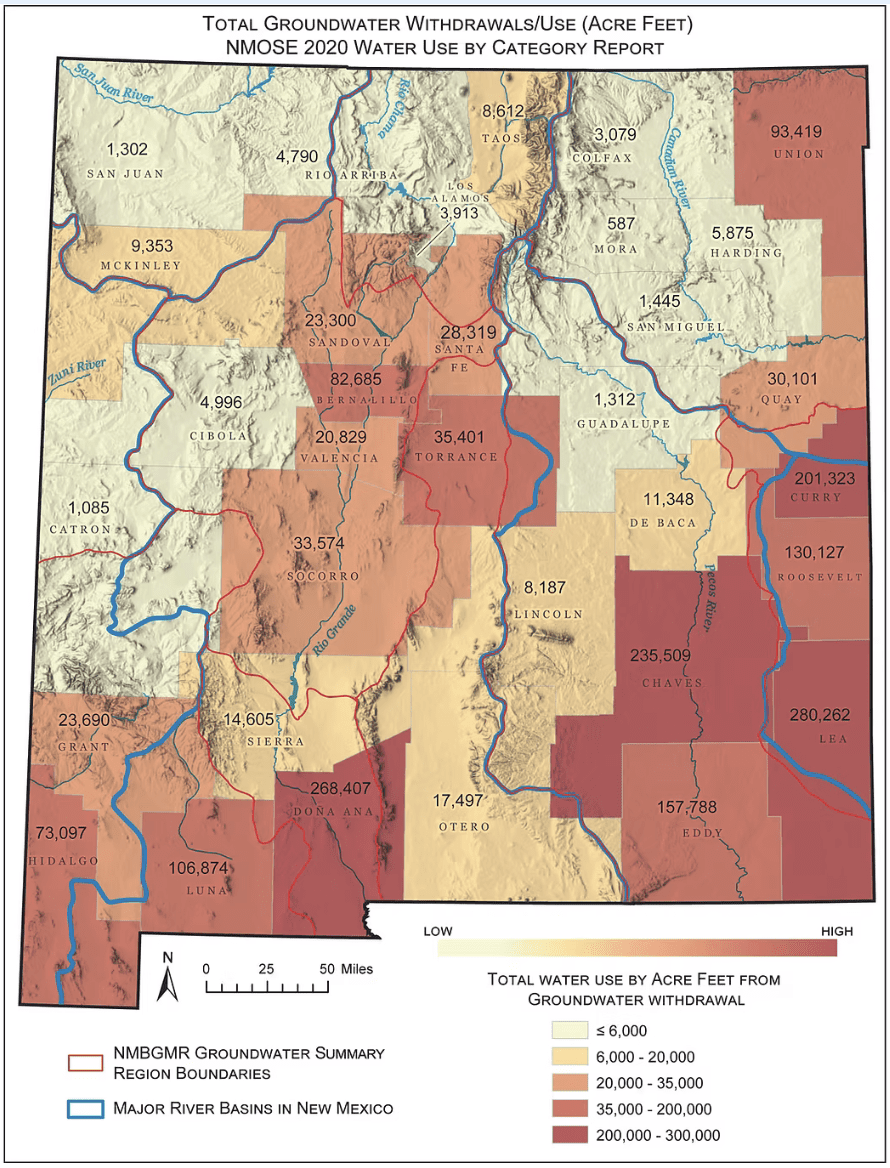


 The study authors’ basin-wide accounting of water use in the Rio Grande–Bravo Basin concludes that more than half (about 52 %) of all water consumed in the basin is unsustainable, meaning it is withdrawn faster than it can be replenished. The study finds that irrigated agriculture accounts for roughly 87 % of all direct consumptive water use, making it by far the dominant driver of depletion. Within that agricultural use, forage crops grown primarily for livestock feed—especially alfalfa and other hays—account for approximately half of total agricultural consumption, far exceeding the water use of food crops for direct human consumption. This pattern of