

By John Brown, an unpublished article from 2023
It would appear useful to our efforts to make New Mexico’s water resources more resilient to the impacts of climate disruption, if we can achieve a common understanding among members and allies of what we mean when we use and invoke terms like “tragedy of the commons,” collective action, institutions, “institutional arrangements,” “polycentric governance,” etc. Lin Ostrom’s Governing the Commons is foundational, but more recent work by Michael Cox and others has expanded on her original “design principles for common-pool resource (CPR) institutions.”
Institutions
If the Ostrom “design principles” for successful long-standing CPRs are to be useful as part of our analytic framework, I think we need to come to a fuller understanding of what she means by “institutions.” The subtitle of her book suggests their importance: “The Evolution of Institutions for Collective Action.” Institutions are not organizations per se. Instead, they are the “rules-in-use” that organizations (and communities and individuals) have crafted over time and use to order their ongoing dealings with one another in recurrent situations.[1]
In his 1968 Science article, Garrett Hardin posited that users of a common-pool resource are hopelessly trapped, unable to extricate themselves from the inevitable ruin caused by the commons dilemma—essentially, the problem of “free-riding.” Unless saved by Leviathan (the state) or privatization (“the market”), they are doomed to destroy the resource they depend on. Ostrom argued that Hardin was wrong: “commons” are not “open access” resources, free-for-all. Successful collective action is possible to devise and enforce rules limiting the temptation to cheat. Thousands of cases of long-enduring self-governed CPRs provide evidence that alternative institutional arrangements are feasible.[2]
For democratic governance of our (New Mexico’s) water resources to work effectively to address “public welfare values and the needs of future generations of New Mexicans”[3] (e.g., resilience, equity, sustainability…) the evolution of institutions across scales and jurisdictions must take place in settings that foster cooperation and communication. The NM Water Advocates’ and NM Water Dialogue can be critical catalysts for these transitions. Working through these processes to achieve effective institutional arrangements, it seems to me, is what the Water Advocates are about.
Collective action
Market oriented skeptics stress the difficulty of getting individuals to act collectively to pursue their joint welfare (as opposed to their private interests). Believing that allocational “efficiency” is solely the product of myriad individual choices of “rational actors” acting in their own self-interest, they are critical of what they view as illegitimate efforts to achieve “fairness” and other social goods. Collective action is costly in terms of time, effort, and money invested in participation. To be successful, expected collective benefits must be proportionate to the investment undertaken.
Polycentric Governance
Governance, McGinnis[4] reminds us, “is not just the province of governments.” The term “polycentric governance” (PG) describes governance systems where decision making authority over provision and appropriation of a public good (the water resource) is not held centrally by the state, but instead is divided across multiple, overlapping decision centers that use diverse approaches to coordinate their activities. The concept can be applied to many important emergent governance practices, including collaborative governance, multi-level governance, governance networks, public private partnerships, and intergovernmental cooperation agreements. PG as a concept does not imply a single type of governance arrangement.
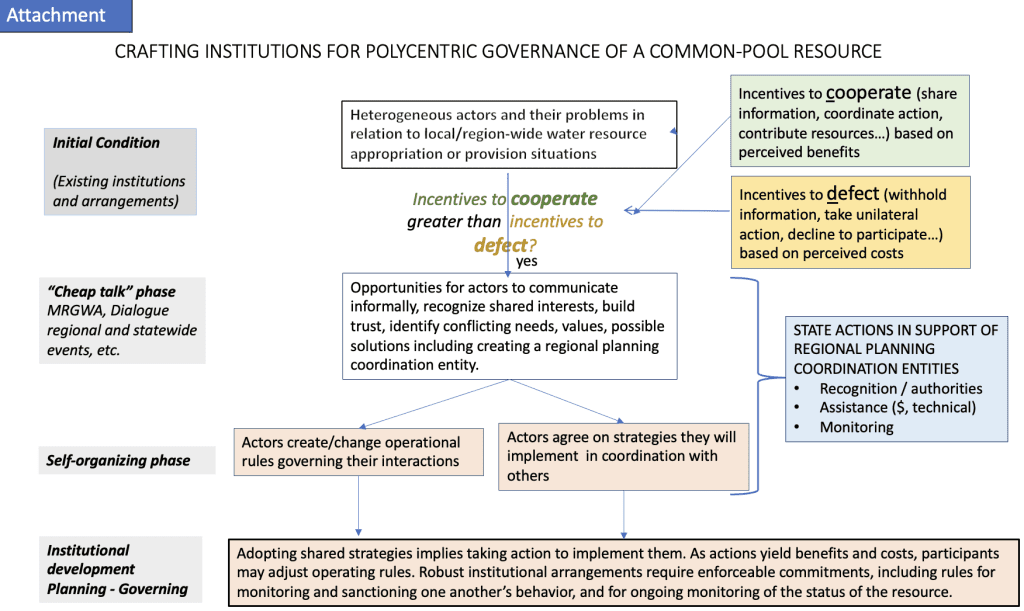
The idea here is that there are different forms or (as Bob would say) “flavors” of polycentric governance. The flavor adopted initially by a regional planning coordination body will be congruent with the underlying social-ecological setting and will presumably evolve to meet changing needs as the parties develop working relationships and agree upon shared strategies. Attached is a simple diagram illustrating how both capacity and institutional development may emerge through largely self-organizing processes.
________________
[i] Some rules-in-use are recorded and actively enforced; others may simply be commonly understood and accepted behavioral norms. In both cases, the rules inform the actors, who hold different positions, what actions are required, what is allowed, and what is forbidden.
[ii] See Digital Library of the Commons https://dlc.dlib.indiana.edu/dlc/
[iii] Regional Water Security Planning Act, Section 72-14A, NMSA 1978.
[iv] Michael McGinnis, ed. 1999. Polycentric Governance and Development