What do some residents do on an early August Sunday evening when the Great River dies into its Albuquerque bed?
They create large clouds of dust and noise with racing ATVs.
They look upstream on August 3 at the Rio Bravo Bridge across the wet clay, cracked mud, and dry sand.
There is no flow. All the water flowing in the river at Bernalillo and all remnants of the big storm on July 31 have disappeared into the sand.
Downstream slightly, people are fishing and hanging out where a tributary temporarily restores the river’s flow.
People hanging out at the treated wastewater discharge to the Rio Grande. A puddle of effluent is to the left, where the river once flowed. Downstream is to the right.
The tributary is the Albuquerque wastewater treatment plan discharge, the third largest tributary to the river by annual volume. Now the discharge is 100% groundwater pumped from beneath the City, that has passed through our plumbing, and has been treated. Now, the river is only discharge, for a few more miles. Are there really fish there?
As of May 2025, the U.S. Drought Monitor shows that Albuquerque is gripped by Drought Stage D3—Extreme Drought. Nearly 97% of Bernalillo County is in the same condition, along with most of New Mexico’s Rio Grande Basin.
Yet, the Albuquerque Bernalillo County Water Utility Authority says we’re in Drought Stage D0—a designation that, in the Authority’s framework, means customers are conserving more water than the utility’s target. This internal metric, however, is not a hydrologic drought indicator. It contradicts observable realities and misleads the public.
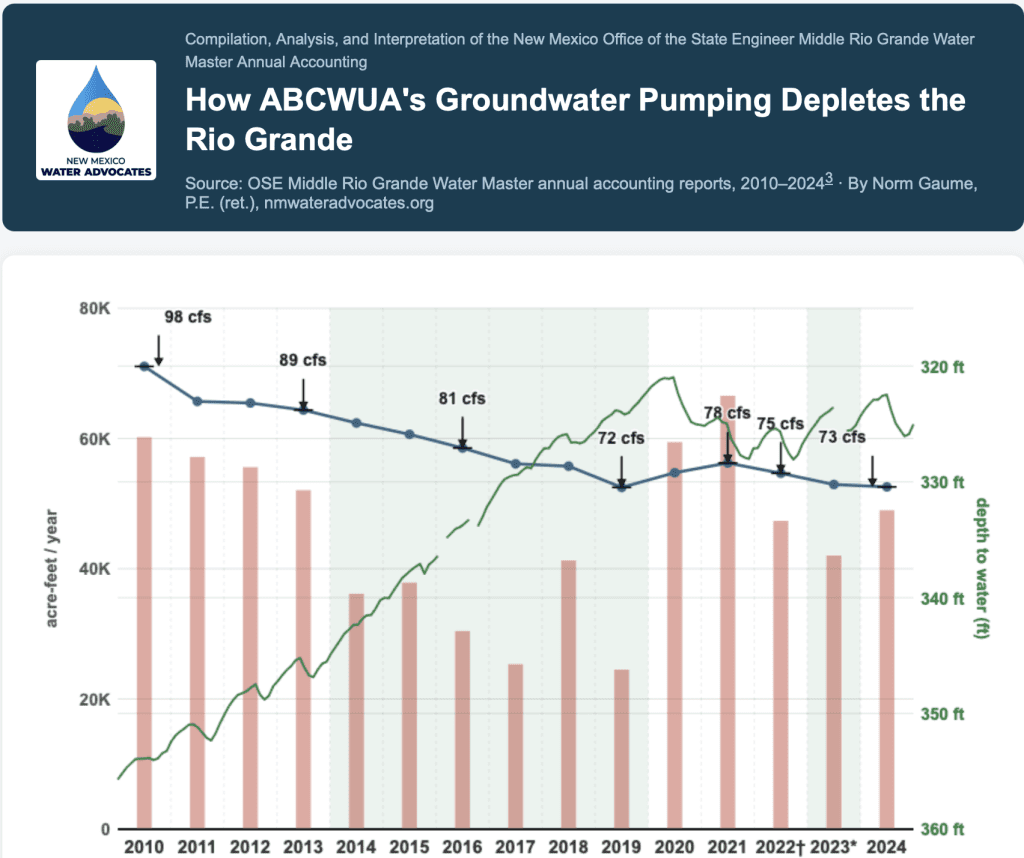
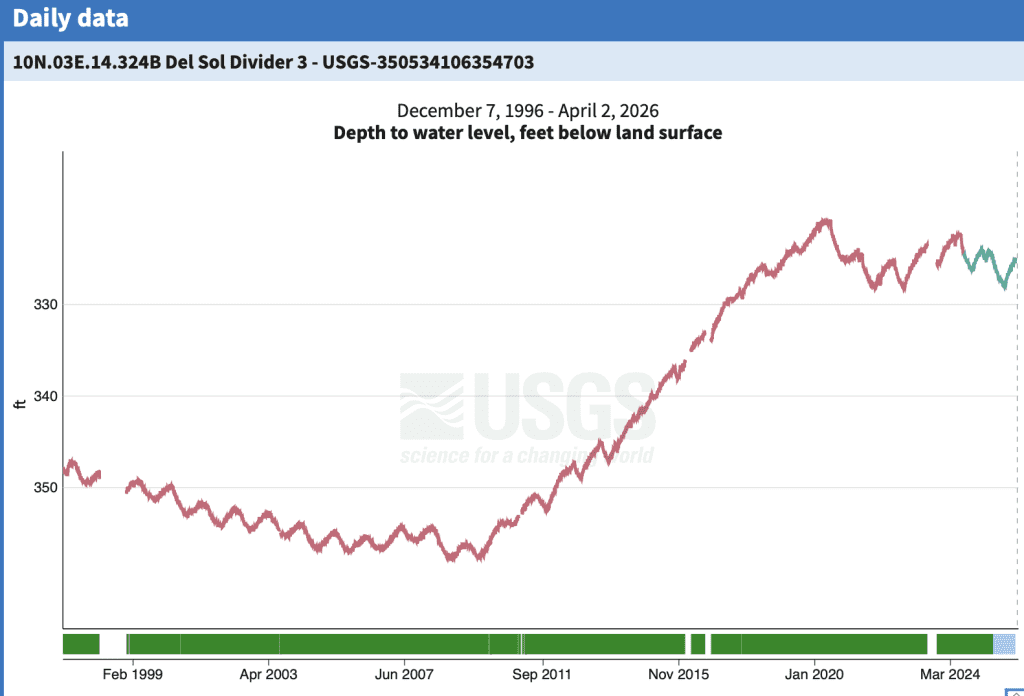
This disconnect matters. The Authority is heavily pumping groundwater to meet demand. The Middle Rio Grande’s surface water is already over-allocated, and vast stretches of the river from Elephant Butte to Albuquerque will likely be dry this summer. Despite this, the utility tells customers there’s no cause for concern.
Two slides below are copied from a water resources presentation posted for the May 21 Water Authority Board meeting. They show that the utility’s definitions are decoupled from actual drought conditions, such as those recognized by federal agencies.
At the same meeting, the Board adopted its FY2026 budget. Discussion revealed that customer conservation is reducing utility revenue, threatening the Water Authority’s ability to meet debt service and annual operating costs.
So what does the utility do? It downplays the drought. Never mind that:
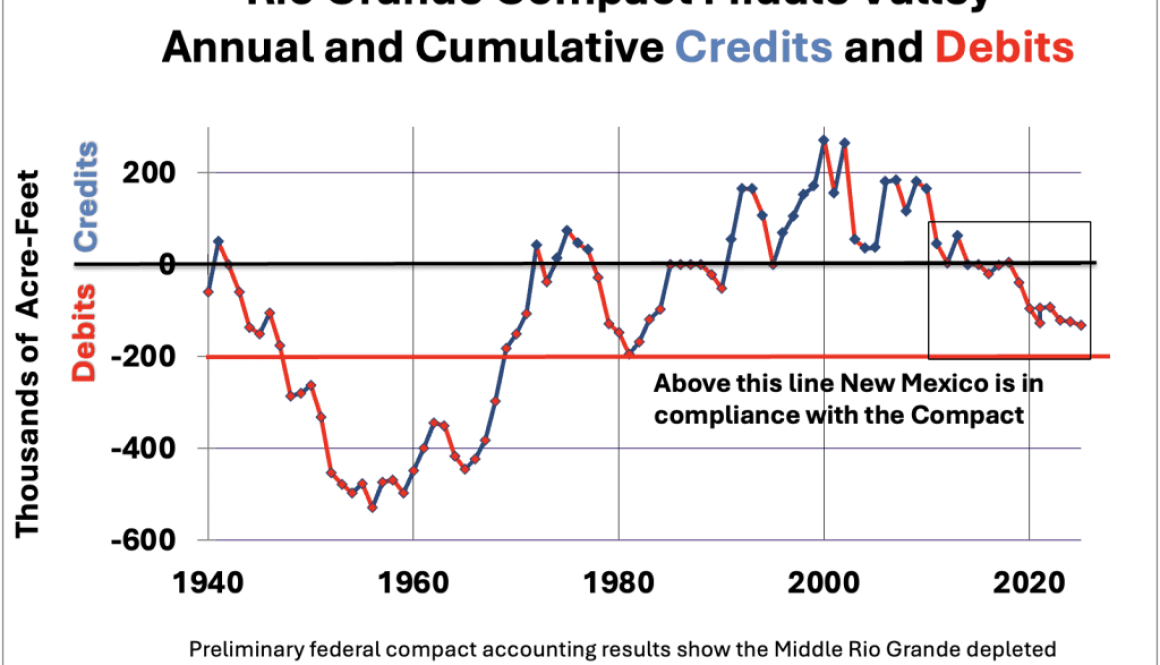
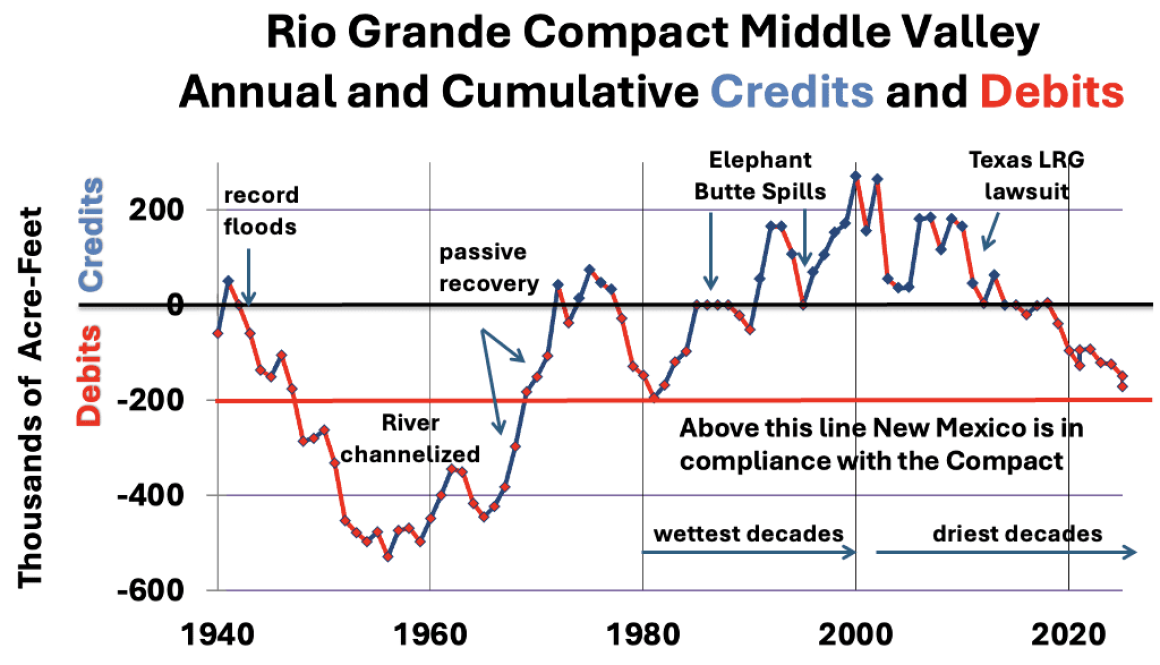
Middle Rio Grande water users are consuming water legally allocated to downstream users under the Rio Grande Compact,
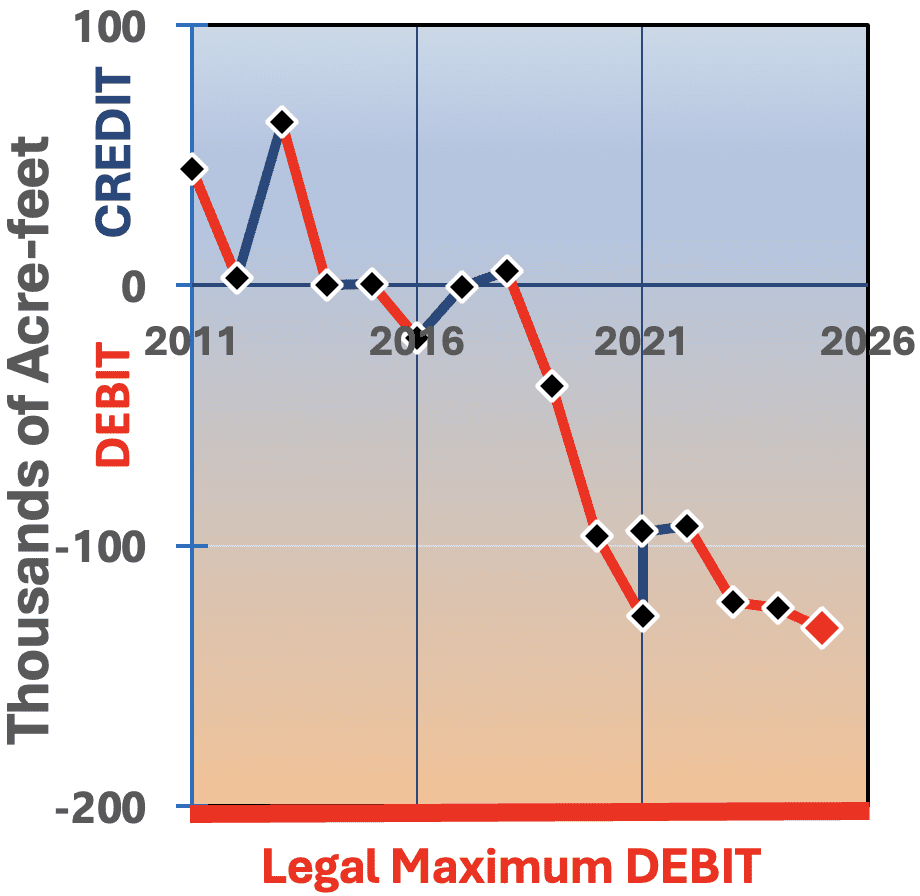
Without urgent state action, the region’s cumulative water debt could exceed the Compact’s legal limit this year or next, subjecting New Mexico’s water management to judicial discretion.
From the Water Advocates’ perspective, the problem is deeper than misleading messaging. No one is taking effective charge. No public agencies are acting with the urgency that increasing aridity coupled with extreme drought conditions demand.
The Water Authority undermines its own credibility — and fails its customers and the region’s economy — by using internally defined drought stages that obscure reality rather than reflect it. We urge the Authority to adopt transparent, science-based drought metrics and to communicate honestly with the public about the very real risks we all face.
The Rio Chama snowpack holds less water today than on this date in any year since measurements began—zero percentile. Click the graphic to download a larger version.
The red line at the bottom marks the historical minimum. The black line shows this year’s measurements. The red shaded area represents the bottom 10th percentile. The green band spans the 30th to 70th percentiles. The top blue line indicates the historical maximum, with the top 10th percentile shaded in blue.
In early March, the Bureau of Reclamation issued its Rio Grande Annual Operating Plan, based on similarly low snowpack measurements across the headwaters. The plan forecasts Rio Grande flows from the source to Texas. This graphic shows the forecast for prolonged dry river conditions at Bosque Farms and San Acacia—briefly interrupted, we hope, by summer monsoon spikes.
Here we go: 2025—our next record-setting hot, dry year.
The Politics of Building Water Resilience versus Water Neglect
We face a multifaceted water crisis – overuse, dwindling aquifers, insufficient political action – all exacerbated by a warming climate.
Introduction
Building water supply resilience throughout New Mexico demands prompt effective leadership. While growing public awareness and initial state actions to adapt to a hotter climate are encouraging, political inertia is a major barrier. This essay emphasizes the urgent need for responsive political leadership to address our state’s hydrologic realities.
Growing Public Awareness and Political Realities
Paraphrasing NM water expert Dr. Phil King, “we have boundless opportunity” because our situation is so dire and we are doing so little to timely adapt. The good news is that there is increasing public awareness, supported by hardworking state water agency staff. However, NM’s political reality is far from responsive to climate and unsustainable water use challenges. New Mexico lawmakers must support effective water resilience improvement initiatives across the state if New Mexico is to survive. ¡Sin agua no hay nada!
Issues and Political Challenges
A few state and local elected politicians understand the consequences of failing to adapt, the urgency of New Mexico’s water crisis, and are taking action. Others, including our Governor, either do not recognize the crisis or find it politically unacceptable to address. We are long on neglect and disinformation. We are short on legislative appropriations and gubernatorial leadership to accelerate state government fulfillment of its critical, unique role in water management and governance, and helping local governments identify, develop, and implement theirs.
Dress for Success; Minimize Opportunity Costs
What is needed for success? We must focus our efforts on stewardship of the irreplaceable resources we have: Surface Water, Groundwater, and appropriate Flood Management. We must build effective collaboration among many and diverse stakeholders, ensure permanent and adequate staffing to do the necessary work, and lobby to secure funding sufficient to the task.
The concept of treating fracking wastewater and transporting it for use as a water supply is a dangerous fantasy marketed to the public with industry and official disinformation. Desalination of brackish groundwater may be needed but is feasible only where 1) large volumes of readily extracted brackish or saline water resources exist, 2) disposal of the concentrated brine is feasible, and 3) water users can afford or secure subsidies for expensive water.
Remember, New Mexico hasn’t done its homework. We don’t know how much good quality groundwater we have left, and know less about New Mexico’s brackish aquifers.
The State of New Mexico instead must focus on stewardship of the good water that we have. We deserve to know how much good groundwater we have left and how fast it is declining. Implementing the 2022 New Mexico Water Policy and Infrastructure Task Force vetted consensus recommendations is a great place to start. Increased state and local capacity to do this work requires State funding.
Legislative Finance Committee’s Role
Those in charge of the Legislative Finance Committee wield the real power and are a real barrier. LFC leaders and members ignore and even mock the legislature’s Water and Natural Resources Committee that focuses on water and natural resources policy in between legislative sessions. The question is whether LFC voting members and leaders have adequate knowledge of the crisis but find it politically inconvenient to address, or choose the status quo knowing the consequences, or if they lack adequate knowledge.
Bottom line: The Legislative Finance Committee and the Senate and House Finance Committees are budgeting for water as if it were a nuisance problem, rather than a full blown, slow rolling, crunching crisis. The State Engineer/Interstate Stream Commission’s June 28, 2024 letter to the Middle Rio Grande Conservancy District demonstrates one example of New Mexico’s jeopardy. The crisis of Portales, other municipalities and rural regions, and Eastern New Mexico University running out of Ogallala water is another.
Increases in the personnel budgets were allowed for NMED and OSE/ISC in the current fiscal year. NMED chose to use the extra funding to competitively pay its existing staff. The OSE/ISC chose to fund new positions. I have now heard both agencies discuss their reasons. My question is this: Why are the bean counters requiring this choice?
Both agencies require more staff to do the agencies’ work. Neither can attract and retain talented staff if the pay is not competitive. Why, can’t they have both? And why can’t our public employees have modern information technology? The Governor and the Legislature have the money. Do they lack knowledge? They certainly lack political will to lead us appropriately given the consequences of inaction.
Water can’t wait. A resilient and sustainable water future requires our state water agencies to have adequate numbers of qualified staff and tools to maximize the staff’s productivity given the magnitude of what they and our local governments must do if New Mexico is to achieve water resilience for the long-haul. Why, when funding is plentiful and the water future looks dire are we failing to recognize its importance in state budgets? If New Mexico doesn’t take care of its water, many of our children and grandchildren will not find their future in New Mexico because to use up our water really means we are using up what makes our lives possible.
LFC Water Subcommittee Members and Witnesses, Carlsbad, NM, June 11, 2024
Beginning with the End in Mind
During an engaging conversation with a Legislative Finance Committee staff budget analyst, I was challenged to identify the five most crucial goals New Mexico must strive to meet in the next decade to secure its water future amid increasing aridity. This approach, inspired by Stephen Covey’s principle of “beginning with the end in mind,” and discussion within the Water Advocates led me to these draft goals.
Five Water Governance Goals for 2035 – Draft for Discussion and Refinement
Aquifer Resilience: Sustainable groundwater programs are in place across New Mexico pursuant to law. Areas in crisis, such as the region served by the Ogallala Aquifer, have fully implemented their programs to protect municipal and institutional water supplies.
Modernization for Resilience: State water agencies have utilized reliable levels of funding/staffing to build their capacities to manage water effectively. They have modernized their business processes, data collection and verification, and information technology. The 2019 Water Data Act has been fully implemented. All state-funded water data is being made available online.
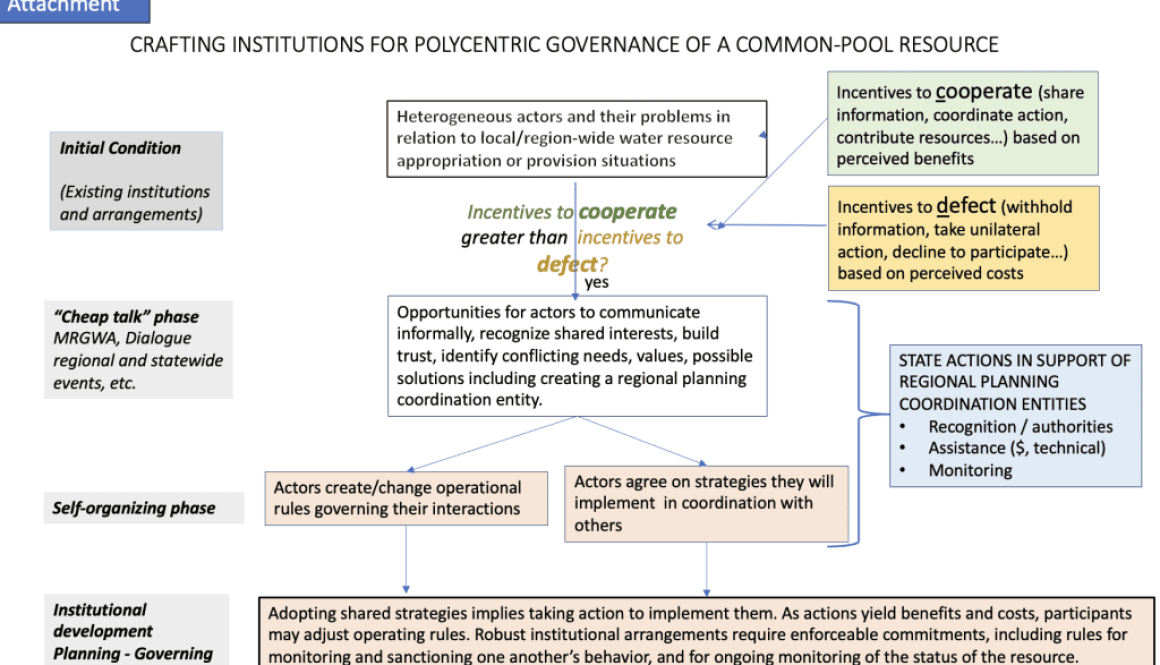
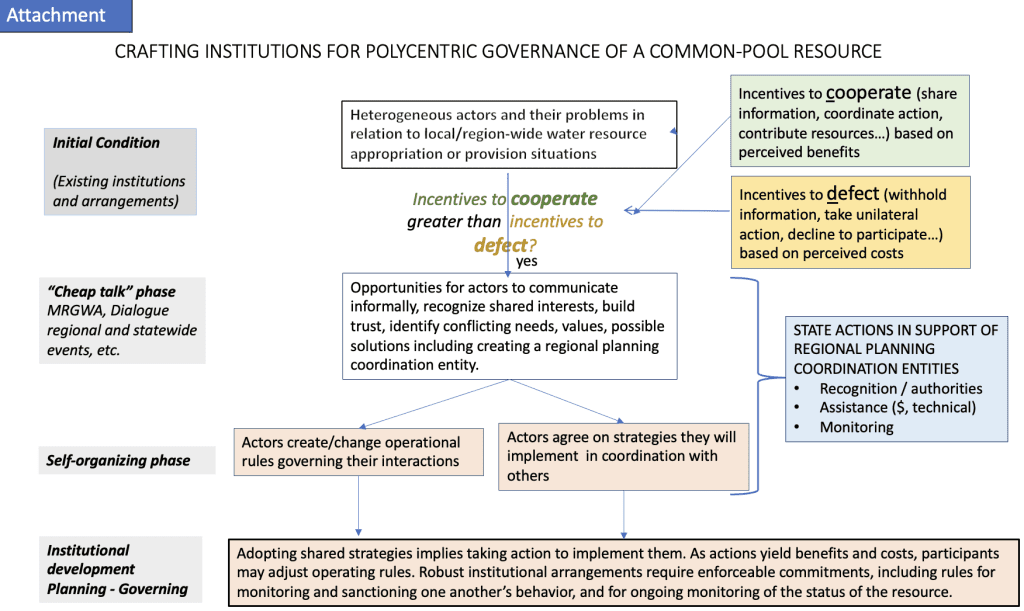
Regional Water Planning: Each region is implementing their regional water security plans, prepared and approved in accordance with the 2023 Water Security Planning Act. in. All regions have received effective state support to secure federal and state matching funds to implement their prioritized programs, policies, and projects.
Interstate Streams Compacts Compliance: Active Water Resources Management has been implemented in the Lower and Middle Rio Grande with Alternative Administration plans for conjunctive use of surface water and groundwater. The plans were developed regionally and approved by the State Engineer.
Water Workforce Development: A skilled water workforce development program is in place. It has produced initial cohorts of graduates bolstering local capacity as water systems governing board members, operators, managers, planners, engineers.
The Water Advocates will present the final version of the five 2035 goals, with interim 2030 goals and the year 1 and year 2 authorization and funding needs at the LFC water subcommittee’s September 17-19, 2024, meeting, if allowed, and to the Water and Natural Resources Committee.
Conclusion
By setting a few high-level water governance outcomes needed by 2035, we can then focus on the first steps to get there, beginning with the end in mind. The Water Advocates seek a much more resilient water and economic future for New Mexico. The Governor and the Legislature must, but have not, recognized that achieving water and economic security requires transformative change.
Your thoughts and recommendations for refining these goals are welcome. The Water Advocates seek opportunities to present them to interim committees in September, in time for budgeting and bill drafting.
Take Action
Demand that the candidates for the NM Legislature, that are running to represent you, recognize New Mexico’s water crisis and pledge to make sustainable water management a priority. Write the Governor and ask her to get serious about water, as she has promised in writing. Learn more by attending our monthly workshops and bringing a friend. Speak up, speak out.
Glossary
Alternative Administration Plans: Strategies for managing water resources in response to changing conditions, optimizing surface and groundwater use.
Aquifer: An underground layer of water-bearing rock or materials from which groundwater can be extracted.
Aquifer Resilience: Sustainable management and planning of regions’ use of groundwater resources.
Badwater Treatment: Treating fracking wastewater, or water that is contaminated by industrial processes or naturally occurring high mineral content.
Conjunctive Use of Surface Water and Groundwater: Coordinated use of both surface water and groundwater to maximize water supply reliability and sustainability.
Elephant Butte Dam: A federal dam on the Rio Grande in southern New Mexico that provides essential water storage, irrigation supplies, flood control, and deliveries to the New Mexicans, Texans, and the Republic of Mexico downstream. It is the boundary between the Middle and Lower Rio Grande segments.
Fracking Wastewater, aka Produced Water. The highly saline, oily ancient water released by the Oil and Gas Industry’s hydraulically fracturing rocks for oil and gas with unconventional wells the rate of four to seven barrels of fracking waste for every barrel of oil. It contains toxins, carcinogens, mutagens, radionuclides, and potent poisons that originate in the oily water and the trade secret fracking additives. Ninety-eight percent of NM produced water is from the Permian Basin. It is 10 to 20% salt, more saline than ocean water.
Interstate Streams Compacts: Agreements between states and the USA to share the water of a river or stream to ensure fair distribution and prevent conflicts.
Middle Rio Grande: A segment of the Rio Grande Basin through central New Mexico from the highway bridge to Los Alamos to Elephant Butte Dam.
Regional Water Security Plans: Comprehensive plans ensuring long-term water resource availability and quality, continuously adapted and updated, per the 2023 Water Security Planning Act.
Water Data Act (2019): Legislation intended to transform the collection, management, reliability, and accessibility of New Mexico water data.
Water Policy and Infrastructure Task Force: A group of 9 state officials and 20 diverse public members appointed by the State Engineer that developed a comprehensive set of water policy and action recommendations in 2022.
Water Workforce Development: Initiatives for training professionals in water infrastructure and management roles.