

What Remains Unresolved
NM Water Advocates Workshop Review, March 19, 2026
Hannah Riseley-White, Director of the NM Interstate Stream Commission, and Nat Chakeres, the State Engineer’s General Counsel, deserve our thanks as public servants and State leaders with authority and responsibility to govern New Mexico’s waters, which are the public’s. They made an admirably frank and thoughtful presentation, supported by informative slides, at the Water Advocates’ Middle Rio Grande Compact Crisis evening workshop. The prior evening, they had left their agencies’ Open House event at Elephant Butte at 8:00 pm to drive home to Santa Fe. They have big jobs, a large state, and lots of water problems demanding their leadership and judgment.
They presented honestly, using their own data to document the rapidly advancing crisis the Water Advocates have been describing. Hannah called the situation dire. Nat acknowledged the metering order said to be coming almost a year ago is not yet ready. Hannah called it overdue. Nat said plainly, “we will be the bad guy when we have to be.” We are grateful for state leaders willing to engage this directly and this publicly.
The Numbers Aren’t Waiting
But gratitude and concern can coexist.
What makes the case more forceful is not the numbers themselves. It is that top State water officials presented them. That is what carries authority. New Mexico currently sits at -132,000 acre-feet of compact debt. A compact violation occurs at -200,000 acre-feet. 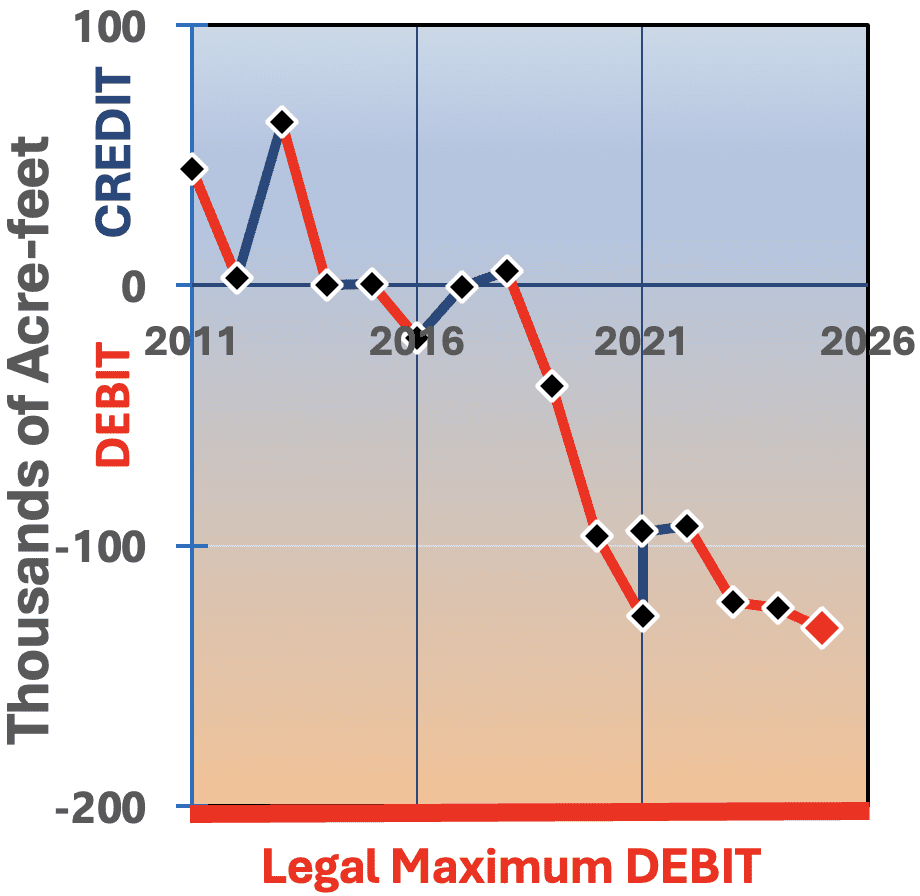 The average annual trajectory over the last decade is -19,800 acre-feet per year. Since 2018, only one year has not increased the cumulative debt. The 2021 apparent improvement was due to a paper accounting adjustment — not wet water arriving at Elephant Butte. Nat put it plainly: “we have been trying to turn the ship.” The ship has much inertia. The currents are strong. The ship has not yet turned.
The ship has much inertia. The currents are strong. The ship has not yet turned.
At the current trajectory, a compact violation is three years away. Hannah showed snowpack at the 0th percentile on the evening of the workshop. That means this year’s snowpack holds less water on this date than ever recorded. The runoff is coming down and will be essentially over in April, when recent peak runoff has been around Memorial Day. EBID’s surface water allotment this year is four inches. Hannah put it plainly: we are in uncharted territory.
A Collection of Parts and Hopes
Against that backdrop, the state’s goal to maintain compact compliance remains a collection of parts and hopes. One hope they expressed without a visible plan is that a negotiation — with whom? — will find a voluntary, timely solution. Are the incentives for cooperation and shared sacrifice greater than the incentives to litigate? “A goal without a plan is just a wish.”[1]
Nat rejected leading with an administrative approach, emphasizing that voluntary efforts must be given a chance. He also said agency staff are actively working, as their professional responsibility, on how to administer the Middle Rio Grande. The reality is the State Engineer is not ready. Some legislators say the leaders are not acting with the urgency demanded to prevent the compact violation.
The State Engineer’s 2004 General Rules for Active Water Resources Management, including a framework for shortage sharing agreements, was upheld by the NM Supreme Court in 2012. Under these rules, as step one, the State Engineer establishes the Middle Rio Grande Water Master District. Step two, the State Engineer issues a metering order. Step three, the State Engineer promulgates additional rules specific to the Middle Rio Grande. The State Engineer has yet to take the first two foundational steps.
Nat and Hannah emphasized that getting more water to Elephant Butte requires Middle Rio Grande water uses — human and natural — to deplete less, but that alone is insufficient. The river must efficiently transport the Lower Rio Grande’s legal share of inflows to Elephant Butte Reservoir where deliveries are accounted. The Middle Rio Grande’s southern end, below Socorro, has a failed engineered channel constructed decades ago. The river now is perched between levees on an elevated bed of sediment. The conveyance losses in this reach are high, regardless of the season and flow.
Hannah cited the genuine work underway — $55M in state channel investments across four legislative sessions, applying the Strategic Water Reserve to purchase water rights, deploying the Active Water Resources Management framework including issuing the forthcoming metering order, and making regional water security planning functional and effective.
But the metering order is being polished instead of issued. Regional planning councils under the 2023 Water Security Planning Act are not yet formed, much less funded, with drafting still underway for the binding guidelines that will set forth how everything is to work. A state regulatory approach is contemplated. That’s important because the adverse outcomes of rigid priority administration will motivate earnest negotiations for better outcomes. Negotiated outcomes are a goal of the Active Water Resources Management Program, but they take motivation and lots of time. Do we have enough time, with the three years to a violation trajectory?
Notably, the Interstate Stream Commission, the State agency created and given strong powers by statute, has never, not once, deliberated this Middle Rio Grande compact compliance crisis nor the approach and policies the Commission should apply.
One audience member asked a technical question about leveraging New Mexico’s stranded accumulated “relinquishment credits” to store water or for some other advantage. That brought a smile to Nat’s face; he replied he has been thinking about this. He again emphasized our situation is unprecedented, and that a Bureau of Reclamation official told him nothing should be off the table. Plainly, however, there is no water to store, and conveyance losses for water stored in spring and released the following winter for delivery to Elephant Butte Reservoir are too high.
Naming the Problem
Although both Hannah and Nat acknowledged our situation is aridification, Hannah used the word “drought” and announced the ISC is preparing a “Drought Toolkit” as a resource for communities. We raise this as a concern that has consequences, not a quibble. Hannah’s message describing our situation as “drought” reflects the notion of temporary — the implicit message that better times lie ahead — without any rational support for that reassurance. To her credit, Hannah stated the overriding plain truth: solving any water resources problem first requires understanding the hydrology and investigating different future conditions. The plain truth the Water Advocates see is that climate heating is permanently reducing and increasing the rate of depletion of New Mexico’s renewable water supplies — bad too soon.
A problem misnamed is a problem misframed. Shouldn’t we plan for the worst and hope for the best?
Norm Gaume opened the workshop challenging the state officials to recognize we are experiencing aridification caused by climate heating. Droughts end. Aridification does not. The data presented that same evening confirmed it — conditions now are worse than projected for 2070. The five warmest summers on record have all occurred in the last eight years, and snowpack is at its lowest in recorded history.
A problem misnamed is a problem misframed. Shouldn’t we plan for the worst and hope for the best? We will soon find the Middle Rio Grande in water bankruptcy if we don’t.
What Comes Next?
We left the evening more resolved. The legal framework exists. Some of the right people are engaged and speaking honestly. The ship must be turned, modernized, and the capacity created to take those essential water management decisions and actions that only the sovereign State of New Mexico has the authority to take. The moment requires the translation of acknowledged urgency into a specific, timed, and accountable action plan.
The State Engineer’s creation of the Water Master District and requiring meters on all significant wells are the first two steps. When will we see them?
Legislators were in the room that evening — we encourage every Water Advocates subscriber to follow our moderator’s advice and invite yours for coffee. When asked how people can help, Nat noted that nobody shows up at the legislature to advocate for essential agency modernization and IT systems funding. Water resources management needs champions.
The river has a lot of sand to deal with, as Nat said in explaining the river’s chronic conveyance problems and losses. As New Mexicans who want the best for New Mexico, in balance with hydrologic reality, we see a lot of sand in the machinery of responsible and responsive State and local water resources governance, too. We are running out of time to move it.
[1] Antoine de Saint-Exupéry, author of The Little Prince (1943). Saint-Exupéry was also a pioneering aviator who navigated by maps and instruments — a man who understood viscerally that aspiration without method is insufficient.
April 8, 2026 @ 7:45 am
This statement is very troubling to me. We should talk.
“Nat noted that nobody shows up at the legislature to advocate for essential agency modernization and IT systems funding. Water resources management needs more champions.”