


New Mexico’s Rio Grande Water Supply is in Grave Danger. It’s High Time to Do Something About It.
The Rio Grande’s water supply in New Mexico is arguably in an even more dangerous condition than the Colorado River
by Brian Richter, Sustainable Waters
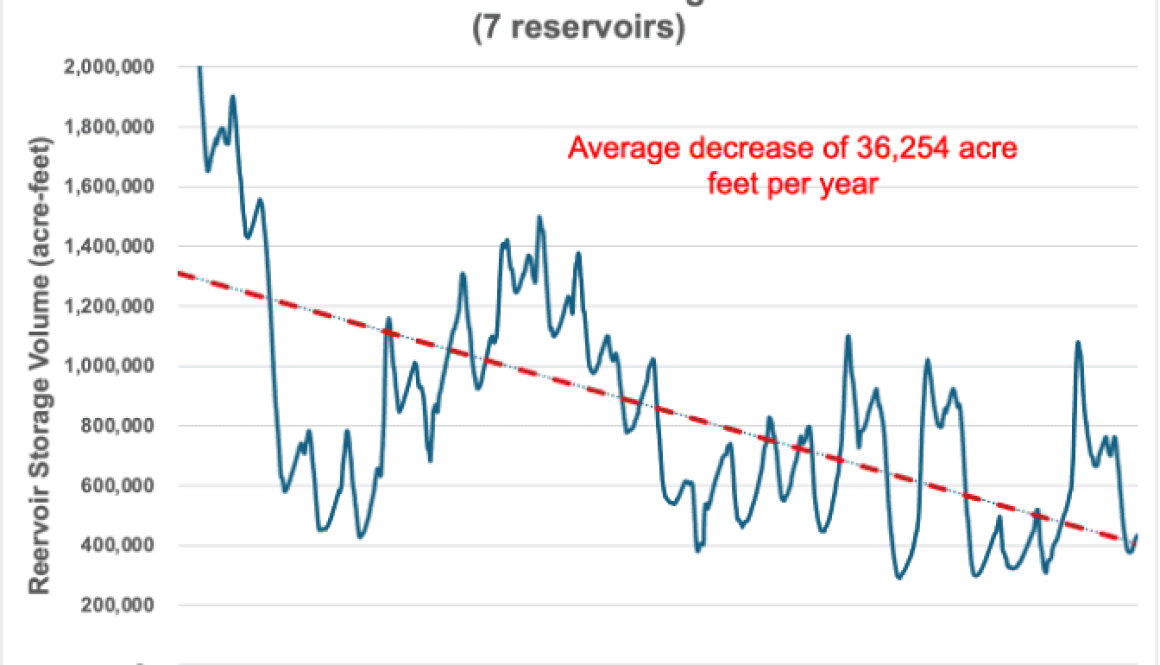
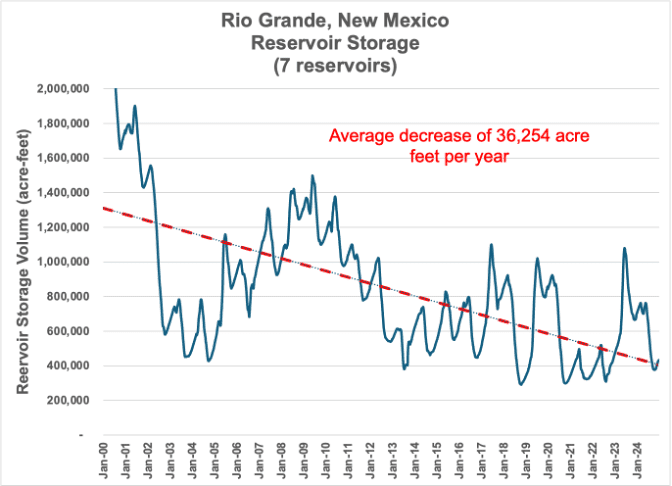
The Colorado River has been in the news headlines a lot lately because the water stored in Lake Powell and Lake Mead has been heavily depleted in recent decades, putting the water supply for 40 million people in extreme jeopardy. The Rio Grande doesn’t receive nearly as much attention as the Colorado, but the Rio’s water supply in New Mexico is arguably in an even more dangerous condition because our reservoirs are tiny compared to those on the Colorado River, and we’ve used up more than 70% of the water that was stored in our reservoirs back in 2000. This year is extremely dry, and what little is left in our reservoirs could easily be wiped out by year’s end.
I’ve spent the past four decades working on water challenges in more than 40 countries. The water crisis facing New Mexico is among the worst I’ve seen.
I knew things were getting bad in the Rio Grande basin because of the increased drying of the river, but it wasn’t until we completed our recent research that I realized how fast we’re using up our available water storage. We documented that only one-third of the water New Mexicans are consuming is being replenished with snowmelt runoff, rainfall, and aquifer recharge. When we consume more water than is being replenished, we dry up our reservoirs and rivers and deplete our groundwater aquifers.
Along the Rio Grande in New Mexico, we have been depleting our groundwater reserves at the rate of more than a half million acre-feet per year. That means that every year, we’re losing a volume of water supply sufficient to provide household water for everyone in New Mexico!
I’ve spent the past four decades working on water challenges in more than 40 countries. The water crisis facing New Mexico is among the worst I’ve seen.
When reservoirs run low, cities and farmers tend to pump much more groundwater to meet their needs. Along the Rio Grande in New Mexico, we have been depleting our groundwater reserves at the rate of more than a half million acre-feet per year! If that overdraft continues, the pumping will begin to suck more and more water out of the river (known as ‘river capture’), the ground surface could begin to drop and fracture roads as well as underground pipes and utility lines, and it will become increasingly expensive to pump groundwater because electricity costs will rise as the groundwater level falls.
Our over-consumption of renewable water supplies in New Mexico is also impacting farmers and cities downstream in Texas. A recent Supreme Court case found that New Mexico’s groundwater pumping downstream of Elephant Butte Reservoir was capturing river water owed to Texas under the terms of the interstate Rio Grande Compact. As a result, more than 9,000 acres (14 square miles) of farmland irrigated with groundwater within the Elephant Butte Irrigation District will need to be retired permanently. More frightening is the fact that New Mexico’s multi-year water debt to Texas has grown to a level that could trigger another Supreme Court lawsuit from Texas that could legally curtail water uses further upstream in the Middle Rio Grande.
Restrictions on groundwater use are urgently needed to prevent this underground crisis from wreaking havoc on our rivers, infrastructure, and economy.
There are two basic strategies for resolving a water overconsumption problem: reduce consumption or increase supply.
Increasing water supplies — such as by reclaiming polluted water from oil and gas fracking — is very expensive because it takes a tremendous amount of energy to clean the water adequately and to pipe it to where it is needed. These high costs generally make any increases in water supplies too expensive for use in irrigated agriculture, which consumes 90% of the Rio Grande water used for human purposes in New Mexico. There are also legitimate concerns about the inability of water treatment processes to remove hundreds of toxic chemicals and radioactivity.
Our research suggests that our reservoirs could be stabilized by reducing our use of river water by about 5%, but greater reduction will be needed to refill reservoirs. This certainly seems attainable at present, but this target will grow as our climate continues to warm in coming decades. Much more challenging is the need to reduce groundwater pumping by more than 60% to stabilize groundwater levels. Clearly, restrictions on groundwater use are urgently needed to prevent this underground crisis from wreaking havoc on our rivers, infrastructure, and economy.
Corrections: At Brian Richtor’s May 21 request, three corrections to the April 30 version are identified in blue italics type to correct errors discovered in the published paper.