Why Water Planning Matters
Aquifers are vanishing. Climate stress is growing. Decentralized water planning is the path forward.
New Mexico faces a stark and accelerating water crisis. In many parts of the state, aquifers are being depleted to support uses that cannot be sustained, especially agriculture dependent on non-recharging groundwater. This extraction is not just borrowing from the future: it is stealing from it. As climate change reduces snowpack, accelerates evaporation, and intensifies drought, the state’s water supply is shrinking.
Though aware of the situation, our political leaders seem unwilling or unable to confront its urgency, while the consequences of delay grow more severe by the year.
An “all hands” commitment to water resources planning (or more simply “water planning”) is how we propose to confront this reality.

Water planning is about solving problems. Good planning helps us understand our water supply and uses, face hard choices, anticipate future conditions, and make informed decisions to secure a livable and just future for New Mexicans.
The choices we make in the next few years will determine whether many communities across New Mexico have water security, or whether too many will face escalating crises. The time for planning is not someday. It is now.
Purpose of Water Resources Planning
Water resources planning is a forward-looking, problem-solving process to ensure the sustainable, equitable, and efficient use and management of water in the face of increasing and permanent scarcity. Its purpose is to identify and address water challenges, especially those driven by climate change, aquifer depletion, legal obligations, and shifting demands. It does this by thoughtfully and carefully integrating science, law, governance, and public values.
Water planning in New Mexico must take place in conformity with state and federal laws, while also confronting a basic truth: Many essential water needs and uses are not protected by law. Drinking water and sanitation for all, reliable supplies for communities, schools and hospitals, our beloved rivers and the sacred needs that they supply—these uses have no claim to water rights or have rights with low priority under law. Yet these needs are not going away. and raise the fundamental question: how to share shortages fairly. Thus, planning involves negotiating the rules for who gets what, when and how.
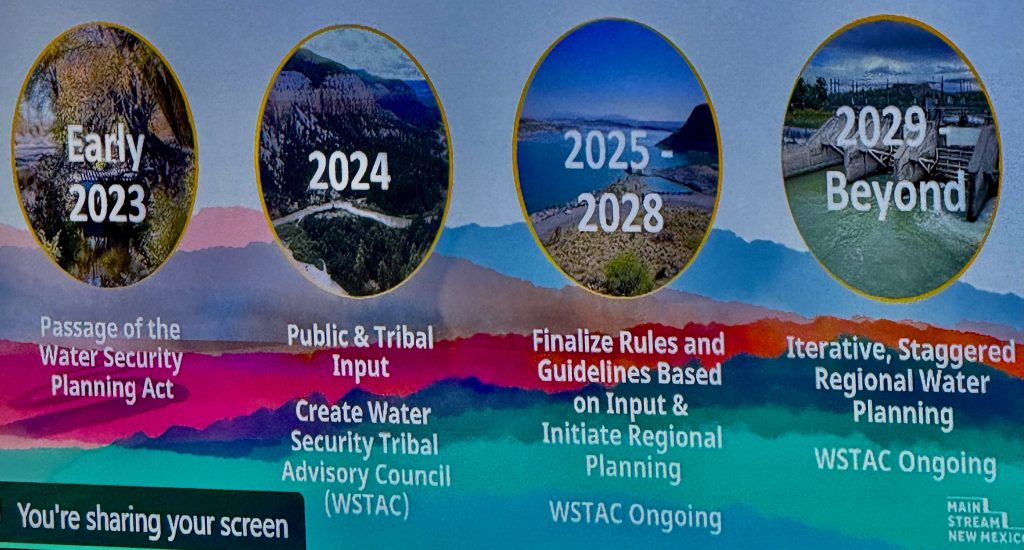
Drained aquifers cannot be brought back. Adaptive action is the only way to avoid catastrophic and irreversible loss. Urgency in understanding local situations now through planning will reduce the number of future New Mexico communities that will run out of water. Decentralization is essential. The problems are local and regional. Planning must be too.
Key Goals
1. Balance Supply and Demand
Assess available water under changing climate conditions and align this reality with current and future demands for people, farms, ecosystems, and economies. This requires a reliable understanding of the planning region’s water supplies and water uses.
2. Balance Competing Needs
Navigate the intersecting and often conflicting demands of:
• Urban and rural communities
• Agriculture
• Environmental protection
• Economic development
In New Mexico, this includes confronting the consequences of continued agricultural uses and proposed economic development new uses that mine groundwater at the expense of communities and future generations who will be left without. Planning must grapple with these intergenerational trade-offs and define transitions toward sustainable use.
Water measurements and hydrogeologic science developed and applied with scientific integrity must define a framework upon which the social methods of water planning. Water planning overlays the law, legal uncertainty, economics, and values on the facts. A beginning common ground between diverse interested parties can be built on understanding facts and the legal situation in a process where the parties learn about the problems that planning must address and get to know each other.
Irrespective of the diversity of belief systems held by members of a community, it is essential that planning be built on a framework of agreed upon hydrological, hydrogeological, and meteorological data. (You are entitled to your own opinions but not your own facts!) Face to face communication among members of a planning group is essential in building the trust needed to get beyond “head in the sand” refusal to listen or to entertain opposing points of view. That trust is key to building a workable plan.
The work of planning is social and probabilistic, not deterministic. A major social component is breaking through the head-in-the-sand attitude that is apparent in so many local business leaders and public officials. It may be difficult to bring recalcitrant parties to the table, but easier as they come to understand the risks they and their interests face by simply being members of the community. Their participation is needed to help find solutions.
3. Promote Long-Term Sustainability
Acknowledge the limits of natural recharge. Many New Mexico aquifers are essentially non-recharging, and climate change is reducing recharge further due to accelerating evapotranspiration. Planning must reflect these realities and support strategies to limit further depletion, extend critical supplies, and protect water security for future generations. Planning should support monitoring systems and adaptive governance frameworks to respond to depletion trends and new data.
4. Manage Risks and Uncertainty
Prepare for droughts, floods, compliance with legal constraints like the Rio Grande Compact, and intensifying climate volatility. Regional water budgets and enforceable demand management agreements are tools that might be produced through regional water planning to address uncertainty.
5. Protect Ecosystems and Water Quality
Safeguard river health, aquifer integrity, and clean water supplies through integrated, science-based planning. Planning should address nature-based solutions—such as increased natural infiltration of stormwater runoff, watershed restoration, ecological flow targets, and aquifer recharge zones—as climate adaptation strategies.
6. Guide Investment
Make sound decisions and recommendations for infrastructure spending. Prioritize projects, programs, and policies for implementation. Well-prepared regional plans will unlock access to state and federal infrastructure funding. Technical assistance should be provided to ensure all regions, especially underserved and rural areas, are competitive and ready.
7. Ensure Equity and Public Benefit
Plan to meet the needs of all people, not just those with the most power or resources. Respect and integrate tribal, cultural, and historical water rights in all decisions. This includes supporting capacity-building for Tribal and rural communities to ensure their voices, rights, and knowledge systems are equitably integrated into planning and governance processes.
8. Inform Policy and Governance
Provide a science-based framework to guide laws, public funding, institutional design, and transparent decision-making. Planning must support governance that is lawful and enforceable, while also addressing essential and sacred water requirements—like those for communities, hospitals, schools, ecosystems—that are often subordinate under existing water rights but are indispensable to a functioning society.
Without a clear planning framework and enforceable rules, these essential needs will remain vulnerable. Some will go unmet. The window for proactive, science-informed policy is rapidly closing. We must choose between managed transition and unmanaged collapse. Sound regional planning based on truth, urgency, and local leadership is the foundation for New Mexico’s water future.
ISC Commission members have the power to unlock access to funding so that across NM regions and regional leaders can begin now, instead of dates far into the 2030s, to begin to fulfill their lawful decentralized responsibilities.