At winter’s end early this year, the snowpack was low; the spring runoff forecast was dismal. Two federal agencies, the Bureau of Indian Affairs and the Bureau of Reclamation, stored all the native Rio Chama runoff in El Vado and Abiquiu to ensure a full supply for the six Middle Rio Grande Pueblos prior and paramount water rights. Of the approximately 34,000 acre-feet of water stored, 13% was used and 5% evaporated. Winter arrived again with 26,000 acre-feet remaining in storage.
Federal and state water agencies planned the release of this water. This article summarizes the fate of the release as the water flowed downstream.
A block release of the remaining 26,000 acre-feet of stored water began November 30. Water agencies intended that it flow unused into Elephant Butte Reservoir to reduce this year’s large underdelivery of the water that belongs to water users below Elephant Butte Dam. As of November 24, 2025, the Rio Grande Compact accounting model showed New Mexico’s deliveries were about 39,000 acre-feet short of the delivery obligation.
The hydrographs below show vividly what happens when water is poured down losing reaches of a river. We hope the OSE and ISC will collect a complete data set of this event, analyze it, and report their technical analysis and full data set.
Superimposed USGS hydrographs_Rio Chama winter block release. NM Water Advocates graphic
Let This Set of Hydrographs Tell Their Story
Let’s start with a summary of the MRG geography.. The Cochiti Dam releases drive the downstream responses, as the hydrographs above illustrate. The step increases in Cochiti Dam releases are in response to Abiquiu Dam releases to the Rio Chama upstream. The Abiquiu Dam releases flowed down the Rio Chama to its confluence with the Rio Grande, and down the Rio Grande into Cochiti Reservoir. Cochiti Dam releases were stepped up or down once daily to match the total inflows to the reservoir.
During the block release period, the Rio Grande below Cochiti Dam gage steps up rapidly to 2,000 cubic feet per second (cfs) for six days and then steps down. The Cochiti Dam release mimics the Abiquiu Dam release on the Rio Chama, which was sustained at 1,400 cfs for six days. The difference is water from the northern Rio Grande, measured at the Rio Grande at Embudo gage.
2025: An Extremely Dry Setup.
How much of the release made it to Elephant Butte? The answer begins with the conditions leading into the release. Rio Grande flows in 2025 set record lows. The runoff was small and brief. After the runoff ended prematurely in May, the riverbed was dry through Albuquerque and more extensively downstream for several months.
River water users did their best to meet their needs with increased groundwater pumping.
Floodplain and riparian vegetation— cottonwoods, willows, salt cedar, Russian Olive — drank from the wetted soil zones above the shallow groundwater table.
How Much Made It to Elephant Butte? Peak Flows at Downstream River Gages Reveal Large Losses
Individual hydrographs show consistently lower peak flows as the block release moved down the river. The pattern is clear.
Cochiti Dam release: Peak flows of 2,000 cfs were sustained.
Bosque Farms: The peak flow is much lower, delayed, and smoothed. Comparing the flow downstream of Albuquerque with the Cochiti Dam releases shows large losses through the Albuquerque reach.
San Acacia: The peak is lower still at this river gage at the head of the Socorro Valley, but not by a huge amount. The losses between Bosque Farms and San Acacia are relatively small.
San Marcial (floodway): The peak is further reduced and delayed. The river above San Marcial suffers especially high river losses. The river channel is perched several feet above the adjacent floodplain, trapped between levees on an elevated bed of accumulating sediment.
Elephant Butte Narrows: As of December 18, only a muted remnant of the original pulse has made it Elephant Butte Reservoir as of December 18.
Reclamation’s 1950s low-flow conveyance channel at San Marcial is added to the San Marcial river flow as the total surface flow moving downstream at that river location. Both flows come together before the Narrows gage.
Comparison of the San Marcial and Elephant Butte Narrows hydrographs shows significant intervening losses as the water flows down a temporary channel dredged by amphibious excavators to the Narrows. The channel is dredged through the top layer of the thick sediment beds that accumulated when the Elephant Butte Reservoir was routinely full and the pool reached almost all the way north to San Marcial.
Summary – What the Hydrographs Show
Each downstream gage captures a smaller and flatter version of the same release, indicating significant losses in every reach. Our calculations show the river lost more than 40% of the block release.
The Embudo gage provides a steady upstream reference.
The Abiquiu release provides a controlled input.
The Cochiti release shows their combined signal.
Everything downstream shows systematic attenuation clearly visible in the curves.
The Bottom Line
The block release was intended to move Prior and Paramount stored water downstream to Elephant Butte Reservoir.
The hydrographs show that much of the water never made it.
The Middle Rio Grande took it — into the channel, the banks, the shallow aquifer, and the steady flow to deep groundwater pumping zones.
Downstream river gages reproduce the Cochiti Dam stepped pattern, particularly the steps down. You can trace the first big drop. These data show a pattern that is consistent with what would be expected after a long season with a dry river, accelerated groundwater pumping, major riparian and domestic withdrawals from the shallow aquifer, and poor channel conditions.
This is more evidence that our current water uses can’t be sustained. Sobering thoughts to consider as a new, even drier year begins.
After explicitly threatening litigation since 1997, Texas v. New Mexico was filed in 2013. The United States added its claims against New Mexico.
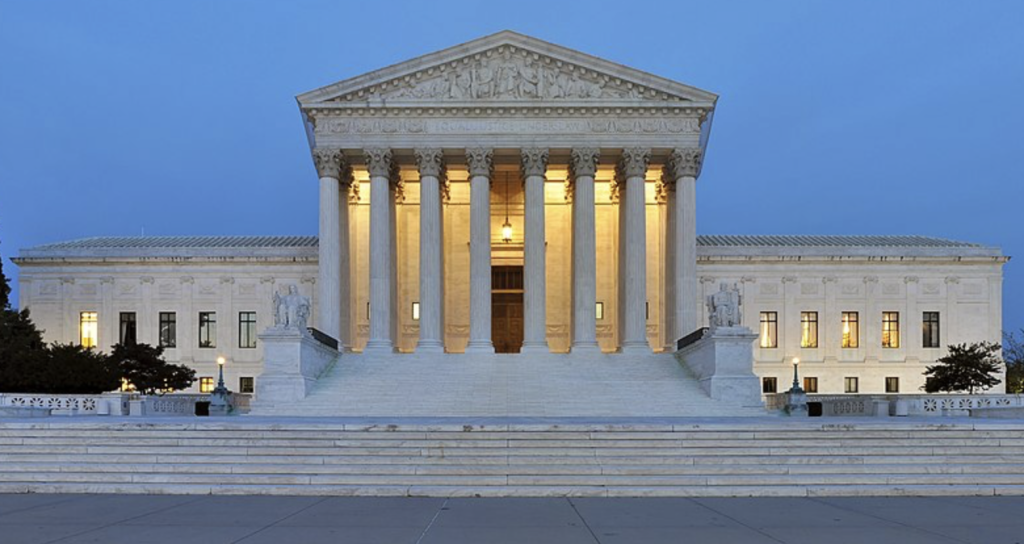
US Supreme Court Building Photo Courtesy of Wikipedia
On August 29, 2025, parties and amici filed a proposed settlement with the U.S. Supreme Court’s Special Master. The settlement consists of a proposed Consent Decree and four implementing agreements that establish an explicit New Mexico downstream delivery obligation for the waters released annually from Caballo Dam. Together, these legal documents total more than 130 pages. They
Establish institutional and financial responsibilities,
Create the Effective El Paso Index that New Mexico’s water deliveries must meet,
Restore New Mexico’s original 57% apportionment of Rio Grande Project water,
Limit New Mexico groundwater pumping, including state purchase of 18,200 acre-feet of actively used groundwater rights from willing sellers,
Require detailed water measurement and accounting procedures,
Set limits on annual and cumulative water delivery debts and credits,
Trigger water allocation transfers, cumulative water underdelivery penalties, or consultation under specific circumstances, and
Leave NM’s discretion intact to continued to buy water or to regulate water uses to achieve compliance.
If approved, New Mexico must comply with numerous, difficult, and permanent requirements. New Mexico’s compliance will cause significant water user and taxpayer impacts.
Why This Analysis is Needed
The Office of the State Engineer posted the proposed settlement documents but with very limited public explanations, all of which have been before the Legislature’s interim committees. Individual requirements are addressed in multiple documents. They must be understood as an integrated whole. The agreements were negotiated as an integrated package but have not been interpreted for the interested public.
Without an official interpretation for New Mexico’s interested and affected public, understanding how the five documents work together is difficult and time-consuming. That’s the purpose of this second Water Advocates’ analysis that focuses on the proposed settlement’s compliance measures.
Understanding the Settlement
There are two parts to the Water Advocates explanation of the proposed Settlement. This article introduces our new analysis. It argues below for the State Engineer to achieve permanent compliance through State Engineer administration of diversions rather than continuing to pay NM water users to not use Texas’s water. Continuing to pay means after the ISC purchases 18,200 acre-feet of actively used groundwater rights from willing sellers.
This article also describes the situation municipal and industrial water users face. The settlement requires negotiation to find a solution to not having enough physical water for all New Mexico users. Almost all municipal and industrial water rights were adjudicated priority dates that are junior to Elephant Butte Irrigation District’s 1903 priority date for Project water and supplemental groundwater. In recent years, New Mexico’s entire annual share of the Caballo Dam release has not been sufficient to meet the 1903 rights.
Our settlement analysis is based on the premise that a good general settlement understanding can be gained answering these questions.
How does the settlement work?
Who pays?
The analysis summarizes each of ten compliance mechanisms we identified in studying the documents. Understanding these compliance mechanisms gives a good answer to the first question above. Seven of the ten compliance measures are mechanisms to reduce water use. Six of the seven require state funding. One of the six mandates state spending to purchase and permanently retire 18,200 acre-feet of actively used groundwater pumping rights from willing sellers. State administration by priority or the water users’ agreed alternative is the seventh.
Five settlement compliance mechanisms would require considerable continuing state funding over and above the mandatory groundwater rights purchases. The seventh measure allows the state to limit diversions in the Lower Rio Grande through regulatory action. Using water that belongs to downstream users is illegal and can be cut off through the State Engineer’s existing but unused regulatory authority.
Please consider that the costs of regulatory action to enforce against illegal water uses should be routine across New Mexico. In reality, State Engineer enforcement against illegal water use is rare.
The New Mexico Water Advocates urge New Mexico’s top water decision-makers to make the State’s water administration in accordance with law routine. We urge the Governor and Legislature to invest now in creating OSE/ISC capacity to administer and make clear the state must stop spending tens of millions routinely for short-term fallowing of irrigated lands. It’s pertinent that the ISC on December 11, 2025, approved contracts to pay $17.5 million to 163 EBID farmers to fallow about 8,300 acres for one, two, or three years.
That amount of money would go a long way if the 2026 Legislature appropriated an equivalent amount to increase the water agencies’ enforcement capacity.
Why This Matters Now
The Effective El Paso Index becomes effective on the day the U.S. Supreme Court issues the decree. New Mexico has five years to purchase and retire 9,100 acre-feet of active groundwater rights, and ten years to retire the full 18.200 acre-feet. Interim compliance with that Index and full implementation of everything the Settlement imposes on New Mexico will cost hundreds of millions. The OSE/ISC are requesting $50 million from the 2026 Legislature to get started. Additionally, the State Engineer must implement Active Water Resources Management (AWRM) regulation of diversions so that New Mexico can stop forever paying farmers to not use water that is not theirs to use.
Regardless, the settlement will have a major impact on New Mexico’s Lower Rio Grande water use and water users. Legislators, local officials, water managers, and the public all have an interest in understanding New Mexico’s many compliance obligations including the settlement’s processes, required milestones, deadline, and penalties, in addition to the state funding requirements and options.
This settlement must serve as a warning to New Mexico’s water-resource agencies, the Governor, and the Legislature’s finance committees and leadership. New Mexico’s water resources agencies don’t think or act like regulators. The settlement will teach New Mexico a painful lesson of water resources governance neglect.
Continued failure by the Office of the State Engineer to implement Active Water Resources Management as authorized by the 2003 Legislature will cause a massive taxpayer burden. Instead, the State Engineer must apply the General Rules for AWRM unanimously upheld by the NM Supreme Court in 2012. AWRM is essential to avoid draining the public purse into both the Lower and Middle Rio Grande.
Continued failure to stop ongoing depletion of the Lower Rio Grande’s Rio Grande Compact entitlement by unregulated Middle Rio Grande water uses will bring the next new SCOTUS litigation in two or three years. It’s time to stop the never-ending-saga of successive chapters of Texas v. New Mexico. State leaders collectively can stop that saga, but that requires the State to get its water management house in order and take actions, muy rápido.
New Mexico State Capitol Photo: Mike Sanchez
What About Municipal and Industrial Water Users?
One major impact of the settlement is its ultimate effect on junior water uses. The state adjudication court awarded 1903 priority dates to EBID’s share of Caballo Dam releases and for EBID farmers’ supplemental groundwater pumping required for a full annual water supply of 3.024 acre-feet. According to the State Engineer’s chief lawyer, almost all municipal and industrial water rights are junior to EBID water rights. The hydrologic record shows the total available annual surface water has been insufficient in many years this century to meet the 1903 water rights. We believe that administration involving cutting off junior uses and cutting into senior uses will be required to meet the new Effective El Paso Index.
That leaves the junior uses in the coming collision between equitable requirements for water and the hydrologic reality of insufficient water. Statutory law does not recognize these equitable requirements for water, but we believe courts will not cut off junior hospitals and schools or people from their drinking water.
The OSE and ISC are not talking about this publicly, although the topic is addressed in the Operations Settlement Agreement, Section II.B.
“Other Adjudication and Administration Issues. The United States, New Mexico, and EBID agree to negotiate in good faith among themselves and the Other Amici in New Mexico (“Other New Mexico Amici”) to seek to resolve, by no later than October 1, 2026: (1) the potential objections of the Other New Mexico Amici to the [EBID water right priorities in the] proposed amended subfile order in SSI 101; (2) other appealable issues raised by the United States’ and New Mexico’s notices of appeals in SSI 104; (3) a separate appeal filed by the City of Las Cruces in SSI 104; and (4) final decrees of subfile orders on the water rights of EBID, the City of Las Cruces, and New Mexico State University. In addition, by no later than October 1, 2026, the United States, New Mexico, and EBID agree to negotiate in good faith among themselves and with the Other New Mexico Amici on issues associated with the manner in which the New Mexico State Engineer will administer water rights determined in the LRG Adjudication, including a potential alternative administration plan that might replace strict priority administration. Nothing herein precludes the participation in the negotiations of an affected party or amicus in the adjudication.“
What About Upstream in the Middle Rio Grande?
OSE and ISC are avoiding naming this problem, also. The plain truth is that New Mexico will by its neglect cause a new violation of the Rio Grande Compact within 2 or 3 years, due to routine Middle Rio Grande use of water the Compact apportions for use below Elephant Butte Dam. This overuse is due in part to the unregulated diversions of water by the siloed water institutions named above, excessive groundwater pumping that takes water from the river, and the poor condition of the Rio Grande channel to move water downstream. If New Mexico does not stop this pending new compact violation, it will create a huge new taxpayer burden. In the end, New Mexico will be left with the same choice it faces today: to comply or to be held accountable by Texas and the U.S. Supreme Court. Assuming the proposed Lower Rio Grande Consent Decree is an example, noncompliance will be met with large penalties, paid back in real, wet water.
The Public Welfare of the State
Taxpayers and downstream users will suffer from the structural mistake of legally enabling water-management silos in New Mexico, such as the Elephant Butte Irrigation District, the Middle Rio Grande Conservancy District, and the Albuquerque Bernalillo County Water Utility Authority without constraining them to act in a manner that is consistent with “the public welfare of the state.” These entities pursue their own interests while disregarding the impacts of their actions on Rio Grande Compact compliance. The plain truth is New Mexico allows actions by these siloed agencies that are “detrimental to the public welfare of the state.”
We have not acted to prevent this mess. Now we have to deal with it. It will be difficult.
Editor’s Note
We strive to provide accurate and thorough information in this analysis. We encourage you to let us know if you identify any errors or omissions. Your feedback is valuable and will help us maintain the accuracy and usefulness of this resource. Thank you for your assistance in ensuring the quality of this public reference.
On August 29, 2025, the Lower Rio Grande litigation parties and “friends of the court” filed a proposed settlement with the U.S. Supreme Court’s Special Master in the interstate water lawsuit brought by Texas against New Mexico in 2013. The United States later joined the litigation to assert its claims against New Mexico. In 2023, the U.S. Department of Justice objected to a proposed settlement between the three Compact States, stating that New Mexico must be specifically required to timely meet its commitments. The Supreme Court rejected it.
The “canalized” Lower Rio Grande in the Mesilla Valley. Photo credit: El Paso Water
A revised settlement was filed in August 2025. It consists of a proposed Consent Decree and four implementing agreements between the litigants and the irrigation districts in both states. Following a Special Master hearing in Philadelphia, state water officials informed legislative committees in November that they expect the Special Master to recommend approval to the Supreme Court. If approved, the Court will issue a final decree making the agreements binding and enforceable. The Supreme Court practice is to create a continuing Special Master position to perform decree accounting and report or oversee compliance.
The Consent Decree and four implementing agreements exceed 130 pages and are highly technical. This New Mexico Water Advocates summary explains, in straightforward terms, what the settlement requires, what it authorizes, and how the parties are to carry it out. It identifies who must act, under what conditions, by when, and with what consequences. The settlement would significantly change water management downstream of Elephant Butte Dam.
New Mexico Water Advocates invites readers provide comments regarding errors or important material missing from this summary.
October’s Big Storm Helped the River But the Middle Rio Grande Depleted 40% of the Lower Rio Grande’s Share
An intense rainstorm centered on the San Juan River mountain headwaters spilled over into the headwaters of the Rio Grande, sending a surge of mountain runoff into the San Luis Valley. This is the storm that flooded Pagosa Springs. The October 14 Alamosa Citizen story headline on the flood was followed by the reporter’s understanding of routine Colorado water management in the subtitle, “Now it’s time to measure and account for the extra water in management of the Rio Grande Compact.”
The Rio Grande at the Del Norte gage peaked at 7,000 cubic feet per second—a very high flow for autumn. The Colorado Division of Water Resources contemporaneously estimated 20,000 to 25,000 acre-feet entered the San Luis Valley in Colorado, and reported that 15,000 acre-feet was diverted into the Valley’s canals. Colorado’s Rio Grande Division Engineer, Pat McDermott, told the Rio Grande Basin Roundtable that the Middle Rio Grande might see roughly 5,000 acre-feet of this water, but that it would likely not extend as far south as Elephant Butte Reservoir. The Rio Grande benefit in New Mexico actually was much larger but he was right about Elephant Butte.
Because the Rio Grande Compact divides the river’s flow among Colorado, the upper, middle and lower Rio Grande in New Mexico, and the Lower Rio Grande in Texas, how each state measures and manages water determines whether its downstream obligations are met.
The irrigation season in Colorado and New Mexico ended November 1. Colorado flows increased as a result but are tapering down. Deliveries into Elephant Butte are now slowly increasing, but didn’t benefit from the Colorado flood. The contrast between Colorado’s prompt accounting and New Mexico’s limited conveyance is striking.
A Growing Water-Delivery Debt
The Middle Rio Grande entered the year 124,000 acre-feet behind in its accrued annual water deliveries to Elephant Butte Reservoir. Throughout the year, that debt has inexorably grown due to the complete failure of this year’s spring runoff and the Middle Rio Grande’s excessive depletions over the last 15 years. New Mexico does not manage the Middle Valley’s groundwater pumping, which accelerated due to lack of river water, the Middle Rio Grande Conservancy District’s diverting more than New Mexico’s share, and poor channel conveyance.
Neither the State Engineer nor the Interstate Stream Commission have publicly discussed this year’s growing debt. Neither has emphasized New Mexico’s serious risk of a new violation of the Rio Grande Compact due to the Middle Rio Grande’s chronic taking of the Lower Rio Grande’s share, year after year.
I decided to calculate what happened on the Rio Grande in New Mexico from the storm. I used online river and reservoir gage data from October 12 through November 9, the last day for which a complete data set is available online. My calculations show that between those dates, 40,900 acre-feet of water flowed under the highway bridge to Los Alamos as measured at the Otowi Bridge gage. Colorado state-line water deliveries were about 60 percent; the other 40 percent came from New Mexico springs and tributaries. The Lower Rio Grande’s share of that, which is the same thing as the Middle Rio Grande’s delivery obligation, was 23,300 acre-feet.
Elephant Butte’s storage increased only 14,000 acre-feet and releases were 100 acre-feet, creating an actual water delivery during this period of 14,100 acre-feet. The result: this a deficit of 9,200 acre-feet over this 29-day period was added to New Mexico’s 2025 debit. Roughly 40 percent of the water that should have reached the reservoir disappeared within the Middle Valley.
Some unknown combination of Middle Rio Grande Conservancy District diversions, increased groundwater pumping that induces recharge from the river, and the poor water-conveyance condition of the river channel upstream from and into the nearly dry Elephant Butte Reservoir absorbed or intercepted much of the flow. This is why so little of the high flows reached Elephant Butte, leaving New Mexico much worse off with regard to its Compact obligations.
Why I’m Tracking Deliveries Monthly
The Water Advocates for several years has urged the Interstate Stream Commission staff to begin paying public attention to water deliveries through the Middle Rio Grande each month and forecasting the year-end results. Sure there are uncertainties and unknowns, but both tracking intra-year progress and forecasting the year-end results are an essential first step to recognizing and managing this serious problem.
The State can’t manage what the State doesn’t measure—and that includes contemporaneous annual compliance as a year progresses. Water delivery debt has grown significantly during 2025, without any Interstate Stream Commission acknowledgement of that fact. Both the facts and state agency silence should alarm the Legislature and the public.
My independent review of this year’s Compact deliveries began this summer. I requested data at the end of each recent month from the Bureau of Reclamation’s engineer who operates the official Rio Grande water accounting model. Last month he discovered a problem with the initial condition for the 2025 accounting. We both made bad estimates because Reclamation’s Elephant Butte Reservoir instrumentation, which measures the reservoir’s water-surface elevation and determines its storage volume, became stuck. I misunderstood how the model accounts for federal storage of New Mexico water in Rio Chama reservoirs to ensure the six Middle Rio Grande Pueblos’ Prior and Paramount water rights have a full supply. The release of unused prior and paramount water between now and the end of the year should materially improve net Compact deliveries over the remainder of the year because it was properly accounted when it was stored.
The Outlook
I project the year will end with an annual 2025 Middle Rio Grande water-delivery debt of about 26,000 acre-feet and an accrued water debt of about 150,000 acre-feet. If so, that may give us two years to avoid a Compact violation rather than only one. We must use this time to stop and reverse the current trend, prevent the violation that continued inaction will cause, and begin working our way out of Compact debt. Any accrued water debt above about 50,000 acre-feet effectively prevents Middle Rio Grande water from being stored upstream in Rio Chama reservoirs.
A public agency can’t deal with a complex problem that impacts the public unless and until the agency names the problem and describes it. A problem can’t be managed if progress toward the desired outcome is not measured. The State Engineer’s job is to comply with the Compact. The ISC’s job is to gather accurate information, professional analysis, and make it publicly available. Both have the duty to communicate openly and promptly.
I speculate this crisis is getting the silent treatment by both state agencies because they don’t have the Governor’s consent to confront it. Dealing with this compact emergency is not in the Governor’s 50-Year Water Action Plan. Neither is water planning. If we have to wait for a new Governor to attend to New Mexico’s water emergency, it may not be in time to prevent a brand new Texas v. New Mexico case before the US Supreme Court. Failing to take serious action now is another step toward the huge risks and costs of the litigation that will follow a violation. That’s a poor legacy for everyone involved.
New Mexico needs transparent water management to prevent the looming Compact violation. It needs funding. It needs it now.
We’re Asking the Governor & Legislature to Fund State Water Agencies to Secure A Better Water Future
Senator Liz Stefanics, Chair of both the Legislature’s Water and Natural Resources Committee and the Senate Conservation Committee, asked water advocates to identify financial resources needed to confront New Mexico’s deepening water crisis. The New Mexico Water Advocates responded with three essential programs: Rio GrandeCompact Compliance, Water Data infrastructure, and Regional Water Security Planning.
These are not long-term wish-list items. They were recommended specifically by the 2022 New Mexico Water Policy and Infrastructure Task Force. They are well-vetted and justified emergency responses to New Mexico’s water crisis that is already destabilizing communities and ecosystems and threatening our economy. New Mexico is over-using its renewable water supplies while climate heating drives aridification and the decline of both groundwater and surface water resources. The State must improve its ability to comply with the Rio Grande Compact, to track and manage actual water use, and to plan realistically for a more resilient water future that is now in jeopardy.
These three programs are designed to meet the crisis and bring it under control. Together they build the State’s essential capacity to enforce water rights, meet New Mexico’s Rio Grande Compact obligations, generate and share reliable water data, and empower regional planning councils to act on that information. Only the State of New Mexico, through its agencies and technical institutions, has the authority and responsibility to do these essential jobs. With adequate funding to begin multi-year efforts this session, the State can start stabilizing the crisis and lay the foundation for science-based, transparent, and durable water governance. Without funding, New Mexico will remain in emergency mode—reacting to shortages, assuming the enormous risk and costs that a compact violation unleashes, and defending against new Texas litigation—instead of preventing or managing to mitigate them.
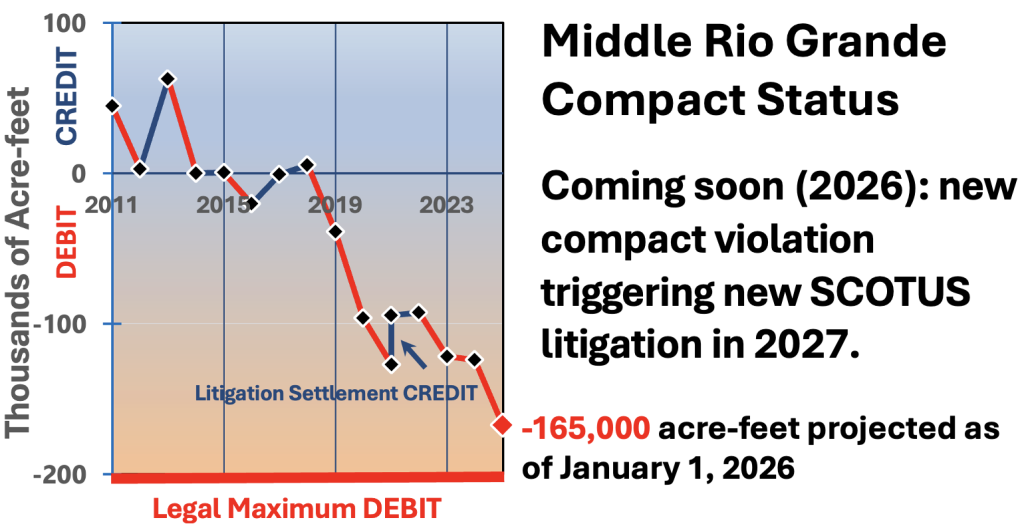
Rio Grande Compact Accrued Debit/Credit History
1) Rio Grande Compact Compliance
New Mexico must meet its delivery obligations to Texas and the United States while protecting communities and ecosystems in the Middle Rio Grande. We recommend:
$10 million (one-time) to the Office of the State Engineer (OSE) to implement the Lower Rio Grande settlement and prevent a new Rio Grande Compact violation due to Middle Rio Grande water overuse. At the current trend, we have only two years and perhaps only one to prevent new Texas v. New Mexico litigation. An emergency clause is needed to provide funding as early in 2026 as possible.
$1 million (recurring) for enforcement capacity—staff, office space, vehicles, and equipment—so the OSE can enforce Lower and Middle Rio Grande water rights.
Pass the Water Rights Enforcement bill, the 2025 measure to modernize an outdated statute that stalled on the Senate floor awaiting a final vote. The State Engineer needs workable administrative enforcement authority to stop illegal water uses without having to sue the user.
Why it matters: The Lower Rio Grande settlement requires New Mexico’s detailed plan in two years to substantially reduce Lower Rio Grande water use and full compliance in 10 years. At the present trend, Middle Rio Grande illegal water overuse will cause a compact violation in two years.
2) Water Data to Support Planning & Management
New Mexico’s water decisions are only as good as the data behind them. We recommend:
$7 million (one-time) to the OSE to replace the outdated water-rights database and application, build a real-time water-use database and application, and implement a modern management information system.
$3 million (one-time) to NM Tech for the Bureau of Geology & Mineral Resources (NMBGMR) to contract with Water Data Act directing agencies to publish priority datasets to the state water data catalogue. These datasets will be selected in consultation with the Interstate Stream Commission (ISC) to help ensure regional water planning councils have the best available science, data, and models.
$21.5 million (one-time) to NM Tech for NMBGMR to accelerate the statewide Aquifer Mapping Program—geophysics, new characterization and monitoring wells, and term staff—to illuminate where, how fast, and why groundwater conditions are changing.
Why it matters: You cannot manage what you don’t measure. These investments give local water managers, planners, and the public the transparent, timely information demanded by aridification, warming, and overuse.
3) Regional Water Security Planning
To make the Water Security Planning Act work on the ground, regions must organize credible councils and set pragmatic work plans. We recommend:
$4.8 million (one-time) to the OSE for the ISC to make grants to nine regional entities to stand up councils and develop work plans for Commission approval. The appropriation includes 6% for ISC administrative costs at $300,000.
Why it matters: Durable solutions are local and data driven. Funding regional councils to organize and plan with the best data available creates a transparent path from facts to decisions.
Bottom line: New Mexico is overusing declining renewable water supplies in a warming climate. The responsible fix is not slogans or one-off projects. It is steady, statewide capacity in water law enforcement, water data, aquifer science, and regional planning. Please urge your legislators to fund these requests and pass the enforcement bill this session. It’s the most cost-effective way to protect communities, economies, and rivers—not just this year, but for decades.
Middle Rio Grande Compact Deliveries & Water Delivery Debt
New Mexico’s water situation is deteriorating; under the Rio Grande Compact, NM is accruing historic water delivery debt. This reveals a clear leadership failure in protecting New Mexico’s water.
As would be expected with a dry Rio Grande riverbed aggravated by uncontrolled diversions and groundwater pumping, the September compact compliance news is bad. According to the Bureau of Reclamation’s water accounting model, New Mexico’s water delivery arrears increased to -52,100 acre-feet as of midnight on September 29. Reclamation can’t provide the end of September figures because the federal government is shut down.
Projection of Future Water Delivery Debt
Unless we experience a weather miracle, namely the remnants of a hurricane crossing the Middle Rio Grande, I estimate that by the end of 2025, cumulative water delivery debt will be about -165,000 acre-feet. New Mexico’s increasing debt trend will look like this.
My experience as Interstate Stream Commission Director (1997-2002) and “engineer advisor” to the New Mexico Commissioner, Rio Grande Compact Commission and my license as a retired water resources engineer qualify me to publish this projection. Time will tell if it is accurate.
The Urgent Need for Courage & Transparency
The Interstate Stream Commission Director’s September 18 staff report cites only the official compact debt as of January 1, 2025:
Rio Grande Compact Status – New Mexico’s cumulative Compact debit status is 124,000 acre-feet and Article VII restrictions continue to be in effect.
Nothing was said at the Commission’s September 18 public meeting about the Water and Natural Resources Committee’s September 12th meeting. Legislators charged that New Mexico water agencies lack courage and urgency to confront the imminent new new compact violation and prevent it.
Preventing this imminent new Rio Grande Compact violation requires the leaders of these agencies to tell us the transparent truth. No major New Mexico water problem can be solved until it is publicly named and described.
The legislature recognizes that the adjudication process is slow, the need for water administration is urgent, compliance with interstate compacts is imperative and the state engineer has authority to administer water allocations in accordance with the water right priorities recorded with or declared or otherwise available to the state engineer.
The state engineer shall adopt rules for priority administration to ensure that authority is exercised.
This law and the associated regulations were written to manage the illegal overuse of water Lower and Middle Rio Grande. The New Mexico Supreme Court in 2012 unanimously upheld the regulations. Successive State Engineers have not upheld this law or invoked these regulations.
Budget Battles: Legislature vs. Water Protection
Governor Michelle Lujan Grisham requested $500,000 annually from the 2025 Legislature to enforce Middle Rio Grande water rights and confront the Middle Rio Grande water overuse problem. The House Appropriations and Finance Committee under Chairman Nathan Small’s leadership refused to include that request in the budget, instead choosing to direct millions of dollars to oilfield produced water and brackish water treatment. That decision shows legislators who rightfully criticized and mocked both agencies lack of urgency are collectively guilty of the same failures.
Legislative leaders and state budget appropriators: where is your leadership to protect New Mexico’s water?
New Mexico’s problem isn’t so much that some people take too much, although that’s a problem, too. It’s that all surface and groundwater uses together exceed with nature deplete more river water than the Middle Rio Grande’s legal share. Every extra diversion comes out of the water owed downstream. If we keep doing that, the question of how to get the Lower Rio Grande it’s entitled share to Elephant Butte will no longer be ours to decide. The U.S. Supreme Court will decide for us, with absolute discretion. They would order whatever it takes, even turning the Rio Grande into a controlled delivery canal like downstream.
That’s why it matters. That’s why we must eliminate Middle Rio Grande depletions of water owned downstream and work our way out of compact debt.
The Rio Grande Compact is a perfect barrier protecting the Middle Rio Grande from downstream users demands, but only if New Mexico complies.
Energetic Water Discussion in Taos at the NM Legislature’s interim Water & Natural Resources Committee
Elephant Butte Reservoir is 4% full; bathtub rings are evidence of a crisis NM is failing to address, N Gaume photo 8/27/25
Evidence of Overuse & Looming Compact Violations
The Water & Natural Resources Committee considered Middle and Lower Rio Grande overuse and Compact compliance together as one issue.
Legislators’ discussion began with a five-member Water Security Planning Act panel including ISC Director Hannah Riseley-White, former State Engineer Mike Hamman, Jicarilla Apache Tribe water manager Daryl Vigil, New Mexico Acequia Association Policy Director Vidal Gonzales, and me, a former ISC Director and Water Advocates president. I went last.
The Water Security Planning Act should be implemented to meet its potential as a powerful water resources management problem-solving tool, and
Three priorities require legislative action:
Implement the 2023 Water Security Planning Act.
Modernize the Office of the State Engineer and the Interstate Stream Commission. including their compliance with their 2019 Water Data Act responsibilities.
Enforce water rights by changing the law and funding staff to make enforcement practical and effective.
Elephant Butte Reservoir once-drowned resort foundations and the marina, 4% full, N Gaume photo 8/27/25
Camping on the normally wet, upstream side of Elephant Butte Dam when the reservoir is 4% full, N Gaume photo 8/27/25
Legislators recognize Lower and Middle Rio Grande water overuse and compact compliance are one problem
Legislators’ were engaged. Many still had not spoken when Chair Sen. Liz Stefanics decided to postpone the next panel. She said, “See, we are paying attention to water.” Several legislators directly referred to the Water Advocates handout or the compact compliance graphic while asking questions.
The Lower Rio Grande’s overuse problem in litigation since 2013 reaches a settlement
State Engineer Elizabeth Anderson, her office’s chief counsel Nat Chakares, ISC Director Hannah Riseley-White, and Chief Deputy Attorney General James Grayson presented a clear summary explanation of the Lower Rio Grande compact settlement with Texas, the U.S. Department of Justice, the Bureau of Reclamation, and the New Mexico and Texas irrigation districts.
All officials praised the settlement as the best New Mexico could have done.
In my educated opinion, by the time this is over the taxpayers cost for the litigation and the settlement will be at or over $500,000,000.
It’s one big problem
The legislators’ questions and discussion then refocused on Middle Rio Grande and Lower Rio Grande overuse. They again discussed it as a single problem — an alarm that is growing, uncontained, and far from a solution.
Courage
Sen. Joseph Cervantes, D-Dona Ana, made two strong points. A legislator for 25 years, he is a Las Cruces litigator from a long-established family that owns extensive pecan orchards. He bluntly pinpointed the missing ingredient: Courage.
Later, he mocked the Office of the State Engineer for “planning” a well-metering order for the Middle Rio Grande and “planning” to begin the Middle Rio Grande water rights adjudication. Paraphrasing, He said it was ‘much too little, way too late.’
Yes, but still better than nothing, as the State Engineer’s 2004 shortage-administration rules already have the full backing of the New Mexico Supreme Court (2012). The metering order is one of several initial steps. The water agency executives should be motivated to take those steps very soon.
Urgency
Rep. Matthew McQueen, the Committee vice-chair, asked ISC Director Riseley-White two direct questions about what the ISC is doing to prevent the new compact violation, referring to the trend graphic in the Water Advocates handout. He concluded, saying he was dissatisfied with her lack of urgency.
Authority and Accountability
To be clear, the Office of the State Engineer has the power to stop the overuse, but has not yet taken any overt, public action. The ISC has the responsibility to know the facts and communicate the risk and urgency, and spend money to maintain the river channel. Neither the ISC Director, staff, nor any commissioner publicly recognized any urgency at the Commission’s September public meeting.
The Legislature’s existing accountability metric for Rio Grande Compact compliance should also hold the Office of the State Engineer accountable, not just the ISC. That’s because by law, the State Engineer has the specific responsibility and authority to prevent the Compact violation. The ISC’s purpose with broad authority includes “to protect and to do any and all other things necessary to protect” New Mexico’s water.
Courageous Actions Required
To New Mexico State Engineer Elizabeth Anderson: Please act decisively to prevent the looming Compact violation. It is past time for your office to speak openly about the risks we face — and what your office and others in authority must do to keep the Middle Rio Grande’s water future out of the U.S. Supreme Court.
We wish you Courage and Godspeed.
To Governor Lujan Grisham: Your executive direction to the State Engineer is needed: “do any and all things that are necessary” and within your authority to prevent this new violation of the Rio Grande Compact. Call for the Special Session to pass the 2025 water rights enforcement bill that you recommended by died before its final vote on the Senate floor.
Reference Section 72-2-9.1.A quoted below. This water law passed in 2003 and was upheld by the New Mexico Supreme Court in 2012:
A. The legislature recognizes that the adjudication process is slow, the need for water administration is urgent, compliancewithinterstate compacts is imperative and the state engineer has authority to administer water allocations in accordance with the water right priorities recorded with or declared or otherwise available to the state engineer.
To the NM Legislature: Provide New Mexico’s water resources management agencies with the resources and capacity they require to do their jobs to protect New Mexico’s water resources. Pass the 2025 enforcement bill.
To the public: Demand officials take emergency actions to prevent New Mexico’s new violation of the Rio Grande Compact next year that will place the Middle Rio Grande’s water future in the unfettered and unappealable discretion of the U. S. Supreme Court.
Interested members of the public should know:
The Rio Grande Compact shields the Middle Rio Grande from downstream demands, but only as long as New Mexico stays in compliance.
Since 2018, New Mexico’s annual overuse has averaged about 22,200 acre-feet — small compared to average Rio Grande inflows of more than 750,000 acre-feet per year.
Groundwater pumping undermines the river’s flow.
Coming Soon
Articles describing,
The looming risk: If New Mexico fails to prevent a new Rio Grande Compact violation, the State’s neglect will impose severe risks on the State and Middle Rio Grande residents. The article will describe why and how the Compact violation risks our river and our lifestyles.
Polycentric water governance: Effective stewardship requires state government, local governments, and the special districts that supply water to share authority and responsibility. Only by working together can we manage common water supplies to meet today’s needs and secure water for future generations of New Mexicans.
A Bureau of Reclamation hydrologic engineer promptly responded to my request for updated Rio Grande Compact accounting data through August 2025. Based on that information and my analysis, the Middle Rio Grande’s 2025 water delivery shortfall is alarmingly large. Summer rains wet the land but not the river, leaving New Mexico much closer to serious legal jeopardy.
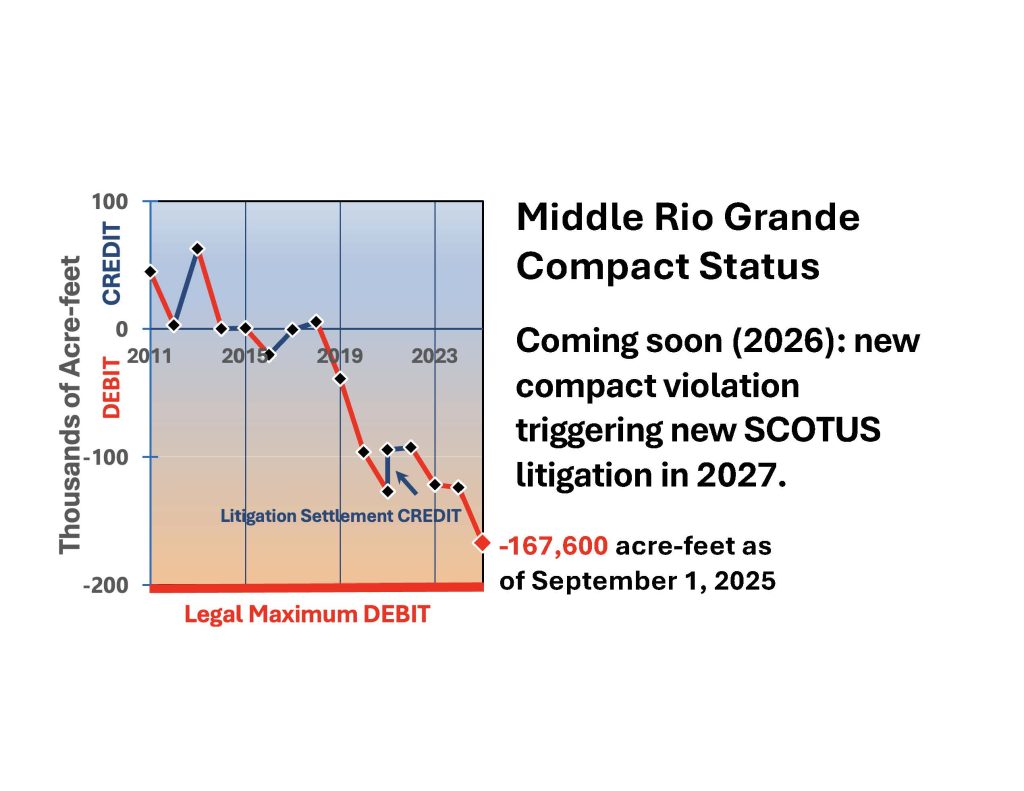
167,600 Acre-Feet Cumulative Water Delivery Debt At August’s End
As the chart illustrates, New Mexico accumulated a 167,600 acre-foot water delivery debt under the Rio Grande Compact as of the end of August 2025. That includes:
43,600 acre-feet of underdelivery during 2025 (so far), and
124,000 acre-feet of accumulated shortfall between 2018 and 2025, as agreed by the Rio Grande Compact Commission.
The Compact sets a legal maximum debit of 200,000 acre-feet.
Federal Water Storage for Pueblos
To support the six Middle Rio Grande Pueblos’ “prior and paramount” rights to water, federal agencies stored as much native Rio Chama water as possible earlier this year in El Vado and Abiquiu reservoirs. While about 3,800 acre-feet has been released to date, over 26,000 acre-feet remains stored. Reclamation traditionally releases the remaining stored water in December for delivery to Elephant Butte Reservoir.
The heat of summer and accelerated groundwater pumping are causing extreme losses of the river’s flow to seepage and evaporation. The shallow groundwater under the riverbed must be recharged before the river can deliver water to Elephant Butte. How much water will actually reach Elephant Butte by the end of this year? No one knows.
My educated guess: New Mexico will end 2025 with a cumulative delivery debt of roughly 160,000 acre-feet—perilously close to the legal limit.
Restored Compact Credit Breathing Room Is Now Gone
New Mexico reached agreement with Texas and Colorado in 2021 to restore 32,400 acre-feet of Compact credit. This resolved a long-standing dispute stemming from Reclamation’s 2011 illegal taking of New Mexico’s credit water.
Without that restored credit, New Mexico’s delivery debt as of August 31 would be equal to the 200,000 acre-foot legal cap. [124,000 + 43,600 + 32,400 = 200,000]
Official Action Delayed?
Nat Chakeres is the top lawyer for New Mexico’s top water official, the New Mexico State Engineer. In his excellent May 2025 Water Advocates workshop presentation, he said the State Engineer planned to begin official regulatory action soon, including a Middle Rio Grande metering order and warning letters to the Middle Rio Grande’s largest groundwater pumpers. If those actions have occurred, they have not been made public.
Bandwidth is a likely reason: the extreme workload and pressures of finalizing and filing the incredibly complex Lower Rio Grande litigation settlement documents and preparing for trials yet to come. The Special Master’s deadline was August 29; the Special Master will preside over a trial later this year. That trial will lead to the Special Master’s decision to forward the settlement to the SCOTUS. The Justices will decide after their 2026 trial.
Meanwhile, the Middle Rio Grande is squarely on the path to a new Compact violation and Texas complaint. As in the Lower Rio Grande, unregulated groundwater pumping is a major cause.
The Middle Rio Grande’s 2025 River Water Supply Has Collapsed
A Sobering Conversation
On Friday, August 1, a kind and knowledgeable hydrologist at the Bureau of Reclamation’s Albuquerque office responded to my questions about the Middle Rio Grande’s river water supply and our year-to-date Compact deliveries to Elephant Butte. The answers were sobering.
The Future Has Arrived Early
It’s time to stop talking about New Mexico’s projected 25% reduction in renewable surface and groundwater supply by 2070. That number, from the widely cited 2021 report by the New Mexico Bureau of Geology and Mineral Resources, now understates our crisis. The 2025 shortfall in river water supply is more than 50%.
The riverbed through metro Albuquerque is dry. The Bureau of Reclamation’s San Juan–Chama Project, which imports water from the Colorado River Basin, hit a record-low allocation in 2025. This year’s water for project contractors is down 69% from a full supply. That’s a massive shortfall for the Albuquerque Bernalillo County Water Utility Authority, which receives about half the water, and the Middle Rio Grande Conservancy District , which receives about a quarter.
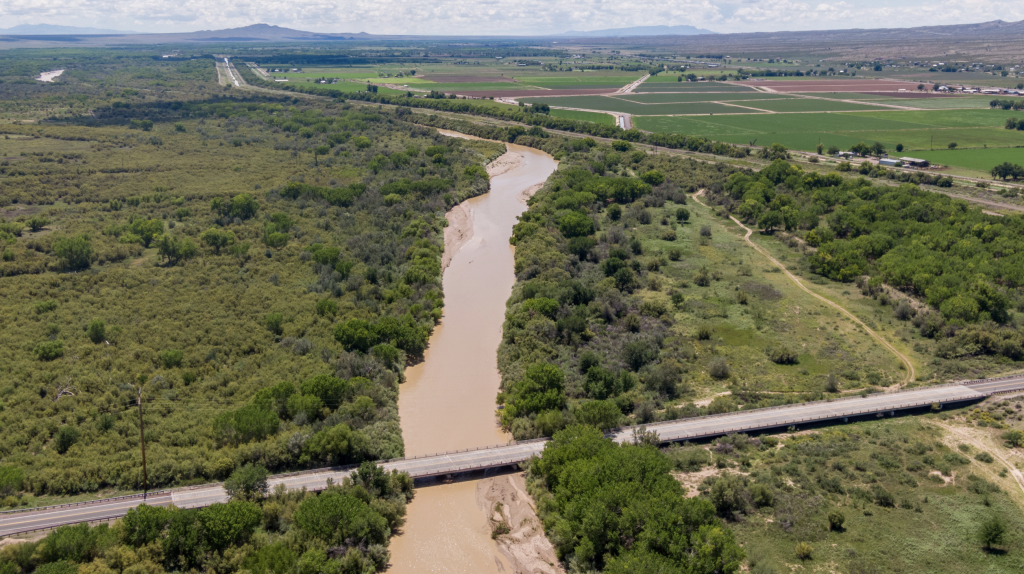
Data show the decline in river flows over the last 50 years, as illustrated in the chart below that I prepared in early June. The drone photo below the chart shows the river channel at the US380 highway bridge near San Antonio in August 2022, a relatively dry year. The river there had water then and the fields are green. This year, the fields may be green but due to rain and groundwater pumping. The river is dry.
Rio Grande at US380 Bridge near San Antonio NM, August 2022. Credit: The Water Desk. c Mitch Tobin
Compact Risk Is Flashing Red
At the May 15 Water Advocates workshop*, State Engineer General Counsel Nat Chakeres stated his belief that the Middle Rio Grande would avoid a Rio Grande Compact violation this year because the water delivery obligation to Elephant Butte is so low. I concur.
But unless the unusual 2025 monsoon delivers a lot more water across the dry watersheds to the river, the Middle Rio Grande’s accrued water delivery debt will rise to roughly 160,000 acre-feet—using up half of New Mexico’s remaining margin. That margin is our buffer before high-stakes interstate litigation returns.
If we exceed the 200,000 acre-foot legal cap on cumulative water delivery debt, we will once again face Texas in the U.S. Supreme Court—this time in another risky, high stakes case that will cost over $100 million and a decade or more to defend. The still ongoing 2013 lawsuit filed by Texas and joined by the United States over New Mexico groundwater pumping in the Lower Rio Grande cost more and is taking longer.
Texas’ formal attempt to bring Middle Rio Grande under deliveries into the ongoing Lower Rio Grande litigation failed, because we remain in compliance, that is, our water delivery debt doesn’t exceed the cap. The Compact creates a clear dividing line that isolates the Middle Rio Grande from the Lower Rio Grande, but only as long as the Middle Rio Grande remains in compliance.
What Must Be Done
We must acknowledge that our renewable water supply is shrinking now—not decades from now. And we must act accordingly. Either we take strong action to comply with the Compact, or we will be forced to devote our state’s water agencies to the enormous task of defending a new Supreme Court case—this time involving water for half of New Mexico’s economy and population. And we will be forced to comply, but with less leeway and discretion.
*Visit the “Past Events” tab at nmwateradvocates.org to access the May 15 workshop recording and slides.
Technical Notes:
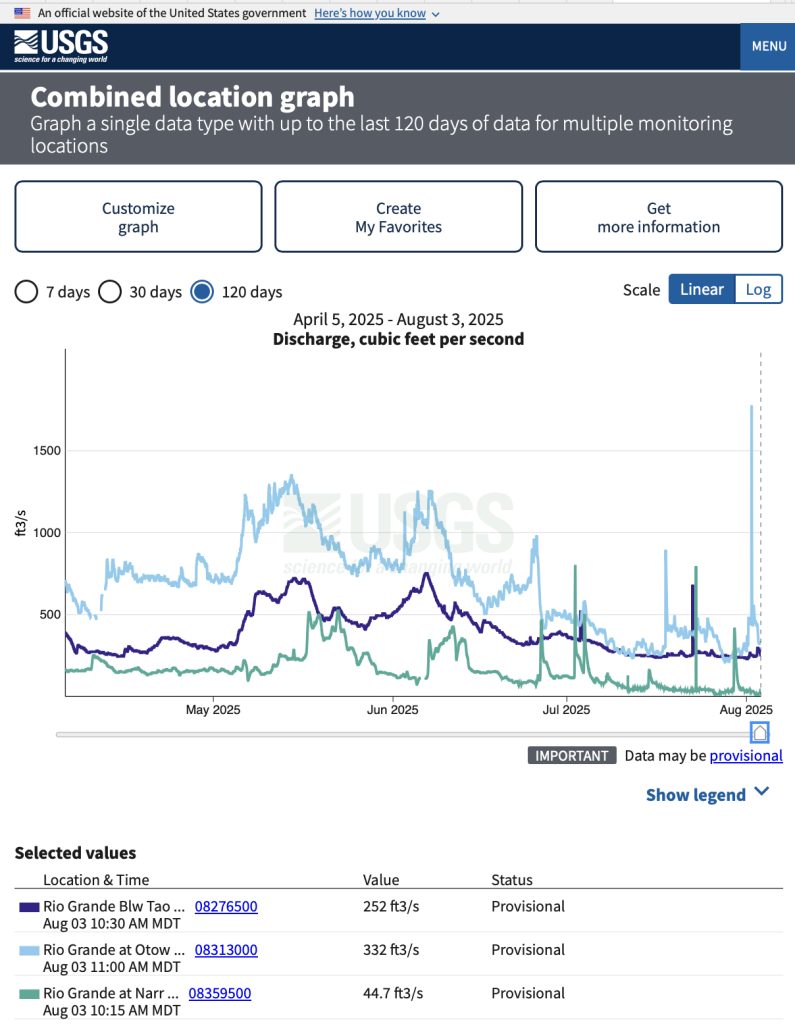
This U.S Geological Survey Chart
The light blue trace in the chart below is from the U. S. Geological Survey’s river streamflow gage at the Otowi Bridge on the Los Alamos highway. It measures Rio Grande Compact inflows to the Middle Rio Grande. San Juan-Chama water volumes are subtracted from the gage reading, which is also adjusted for changes in upstream reservoir native water storage.
The green trace measures the outflow from the Middle Rio Grande at the Narrows within Elephant Butte Reservoir, where the river is flowing in an accessible channel many miles upstream of where the stored water pool has retreated. This is a temporary gage and is useful. The Rio Grande Compact actual water delivery is calculated as the change in storage in Elephant Butte Reservoir plus the release through Elephant Butte Dam.
The dark blue trace shows the flow of the Rio Grande downstream from the Rio Pueblo de Taos. It measures Colorado’s stateline deliveries, tributary inflows and the flows including the Red River and the Rio Pueblo de Taos, and large springs in the upper Rio Grande Gorge. Most of the additional water measured at the Otowi gage (light blue) comes from the Rio Chama, the Rio Embudo, and inflows minus diversions upstream from Espanola.
Comparison of the light blue and green traces shows very little of the inflow to the Middle Rio Grande has made it through. The compact requirement is 57% on an annual basis.
Current Data from Reclamation
Reclamation’s hydrologist said the Otowi gage flows include delivery of 33,884 acre-feet of San Juan-Chama project water in 2025 year-to-date. MRGCD has used essentially all of its allocation.
Federal agencies stored 32,668 acre-feet of native Rio Grande water under conditions when the Compact does not permit storage to guarantee water to meet the “prior and paramount” irrigation requirements for certain Pueblo lands. Of that total, 2,100 acre-feet has been released as of the end of July. The current rate of release is 40 cfs. It has been as high as 60 cfs. All remaining water will be released for delivery to Elephant Butte after the end of the irrigation season. Ir’s rare that prior and paramount water is used because normally the minimum flow of the river is enough. A substantial amount may remain, or not, depending on the monsoon.
The Upper Rio Grande Water Accounting Model shows the Middle Rio Grande’s year-to-date underdelivery of water to Elephant Butte as of the end of July is – 39,000 acre-feet.
The Middle Rio Grande Uses Much More Than Its Share
Water flowing down the Rio Grande that is legally owned by and destined for Lower Rio Grande water users is being intercepted and consumed in the Middle Rio Grande.
In 2025 through May, the Middle Rio Grande was entitled to 43% of the 239,900 acre-feet this year’s native Rio Grande water supply, as measured at the Otowi Bridge gage—adjusted for upstream storage changes and San Juan-Chama imported water. The Middle Rio Grande consumed much more, including 38,400 acre-feet of the Lower Rio Grande’s water. The Lower Rio Grande is entitled to 57%. It got 39%.
The Middle Rio Grande’s spiraling water debt is out-of-control. New Mexico is on track to violate the compact soon. Texas undoubtedly will sue.
Nat Chakeres, General Counsel for the Office of the State Engineer, described this problem in his excellent presentation at the Water Advocates May 15th workshop. He described preparations underway for the State Engineer’s forthcoming Middle Rio Grande regulatory actions to be announced soon. Nat answered a question saying he didn’t think 2025 deliveries would fall short by more than 76,000 acre-feet—the remaining margin before an outright violation of the Rio Grande Compact. When asked for supporting data, he deferred to the Interstate Stream Commission. My calculations show the Middle Rio Grande has burned through half of that remaining margin as of the end of May.
Nat’s presentation was one of the best: extremely well organized, clearly presented, frankly informative, and very timely. He clearly explained the water the Rio Grande Compact provides to the Middle Rio Grande and what it requires. He traced the shift from the Middle Valley’s small delivery credit in 2018 to a growing water debt that reached 124,000 acre-feet by the end of 2024. He emphasized the urgent need to significantly reduce total depletions from the river. “If the next seven years look like the last seven,” Nat warned, “it will be too late.”
Unless we act now—with enforceable limits—New Mexico could face Compact violation and a loss of control over our water future.
We agree—and we believe it may already be too late. Regardless, it’s much better for the State Engineer as New Mexico’s water regulator to begin strong, appropriate actions in 2025 than to by default cede authority and control to the judiciary.
So, how are we doing this year? As a former ISC Director, I know where to find the data and do the compact math. Think of the following as my best estimate, that of an observer rather than an insider with access to the best data and current information. I’m putting forward my estimates with those caveats, transparently.
In recent years, the total of all Middle Rio Grande water uses has consumed much more water from the Rio Grande than is ours. 2025 continues the spiral. There is no effective state regulation or self-regulation by institutional water users to protect the water commons. Groundwater pumpers are not suffering a shortage and have increased pumping to offset lack of surface water and increased demand. That pumping causes increased river seepage losses and consumes stored groundwater.
The facts of 2025 per my calculations summarized below are alarming.
Otowi Bridge Gage Volume to Date: 227,500 acre-feet of water have flowed past the USGS Otowi Bridge gage through May 31, per my calculation based on 15-minute gage readings over the first 151 days of 2025. Some measurements are missing but use of averages is adequate for this preliminary estimate.
The 227,500 acre-foot total winter and spring runoff volume is very low. No snowpack remains, in the Colorado or New Mexico Rio Grande headwaters.
Otowi Index Flow: The total volume flowing past the Otowi Bridge gage is adjusted to determine the amount of native Rio Grande water subject to the compact’s sharing requirements. To calculate the index, subtract 20,000 acre-feet of San Juan-Chama Project water and add 32,400 acre-feet of native water federal agencies stored for the pueblos. The total volume to date this year that must be divided between the Middle and Lower Rio Grande is 239,900 acre-feet.
Delivery Requirement: Of that adjusted total, 57%, or 136,700 acre-feet, is legally allocated to users downstream from Elephant Butte Dam.
Actual Delivery: Based on Elephant Butte Reservoir storage and release data, 99,300 acre-feet have arrived—net of all uses and losses between Otowi and the dam, meaning after accounting for diversions, evaporation, and seepage and unknown losses and errors. This is a 39% delivery, must less than the 57% required.
Cumulative Deficit: The Middle Rio Grande is entitled to 43%, or 103,200 acre-feet. Middle Rio Grande overuse this year to date is 37,400 acre-feet, increasing the cumulative water debt to -161,400 acre-feet.
From a slight credit in 2018 to a deficit of -161,400 acre-feet in May 2025—our water debt has quickly grown out of control.
Figure 1. The Middle Rio Grande’s Plunge Into Compact Water Delivery Debt
Unless we have a strong monsoon, 2025 will push the Middle Valley even deeper into water delivery debt. If the monsoon is weak, none of the water stored upstream for the pueblos’ indigenous rights is likely to be delivered. Little to none of the steady summer low flows expected at Otowi will make it through the Middle Rio Grande. For much of the summer, the riverbed below Albuquerque will be dry—and when flow resumes, rewetting the channel will consume large volumes of water that will not count toward deliveries.
No emergency declared. No plan. No accountability. Most Middle Rio Grande residents remain unaware of the stakes.
Here we are once again doing little, saying less. The House Appropriations and Finance Committee stripped without comment the Governor’s request to increase the State Engineer’s annual budget $500,000 for staff, office space, and expenses for the agency to address the Compact delivery crisis. No public emergency is declared. No action plan has emerged. Reporting is sparse with unheeded exceptions. Most Middle Rio Grande residents remain unaware of the stakes.
The Water Advocates commends General Counsel Nat Chakeres and State Engineer Liz Anderson for their transparency in the General Counsel’s announcement in a public forum that significant policy changes are coming soon, including notices to all large water users, a metering order for all large wells, and the initiation of the Middle Rio Grande adjudication. We appreciate his frank evaluation of our basic alternatives, contrasting the benefits of negotiated agreements with fighting it out first in court only to be forced to settle or having an adverse judicial order imposed. As he put it, there are water uses that are not going away.
We need more, much more, than Nat’s introduction to forthcoming policy changes. If we do not act now—with transparency, accountability, and enforceable limits—New Mexico could face Compact violation, new United States Supreme Court litigation with Texas, and a potentially devastating loss of control over our own water future. Compliance is the barrier against all of that.
Regardless, I urge New Mexico’s two state water resources agencies to become more transparent; They must name, describe, and quantify our vexing water overuse problems. That is the first step toward solving them.
Norm Gaume, P.E. (ret.)
President, New Mexico Water Advocates
A Glossary of Terms for Middle Rio Grande Water Management is available here.
As a retired professional engineer, I have used care in completing these calculations, but they rely on incomplete information and have been checked only by me. I stand by my conclusions even though I want to make it clear the specific numbers are preliminary and my calculations are simplified. Therefore, I do not warrant the numbers I calculated from provisional and unpublished agency data. If my numbers are incorrect, I hope the ISC will let me know and provide their professional estimates, as referenced by Nat.









 Water flowing down the Rio Grande that is legally owned by and destined for Lower Rio Grande water users is being intercepted and consumed in the Middle Rio Grande.
 Figure 1. The Middle Rio Grande’s Plunge Into Compact Water Delivery Debt