If I had only known! How many times have you said that in your life? Grab some caffeine and join me for a tour of our possible water future.
Do you remember that time when you meant to go see someone but something came up, only to get a call that something had happened to them? If you had only known. What about that time you decided to dabble in stocks, play some poker, took that sure bet, and lost everything? If you had only known. Then, there’s that time you bought a beautiful car, and three weeks later the transmission flew into pieces. If you had only known.
We can’t predict the future with total accuracy, BUT, in many cases, we can get what would be called a ‘weighted decision’ of good odds. High probability.
Some of our City leaders that have been here for a decade or more have possessed information that foretold the future of Portales regarding our water resources. They were given the chance to be proactive. They chose this action, or that action, or more often than not non-action and now find themselves in the uncomfortable position of ‘if we had we only known.’
Yet, they DID know, with high probability, but the decision was made to ride out the storm and wait for the Ute Lake Pipeline to save Portales. I have heard it said too many times that “no one on the City Council is a water expert.” Then, why don’t they listen to the hired experts? You know, the ones we have paid millions of taxpayer dollars to tell us about our water future probability.
The point is, it has been projected with high probability that Portales will run out of water prior to the pipeline being finished. A multitude of independent experts (Charles Wilson, Geoffrey Rawling, etc.) were paid large amounts of money (your money) for their water intelligence to study our situation. This expertise established the phrase and concept of “bridging the gap” between where we are now and Ute Pipeline delivery of surface water. For example, it was recommended that our City reduce water consumption from 900 million to 700 million gallons per year to bridge that gap. Today, we have failed 4 years in a row by 200 million gallons per year, by continuing to use 900 million gallons per year. So, over a full year of our projected water savings (800 million gallons) is gone.
There is a substantial probability (Whipple Report, 1994) that the Ute Pipeline Project will not deliver the amount of water originally projected. This Project is estimated to be completed in 2030 and requires two years to be tested, thereby producing benefit no earlier than 2032. There are also a multitude of factors (money, weather, physics) that could delay this project and/or reduce its promised capacity.
As a community, as we speak, our actions are literally choosing IF we run ourselves out of water and how many years we want to be without water.
The ultimate point is this is not about green grass, washing your car, or resolution documents. You can cite ‘quality of life’ as your motivating force for rescinding water restrictions, and I ask what is our quality of life with no water? You can cite ‘people moving away’ or ‘property value declining’ as reasons why the City Council recently voted to reduce Stage 3 Emergency Water Restrictions from a level 3 to a level 2 to allow people to begin watering their yards, and I further ask how much will your property be worth or how many people will move away from a City that has insufficient water?
I honestly don’t think (opinion) this situation can be totally repaired. There is a very good possibility we will never be able to return to our version of ‘normal.’ Kind of like what Covid did to us. Understand that I, 100%, hope that I am wrong, but we may have to change the way we think in order to ‘water survive.’ I do think we can intervene and turn this situation around and have an excellent quality of life for many years to come BUT not on the current path we are following.
I have been told “no one knows Mike, you might be wrong Mike, that’s a pessimistic view Mike.” I accept that, but I’m also 100% fine with it. If I’m right, then our governance better wake up and start trying to understand the dynamics that are happening to our water resources and act accordingly instead of five years from now saying, one more time, “If we had only known.”
If I’m wrong, you and I will both have more water. . .
Mike Davidson was born and raised in Portales, New Mexico. Since Portales went on Stage 3 Emergency Water Restrictions in June 2023, he has launched and administered the Portales Water Facebook page and advocated fiercely for water security. He is currently a member of the Water Advisory Committee and played a central role in its creation.
Water managers along the Middle Rio Grande (MRG) and across New Mexico increasingly feel as if they are staring into an abyss of water shortages for increasing numbers of users who depend on water supplies for drinking, for economic growth, and even for the survival of our present-day economy.
The reliable supply of NM’s surface water to our streams, rivers, lakes, irrigation systems, and other critical water needs depends primarily on winter and early spring accumulations of mountain snow.
As we have experienced in recent years, climate warming increasingly causes the over-winter loss of snowpack, markedly reducing the total annual water supplies available and causing snowmelt runoffs earlier in the spring before crops have had sufficient time to develop to when they could benefit from earlier watering.
Couple these changes to the long tendency along the Rio Grande and across NM to over-use surface water supplies. For example, early in the 1800s the annual water supply of the Rio Grande was declared to be fully allocated. Then, with the drought of 1888, it was then declared to be over allocated, a condition that is unchanged today. And we have added more and more water users over time.
With climate warming also producing changes in global atmospheric circulation patterns, future projections forecast that NM will become increasingly dryer due to total region-wide reductions in snowpack and increased water loss due to increasing evaporation rates.
In an attempt to have equitable water supplies from the Rio Grande for Colorado, New Mexico, and Texas, as well as addressing US treaty requirements to Mexico, the three states signed the Rio Grande Compact, which was then ratified by Congress in 1939.
Today, the claim that NM is and has long been shorting the agreed-to water supply deliveries to Texas is awaiting a final US Supreme Court decision. The original terms of the Compact effectively caused additional limits on the surface water supply available to MRG users. The final court decision might further constrain the MRG supply.
To fill the gap in limited surface water supplies, communities and individuals have increasingly depended on pumping groundwater to address their need for water. Today, many of NM’s groundwater aquafers are nearing depletion.
MRG water supplies have been augmented by diversion of water from the San Juan River in the upper Colorado River basin into the Rio Chama and then into the Rio Grande. Here it is important to recognize that the effects of climate warming are similarly affecting water supplies across the entire southwest into California as the Colorado River and San Juan River are seeing reduced volumes as well.
Multistate negotiations on how climate-driven water supply shortages from the Colorado river will be distributed to all of the affected southwest states are ongoing with no permanent plan in sight. How that final future plan will affect San Juan River diversions to the Rio Grande is unknown, but in recent years that diversion has been short of the originally anticipated supply.
How best to address the increasing water supply shortages across NM is an open question.
Can the many and different water users within each of NM’s river basins and water management areas somehow reach agreements on how best to equitably share these shortages, as has become the custom for over 100 years along NM’s acequia communities?
As a start, the Water Advocates for NM and MRG are working with water managers along the MRG, including the NM Interstate Stream Commission, the MRG Conservancy District, Bernalillo County, ABCWUA, the US Bureau of Reclamation, and others to start planning for our shortened mutual water supplies.
The NM Interstate Stream Commission is hosting several Water Planning Open Houses to hear water related concerns from communities across the state as first step to draft the rules and regulations for updated regional water planning. We encourage you to attend these meetings and make your voice heard. Without accurate information and community engagement, the abyss will only grow. Let’s back away from the abyss and create a sustainable water future for New Mexico and the Middle Rio Grande.
The New Mexico Environment Department (NMED) has access to millions of dollars in loans to help with these and other types of water system projects. These loans are available to community water systems as well as non-profit, non-community water systems (for example, at a school or a camp). The loans come from the Drinking Water State Revolving Fund. That is a federal-state program that provides low-cost financial assistance to water systems for a wide range of drinking water projects.
These loans offer excellent terms:
Communities with a low median household income can qualify for 0% interest, and up to 75% of the loan principal may be forgiven.
For regionalization projects, up to 90% of the loan principal may be forgiven.
For green projects – like water conservation, increased efficiency, and green infrastructure – even more of the loan principal may be forgiven.
Loans for removing “emerging contaminants” from water systems – including PFAS and manganese – may be 100% forgiven. The six lists of emerging contaminants are here: https://www.epa.gov/ccl
Getting started is easy. Your water system administrator just needs to:
Submit a simple pre-application, using this form: https://forms.office.com/g/fnjniAZzRL
Provide some additional documents when NMED’s Drinking Water Bureau staff request them.
Complete a full loan application for the New Mexico Finance Authority after the pre-application is placed on the Fundable Priority List.
Help is available!
If your water system administrator isn’t sure exactly what is wrong with your water system, staff from the New Mexico Rural Water Association may be able to come out and troubleshoot.
The Rural Community Assistance Corporation and the Southwest Environmental Finance Center may be able to help the administrator with the application process.
The Infrastructure Support Team at NMED’s Drinking Water Bureau is available to answer questions. Please contact them at: NM**************@******nm.us
And if the pre-application isn’t placed on the Fundable Priority List the first time around, NMED staff will provide recommendations on how to strengthen it before it is re-submitted.
You can find links to the pre-application and the checklist on that site, too. Thanks to the New Mexico Environment Department for this information and work to help New Mexico communities
The so-called strategic water supply is the opposite, like “produced water” as a name for toxic oil field waste. It is not beginning with the end in mind. It is not putting first things first. It is not informed by facts and science. It is unvetted. It is wrong.
Where did this come idea come from? Our Governor announced it from Dubai, located on the desert north Mediterranean shore of North Africa, that has no freshwater. The only irrigation is from municipal wastewater. All water comes from ocean desalination plants.
Dubai ocean desalination plant
Water produced by an ocean desalination plant costs about $7.50 for a thousand gallons, or $2,450 per acre-foot. Ocean desal plants pump water from the limitless ocean and discharge their brine right back in. The waste disposal is free. In Dubai, a petroleum absolute monarchy, energy is free and carbon emissions are not a consideration.
A typical Albuquerque household uses about 11,000 gallons per month, on average. The average cost is $35 per month, or about $425 dollars per year. The raw water costs the water utility nothing, the costs cover operations and infrastructure.
What if the water itself required desalination at the ocean desal rate of $7.50 per 1000 gallons plus 50% for pumping the water from deep within the ground, pumping it to the desal plant, and costly disposal brine with no ocean handy. That would boost the cost to $11.20 per 1000 gallons. The Albuquerque resident’s bill would go up 356%, from $425 per year to $1,500.
Exhaust stacks at Dubai Desal Plant
Oil field waste, marketed by the oil and gas folks as “produced water” is incredibly more difficult to treat. Treatment for discharge to a large river reportedly costs $10 per barrel in Pennsylvania, which is about $78 per acre-foot.
If the cost were only $2 per barrel, the number New Mexico produced water boosters toss around currently, half a billion dollars would buy 32,000 acre-feet of water once. Why? Permian Basin produced water is 20% salt by weight, or more. Ocean desal technologies don’t work. “Thermal” treatment is required to boil the brine, capture the condensate (contains organic poisonous but unknown volatile compounds that also boil and condense) remove the poisons, and dispose of mind boggling tons and tons and tons of salt.
Precious or rare earth recovery? Nope. Not feasible or economic from this ancient salty waste, according to state data not yet made public to the best of my knowledge. New Mexico Environment Department officials said the opposite.
More reasons to put this idea aside for future research and demonstration are listed below.
We need to face the facts our hydrologic and climate change water future and take productive action. We have no dollars or hours to waste on ideas that can’t pencil out.
The desalination disruption by of the 2024 Legislature by the Governor’s half-billion dollar speculation comes simultaneously with the Legislature’s and the Governor’s neglect of basics required to secure New Mexico’s future. The Governor and the Legislature are not meeting the critical basic needs of New Mexico for water security. Without water security, there is no economic security.
The Sovereign State of New Mexico is failing to Fund and Do the crucial water management work identified by a consensus of the 2022 Water Policy and Infrastructure Task Force.
The State of New Mexico’s water administration consists of issuing permits in most areas of New Mexico and not looking back. New Mexico water governance is pushing paper, not dealing with wet water. Wet water scarcity is worsening and the State’s paper and data are in disarray.
The Sovereign State of New Mexico watched without planning or action the draining of the Ogallala Aquifer by individual water rights owners maximizing their private benefit. Now we see that the externalized costs include the welfare of all of eastern New Mexico.
That situation is playing out in other closed basin aquifers in New Mexico as you read this. New Mexico is ignoring the Portales/Eastern New Mexico canary in the coal mine, the canary desiccated by dairy (home to the largest Mozzarella cheese plant in the world!). Only the scientists are paying attention.
The Sovereign State of New Mexico is failing to fund and staff the basics of 21st century water management for our much more arid future.
Water Data – 2019 Water Data Act Implementation.
Aquifer Characterization in a state that depends on groundwater more than any other state. We don’t know how much water we have left after a century of hard pumping.
Regional water planning – 2023 Water Security Planning Act Implementation, which means the Sovereign State of New Mexico must fund regions and communities to begin appropriate self-organization of the Regional Water Planning Entities authorized and made responsible by the 2023 Act.
The Sovereign State of New Mexico fails its employees by not prioritizing two essential things that successful enterprises always do.
New Mexico water agencies fails to provide their workers with modernization – modern information technology, training, productive work processes, quality assurance, etc
As a result, workers productivity and individual contributions are not what they could be and must become.
Many New Mexico communities need help to replace failed existing infrastructure, like pipes that don’t leak so our water can be conserved.
Desal has a huge carbon footprint. Produced water treatment has a MASSIVE carbon footprint. The energy required is enormous and the carbon load unacceptable
The New Mexico Produced Water Research Consortium management tells half-truths and flat out lies. Professor’s are objecting their research findings are being twisted without scientific integrity by the Consortium’s public faces. The Consortium’s manager refuses to do a basic feasibility study that would show the utter infeasibility of the vision that the PWRC is publicly espousing and is dangerous to the public health. Some Oil and Gas Companies know this truth but remain silent. They require a complete release of liability.
The potential for unknown adverse consequences is unacceptable. We know very little about New Mexico’s brackish water and saline aquifers or their interconnections to the legally protected aquifers above or beside. The NM Legislature appropriated millions last year to begin that characterization. The Sovereign’s huge capital investment plopped down without doing that basic science first is not the right way.
It is just not right to neglect the basics – staff capacity in all water agencies, full-bore implementation of the 2019 Water Data Act, meeting our downstream water delivery obligations, accelerated aquifer research, regional water planning, watershed restoration, protection of our headwaters, replacing the clean water regulatory authority the US Supreme Court just stripped from over 90% of our waters – while spending wildly on speculative unplanned, infrastructure.
It’s just not right for the Governor and Legislature from denying funding for New Mexico Environment to pursue New Mexico’s water quality protection and clean-up imperatives, and then demand they devote scarce professional staff resources to Governor’s badwater vision.
It is shameful to have top state appointed officials, who know better because they are smart, educated people, to be purveyors of disinformation as they were during the 2024 legislature trying to get huge sums authorized for the Dubai badwater bad dream.
Only if we wake up NOW, will it be possible for future generations of New Mexicans to live in our beloved New Mexico, our home place, our querencia. Collaboration can get us where we need to be. Reaching Agreement. Nothing else will. Change–Big Change–is essential. We must change, or lose New Mexico for most of our descendants, forever.
/s/
Norm Gaume, P.E. (ret.)
_________________________
President, Water Advocates for New Mexico and the Middle Rio Grande
New Mexico Water Ambassador
Research Scholar, University of New Mexico
Former New Mexico Interstate Stream Commission Director
Former member, NM Produced Water Research Consortium Technical Steering Committee
Sweetwater is better than Badwater. As a grade school kid living ½ block from the main US highway from El Paso to Los Angeles as Interstate 10 was being built to bypass Deming, I remember being curious about places named Badwater or Sweetwater, sour water wash and gypsum draw. Google Maps shows three Sweetwater Streets in Albuquerque and Santa Fe today. Many places are named that across the West. Sweetwater is a generic goods and services brand, too.
The sweet waters of New Mexico are necessary for all life in our beloved state, in all our home places, our querencias. An acerbic senior ISC water engineer told me 25 years ago that we know where New Mexico’s water is. It is where we live, irrigate, water livestock, hunt and fish, and enjoy our heritage. He didn’t need to say “sweetwater.”
New Mexico’s sweetwater overuse and increasing scarcity not a State of New Mexico priority. New Mexico is in a water crisis. It is a crisis that begs for our actions this year, not next, which is simply not the way New Mexico’s elected leaders behave because they do not know. The crisis will be realized gradually on the human time scale of years and decades. Intentional informed action today will make tomorrow as good as it can be. Continued neglect will destroy New Mexico’s future, as we watch 40 years of water stewardship neglect continuing with little concern from the top.
Water can’t wait. Water scarcity is increasing. Pumps are everywhere without any control of pumping other than the permit to drill them. Surface water right owners do not have enough, and are granted state permits to pump out-of-sight, out-of-mind groundwater that is always there, accelerating groundwater overuse.
The only realistic opportunity to meet our needs and create a livable New Mexico with water for future generations of New Mexicans is much better stewardship of our remaining sweetwater. Someone reminded me of an adage that could have come from a southern NM uncle: if you are digging a hole and begin to wonder if you can get out or it will cave in on you, stop digging.
Why are we digging until all we have left is badwater?
New Mexico is pumping irreplaceable groundwater and has been at it for a century without an eye to the future. This summer, Portales ran out of water. Through neglect, that historic New Mexico community, home to Eastern New Mexico University, the pride of many east-side legislators, ran out of water.
What will the City fathers and the State do to keep Portales from becoming a ghost town, like others across New Mexico that dried up and blew away after exhausting resources? Where has the water gone, the scarcity of which threatens Portales’ very survival? Not for the greater good or the public welfare of the region, or of the State.
Public welfare of the state is the measure of state law for discretionary state engineer decisions. Public welfare of the region is a new legal term created by the House Floor Amendment prior to the 2023 Legislature’s unanimous approval of the Water Security Planning Act. We are the state most dependent on groundwater. We are mining it out, and when it’s gone, it’s gone forever. Since water is life, and without water, there is nothing, so will we. What is the public welfare of the state, and the public welfare of the region, in that light?
Formerly gushing wells are dribbling and well drillers can’t begin to meet the burgeoning demand for new and replacement wells. We are blowing off Rio Grande interstate water sharing agreements despite the clear trend toward a brand new decade-long lawsuit brought by the Texas. How much longer will we chase the water?
The New Mexico default answer is, until the rivers are all sand and the aquifers are empty. By their actions, our elected leaders show that water security, which requires stopping grossly unsustainable and low benefit water depletions, is not on their minds.
Badwater investment. Planned badwater treatment for use may be part of a future vetted water resources management portfolio but has no place in a wise water management strategy that begins with the end in mind, a livable future for New Mexicans throughout our state. And puts first things first.
Tremendous opportunity costs. Meanwhile, none seemed to recognize the dispute between the Legislature and the Governor was blocking state funding for State water agency work essential to New Mexico’s survival. This essential, foundation work would, after sufficient investment, tell us how much groundwater we have left and how fast we are using it up. We will wait to rev that effort up until a future day when we have more money? What?
Opportunity cost examples. No funding was provided for expanding the groundwater science staff at the NM Bureau of Geology and Mineral Resources nor drilling aquifer characterization monitoring wells to tell us how much water we have left, and the years remaining. New Mexicans deserve to know that.
The Governor proposed a few large appropriations of federal funds for water infrastructure, like drilling the monitoring wells and for an Indian Water Rights Settlement Fund. None survived the 2024 Legislature. One casualty was $4.5 million in federal ARPA funding allocated to begin a planned 10-year program to systematically drill and equip aquifer research and monitoring wells.
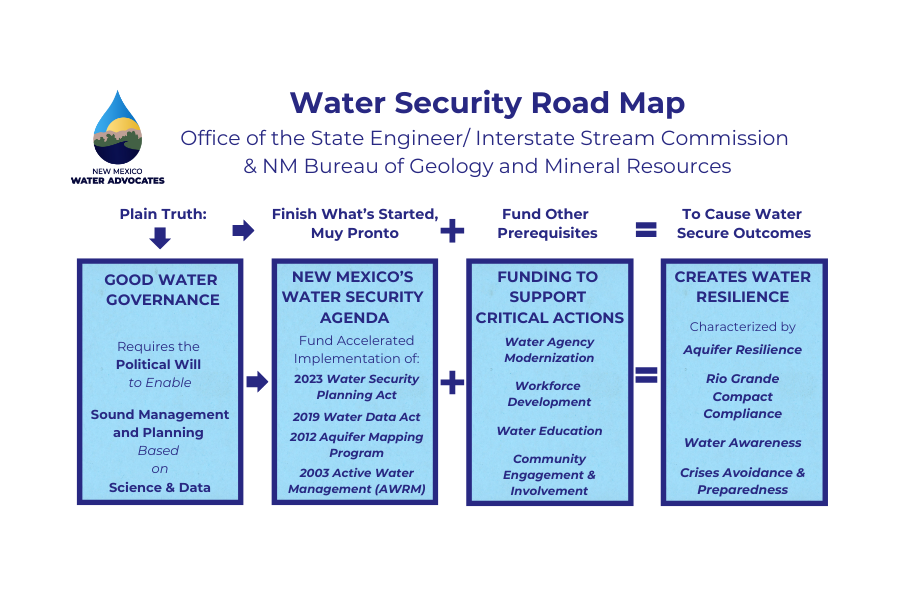
Failing to fund accelerated implementation of the 2019 Water Data Act is in my view the most egregious failure of the Executive and the Legislature to put first things first. The data required for all state funded regional water planning must come from full implementation of the NM Water Data Initiative. §72-14A-4 (7) NMSA 1978
Problems with the Legislature. Concurrently, Legislative Finance Committee staff reportedly were justifying not funding implementation of the 2023 Water Security Planning Act with their own internal longstanding misinformation blaming the ISC and regional water planners for producing shelf reports, shamelessly or without knowledge that shelf reports were exactly what was authorized by the “not-planning, not intended for implementation” statute passed in 1987.
The 2023 Water Security Planning Act replaced the narrow, useless 1987 statute. The Legislature’s appropriators again did not adequately funding implementation of that planning law passed unanimously last year commensurate with the urgent need. Their staff based this neglect on irrelevant uninformed criticism of the law that was. Who can explain this? I can. They simply don’t know what they don’t know about New Mexico’s water crisis.
Problems with the Executive. After recovering from my shock and anger witnessing the Senate Conservation Committee hearing of “dummy bill” SB294 approximately 50 hours before the 2024 Legislature ended, I asked myself if I was hearing misinformation or disinformation.
The Executive’s principal spokespersons for the badwater, so-called strategic water supply during the session, that emerged at the 11th hour as SB294, are knowledgeable, sophisticated professionals, one a professional engineer, the other a lawyer. Their facts and inferences were not reasonable or true, from my perspective. Their arguments were not rational. Did they intend harm through disruptive out-in-front support for an ocean idea imported to the high desert withholding all judgment as to feasibility and priority? Intention to harm is the criterion distinguishing disinformation from misinformation. Regardless, the initiative they were leading as the faces of the Executive created harm.
Produced water treatment was removed from the SB294 before introduction. The Governor put it back. Follow the money. Our state’s reins are held by oil and gas.
Parallel of the Gila Diversion Project modus operandi. The Executive pitch to date for the Governor’s badwater project shares characteristics with the New Mexico Interstate Stream Commission’s wasteful attempt to develop the known-to-be-infeasible Gila Diversion Project from 2004 to 2020. The parallels I see:
Throw money at the problem while avoiding a feasibility study
Facts are not favorable so are secret or immaterial
Disinformationpaints a fantasy word picture of an unfeasible outcome
Opacity hides the fatal flaws of the proposed project, its data, technology, costs, benefits, beneficiaries, and the self-serving participation of key players
Known Unknowns. I admired Senator Harold Pope, Jr.’s thoughtful critique of the dummy badwater project bill SB294 at the Senate Conservation Committee hearing about 50 hours before the session ended. The legislature’s streamed video recording is available here. Senator Pope observed we need answers to the many known unknowns about the project before it is fully funded.
Everything is unknown, including the basic feasibility and any assurance this project will be assessed to any reasonable public standard. It is ironic that the law imposes stringent proper planning, vetting and prioritization requirements on anything proposed by a regional water planning entity, but the same doesn’t apply to the so-called strategic water supply.
We can see the opportunity costs as described above. We can’t assess unintended consequences of the proposal because nothing is known.
South American public policy scholars. My thinking went back to the cohort of South American Fulbright Scholars I was privileged to work with at the University of New Mexico in June 2023. They loved getting to know New Mexico and learning about the Middle Rio Grande and our water. Water policy is not something they had considered previously because their federal government manages their country’s water resources and uses with more equity, appropriate prioritization, and realism.
After three weeks at UNM with international academic scholars and Peace Engineering leaders, the scholars’ water policy case study diagnosis and remedy get right to the point. Regular type is theirs; italicized is mine.
Research continues to find problems and propose solutions that don’t reach the people
New Mexico legislators are people.
Water is a community-problem. Community problems require community-driven solutions.
The only way to generate sustainable solutions is to understand water as a collective action problem and empower the people to take action
What concerns me most is that consequences on New Mexico of the fundamental hydrologic and climate reality we face are an unknown, unknown to most NM legislators
When Senator Pope talked about the known unknowns of a not-even-located desal or oilfield toxic wastewater treatment for reuse plant or any high tech, high energy required solutions, my mind went to the highly inconvenient truths of our hydrologic and climate reality that most NM Legislators do not know, or even know that they don’t know.
The Fulbright Scholars participated in meetings with VIPs, including local and state elected officials, the University of New Mexico Global Studies program had previously arranged. One aspect of New Mexico’s water problem is social, a public lack of awareness of the water crisis known to water science but unknown and unconsidered by almost all. A late 2021 Thornburg Foundation/Water Foundation-sponsored water attitudes poll questioned a cross section of urban, suburban, and rural New Mexico voters across New Mexico.
I included the poll interpretation and data in the scholars initial Middle Rio Grande case study orientation and suggested they consider using that approach in their prearranged meetings. They asked the VIPs about New Mexico’s most important problems. None volunteered that water is a most important problem. The scholars asked, what about water? All VIPs agreed it was important. None knew much about it. Most indicated someone else is working on it.
The poll report explains that was the public reaction to the pollster. But once asked what about water, look what they said:
The truth is that many scientists and state staffers are working on water without adequate resources in this time of crisis but huge budget surplus. Few lawmakers are. No state appropriators are commensurate with the crisis. The Governor is a little in, mostly out,
Unless addressed, New Mexico water problems are terminal across New Mexico. If our people and our leaders don’t learn, understand what we must face and deal with, we are going to evaporate our people and economy.
I remember a meeting not that long ago with David Abbey, the legislative key financial staffer who presided at the right hand of Senator John Arthur Smith. This was around 2019, when the Water Advocates tried to get regional water planning reform legislation passed.
Abbey said New Mexico’s water problems are chronic. What I argued, and he would not accept, was that while water is indeed a chronic problem, hydrologic reality is catching up with us and severe global warming has overtaken us. What may appear chronic to a budget expert with little knowledge of water is actually a worsening full-blown crisis enveloping us right now. Failure to recognize the crisis and act to mitigate it and adapt has consequences. Just look around at the scarcity emerging. This is not drought. This is permanent.
Phil King recently observed that as a species, humans have failed miserably for four decades to ignore the warnings of expert scientists that we must mitigate greenhouse gasses. Similarly, now we have no choice but to adapt to having much less water now or see our descendants as climate refugees. When we overpump our groundwater, we are eating our seed corn.
Sweetwater Bright Spots to Close.
Dr. Phil King also observes opportunities for effective action abound. We can do this. We have to start. We have to go big. We love New Mexico and its people. We love our home places. We will take action.
State Engineer Mike Hamman in 2024 broke the Governor’s and Legislature’s essential lock on agency staff capacity. He won 27 of the 31 new positions he openly requested, all associated with general categories of endeavor.
The Legislature funded priorities and projects of New Mexico’s environmental values community represented by the Water Task Force workgroup addressing river stewardship and watershed health but not aquifer health. The Legislature also funded communities and community infrastructure.
Two Legislators provided allocations of their junior money to water. Senator McKenna allocated $200,000 to the State Engineer to fund OSE implementation of the 2019 Water Data Act. Rep. Marian Mathews allocated $160,000 for implementation of the 2023 Water Security Planning Act, the only appropriations by the Legislature for those named purposes. Thank you to Senator McKenna and to Rep. Marian Mathews.
The NM Bureau of Geology and Mineral Resources at NM Tech received half of what the New Mexico Department of Higher Education requested to provide reliable actionable data and information for New Mexico’s more resilient water future. Emerita Director Nelia Dunbar, also a NM Water Ambassador, reported last week the NMBGMR would fully fund the water education program for Legislators. The Bureau of Geology will ask again in 2025 for aquifer monitoring and mapping staff and capital money to drill the wells to provide the data that will cause us to wake up and decide to act.
Now, to all our readers. Please! Write your Senator and your Representative and ask that they fully participate in all the Water Education for Legislators programs during the 2024 Interim. We must change course or perish. They Governor and Legislators need to learn about our water crisis and provide resources to the water agencies and the people to find the transformative change New Mexico’s survival requires.
I was born and raised in Albuquerque, New Mexico and proudly claim the title of “desert baby”. I am deeply afraid of the ocean and large bodies of water, but my heart sings during a drenching rainstorm. I was raised to conserve water and to be conscious of its limited supply. I love New Mexico and its hard to imagine living anywhere else.
I currently live in the Near North Valley, and I have 1/3 of an acre which I irrigate from the Griegos Lateral. I have giant elm trees, ash trees, mulberry and Arizona cypress trees. I also have many fruit trees including, apricot, apple, cherry, peach, plum, pluot, and pomegranate. The first time I irrigated it felt like a miracle. I could almost hear the gratitude of the trees soaking up the much-needed water.
On my block, all of the properties on the south side of my street are small urban irrigators like me. On the north side of the street the irrigation was cut off many decades ago and the contrast is stark. The south side is shaded and cool with massive trees, the north side is all dirt lots with few remaining trees. The north side is the embodiment of aridity. I am grateful to live on the watered side of the street.
Every spring, I work hard to clear my ditches and am eager with anticipation of the first irrigation of the season. In mid-summer my anxiety builds as the thermometer increases, but that anxiety is washed away when I open my headgate, and see the water pour onto the thirsty land. While irrigating is hard work, the water satiates my soul and sooths a deep-seeded fear of not having enough. And then the guilt kicks in. Shouldn’t I be conserving more water? Shouldn’t our precious water only be used to grow food crops? How can I justify irrigating my urban property?
Urban Albuquerque ditch
As a water rights consultant and a Water Advocate I know that basically every drop of irrigation water I am using is increasing our compact debt to Texas. I know that my water use is not sustainable. I know that the system is going to fail unless we take drastic measures to change our behaviors. Alternatively, I could use a hose and use Albuquerque Bernalillo County Utility Authority (ABCWUA) water, but I also know that our groundwater is limited and so watering from water provided by ABCWUA is also not the answer. I try to remind myself that by irrigating I am also recharging the aquifer. But isn’t that just another excuse for doing what I want to do, which is to keep irrigating?
Like climate change, while individuals have a responsibility to do their part, it is the institutions that need to step up and make the big changes. Should I stop watering my trees, using about 1 acre-foot of water per year, while the proposed Santolina development will need approximately 14,000 acre-feet per year, while growth and development remain unchecked, while we grow crops for livestock feed instead of food for humans? How do we balance economic growth with a dwindling water supply? How do we balance the needs of all water users? How do we decide what is most important and therefore should get the most water?
The trees on my property keep the land and the adjacent street much cooler in the summer. When I drive home in the evening on a summer day it is not uncommon for the temperature to drop by more than 10 degrees as I pull into the driveway. It is common knowledge that green spaces are critical in reducing the temperatures in urban areas. Would even more water be used for air conditioning and cooling if the big trees were to die? How do we balance carbon reduction with water needs?
I don’t know how old my biggest trees are, but I would guess at a minimum they are 50 years old. Do I not also have a responsibility to these elder beings to keep them alive and as healthy as possible? But don’t I also have a responsibility to future generations to ensure they have enough water to survive? What about the responsibility to ensure the environment, flora, and fauna are getting their fair share of the water?
I will do my best to keep conserving water, to collect rainwater and to use greywater but I will also keep irrigating my big trees as long as I can justify that water use. I really don’t know how long that will be as each year my list of questions and my guilty conscious grow larger.
I have so many questions and no real answers. Reduced water supply is a complicated issue, and it will require a complicated solution with buy-in from all the different types of water users. I hope for a future where we can share water in equitable way where everyone’s needs are met. I know a solution exists and I hope you will join the Water Advocates in finding it, by continuing to come to the !Agua es Vida: Do your Part! Speakers Series. While we work to towards finding that resilient water future, I will continue to stand on my acequia and feel gratitude for each drop of water and for the life that is sustains, but I will also be grieving for the water I know will not always be there.
A stone discovered in ancient rock layers exposed by tectonic shifts delicately picked out of its strata and examined, was found to contain a bit of water billions of years old: young water of our home, planet Earth.
Young water, which itself took eons to become a source of all life: around, within, below, above, A sacred gift. There is ONLY ONE supply of Water for the EARTH’S ENTIRE LIFE.
Of Earth’s Water, 97% is oceanic salt water, leaving, yes, only 3% of fresh water for all land based life. Our own bodies are made of 50-65% of water, blood, spinal fluid, eyes & more, even bones.
Earth’s water continually cycles, thus recycled water abides in us. Most fresh land water had been in the ground, rather than in air or surface rivers, lakes, snow, glaciers, Polar ice. Traditional peoples keenly observed life to survive. As their survival skills grew they realized lives depended on sustaining what they used in nature. Discovering their own lives inextricably linked to those of all other life, including life of water, awed by what they observed in mysteries of night’s dark skies lit by moon, stars & comets, with sun’s vital warmth and light by day, they honored a creator beyond the Earth. Daily community lives involved ritual practices of gratitude.
Knowing they belonged to the land, young & old honed skills of sustainability as they found how all life is inter-related to be fruitful; & reflected that in traditional daily life, languages, stories, sacred spaces, art, dance and song.
Conquests of land and people erased sustainable ways of life through dominion over, rather than inter-relationship with nature. Pressures of subjugation for power/profit/pleasure objectified natural resources. Science was at times controlled by rulers of lands or church. While science thrived, sustainability was only at times prioritized. Working for the common good of even people fell away. Gradually seduced by the 3 Ps, & commodification, human hubris overwhelmed Water & Air on which all animate life depends.
Air & Water, how terrifying you’ve become! Poisoned with human pollution, altered by thoughtless extraction & careless overuse, your ravaged life cycles plummet over precipices to escalating heat waves creating permanent deluge, drought & raging fires. Each year is hotter for longer now. Each year extreme weather expands. Each year more animals & habitat become extinct, unable to adapt. Each year more natural & ‘civilized’ resources are destroyed by you, as your frantic climate strained life cycles are disarrayed. Air & Water, many humans deny your desperate extreme effects, continuing to cling to life riddled with power, profit, pleasure. They blind their minds while polluting wastes proliferate. They numb themselves to effects of their casual use of natural resources. Earth’s essential elements rapidly spiral to extinction. We with that.
Mother Earth, there still are humans who hear your desperate pleas of floods, fierce winds, extreme swings of heat & cold. Right here, right now, many traditional and modern New Mexican scientists with skill & will have joined together to help communities across our Land of Enchantment weave differing regions of our land and cultures into comprehensive systems of water planning & management. Led by carefully conceived visions of these sustainability experts, we have hope of using current water data to help us adapt to climate degradation in our deserts, valleys, mountains, plains.
Laws were passed to create Regional Water Utility Authorities to adjust to decreasing precipitation & rapidly depleting groundwater. These comprehensive community actions must be well funded now to be established before time for adaption runs out. Clovis energetically & systematically has made these complex changes. Its success is urgently needed in Portales
in 3rd stage (of 5) water loss requiring stringently restricted uses. 250 other rural NM communities may need these soon. We can slow progress of NM’s permanent drought by conserving and catching water, helping Water reclaim her cycling life.
Every NM citizen can join in this work by: – looking at the NM Water Advocates website, – knowing that quick fixes fail to secure sustainability, – conserving water & catching precipitation, – contacting your legislators and telling them how urgent it is to fund community regional water utility work now, and – share information about all this with everyone you meet.
Betsy Diazis a board member for the Water Advocatesand Interfaith Power & Light/Sacred Land & Water. She has been in New Mexico for over 45 years and considers herself a seasoned water advocate.
State residents need to think of ways to conserve our water supply
Following is an Op-Ed that was published in the Albuquerque Tribune on May 29, 2007, before climate warming became as publicly visible and intense as it is today. Promptly (sarcasm intended), a mere sixteen years later, the 2023 New Mexico Legislature unanimously passed the landmark Water Security Planning Act. Now, we’re eagerly watching and waiting to see if the 2024 Legislature will see fit to fund the Act’s implementation. This article is even more relevant than it was in 2007, as the aridification of the West has only increased. Time is of the essence, New Mexicans and specifically the 2024 Legislature must act now in order to secure a sustainable and resilient water future for New Mexico. !Agua es Vida: Do your Part!
Drought – nature’s reminder that water does not grow on trees.
Drought is the time when some form of government advice or regulation prescribes that we collectively choose to reduce our uses of water, usually because of some form of government advice or regulation. It is the time when we receive less rainfall than we would like to have. In New Mexico, we get such a reminder from nature virtually every year.
As a result, we are setting ourselves up for a day of water reckoning.
In Sandoval, Bernalillo and Valencia Counties, we have been using over 20 percent more water than we receive overall, deficit-spending our resource, resulting in the gradual draining of our aquifers. We must stop burying our collective heads in the sand, or all we will have left is sand.
Consider: 23, 28, 35, 39, 47, 34, 29. A familiar series of numbers? Probably not. These are the annual inches of precipitation during droughts in Chicago, Cincinnati, Memphis, Miami, New Orleans, New York and Portland. The averages are substantially higher.
These cities are some of the places from which three quarters of New Mexico’s new residents move. The other quarter of the newcomers is born here. It takes some effort to recognize the implications of Albuquerque’s precipitation levels – which average just over 8 inches and peak around 12 inches.
The folks who grow up here usually recognize that we are in a perpetual drought. Generally, that knowledge is reflected in their concern for water and their resultant behaviors for using water. The only question is whether this year’s drought-descriptor should be noticeable (above average rain) or serious (near average rain) or desperate (below average rain).
To set a reference, look at precipitation averages from tree ring studies over the last 2,200 years. It is interesting to note Chaco Canyon was abandoned during below-average rainfall, and the middle Rio Grande region’s 20 percent water-consumption deficit was during the wettest quarter-century in those two millennia.
Because we are not elected officials in Washington, D.C., deficit spending cannot go on forever. We have limited ability to increase our water income at a finite dollar price, which suggests we need to terminate a sizable chunk of our total uses. That’s a tough order.
When we think about it carefully, it’s even tougher than it first looks. We have to realize over a third of our total water goes to natural, open-water evaporation and riparian plant life within the three-county region. We have minimal ability to reduce these natural uses. The only credible reduction targets are agricultural, domestic and industrial uses. To meet the goal, those target uses would have drop from 195,000 to 140,000 acre feet per year – with everyone using 30 percent less.
And the toughness of our water-budget balancing order doesn’t stop there. The region’s population is growing by 1 percent to 2 percent each year – more people wanting more water. Our behaviors, deeper pumping and releasing of effluents are degrading the quality of some of our water sources. The global-warming scientists tell us to anticipate even less rainfall this century than the average over the past 2,000 years.
The techies at the Drought Mitigation Center at the University of Nebraska-Lincoln define four kinds of droughts: meteorological (rainfall shortage); hydrological (water supply shortage); agricultural (soil-moisture shortage); and socioeconomic (resultant goods or services shortage). Their beginnings tend to follow one another and occur in cycles.
Usually, it is local governments that declare what actions we are politically willing to take in response to a drought – sometimes depending on the drought’s intensity or duration. While our political will has increased somewhat over the last few years of meteorological drought and improved scientific information, it has a long way to go.
While we have increased the price of water delivery a little, there is still a negligible charge for the water itself. When we perceive meteorological drought, we sometimes limit car washing for a few weeks or so or limit lawn sprinkling to selected days. We even replace a few percent of our toilets with low-flow devices. And we sometimes shorten the irrigation season by a few weeks.
For your homework, please do a little arithmetic, and see how far you think those use-reductions will go toward mitigating our 30 percent annual shortfall.
Drought: It’s nature’s reminder that water does not grow on trees. Ask your elected officials what they are doing, each and every day, to help us all work together and survive our perpetual state of drought.
Part II – Co-Creation of a Sustainable Water Future for the Middle Rio Grande
Introduction to Part II
The past two years have set the stage for accelerated progress in managing New Mexico’s water resources for much greater resilience, as described in Part I, a 2023 summary report. Part II is about 2024.
Two years of action have been productive. Under State Engineer Mike Hamman’s adept leadership since January 2022, New Mexico created and began implementing pivotal strategies recommended by consensus, most were unanimous, of the 2022 Water Policy and Infrastructure Task Force. Progress in 2023 demonstrates a crucial shift in New Mexico’s approach to water governance, moving from historical neglect to a proactive path focused on resilience and sustainability. More leaders know New Mexico faces a profound water problem and are taking action. Fewer are ignoring or denying it.
Water Advocates 2024 Action Plan
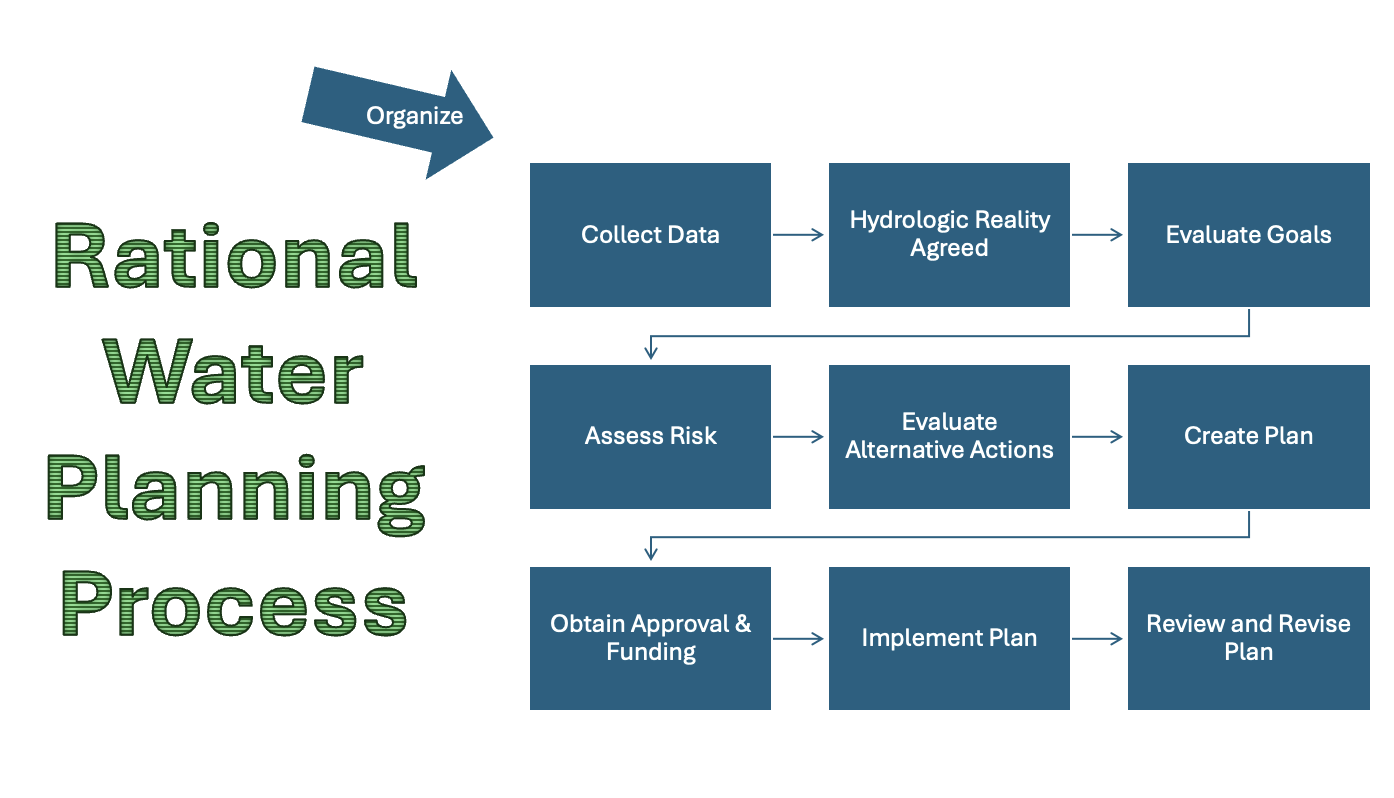
Generous board member and public donations to the Water Advocates in November and December and our intensive planning work last fall made it possible for the Water Advocates to prepare the illustration below. It shows creation of a Middle Rio Grande Water Planning Entity and a substantial amount of preliminary work to set the stage for the Entity to be immediately productive in 2026 after its collaborative creation in 2025.
Leaders of several state and local government water agencies and institutions have expressed support recently for the technical plan to implement the 2023 Water Security Planning Act in the Middle Rio Grande. The illustrated parallel approach, presuming substantive progress is made starting NOW could result in completion of the Middle Rio Grande regional plan before the next decade. A sequential approach that waits until 1) the New Mexico Interstate Stream Commission has completed rules for implementation of the statewide program, and 2) doesn’t complete technical mandatory work and analyses in parallel throughout 2024 and 2025 would not allow completion of the Middle Rio Grande plan until 2033, at the earliest.
Motivation for Change
The Middle Rio Grande requires effective changes now to the status quo management of the Middle Rio Grande’s water resources. Our state officials have already dealt with a Texas legal motion and brief to expand the US Supreme Court litigation to include the Middle Rio Grande. The Court said no. Texas will certainly sue to enforce the plain terms of the Rio Grande Compact requirements that define the Middle Rio Grande’s share if we violate them.
If we don’t act now, and if the State Engineer continues to not regulate Middle Rio Grande excess water uses and allows New Mexico to violate the explicit compact water delivery requirements, the US Supreme Court will step in. This would be a gross failure of water management because overuse in the Middle Rio Grande deprives New Mexicans who live downstream of Elephant Butte Dam of their full 57% share of the water that the interstate and federal compact, a binding water sharing agreement, requires New Mexico to deliver through the Middle Rio Grande. A violation will show New Mexico can’t solve its own intrastate water allocation problem.
Continuing unsustainable water depletions in the Middle Rio Grande hurts the region. Every year that the Middle Valley depletes more groundwater than is sustainable, and depletes the flow of the Rio Grande more than our legal share, also eliminates a slice of future Middle Rio Grande water sustainability.
“If your in hole you can’t get out of, first stop digging.”
Emergency Reactions Versus Planned Actions
The Middle Rio Grande is depleting more of its legal share of the Rio Grande, directly, and through pumping groundwater from aquifers adjacent to the Rio Grande. The trend is bad. Inaction or counterproductive actions by Middle Rio Grande water purveyors and our federal and state governments has allowed Middle Rio Grande unsustainable uses of the river and our aquifer system to threaten current compliance. Governments must immediately react to prevent the compact violation.
The State Engineer has two choices. He can continue to rely on facts and persuasion, which is not working, or he can regulate. Regulation means a priority administration. The New Mexico Supreme Court in 2012 upheld State Engineer rules promulgated in 2004, giving the State Engineer the clear authority to make a priority call based on the best information available to the State Engineer. Pueblo sovereign water uses are exempt by law. The water rights that will remain in priority are the oldest, for irrigation. Rights to water developed later will be out of priority.
Reaction implemented for the 2024 snowmelt runoff season to prevent another round of highly demanding and distracting US Supreme Court litigation lasting a decade or more is essential. The reaction can’t be a singular event. It must continue and undoubtedly will bring on much litigation by the curtailed less senior water users, which include the Middle Rio Grande’s cities and the water for much of New Mexico’s economy.
Action taken for water sustainability is available to the Middle Valley through the illustrated plan that would implement the 2023 Water Security Planning Act in the Middle Rio Grande. Creating an agreed set of sustainable actions is superior to always reacting. However we must accept that the current compact compliance status requires the State Engineer’s emergency reaction in 2024.
Collaborative creation of a plan for the Middle Rio Grande’s water, economic, cultural, and environmental survival will require a concentrated effort beginning now to complete our plan this decade, so the plan can be implemented over the next.
Middle Rio Grande self-organization to refine, share, and implement the illustrated vision will shave many years off a more passive, don’t-act-until-the ISC-completes-its-rules-and-guidelines approach. Future generations of New Mexicans depend on all of us to recognize and Do our Parts, because Agua es Vida! Each year we allow the status quo of unsustainable water uses to continue diminishes the Middle Rio Grande’s future.
Two Essential Ingredients
The Middle Rio Grande requires two ingredients to accelerate the progress of 2022 and 2023 and bring that acceleration to our region, our home. One is a Middle Rio Grande initiative to self-organize to refine, share, and implement the illustrated vision. The other is money.
Self-organization is building but it requires governmental support and funding. Bernalillo County appropriated $200,000 for expenditure before June to initiate implementation of the 2023 Water Security Planning Act in the Middle Rio Grande. That funding could provide the resources required to complete “Phase 0” of the illustrated plan by then and to begin a program of public education and outreach regarding the facts of our water governance situation.
The volunteer NM Legislature’s disregard for New Mexico’s Water
Why its so important Bernalillo County appropriated $200,000 of one-time funds in the Middle Rio Grande. It’s because the 2023 Legislature, with unprecedented revenue surpluses available in 2023 to appropriate, passed the landmark 2023 Water Security Planning Act but failed to authorize the staff or provide the budget required for timely Interstate Stream Commission and regional implementation.
This custom and tradition of New Mexico’s Legislature is called out by the 2022 New Mexico Water Policy and Infrastructure Task Force in recommendation 2.7. Nonetheless, the legislature continued the custom and tradition in 2023.
That is a custom and tradition of the State of New Mexico, as water sovereign, must leave behind. The NM Legislature must put its money where its mouth is. The list of critically-important-to-New-Mexico’s-future laws passed by the Legislature, such as the 2019 Water Data Act, but very poorly funded given their existential importance, is lengthy.
It’s as if one branch of the sovereign does not understand Water is Life! Everyone must do their part! Especially the sovereign, all three branches.
Although the Governor’s proposed budget for the 2024 Legislature’s consideration includes 27 of the 31 new positions requested by the Office of the State Engineer/Interstate Stream commission and other long-overdue increases, it contains nothing to support work within New Mexico’s water planning regions. Water planning regions are the statutory heart of future New Mexico planning. Water planning pursuant to this act doesn’t happen without regional self-organization, per the new law.
Dr. Ladona Clayton, Executive Director of the Ogallala Land and Water Conservancy, and I, worked together to develop our joint recommendations that we presented to the Legislature’s Water and Natural Resources Committee on November 7, 2023. She and I are both NM Water Ambassadors, the brand given by the State Engineer who convened and chaired the Water Task Force to its members. Our panel included ISC Director Hannah Riseley-White and ISC Planning Program Manager Andrew Erdmann.
Dr. Clayton and I fear the Legislature will continue to neglect the immediate needs of regions that are in crisis and have a critical need for collaborative solutions. She and I also would like to see immediate changes by the State Engineer to use his discretionary regulatory authority to stop accepting permit applications supplemental wells to drain the Ogallala Aquifer completely dry, immediately threatening the survival of Portales and Eastern New Mexico University. They literally ran dry this summer or were drastically short, with dribbling showers and faucets.
The Middle Rio Grande problem is not as “in your face,” and, therefore not a matter of front-of-mind public concern, but that may only be in Albuquerque.
In the Middle Rio Grande, the State Engineer policies of the last century governing transfer of surface water rights to wells that pump a reliably uninterrupted supply of wet water, must stop. These policies remain unchanged, unlimited by nature, and unsuitable for a sustainable water future despite the fact they don’t protect either the river or the aquifer. These transfers are damaging and further endangering the Middle Rio Grande’s future.
Invitation to Learn More and Engage
The Water Advocates for New Mexico and the Middle Rio Grande invite all to learn more and engage. Participate in our monthly workshops, respond to our calls to action, and share this news with friends, family, and colleagues today.
Urgent Funding Requests for New Mexico’s Water Future
Introduction The Ogallala Land and Water Conservancy and Water Advocates for New Mexico and the Middle Rio Grande jointly propose a vital funding list to the 2024 Legislature. This list was jointly prepared by Dr. Ladona Clayton, Executive Director of the Ogalalla Conservancy, and me. It aims to help secure New Mexico’s much more resilient water future because the status quo leads to disaster. Literally.
Gaining Legislative Support As this list gains traction among legislators, it’s crucial that public support for these appropriations builds. We included the first three requests to amplify essential agency needs.
Amplifying Agency Requests
Capacity Enhancement: The State Engineer’s November 7th report to the Water and Natural Resources Committee highlighted the need for new staff to address water scarcity and aridification.
Water Data Act Fulfillment: Implementing the 2023 Water Security Planning Act hinges on the full realization of the 2019 Water Data Act. We seek to amplify and support funding for essential water data systems and personnel.
Aquifer Mapping: To understand our remaining groundwater reserves, it is essential New Mexico accelerate the existing but to date poorly funded inadequately aquifer mapping program. This program will provide answers to two fundamental questions?
After a century of pumping, how much groundwater do we have left?
What are the groundwater exhaustion or excessive pumping trends across New Mexico. New Mexico relies on groundwater more than any other state, yet has systematically failed to address the questions that are vital to planning for water supply resilience in almost every region of New Mexico..
Supporting Regional Initiatives
Regional Water Planning: We recommend grants for regional collaborations, especially where water scarcity is most urgent, to prepare for future planning and action as set forth in the landmark 2023 Water Security Planning Act. Presenting information about this act was the theme of all “3rd Thursday evening” monthly workshops produced by the Water Advocates in 2023.
Incentivizing Collaboration: A new fund is proposed to provide powerful incentives for regions to prepare prioritized water adaptation strategies, as required by the 2023 Act.
Strategic Implementation
Task Force Recommendations: A special appropriation is requested for the OSE/ISC to integrate the 2022 Water Task Force consensus recommendations into the agencies’ strategic plans or provide justifications if they reject the recommendations or will implement alternatives.
Call to Citizen Lobbyists: This information is shared to encourage citizen lobbyists to voice their support for these requests. The first three items, amplifying agency requests, are particularly critical.
Legislative Session Engagement: The Water Advocates will inform subscribers about opportunities to engage during the legislative session. We urge everyone to take action because water is life, and everyone must play their part. Contact your legislators to ensure the 2024 New Mexico Legislature fulfills its essential role.
Feedback and Action We welcome your feedback and comments on all Water Advocates blog posts. Your voice is crucial in advocating for these fundamental appropriations. Together, we can ensure that New Mexico takes decisive steps toward a sustainable water future.