Norm Gaume is a retired water engineer, former water resources manager for the City of Albuquerque, and former director of the New Mexico Interstate Stream Commission. He is President of the New Mexico Water Advocates. His articles posted at nmwateradvocates.org illustrate the depth and breadth of his expertise.
What a Winter Rio Chama Release Reveals About the Middle Rio Grande
Background: Why the Water Was Stored
Last spring, state and federal water agencies stored approximately 34,000 acre-feet of Rio Chama water to assure a full supply for the six Middle Rio Grande Pueblos’ prior and paramount water rights. Less than 5,000 acre-feet was ultimately used by the Pueblos, about 2,000 acre-feet was lost to evaporation over the storage period, and roughly 26,000 acre-feet remained in storage at the start of winter.
That remaining water was released this month in a planned winter block release.
The Release and River Operations
The release originated at Abiquiu Dam and appears clearly in the Cochiti Dam release as rapid step increases in flow, a sustained six-day release of approximately 1,400 cubic feet per second (cfs), and a more gradual step-down when the release ended. The Rio Chama release flowed into the Rio Grande upstream of Cochiti Reservoir, where Cochiti Dam operations reflected the combined inflows. Cochiti Dam released 2,000 cfs for six days, also. This was by far the highest flow since 2023.
USGS gage data provide a clear picture of the timing and shape of this release as it entered and traversed the Middle Rio Grande system.¹
What these Hydrographs Show
As the pulse moved downstream, it weakened, spread out, and arrived later at each successive river gage below Cochiti Dam. By the time it reached Elephant Butte Narrows, only a small fraction of the released water remained in the river channel.
This behavior is consistent with a river that is hydraulically well-connected to heavily pumped tributary aquifers and dried over extensive distances and durations during the record dryness of early- and mid-2025. Large volumes of groundwater were pumped this past summer by municipal supply wells, domestic wells in and near the floodplain, agricultural wells, and phreatophytic riparian vegetation. Together, those large uses lowered groundwater levels in both the shallow river alluvium and the deeper aquifers beneath metropolitan Albuquerque.
As the surface water of the Cochiti Dam block release moved downstream, increasing portions of the swollen river flow left the river channel. Driven by gravity, it seeped through the river’s bed and banks to recharge the connected but depleted shallow aquifer storage space. The gaps between adjacent upstream and downstream gages illustrate these losses, accumulating reach by reach.²
Why This Winter Releases Is Revealing
Winter conditions make this behavior easier to observe. Irrigation diversions are absent, riparian vegetation is largely dormant, and evaporation from the river surface is small. Under these conditions, losses observed between gages have no plausible destinations other than groundwater recharge and temporary bank storage.
The hydrographs also show delay. Peaks arrive days later downstream, and in some cases downstream flows briefly exceed the contemporaneous Cochiti Dam release. This reflects travel time and temporary storage in the river channel and adjacent aquifers, not the appearance of new inflow.³
What Counts for Compact Accounting
Only water that actually reaches Elephant Butte Reservoir and increases the net volume stored or released from there counts toward New Mexico’s water delivery obligations under the Rio Grande Compact. Compact deliveries are accounted as the sum of the net annual change in Elephant Butte storage and total annual releases from Elephant Butte Dam . Daily reservoir storage volume data needed to complete that calculation are not currently available online so this analysis relies on the reservoir inflow measurement instead. Official accounting results will be available only after the federal agencies approve their provisional data and the Rio Grande Compact Commission approves the accounting. Official results are expected in early spring 2026.⁴
In the meantime, Middle Rio Grande delivery debt continues to accumulate. At the real-time flows shown in the graphic above, today’s under-delivery is approximately 90 acre-feet.
End Notes and Disclaimers
¹ Data limitations. USGS streamflow data are provisional. Several gage locations on the Middle Rio Grande present difficult hydraulic and sediment conditions that limit measurement accuracy and precision. All observations and interpretations presented here should remain roughly accurate as the provisional data are reviewed and finalized. The author’s judgment is that the data set is internally consistent, which supports confidence in this early interpretation.
² Attribution of losses. Attribution of observed surface-water losses to groundwater recharge is based on hydrologic inference, system behavior, and the absence of significant winter surface-water diversions. This analysis does not represent a quantified groundwater balance or a formal causal determination.
³ Delay and return flows. Some delayed return of water from bank storage or groundwater back to the river may occur over time. The timing and magnitude of any such return cannot be determined from the available data. In any case, unless it adds measurably to the volume of water in Elephant Butte Reservoir this year, it won’t be counted in 2025.
⁴ Compact accounting. Daily or interim delivery estimates reflect the author’s qualifications. Those estimates are published here for timely science- and data-driver reporting to the NM Water Advocates readers. Official results are determined annually and are subject to Commission approval, usually in late March each year.
2025 posed many New Mexico water resources challenges, a mixed record of accomplishments for New Mexico’s water resources agencies, and a degree of success for the New Mexico Water Advocates’ work. We are grateful for over 600 new subscribers this year.
The New Mexico Water Advocates is a New Mexico nonprofit corporation and a 501(c)3. We are an informed citizens’ advocacy group that frames our water resource both as essential civic infrastructure and as a sacred right. We have institutional memory and advocate for planning and taking a long-term view. We do our best to communicate the urgency and consequences of New Mexico’s institutionalized water management neglect.
Water is life. Life is sacred. Water in the desert is precious, not a commodity. We must pay attention to growing water scarcity and chronic, unsustainable overuse.
New Mexico’s water resources management problems and opportunities came into sharper focus in 2025. Most water management problems grew. It is fair to say there were few bright spots with more neglect and excuses than progress.
Elephant Butte Reservoir at 3% full, August 2025. Norm Gaume photo
What We Did in 2025
The Water Advocates’ highlights for the year include:
A new website with many articles and substantial growth in engagement
Invited testimony confronting New Mexico’s water crises before the Legislature’s Water and Natural Resources Committee and participation in interim committee meetings
A focus on New Mexico’s interstate stream compact litigation and risk
Continued production of our monthly third -Thursday-evenings speakers series
Attention to produced water, Project Jupiter, and data centers
Expansion of public conversations across faith and civic groups
Board retreat to set our strategic priorities
What Became Clear in 2025
The Rio Grande Compact litigation that has been before the U.S. Supreme Court since 2013 proposed a detailed settlement in August that is agreed to by all the parties and amici except Las Cruces and NMSU. The settlement requires further negotiation with them. New Mexico’s explicit responsibilities will be challenging and expensive.
The State Engineer’s FY27 budget request to the Governor says, “Failure to comply with New Mexico’s interstate obligations could result in renewed litigation and the risk of adverse court rulings that could mandate severe curtailment of groundwater use in the lower Rio Grande, with catastrophic consequences for the economy.”
Unless New Mexico’s water management agencies can achieve an unprecedented decrease in Middle Rio Grande water depletions within the next two years, New Mexico will violate the Middle Rio Grande water delivery debt limit. Texas will sue New Mexico in a new case.
Aridification is taking our water. This is not a drought. Droughts are temporary. We are at risk of desertification.
Overuse of water is rampant and unaddressed, even when illegal.
Predominant short-term thinking to address water problems only when we run out or a judge orders action is still the State of New Mexico norm.
Wells are running dry in rural and exurban areas. The Ogallala Aquifer is the poster child for groundwater management neglect, with communities, institutions, and municipalities as victims.
New Mexico has some of the worst cases nationally of military base gross contamination of actively used groundwater.
The Governor’s “new water” funding and political priorities are years from bearing fruit if they are possible and economically feasible. Produced water treatment and reuse may not be feasible. Nobody is showing their math.
Brackish water development is years away at best. The water will be costly in the limited locations where development is hydrogeologically and economically feasible.
The Rio Grande is becoming an intermittent stream due to overuse.
The Legislature’s will to ignore the water crisis is real and severely limiting the State’s stewardship of the water resources we all depend on. New Mexico water resources governance has few dedicated legislative champions.
Agencies lack capacity but deserve support. They must become more publicly communicative, and internally productive, which would be aided by modernization of information technology.
New Mexico’s thinking regarding the value of the irreplaceable water resources services provided to us by our rivers and aquifers is outdated and harmful. Natures’ water distribution services to our points of diversion are irreplaceable.
Living creatures and our communities suffer when aquifers become so diminished they no longer can convey and supply water, and when unmanaged overuse of interconnected groundwater dries our rivers.
High water use industries that the State is recruiting cannot be supplied with sufficient water anytime soon unless it is taken from irrigation.
Economic development proponents who declare New Mexico is open for business seem uninterested in water resources sustainability or understanding and living within water resources constraints. They are here for the short-term.
Durable Information — What Will Still Matter Two Years From Now
At year’s end, our Operating Committee asked a simple question: what from our work will still matter when time moves on? What will still be valid, even if our elected leaders are not paying attention? Many of our monthly workshops, held at 6:30 pm every 3rd Thursday except December, have featured information from officials and experts with lasting value. The workshop video recordings provide information and document issues that will shape New Mexico’s water management decisions long after this year ends. All recordings are available here.
Workshop Recordings with Content that Will Remain Relevant
Subject
Date
Speaker(s)
Aquifer Mapping and Data Initiative Act
Oct 2024
Stacy Timmons, Rachel Hobbs, Laila Sturgis
What the Aridification of New Mexico Means
Sept 2024
David Gutzler, David DuBois
The Carrots and Sticks for Achieving Interstate Compact Compliance
July 2024
Nat Chakeres, Tanya Trujillo
Carrots and Sticks for Achieving Rio Grande Compact Compliance, Part II
May 2025
Nat Chakeres
Groundwater as Essential Infrastructure
June 2025
Maurice Hall
Project Jupiter: Corporate AI Demands Threaten Community Health
Nov 2025
Rep. Micaela Lara Cadena, Rep. Angelica Rubio
Rural Perspectives on Water
Mar 2025
Bill Conner, Andrew Hautzinger, Blanca Amador Surgeon
Strategic Water Supply (Oil produced water & brackish water development)
Feb 2025
Mariel Nanasi, Melissa Troutman, Norm Gaume
New Mexico’s Water Resources, Part 1 Conventional
May 2024
Bruce Thomson
New Mexico’s Water Resources,Part 2 Unconventional
Aug 2024
Bruce Thomson
Gratitude
We are grateful to our readers, speakers, webmaster, volunteers, and financial contributors that make our work possible. Thank you. We want to recognize those who engaged with us even though it may have been uncomfortable to learn the facts.
Awareness is not enough — but it is where responsibility begins.
At winter’s end early this year, the snowpack was low; the spring runoff forecast was dismal. Two federal agencies, the Bureau of Indian Affairs and the Bureau of Reclamation, stored all the native Rio Chama runoff in El Vado and Abiquiu to ensure a full supply for the six Middle Rio Grande Pueblos prior and paramount water rights. Of the approximately 34,000 acre-feet of water stored, 13% was used and 5% evaporated. Winter arrived again with 26,000 acre-feet remaining in storage.
Federal and state water agencies planned the release of this water. This article summarizes the fate of the release as the water flowed downstream.
A block release of the remaining 26,000 acre-feet of stored water began November 30. Water agencies intended that it flow unused into Elephant Butte Reservoir to reduce this year’s large underdelivery of the water that belongs to water users below Elephant Butte Dam. As of November 24, 2025, the Rio Grande Compact accounting model showed New Mexico’s deliveries were about 39,000 acre-feet short of the delivery obligation.
The hydrographs below show vividly what happens when water is poured down losing reaches of a river. We hope the OSE and ISC will collect a complete data set of this event, analyze it, and report their technical analysis and full data set.
Superimposed USGS hydrographs_Rio Chama winter block release. NM Water Advocates graphic
Let This Set of Hydrographs Tell Their Story
Let’s start with a summary of the MRG geography.. The Cochiti Dam releases drive the downstream responses, as the hydrographs above illustrate. The step increases in Cochiti Dam releases are in response to Abiquiu Dam releases to the Rio Chama upstream. The Abiquiu Dam releases flowed down the Rio Chama to its confluence with the Rio Grande, and down the Rio Grande into Cochiti Reservoir. Cochiti Dam releases were stepped up or down once daily to match the total inflows to the reservoir.
During the block release period, the Rio Grande below Cochiti Dam gage steps up rapidly to 2,000 cubic feet per second (cfs) for six days and then steps down. The Cochiti Dam release mimics the Abiquiu Dam release on the Rio Chama, which was sustained at 1,400 cfs for six days. The difference is water from the northern Rio Grande, measured at the Rio Grande at Embudo gage.
2025: An Extremely Dry Setup.
How much of the release made it to Elephant Butte? The answer begins with the conditions leading into the release. Rio Grande flows in 2025 set record lows. The runoff was small and brief. After the runoff ended prematurely in May, the riverbed was dry through Albuquerque and more extensively downstream for several months.
River water users did their best to meet their needs with increased groundwater pumping.
Floodplain and riparian vegetation— cottonwoods, willows, salt cedar, Russian Olive — drank from the wetted soil zones above the shallow groundwater table.
How Much Made It to Elephant Butte? Peak Flows at Downstream River Gages Reveal Large Losses
Individual hydrographs show consistently lower peak flows as the block release moved down the river. The pattern is clear.
Cochiti Dam release: Peak flows of 2,000 cfs were sustained.
Bosque Farms: The peak flow is much lower, delayed, and smoothed. Comparing the flow downstream of Albuquerque with the Cochiti Dam releases shows large losses through the Albuquerque reach.
San Acacia: The peak is lower still at this river gage at the head of the Socorro Valley, but not by a huge amount. The losses between Bosque Farms and San Acacia are relatively small.
San Marcial (floodway): The peak is further reduced and delayed. The river above San Marcial suffers especially high river losses. The river channel is perched several feet above the adjacent floodplain, trapped between levees on an elevated bed of accumulating sediment.
Elephant Butte Narrows: As of December 18, only a muted remnant of the original pulse has made it Elephant Butte Reservoir as of December 18.
Reclamation’s 1950s low-flow conveyance channel at San Marcial is added to the San Marcial river flow as the total surface flow moving downstream at that river location. Both flows come together before the Narrows gage.
Comparison of the San Marcial and Elephant Butte Narrows hydrographs shows significant intervening losses as the water flows down a temporary channel dredged by amphibious excavators to the Narrows. The channel is dredged through the top layer of the thick sediment beds that accumulated when the Elephant Butte Reservoir was routinely full and the pool reached almost all the way north to San Marcial.
Summary – What the Hydrographs Show
Each downstream gage captures a smaller and flatter version of the same release, indicating significant losses in every reach. Our calculations show the river lost more than 40% of the block release.
The Embudo gage provides a steady upstream reference.
The Abiquiu release provides a controlled input.
The Cochiti release shows their combined signal.
Everything downstream shows systematic attenuation clearly visible in the curves.
The Bottom Line
The block release was intended to move Prior and Paramount stored water downstream to Elephant Butte Reservoir.
The hydrographs show that much of the water never made it.
The Middle Rio Grande took it — into the channel, the banks, the shallow aquifer, and the steady flow to deep groundwater pumping zones.
Downstream river gages reproduce the Cochiti Dam stepped pattern, particularly the steps down. You can trace the first big drop. These data show a pattern that is consistent with what would be expected after a long season with a dry river, accelerated groundwater pumping, major riparian and domestic withdrawals from the shallow aquifer, and poor channel conditions.
This is more evidence that our current water uses can’t be sustained. Sobering thoughts to consider as a new, even drier year begins.
After explicitly threatening litigation since 1997, Texas v. New Mexico was filed in 2013. The United States added its claims against New Mexico.
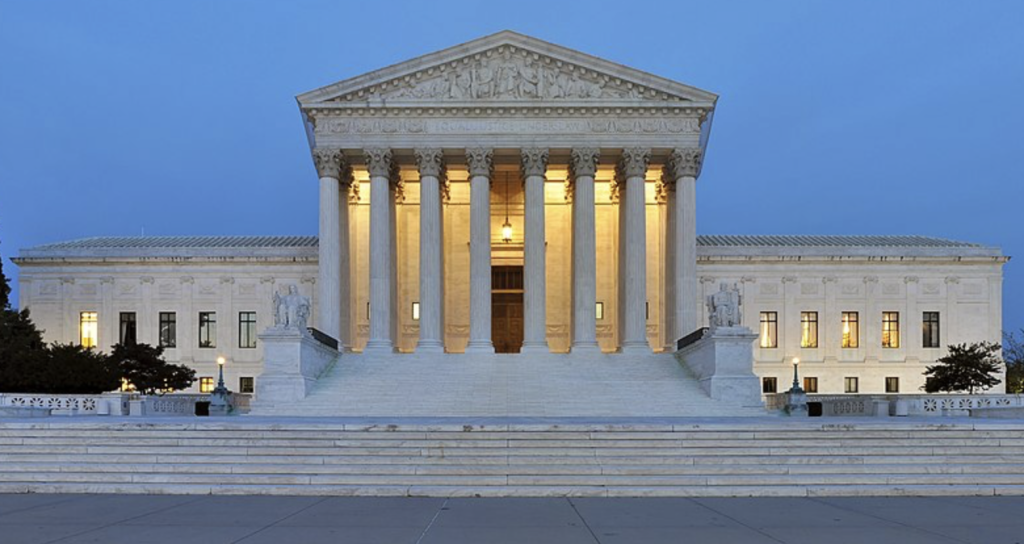
US Supreme Court Building Photo Courtesy of Wikipedia
On August 29, 2025, parties and amici filed a proposed settlement with the U.S. Supreme Court’s Special Master. The settlement consists of a proposed Consent Decree and four implementing agreements that establish an explicit New Mexico downstream delivery obligation for the waters released annually from Caballo Dam. Together, these legal documents total more than 130 pages. They
Establish institutional and financial responsibilities,
Create the Effective El Paso Index that New Mexico’s water deliveries must meet,
Restore New Mexico’s original 57% apportionment of Rio Grande Project water,
Limit New Mexico groundwater pumping, including state purchase of 18,200 acre-feet of actively used groundwater rights from willing sellers,
Require detailed water measurement and accounting procedures,
Set limits on annual and cumulative water delivery debts and credits,
Trigger water allocation transfers, cumulative water underdelivery penalties, or consultation under specific circumstances, and
Leave NM’s discretion intact to continued to buy water or to regulate water uses to achieve compliance.
If approved, New Mexico must comply with numerous, difficult, and permanent requirements. New Mexico’s compliance will cause significant water user and taxpayer impacts.
Why This Analysis is Needed
The Office of the State Engineer posted the proposed settlement documents but with very limited public explanations, all of which have been before the Legislature’s interim committees. Individual requirements are addressed in multiple documents. They must be understood as an integrated whole. The agreements were negotiated as an integrated package but have not been interpreted for the interested public.
Without an official interpretation for New Mexico’s interested and affected public, understanding how the five documents work together is difficult and time-consuming. That’s the purpose of this second Water Advocates’ analysis that focuses on the proposed settlement’s compliance measures.
Understanding the Settlement
There are two parts to the Water Advocates explanation of the proposed Settlement. This article introduces our new analysis. It argues below for the State Engineer to achieve permanent compliance through State Engineer administration of diversions rather than continuing to pay NM water users to not use Texas’s water. Continuing to pay means after the ISC purchases 18,200 acre-feet of actively used groundwater rights from willing sellers.
This article also describes the situation municipal and industrial water users face. The settlement requires negotiation to find a solution to not having enough physical water for all New Mexico users. Almost all municipal and industrial water rights were adjudicated priority dates that are junior to Elephant Butte Irrigation District’s 1903 priority date for Project water and supplemental groundwater. In recent years, New Mexico’s entire annual share of the Caballo Dam release has not been sufficient to meet the 1903 rights.
Our settlement analysis is based on the premise that a good general settlement understanding can be gained answering these questions.
How does the settlement work?
Who pays?
The analysis summarizes each of ten compliance mechanisms we identified in studying the documents. Understanding these compliance mechanisms gives a good answer to the first question above. Seven of the ten compliance measures are mechanisms to reduce water use. Six of the seven require state funding. One of the six mandates state spending to purchase and permanently retire 18,200 acre-feet of actively used groundwater pumping rights from willing sellers. State administration by priority or the water users’ agreed alternative is the seventh.
Five settlement compliance mechanisms would require considerable continuing state funding over and above the mandatory groundwater rights purchases. The seventh measure allows the state to limit diversions in the Lower Rio Grande through regulatory action. Using water that belongs to downstream users is illegal and can be cut off through the State Engineer’s existing but unused regulatory authority.
Please consider that the costs of regulatory action to enforce against illegal water uses should be routine across New Mexico. In reality, State Engineer enforcement against illegal water use is rare.
The New Mexico Water Advocates urge New Mexico’s top water decision-makers to make the State’s water administration in accordance with law routine. We urge the Governor and Legislature to invest now in creating OSE/ISC capacity to administer and make clear the state must stop spending tens of millions routinely for short-term fallowing of irrigated lands. It’s pertinent that the ISC on December 11, 2025, approved contracts to pay $17.5 million to 163 EBID farmers to fallow about 8,300 acres for one, two, or three years.
That amount of money would go a long way if the 2026 Legislature appropriated an equivalent amount to increase the water agencies’ enforcement capacity.
Why This Matters Now
The Effective El Paso Index becomes effective on the day the U.S. Supreme Court issues the decree. New Mexico has five years to purchase and retire 9,100 acre-feet of active groundwater rights, and ten years to retire the full 18.200 acre-feet. Interim compliance with that Index and full implementation of everything the Settlement imposes on New Mexico will cost hundreds of millions. The OSE/ISC are requesting $50 million from the 2026 Legislature to get started. Additionally, the State Engineer must implement Active Water Resources Management (AWRM) regulation of diversions so that New Mexico can stop forever paying farmers to not use water that is not theirs to use.
Regardless, the settlement will have a major impact on New Mexico’s Lower Rio Grande water use and water users. Legislators, local officials, water managers, and the public all have an interest in understanding New Mexico’s many compliance obligations including the settlement’s processes, required milestones, deadline, and penalties, in addition to the state funding requirements and options.
This settlement must serve as a warning to New Mexico’s water-resource agencies, the Governor, and the Legislature’s finance committees and leadership. New Mexico’s water resources agencies don’t think or act like regulators. The settlement will teach New Mexico a painful lesson of water resources governance neglect.
Continued failure by the Office of the State Engineer to implement Active Water Resources Management as authorized by the 2003 Legislature will cause a massive taxpayer burden. Instead, the State Engineer must apply the General Rules for AWRM unanimously upheld by the NM Supreme Court in 2012. AWRM is essential to avoid draining the public purse into both the Lower and Middle Rio Grande.
Continued failure to stop ongoing depletion of the Lower Rio Grande’s Rio Grande Compact entitlement by unregulated Middle Rio Grande water uses will bring the next new SCOTUS litigation in two or three years. It’s time to stop the never-ending-saga of successive chapters of Texas v. New Mexico. State leaders collectively can stop that saga, but that requires the State to get its water management house in order and take actions, muy rápido.
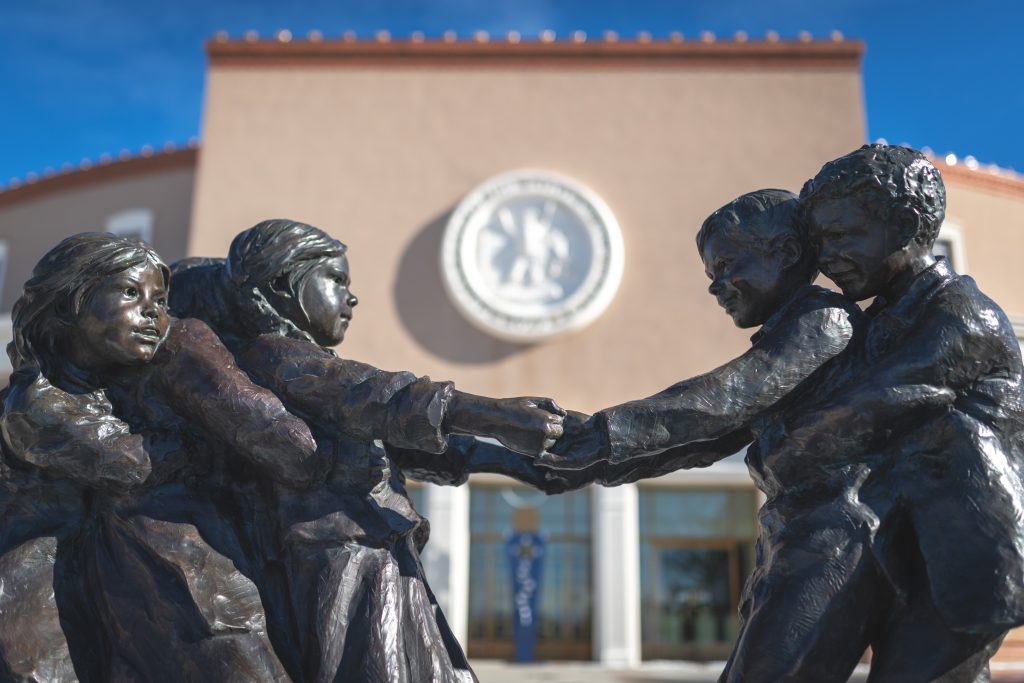
New Mexico State Capitol Photo: Mike Sanchez
What About Municipal and Industrial Water Users?
One major impact of the settlement is its ultimate effect on junior water uses. The state adjudication court awarded 1903 priority dates to EBID’s share of Caballo Dam releases and for EBID farmers’ supplemental groundwater pumping required for a full annual water supply of 3.024 acre-feet. According to the State Engineer’s chief lawyer, almost all municipal and industrial water rights are junior to EBID water rights. The hydrologic record shows the total available annual surface water has been insufficient in many years this century to meet the 1903 water rights. We believe that administration involving cutting off junior uses and cutting into senior uses will be required to meet the new Effective El Paso Index.
That leaves the junior uses in the coming collision between equitable requirements for water and the hydrologic reality of insufficient water. Statutory law does not recognize these equitable requirements for water, but we believe courts will not cut off junior hospitals and schools or people from their drinking water.
The OSE and ISC are not talking about this publicly, although the topic is addressed in the Operations Settlement Agreement, Section II.B.
“Other Adjudication and Administration Issues. The United States, New Mexico, and EBID agree to negotiate in good faith among themselves and the Other Amici in New Mexico (“Other New Mexico Amici”) to seek to resolve, by no later than October 1, 2026: (1) the potential objections of the Other New Mexico Amici to the [EBID water right priorities in the] proposed amended subfile order in SSI 101; (2) other appealable issues raised by the United States’ and New Mexico’s notices of appeals in SSI 104; (3) a separate appeal filed by the City of Las Cruces in SSI 104; and (4) final decrees of subfile orders on the water rights of EBID, the City of Las Cruces, and New Mexico State University. In addition, by no later than October 1, 2026, the United States, New Mexico, and EBID agree to negotiate in good faith among themselves and with the Other New Mexico Amici on issues associated with the manner in which the New Mexico State Engineer will administer water rights determined in the LRG Adjudication, including a potential alternative administration plan that might replace strict priority administration. Nothing herein precludes the participation in the negotiations of an affected party or amicus in the adjudication.“
What About Upstream in the Middle Rio Grande?
OSE and ISC are avoiding naming this problem, also. The plain truth is that New Mexico will by its neglect cause a new violation of the Rio Grande Compact within 2 or 3 years, due to routine Middle Rio Grande use of water the Compact apportions for use below Elephant Butte Dam. This overuse is due in part to the unregulated diversions of water by the siloed water institutions named above, excessive groundwater pumping that takes water from the river, and the poor condition of the Rio Grande channel to move water downstream. If New Mexico does not stop this pending new compact violation, it will create a huge new taxpayer burden. In the end, New Mexico will be left with the same choice it faces today: to comply or to be held accountable by Texas and the U.S. Supreme Court. Assuming the proposed Lower Rio Grande Consent Decree is an example, noncompliance will be met with large penalties, paid back in real, wet water.
The Public Welfare of the State
Taxpayers and downstream users will suffer from the structural mistake of legally enabling water-management silos in New Mexico, such as the Elephant Butte Irrigation District, the Middle Rio Grande Conservancy District, and the Albuquerque Bernalillo County Water Utility Authority without constraining them to act in a manner that is consistent with “the public welfare of the state.” These entities pursue their own interests while disregarding the impacts of their actions on Rio Grande Compact compliance. The plain truth is New Mexico allows actions by these siloed agencies that are “detrimental to the public welfare of the state.”
We have not acted to prevent this mess. Now we have to deal with it. It will be difficult.
Editor’s Note
We strive to provide accurate and thorough information in this analysis. We encourage you to let us know if you identify any errors or omissions. Your feedback is valuable and will help us maintain the accuracy and usefulness of this resource. Thank you for your assistance in ensuring the quality of this public reference.
This excellence water science and policy paper has a lot to say. It should be required reading for all New Mexico elected officials. The report’s discussion of the data it summarizes and presents begins with this contrast between the Colorado River Basin’s and the Rio Grande/Río Bravo Basin’s water security problems and policy-makers’ attention.
The water scarcity challenges within the RGB basin have received much less attention from media outlets and national policymakers as compared to the Colorado River Basin (CRB) in the American Southwest. This can largely be explained by the comparatively smaller volume of water it carries (natural flows of 11,225 MCM/yr or 9.1 million AF/ yr) in the RGB [25] vs. 18,996 MCM/yr (15.4 million AF/yr) in the CRB [26], as well as the smaller population it serves with drinking water (15 million in RGB vs. 40 million in CRB) and the area of irrigated farmland it supports (7,800 km2 in RGB vs. 22,300 km2 in CRB) [2]. However, the water crisis facing the RGB is arguably more severe and urgent than the CRB, as illustrated by these conditions.
Data collection and interpretation by the authors leads to this conclusion.
We estimate that only half (48%) of water directly consumed for anthropogenic purposes is supported by renewable replenishment; the other half (52%) has been unsustainable, meaning that it is causing depletion of reservoirs, aquifers, and river flows. The over-consumption of renewable water supplies is primarily due to irrigated agriculture, which accounts for 87% of direct water consumption in the basin.
And this opportunity.
This water crisis presents an opportunity for the residents of the RGB to envision a new, more sustainable water future. The ‘Multi-benefit Land Repurposing Program’ underway in the water-stressed Central Valley of California provides one example of productive community dialogue around possible future scenarios [42]. The “Exploratory Scenario Planning” approach being advanced by the Lincoln Institute of Land Policy in various communities in the western US similarly offers ways to engage local communities in planning for their water future [43]. Any transformational strategies will require careful and inclusive planning, provision of strong financial incentives for farming communities to facilitate needed changes, and a bold willingness of water management agencies and decision makers to ensure water and food security for the region. Alternate pathways toward a sustainable water future are available for the RGB basin, but time is of the essence in correcting the highly unsustainable conditions that presently exist.
October’s Big Storm Helped the River But the Middle Rio Grande Depleted 40% of the Lower Rio Grande’s Share
An intense rainstorm centered on the San Juan River mountain headwaters spilled over into the headwaters of the Rio Grande, sending a surge of mountain runoff into the San Luis Valley. This is the storm that flooded Pagosa Springs. The October 14 Alamosa Citizen story headline on the flood was followed by the reporter’s understanding of routine Colorado water management in the subtitle, “Now it’s time to measure and account for the extra water in management of the Rio Grande Compact.”
The Rio Grande at the Del Norte gage peaked at 7,000 cubic feet per second—a very high flow for autumn. The Colorado Division of Water Resources contemporaneously estimated 20,000 to 25,000 acre-feet entered the San Luis Valley in Colorado, and reported that 15,000 acre-feet was diverted into the Valley’s canals. Colorado’s Rio Grande Division Engineer, Pat McDermott, told the Rio Grande Basin Roundtable that the Middle Rio Grande might see roughly 5,000 acre-feet of this water, but that it would likely not extend as far south as Elephant Butte Reservoir. The Rio Grande benefit in New Mexico actually was much larger but he was right about Elephant Butte.
Because the Rio Grande Compact divides the river’s flow among Colorado, the upper, middle and lower Rio Grande in New Mexico, and the Lower Rio Grande in Texas, how each state measures and manages water determines whether its downstream obligations are met.
The irrigation season in Colorado and New Mexico ended November 1. Colorado flows increased as a result but are tapering down. Deliveries into Elephant Butte are now slowly increasing, but didn’t benefit from the Colorado flood. The contrast between Colorado’s prompt accounting and New Mexico’s limited conveyance is striking.
A Growing Water-Delivery Debt
The Middle Rio Grande entered the year 124,000 acre-feet behind in its accrued annual water deliveries to Elephant Butte Reservoir. Throughout the year, that debt has inexorably grown due to the complete failure of this year’s spring runoff and the Middle Rio Grande’s excessive depletions over the last 15 years. New Mexico does not manage the Middle Valley’s groundwater pumping, which accelerated due to lack of river water, the Middle Rio Grande Conservancy District’s diverting more than New Mexico’s share, and poor channel conveyance.
Neither the State Engineer nor the Interstate Stream Commission have publicly discussed this year’s growing debt. Neither has emphasized New Mexico’s serious risk of a new violation of the Rio Grande Compact due to the Middle Rio Grande’s chronic taking of the Lower Rio Grande’s share, year after year.
I decided to calculate what happened on the Rio Grande in New Mexico from the storm. I used online river and reservoir gage data from October 12 through November 9, the last day for which a complete data set is available online. My calculations show that between those dates, 40,900 acre-feet of water flowed under the highway bridge to Los Alamos as measured at the Otowi Bridge gage. Colorado state-line water deliveries were about 60 percent; the other 40 percent came from New Mexico springs and tributaries. The Lower Rio Grande’s share of that, which is the same thing as the Middle Rio Grande’s delivery obligation, was 23,300 acre-feet.
Elephant Butte’s storage increased only 14,000 acre-feet and releases were 100 acre-feet, creating an actual water delivery during this period of 14,100 acre-feet. The result: this a deficit of 9,200 acre-feet over this 29-day period was added to New Mexico’s 2025 debit. Roughly 40 percent of the water that should have reached the reservoir disappeared within the Middle Valley.
Some unknown combination of Middle Rio Grande Conservancy District diversions, increased groundwater pumping that induces recharge from the river, and the poor water-conveyance condition of the river channel upstream from and into the nearly dry Elephant Butte Reservoir absorbed or intercepted much of the flow. This is why so little of the high flows reached Elephant Butte, leaving New Mexico much worse off with regard to its Compact obligations.
Why I’m Tracking Deliveries Monthly
The Water Advocates for several years has urged the Interstate Stream Commission staff to begin paying public attention to water deliveries through the Middle Rio Grande each month and forecasting the year-end results. Sure there are uncertainties and unknowns, but both tracking intra-year progress and forecasting the year-end results are an essential first step to recognizing and managing this serious problem.
The State can’t manage what the State doesn’t measure—and that includes contemporaneous annual compliance as a year progresses. Water delivery debt has grown significantly during 2025, without any Interstate Stream Commission acknowledgement of that fact. Both the facts and state agency silence should alarm the Legislature and the public.
My independent review of this year’s Compact deliveries began this summer. I requested data at the end of each recent month from the Bureau of Reclamation’s engineer who operates the official Rio Grande water accounting model. Last month he discovered a problem with the initial condition for the 2025 accounting. We both made bad estimates because Reclamation’s Elephant Butte Reservoir instrumentation, which measures the reservoir’s water-surface elevation and determines its storage volume, became stuck. I misunderstood how the model accounts for federal storage of New Mexico water in Rio Chama reservoirs to ensure the six Middle Rio Grande Pueblos’ Prior and Paramount water rights have a full supply. The release of unused prior and paramount water between now and the end of the year should materially improve net Compact deliveries over the remainder of the year because it was properly accounted when it was stored.
The Outlook
I project the year will end with an annual 2025 Middle Rio Grande water-delivery debt of about 26,000 acre-feet and an accrued water debt of about 150,000 acre-feet. If so, that may give us two years to avoid a Compact violation rather than only one. We must use this time to stop and reverse the current trend, prevent the violation that continued inaction will cause, and begin working our way out of Compact debt. Any accrued water debt above about 50,000 acre-feet effectively prevents Middle Rio Grande water from being stored upstream in Rio Chama reservoirs.
A public agency can’t deal with a complex problem that impacts the public unless and until the agency names the problem and describes it. A problem can’t be managed if progress toward the desired outcome is not measured. The State Engineer’s job is to comply with the Compact. The ISC’s job is to gather accurate information, professional analysis, and make it publicly available. Both have the duty to communicate openly and promptly.
I speculate this crisis is getting the silent treatment by both state agencies because they don’t have the Governor’s consent to confront it. Dealing with this compact emergency is not in the Governor’s 50-Year Water Action Plan. Neither is water planning. If we have to wait for a new Governor to attend to New Mexico’s water emergency, it may not be in time to prevent a brand new Texas v. New Mexico case before the US Supreme Court. Failing to take serious action now is another step toward the huge risks and costs of the litigation that will follow a violation. That’s a poor legacy for everyone involved.
New Mexico needs transparent water management to prevent the looming Compact violation. It needs funding. It needs it now.
We’re Asking the Governor & Legislature to Fund State Water Agencies to Secure A Better Water Future
Senator Liz Stefanics, Chair of both the Legislature’s Water and Natural Resources Committee and the Senate Conservation Committee, asked water advocates to identify financial resources needed to confront New Mexico’s deepening water crisis. The New Mexico Water Advocates responded with three essential programs: Rio GrandeCompact Compliance, Water Data infrastructure, and Regional Water Security Planning.
These are not long-term wish-list items. They were recommended specifically by the 2022 New Mexico Water Policy and Infrastructure Task Force. They are well-vetted and justified emergency responses to New Mexico’s water crisis that is already destabilizing communities and ecosystems and threatening our economy. New Mexico is over-using its renewable water supplies while climate heating drives aridification and the decline of both groundwater and surface water resources. The State must improve its ability to comply with the Rio Grande Compact, to track and manage actual water use, and to plan realistically for a more resilient water future that is now in jeopardy.
These three programs are designed to meet the crisis and bring it under control. Together they build the State’s essential capacity to enforce water rights, meet New Mexico’s Rio Grande Compact obligations, generate and share reliable water data, and empower regional planning councils to act on that information. Only the State of New Mexico, through its agencies and technical institutions, has the authority and responsibility to do these essential jobs. With adequate funding to begin multi-year efforts this session, the State can start stabilizing the crisis and lay the foundation for science-based, transparent, and durable water governance. Without funding, New Mexico will remain in emergency mode—reacting to shortages, assuming the enormous risk and costs that a compact violation unleashes, and defending against new Texas litigation—instead of preventing or managing to mitigate them.
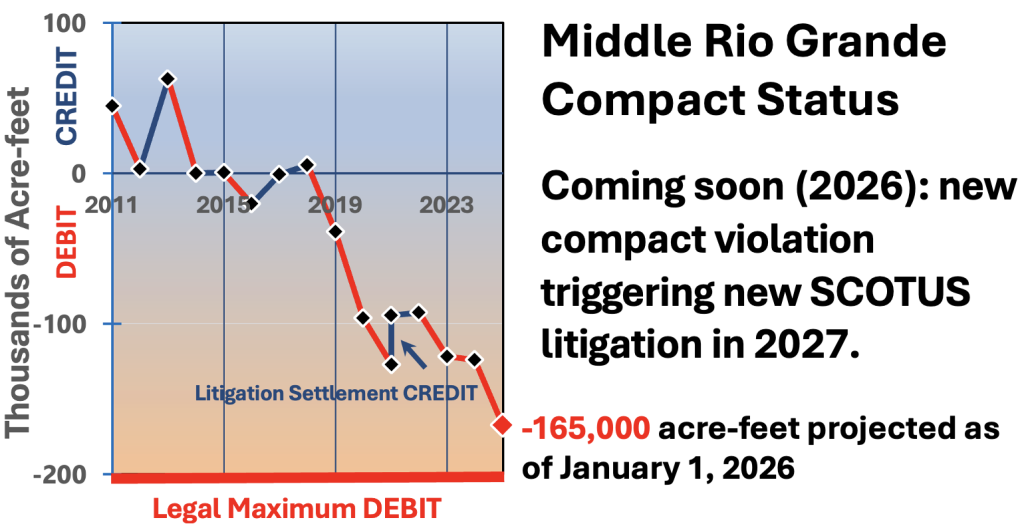
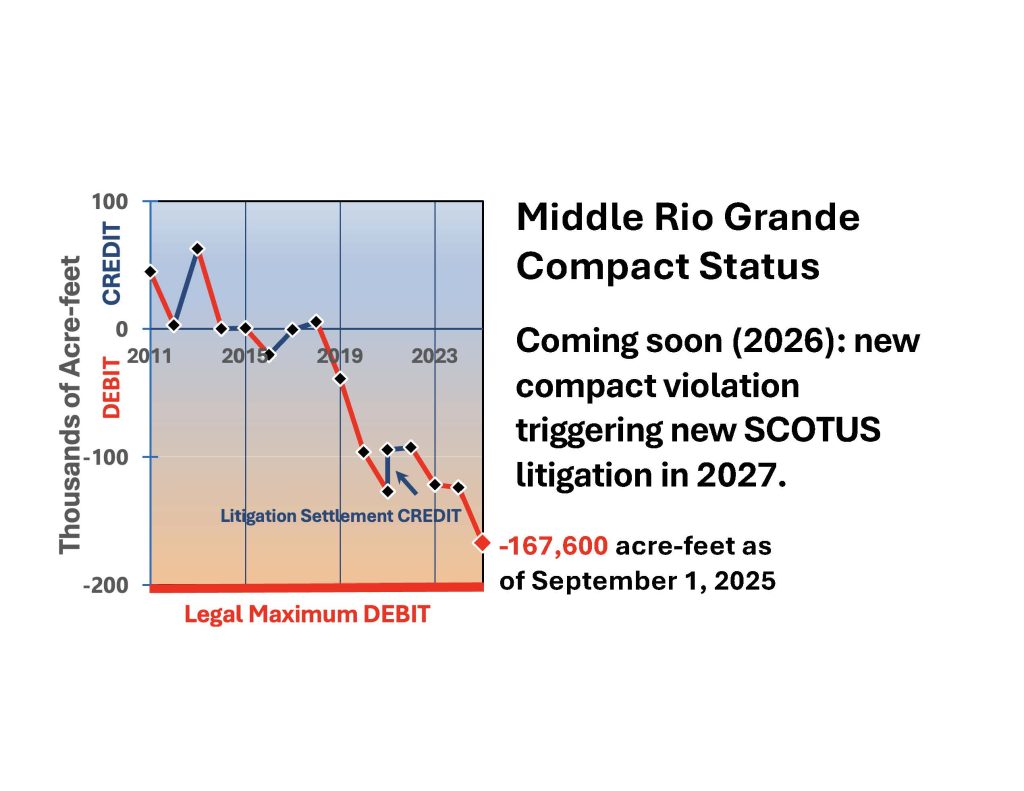
Rio Grande Compact Accrued Debit/Credit History
1) Rio Grande Compact Compliance
New Mexico must meet its delivery obligations to Texas and the United States while protecting communities and ecosystems in the Middle Rio Grande. We recommend:
$10 million (one-time) to the Office of the State Engineer (OSE) to implement the Lower Rio Grande settlement and prevent a new Rio Grande Compact violation due to Middle Rio Grande water overuse. At the current trend, we have only two years and perhaps only one to prevent new Texas v. New Mexico litigation. An emergency clause is needed to provide funding as early in 2026 as possible.
$1 million (recurring) for enforcement capacity—staff, office space, vehicles, and equipment—so the OSE can enforce Lower and Middle Rio Grande water rights.
Pass the Water Rights Enforcement bill, the 2025 measure to modernize an outdated statute that stalled on the Senate floor awaiting a final vote. The State Engineer needs workable administrative enforcement authority to stop illegal water uses without having to sue the user.
Why it matters: The Lower Rio Grande settlement requires New Mexico’s detailed plan in two years to substantially reduce Lower Rio Grande water use and full compliance in 10 years. At the present trend, Middle Rio Grande illegal water overuse will cause a compact violation in two years.
2) Water Data to Support Planning & Management
New Mexico’s water decisions are only as good as the data behind them. We recommend:
$7 million (one-time) to the OSE to replace the outdated water-rights database and application, build a real-time water-use database and application, and implement a modern management information system.
$3 million (one-time) to NM Tech for the Bureau of Geology & Mineral Resources (NMBGMR) to contract with Water Data Act directing agencies to publish priority datasets to the state water data catalogue. These datasets will be selected in consultation with the Interstate Stream Commission (ISC) to help ensure regional water planning councils have the best available science, data, and models.
$21.5 million (one-time) to NM Tech for NMBGMR to accelerate the statewide Aquifer Mapping Program—geophysics, new characterization and monitoring wells, and term staff—to illuminate where, how fast, and why groundwater conditions are changing.
Why it matters: You cannot manage what you don’t measure. These investments give local water managers, planners, and the public the transparent, timely information demanded by aridification, warming, and overuse.
3) Regional Water Security Planning
To make the Water Security Planning Act work on the ground, regions must organize credible councils and set pragmatic work plans. We recommend:
$4.8 million (one-time) to the OSE for the ISC to make grants to nine regional entities to stand up councils and develop work plans for Commission approval. The appropriation includes 6% for ISC administrative costs at $300,000.
Why it matters: Durable solutions are local and data driven. Funding regional councils to organize and plan with the best data available creates a transparent path from facts to decisions.
Bottom line: New Mexico is overusing declining renewable water supplies in a warming climate. The responsible fix is not slogans or one-off projects. It is steady, statewide capacity in water law enforcement, water data, aquifer science, and regional planning. Please urge your legislators to fund these requests and pass the enforcement bill this session. It’s the most cost-effective way to protect communities, economies, and rivers—not just this year, but for decades.
The ISC’s Rulemaking Hearing on New Mexico’s Water Security Planning Act
Record Closed
“Record closed.” Hearing Officer Felicia Orth declared it at the close of the Interstate Stream Commission’s three-day evidentiary hearing. The Commission now must decide what changes to make to staff’s July 17 proposal.
Closing the record means commissioners must rely solely on the evidence already submitted. Until deliberations are complete they may not discuss the rule with anyone, not even each other, except in an open public meeting.
The Act passed unanimously and was groundbreaking; will the rules be equally meaningful and unanimous? The Commissioners will decide. The Commission holds extraordinary power over how New Mexico will plan for its water future. Commissioners have a moral responsibility to ensure the regional water-security program they create fulfills its potential. The people who are working to improve the public welfare need nothing less.
Next Steps
The Commission outlined its next steps. First comes the court reporter’s hearing transcript. Next is the Hearing Officer’s report, described to the Commission at its September 18 meeting:
Commissioner Phoebe Suina: Please give an example of the report and how it would aid the Commission.
Hearing Officer Felicia Orth: Depending on what the record looks like, the report includes a summary of the evidence, a roadmap for deliberations, and maybe threshold questions to address before specific ones. In a rule with many sections, what other rulemaking bodies find useful is a compilation of the differences between sections—the “best and final offer” from each commenter, not interested parties—with citations to evidence in the record that support each version. My goal is to be helpful, not persuasive.
The Commission’s deliberations to finalize the rule will occur in December. The Commission must review the proposed rule line by line, identify what’s missing, and decide what to change or add. Hearing Officer Orth said she would be asking them to identify supporting evidence in the record.
Predictions:
Deliberations will require more than one day, likely concluding in early 2026.
The final rule will differ substantially from the staff’s July 17 draft.
Public Participation and Commissioner Engagement
Public comment and commissioner engagement were robust and well aligned. Pueblo Governors and officials from many Pueblos spoke thoughtfully and persuasively. I heard eloquent, rich statements of values and requests for inclusion and protection from acequias and parciantes, and land-grant officials and heirs. Professionals stressed the urgency of problem solving and the specific improvements required.
The public’s recommendations and commissioners’ thoughtful questions gave me not just hope but confidence. Hearing Officer Orth welcomed public comment, effectively disregarding the ISC staff attorney’s opinion that it should be limited. Commissioners were engaged, providing their thoughtful, diverse perspectives and asking many questions. I believe these exchanges of facts and values will strengthen the final rule so that regional water-security planning achieves its potential to confront the water crisis already underway—and the far worse conditions ahead.
Core Weaknesses of the Staff’s Proposed Rule
The staff’s draft rule misses the mark; it is unfinished, poorly written, and vague.
No guiding principle: Staff showed no consistent method for turning legislative mandates into a clear, functional rule. Most requirements are ignored, others copied as lists, and none made operational except for its top-down membership provisions. One commissioner called it a “laundry list.”
No vision or framework: The draft lacks a coherent vision of the water-security program or the framework these rules must serve. It reads as a disconnected set of administrative steps rather than a roadmap to achieve the Act’s purposes.
Inappropriate centralization: The draft makes a handful of ISC planning staff the indispensable gatekeepers for every regional effort, throttling progress and undermining regional responsibility and creativity that the 2023 Water Security Planning Act intends.
Failure to implement mandates: The rule does not operationalize the Act’s core requirements:
Commission responsibilities (§ 72-14A-4(C)(1) & (3)–(9)): including its duty to provide the best available science, data, and models, and to ensure regions utilize them and report the results with objectivity and professionalism.
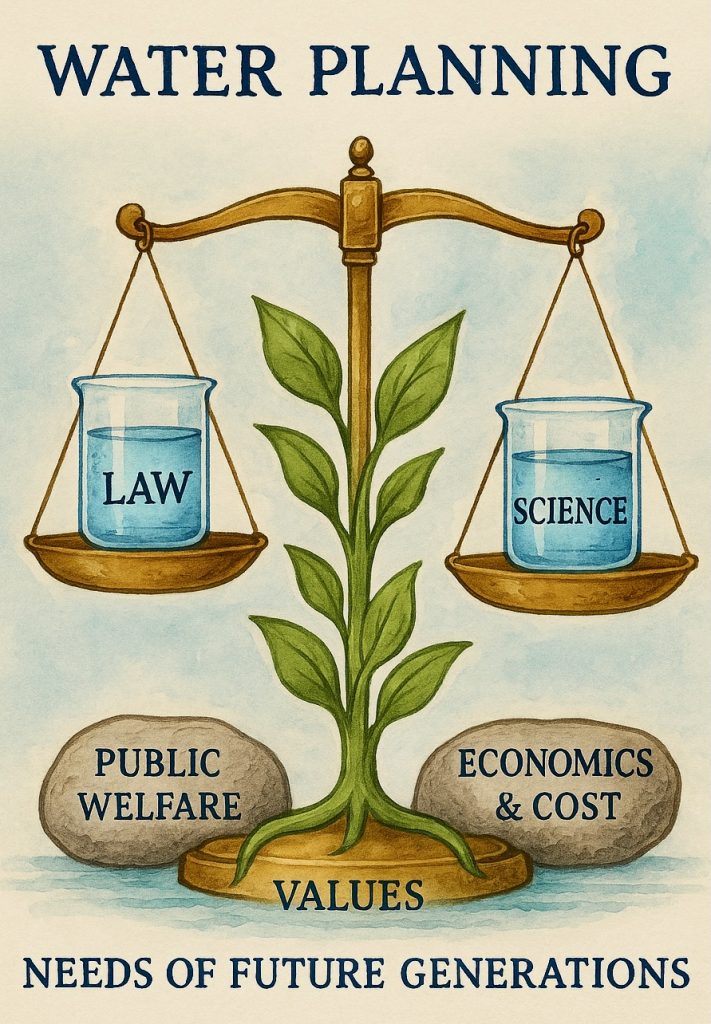
Council responsibilities (§ 72-14A-5(B) & (C)): undermining the law’s mandate by failing to require regional councils’ meaningful and reviewable “consideration” of public welfare and the needs of future generations, and councils’ statutory authority to select their members.
Violates drafting standards: The rule fails the plain-English and structural standards that all administrative rules are required to meet.
Unless thoroughly rewritten and expanded, the final rule will fall short.
Next Steps and the Public Record
The record is closed, but the Commission’s work of agreeing on changes and additions remains to be done, transparently, in public. The Commission’s deliberations in December will determine whether the final rule honors the Legislature’s intent for science-based, community-centered water planning.
Every argument, citation, and recommendation the Water Advocates submitted is in the official record. These filings show how the Proposed Rule can be corrected to comply with the Water Security Planning Act and to produce a lawful, clear, durable framework for regional planning.
Readers can access the complete docket here, and the Water Advocates submittals for the record linked by name below.
Together with others’ testimony and comments, these documents form a consistent record: New Mexico needs clear, lawful rules grounded in science and reasoning. Vague rules are confusing—and therefore legally dangerous.
Summary
The Water Advocates appreciate Hearing Officer Orth’s welcome of public comment and her repeated insistence on transparency. The three-day hearing generated robust discussion and evidence that give the Commission strong guidance. Hearing Officer Orth will organize the record and propose a procedure for the Commission to do its job.
The Commission must transform the staff proposal into a clearer, less staff-centric, and more meaningful rule; one that advances planning with integrity and transparency accessible to all participants. The final rule must reflect local and regional hydrologic reality and give effect to the public welfare and the needs of future generations of New Mexicans.
I am optimistic they will together rise to the occasion.
Middle Rio Grande Compact Deliveries & Water Delivery Debt
New Mexico’s water situation is deteriorating; under the Rio Grande Compact, NM is accruing historic water delivery debt. This reveals a clear leadership failure in protecting New Mexico’s water.
As would be expected with a dry Rio Grande riverbed aggravated by uncontrolled diversions and groundwater pumping, the September compact compliance news is bad. According to the Bureau of Reclamation’s water accounting model, New Mexico’s water delivery arrears increased to -52,100 acre-feet as of midnight on September 29. Reclamation can’t provide the end of September figures because the federal government is shut down.
Projection of Future Water Delivery Debt
Unless we experience a weather miracle, namely the remnants of a hurricane crossing the Middle Rio Grande, I estimate that by the end of 2025, cumulative water delivery debt will be about -165,000 acre-feet. New Mexico’s increasing debt trend will look like this.
My experience as Interstate Stream Commission Director (1997-2002) and “engineer advisor” to the New Mexico Commissioner, Rio Grande Compact Commission and my license as a retired water resources engineer qualify me to publish this projection. Time will tell if it is accurate.
The Urgent Need for Courage & Transparency
The Interstate Stream Commission Director’s September 18 staff report cites only the official compact debt as of January 1, 2025:
Rio Grande Compact Status – New Mexico’s cumulative Compact debit status is 124,000 acre-feet and Article VII restrictions continue to be in effect.
Nothing was said at the Commission’s September 18 public meeting about the Water and Natural Resources Committee’s September 12th meeting. Legislators charged that New Mexico water agencies lack courage and urgency to confront the imminent new new compact violation and prevent it.
Preventing this imminent new Rio Grande Compact violation requires the leaders of these agencies to tell us the transparent truth. No major New Mexico water problem can be solved until it is publicly named and described.
The legislature recognizes that the adjudication process is slow, the need for water administration is urgent, compliance with interstate compacts is imperative and the state engineer has authority to administer water allocations in accordance with the water right priorities recorded with or declared or otherwise available to the state engineer.
The state engineer shall adopt rules for priority administration to ensure that authority is exercised.
This law and the associated regulations were written to manage the illegal overuse of water Lower and Middle Rio Grande. The New Mexico Supreme Court in 2012 unanimously upheld the regulations. Successive State Engineers have not upheld this law or invoked these regulations.
Budget Battles: Legislature vs. Water Protection
Governor Michelle Lujan Grisham requested $500,000 annually from the 2025 Legislature to enforce Middle Rio Grande water rights and confront the Middle Rio Grande water overuse problem. The House Appropriations and Finance Committee under Chairman Nathan Small’s leadership refused to include that request in the budget, instead choosing to direct millions of dollars to oilfield produced water and brackish water treatment. That decision shows legislators who rightfully criticized and mocked both agencies lack of urgency are collectively guilty of the same failures.
Legislative leaders and state budget appropriators: where is your leadership to protect New Mexico’s water?
New Mexico’s problem isn’t so much that some people take too much, although that’s a problem, too. It’s that all surface and groundwater uses together exceed with nature deplete more river water than the Middle Rio Grande’s legal share. Every extra diversion comes out of the water owed downstream. If we keep doing that, the question of how to get the Lower Rio Grande it’s entitled share to Elephant Butte will no longer be ours to decide. The U.S. Supreme Court will decide for us, with absolute discretion. They would order whatever it takes, even turning the Rio Grande into a controlled delivery canal like downstream.
That’s why it matters. That’s why we must eliminate Middle Rio Grande depletions of water owned downstream and work our way out of compact debt.
The Rio Grande Compact is a perfect barrier protecting the Middle Rio Grande from downstream users demands, but only if New Mexico complies.
Energetic Water Discussion in Taos at the NM Legislature’s interim Water & Natural Resources Committee
Elephant Butte Reservoir is 4% full; bathtub rings are evidence of a crisis NM is failing to address, N Gaume photo 8/27/25
Evidence of Overuse & Looming Compact Violations
The Water & Natural Resources Committee considered Middle and Lower Rio Grande overuse and Compact compliance together as one issue.
Legislators’ discussion began with a five-member Water Security Planning Act panel including ISC Director Hannah Riseley-White, former State Engineer Mike Hamman, Jicarilla Apache Tribe water manager Daryl Vigil, New Mexico Acequia Association Policy Director Vidal Gonzales, and me, a former ISC Director and Water Advocates president. I went last.
The Water Security Planning Act should be implemented to meet its potential as a powerful water resources management problem-solving tool, and
Three priorities require legislative action:
Implement the 2023 Water Security Planning Act.
Modernize the Office of the State Engineer and the Interstate Stream Commission. including their compliance with their 2019 Water Data Act responsibilities.
Enforce water rights by changing the law and funding staff to make enforcement practical and effective.
Elephant Butte Reservoir once-drowned resort foundations and the marina, 4% full, N Gaume photo 8/27/25
Camping on the normally wet, upstream side of Elephant Butte Dam when the reservoir is 4% full, N Gaume photo 8/27/25
Legislators recognize Lower and Middle Rio Grande water overuse and compact compliance are one problem
Legislators’ were engaged. Many still had not spoken when Chair Sen. Liz Stefanics decided to postpone the next panel. She said, “See, we are paying attention to water.” Several legislators directly referred to the Water Advocates handout or the compact compliance graphic while asking questions.
The Lower Rio Grande’s overuse problem in litigation since 2013 reaches a settlement
State Engineer Elizabeth Anderson, her office’s chief counsel Nat Chakares, ISC Director Hannah Riseley-White, and Chief Deputy Attorney General James Grayson presented a clear summary explanation of the Lower Rio Grande compact settlement with Texas, the U.S. Department of Justice, the Bureau of Reclamation, and the New Mexico and Texas irrigation districts.
All officials praised the settlement as the best New Mexico could have done.
In my educated opinion, by the time this is over the taxpayers cost for the litigation and the settlement will be at or over $500,000,000.
It’s one big problem
The legislators’ questions and discussion then refocused on Middle Rio Grande and Lower Rio Grande overuse. They again discussed it as a single problem — an alarm that is growing, uncontained, and far from a solution.
Courage
Sen. Joseph Cervantes, D-Dona Ana, made two strong points. A legislator for 25 years, he is a Las Cruces litigator from a long-established family that owns extensive pecan orchards. He bluntly pinpointed the missing ingredient: Courage.
Later, he mocked the Office of the State Engineer for “planning” a well-metering order for the Middle Rio Grande and “planning” to begin the Middle Rio Grande water rights adjudication. Paraphrasing, He said it was ‘much too little, way too late.’
Yes, but still better than nothing, as the State Engineer’s 2004 shortage-administration rules already have the full backing of the New Mexico Supreme Court (2012). The metering order is one of several initial steps. The water agency executives should be motivated to take those steps very soon.
Urgency
Rep. Matthew McQueen, the Committee vice-chair, asked ISC Director Riseley-White two direct questions about what the ISC is doing to prevent the new compact violation, referring to the trend graphic in the Water Advocates handout. He concluded, saying he was dissatisfied with her lack of urgency.
Authority and Accountability
To be clear, the Office of the State Engineer has the power to stop the overuse, but has not yet taken any overt, public action. The ISC has the responsibility to know the facts and communicate the risk and urgency, and spend money to maintain the river channel. Neither the ISC Director, staff, nor any commissioner publicly recognized any urgency at the Commission’s September public meeting.
The Legislature’s existing accountability metric for Rio Grande Compact compliance should also hold the Office of the State Engineer accountable, not just the ISC. That’s because by law, the State Engineer has the specific responsibility and authority to prevent the Compact violation. The ISC’s purpose with broad authority includes “to protect and to do any and all other things necessary to protect” New Mexico’s water.
Courageous Actions Required
To New Mexico State Engineer Elizabeth Anderson: Please act decisively to prevent the looming Compact violation. It is past time for your office to speak openly about the risks we face — and what your office and others in authority must do to keep the Middle Rio Grande’s water future out of the U.S. Supreme Court.
We wish you Courage and Godspeed.
To Governor Lujan Grisham: Your executive direction to the State Engineer is needed: “do any and all things that are necessary” and within your authority to prevent this new violation of the Rio Grande Compact. Call for the Special Session to pass the 2025 water rights enforcement bill that you recommended by died before its final vote on the Senate floor.
Reference Section 72-2-9.1.A quoted below. This water law passed in 2003 and was upheld by the New Mexico Supreme Court in 2012:
A. The legislature recognizes that the adjudication process is slow, the need for water administration is urgent, compliancewithinterstate compacts is imperative and the state engineer has authority to administer water allocations in accordance with the water right priorities recorded with or declared or otherwise available to the state engineer.
To the NM Legislature: Provide New Mexico’s water resources management agencies with the resources and capacity they require to do their jobs to protect New Mexico’s water resources. Pass the 2025 enforcement bill.
To the public: Demand officials take emergency actions to prevent New Mexico’s new violation of the Rio Grande Compact next year that will place the Middle Rio Grande’s water future in the unfettered and unappealable discretion of the U. S. Supreme Court.
Interested members of the public should know:
The Rio Grande Compact shields the Middle Rio Grande from downstream demands, but only as long as New Mexico stays in compliance.
Since 2018, New Mexico’s annual overuse has averaged about 22,200 acre-feet — small compared to average Rio Grande inflows of more than 750,000 acre-feet per year.
Groundwater pumping undermines the river’s flow.
Coming Soon
Articles describing,
The looming risk: If New Mexico fails to prevent a new Rio Grande Compact violation, the State’s neglect will impose severe risks on the State and Middle Rio Grande residents. The article will describe why and how the Compact violation risks our river and our lifestyles.
Polycentric water governance: Effective stewardship requires state government, local governments, and the special districts that supply water to share authority and responsibility. Only by working together can we manage common water supplies to meet today’s needs and secure water for future generations of New Mexicans.





 The Commission’s deliberations to finalize the rule will occur in December. The Commission must review the proposed rule line by line, identify what’s missing, and decide what to change or add. Hearing Officer Orth said she would be asking them to identify supporting evidence in the record.