Stay informed about the latest legislative actions and policy developments related to water management in New Mexico, including bills, hearings, and advocacy efforts.
Seizing the Moment for Sustainable Water Governance in New Mexico
A Long History of Knowing—and Ignoring – For more than half a century, New Mexico has known that its water future is imperiled by persistent overuse, unsustainable pumping, and institutional failure. And for just as long, it has failed to act on that knowledge. Today, we face a narrowing window of opportunity to reverse that course. The 2023 Water Security Planning Act and other recommendations of the 2022 New Mexico Water Policy and Infrastructure Task Force offer a new legal and policy framework that could help New Mexico move beyond a legacy of neglect toward a model of proactive, inclusive, and science-based water governance.
Portales, Clovis, Cannon Air Force Base, and neighboring small towns face existential water shortages.
Ogallala Collapse Foretold—and Ignored – In 1968, the New Mexico Office of the State Engineer (OSE) published Technical Report 31, authored by hydrologist William Galloway. The report warned with unambiguous clarity that groundwater mining in eastern New Mexico was unsustainable and would ultimately collapse the agricultural base of the region. A 1999 OSE modeling report confirmed this trajectory of decline for the Ogallala Aquifer. Yet no policy shift followed.
Today, the communities of Portales, Clovis, Cannon Air Force Base, and neighboring small towns face existential water shortages, as the aquifer they solely depend upon is nearly forever depleted.
The Middle Rio Grande: A Crisis Denied – A parallel pattern of neglect has persisted in the Middle Rio Grande. Overuse and over-diversion of surface water, coupled with excessive groundwater pumping, have undermined both ecological health and legal obligations. This has triggered a new Rio Grande Compact compliance emergency centered on Middle Rio Grande water overuse. The cumulative effect of local water development coupled with state inaction and self-serving local water institutions has pushed the system to the brink. Yet, there remains no unified plan or political will to rein in the overuse or enforce sustainable limits.
State Engineer General Counsel Nat Chakeres recently announced meaningful water policy changes are forthcoming. His presentation covering both the problem and the solution is the best and most accessible I have seen. He admitted it may be too late.
The Governor’s FY26 budget recommendation included dedicated staff and office space for the State Engineer to begin essential regulation of Middle Rio Grande overuse. It died by inaction of the House Appropriations and Finance Committee.
Plans Unheeded: Policy Paralysis – In 2002, the nonprofit 1000 Friends of New Mexico published Taking Charge of Our Water Destiny, a sweeping and thoughtful roadmap for comprehensive water reform. The report called for state leadership, regional empowerment, and public participation in water planning. It urged the use of science, transparency, and collaboration as the foundation of decision-making.
Two decades later, those recommendations remain strikingly relevant—and largely unfulfilled. Once again, knowledge was not the problem; the failure was in the doing.
Once again, knowledge was not the problem; the failure was in the doing.
Public Welfare Standard: Dormant by Design – The consequences of that failure are now visible statewide: rivers drying, aquifers collapsing, and legal obligations nearing breach. Yet even now, decision-makers struggle to apply the tools that already exist. One of the most powerful is the statutory requirement that water rights transactions be consistent with the public welfare of the state. Though this criterion was added to New Mexico law in the 1980s, it has never been defined or interpreted to reflect today’s hydrologic, ecological, or societal realities.
As legal scholar Susanne Dooley Hoffman wrote in 1997, the public welfare standard is a dormant authority—a tool requiring additional legislative definition to ensure that private water use aligns with the broader needs of communities, ecosystems, and future generations. These essential and equitable needs were described by Mr. Chakares as valid claims “that are not going away.”
Ms. Hoffman-Dooley argued that the Legislature’s designation of “the public welfare of the State” as one of three statutory criteria for the State Engineer’s discretionary approvals without defining it is unconstitutional. Almost three decades later, we now await a New Mexico Supreme Count decision related to an illegal lease of a previously dormant Pecos River water right in the Intrepid case by a State Engineer that abused the public welfare of the state criterion. The ISC protested the application that the State Engineer later approved because it was so obviously counter to the public interest and dollars spent to comply with the Pecos River Compact. The State Engineer fired the ISC Director. In this case, the ISC persisted, and will be vindicated in the forthcoming decision.
Here again, the problem is not in the knowing, but in the failure to act.
Sufficient understanding and the political will to confront New Mexico’s existential water crisis does not yet exist in the Governor’s office or the Legislature.
Leadership Vacuum: Executive and Legislative Inaction – This long pattern of neglect—in science, in policy, and in law—must end. Yet the failure is not only administrative. It is also legislative. During the interim between sessions, legislative committees often hold hearings that illuminate the gravity of New Mexico’s water problems. These hearings gather testimony, generate interest, and highlight urgent needs. But rarely—if ever—do they result in committee-sponsored water policy reform legislation. In the 2025 session, the Legislature essentially ignored water resources sustainability altogether.
Meanwhile, the Governor’s office provided no water resources sustainability leadership, leaving state water institutions with a crippling lack of permission to take the bold steps required. Inaction makes it clear that sufficient understanding and the political will to confront New Mexico’s existential water crisis does not yet exist in the Governor’s office or the Legislature.
Effective water governance cannot flourish without transparency, accountability, and public inclusion.
The ISC Restricts Participation – Interstate Stream Commission’s policies are problematic examples. In March 2025, the ISC staff revealed its intended process for the Commission to promulgate regional water planning rules. The announced process would limit technical and expert testimony to only those experts selected by the ISC staff, not withstanding due process guarantees of law. Another example: the ISC’s public comment policy requires a written submission 72 hours in advance with no opportunities for public engagement at ISC public meetings.
At a time when broad civic engagement is critical, the Commission’s approach is misaligned with the scale and urgency of the water supply challenges facing the state. Effective water governance cannot flourish without transparency, deliberation of policy decisions in public, accountability, public inclusion, and yes, due process.
A Path Forward: The Promise of Polycentric Governance – The Water Security Planning Act of 2023 provides a way forward. For the first time, it mandates the creation of regional water planning councils empowered by statute and supported by state resources. These councils represent a shift toward polycentric governance: a model that recognizes the diversity of New Mexico’s water challenges and enables regionally informed solutions within a statewide framework. But that potential will not be realized if state institutions cling to the command-and-control habits of the past.
We have the legal foundation and the scientific understanding. What remains is the political courage to act.
What Must Change: Vision, Function, and Courage – To succeed, the water planning program must be grounded in a clear vision: one that distinguishes the appropriate roles of state and regional actors, prioritizes transparency and public participation, and builds from the ground up. Funding must follow function. Councils must have the means to organize themselves, evaluate and understand water data, and propose actions suited to their unique conditions. And the State Engineer and Interstate Stream Commission must lead by enabling—not overriding—local and regional responsibility.
No More Waiting – New Mexico has waited far too long to confront its water realities. But today, we have sufficient legal foundation, scientific understanding, and the community will. We lack the political courage of our elected and appointed leaders to lead and share power to confront our water crisis. To date, they collectively lack political will. We, and they, must change that.
One of the primary focuses of the New Mexico Water Advocates is advocating for critical support staff (capacity) and improved tools (such as modern computing capacity and software) for the Office of State Engineer and the Interstate Stream Commission. This past legislative session, the NM Water Advocates learned that two bills with the same purpose had been introduced in the House (HB348) and in the Senate (SB210), the main purpose being to raise the penalty for violations of State Water Law*. The existing penalty is a paltry $100/day, first set in 1907 and not updated since. Either bill, if passed, would have raised the penalty to $2000/day; for context, $100/day in 1907 is equivalent to over $3,400/day in 2025 dollars.
These two bills each cleared their first committee in the respective chambers in the first month of the 2-month session, but then stalled respectively in House Judiciary and Senate Judiciary, i.e., not being scheduled for a hearing.
The bills were bipartisan, with Republican Senator Jim Townsend joining as a cosponsor on both the SB and HB. NMWA appealed via email to the chairs of both of the Judiciary committees to schedule the bills; the HJC finally heard the bill on March 14, one week before the session ended and it passed unanimously with a couple of targeted, friendly amendments. When asked for a couple examples of water rights violations that this bill would help likely reduce, the OSE Chief Counsel cited illegal wells drilled to provide water to the O&G industry and illegal diversions of water to the cannabis industry. Additionally, there were only voices of support for the bill during the public comment period in HJC.
[aside: SB210 was never scheduled for a hearing in SJC, but that became moot when HB348 moved along quickly near end of session]
It was then passed unanimously on the House Floor two days later, assigned to the Senate Conservation Committee (SCONC), where it passed unanimously the next day, March 18, again with only voices of support from the public. Recently confirmed State Engineer Liz Anderson stated in the SCONC, “This is the most important bill for the agency (OSE). We can’t enforce against illegal water use with the current penalties. We need this (updated penalty) to modernize our administrative structure. “
With three days to spare before practical end of the session, HB348 seemed to have momentum. It was placed on the Senate calendar. NM Water Advocates expected the Senate Majority Leader to make sure the bill could get a vote by the full Senate. However, it unfortunately did not get scheduled for a vote before the session ended on Sat, Mar 22 and therefore the bill failed for another session. It’s a shame the urgency was apparently not communicated to Senate Majority Leader Peter Wirth.
OSE notes the maximum penalty for a water law violation was set in 1907 at $100 per day and has not been changed since. Analysis from OSE notes in most enforcement cases, the agency seeks payback of water rather than money. This is typically done through compelling the enforced-on party to reduce future diversions by the quantity of water which was previously over-or illegally taken or diverted. OSE has found this practice is a successful deterrent against future diversions or breakings of water law. The HJC amendment clarifies that OSE may not pursue monetary penalties (in the situations of over diversion of legally held rights, e.g., for farmers and ranchers,) and may only pursue repayment of water for over diversion of water rights.
Follow the Money: What the 2025 Legislature Funded—And What It Didn’t
The final version of the 2025 General Appropriation Act tells a clearer story than the session itself: when the dust settled, the Legislature prioritized water infrastructure and dirty water development projects over science-based management and environmental stewardship. While critical needs in clean water access and infrastructure received attention, both the Governor and the Legislature shortchanged programs focused on protecting, conserving, and managing New Mexico’s water resources.
Advocates pleaded, to no avail, for multi-year appropriations to implement the very laws the Legislature has already passed.
The House adopted one-time (non-recurring) water funding allocations—many of which were later slashed by the Senate. These cuts disproportionately affected programs grounded in science, water data, and environmental cleanup.Many of those cuts targeted programs rooted in water data, science, and environmental cleanup. The result: funding levels fell tens of millions of dollars below both the House budget and the Governor’s official budget recommendation. Click the graphic to download a larger copy.
The Legislature also transferred $200 million of General Fund revenue to the Water Project Fund for specific water and wastewater infrastructure projects authorized by HB206.
Key Cuts Included:
NMED cleanup of contaminated sites: Cut by $30 million by the Senate, leaving $20 million
NMED River Stewards Program: Entire $7 million request eliminated by the Senate
NM Tech Aquifer Mapping Program: Cut by a total of $22 million in the House and Senate, leaving $7.5 million
NMED low-interest water and wastewater loans: Cut by $5 million by the Senate, leaving $15 million
Governor’s ‘Strategic’ Treated Brackish Water Supply: Cut by $25 million, leaving $40 million for a project that remains unvetted, undefined, and controversial
Other critical science and management-focused programs were already reduced in the Governor’s budget before the session even began—and then further cut by the House:
OSE Water Rights Enforcement, Middle Rio Grande: Cut $0.5 million in the House, leaving nothing.
Indian Water Rights Settlement Matching Funds: Cut by $15 million, leaving $25 million.
The Legislature’s priorities are clear: funding flowed to infrastructure, water quality enforcement, and so-called ‘new water’ concepts more than stewardship, enforcement against illegal water use, and data and science-driven water resources management and planning. Large appropriations went to the New Mexico Environment Department for water quality assurance and clean-up programs, infrastructure, and brackish water development for high water use industries.
The 2025 Legislature gave little attention—or funding—to the Office of the State Engineer and the Interstate Stream Commission to:
Plan for adapting to a future with much less water,
Establish effective water data systems, and
Enforce against illegal water use and protect against the impacts of Middle Rio Grande overuse
The Legislature has already passed three major laws to support these purposes. Two—the 2019 Water Data Act and the 2023 Water Security Planning Act—passed unanimously. The third law, which requires the State Engineer to administer water to prevent interstate stream compact violations, was upheld unanimously by the New Mexico Supreme Court, along with the detailed rules it authorized.
The political will to prioritize New Mexico’s adaptation to a future with far less water has not yet emerged. The Governor’s and Legislature’s funding choices still fall short of the understanding and leadership our water and economic security urgently require.
What becomes possible when our agencies are well-funded, our water security laws are fully implemented, and we all work together? The Water Advocates envision a future where New Mexico thrives in harmony with its arid environment. When this vision is realized, New Mexico will be a state where:
Diverse cultures flourish: Indigenous and traditional water practices are honored and integrated with modern solutions, ensuring cultural continuity and resilience.
Economic prosperity is sustained: Water is used wisely to support a diverse economy, including agriculture, industry, and tourism, while prioritizing the needs of communities.
Food Security is strengthened: Water is prioritized for local food production, enhancing food security across the state.
Natural ecosystems are protected: Healthy rivers, wetlands, and riparian areas support biodiversity and provide critical ecosystem services.
Communities are resilient: Water resources are managed equitably and sustainably empowering communities to withstand drought and the impacts of climate change.
Achieving this future requires a collective commitment to good water governance, active engagement in New Mexico’s water security agenda, and inclusive participation. By embracing this vision, New Mexico can secure a vibrant and water-secure future for generations to come.
Now is the time to build on the foundation of good water law already on the books. Fully funding the implementation of key legislation—is crucial for securing our water future. These acts provide a framework for addressing critical water challenges, yet their full potential can only be realized if state water agencies have the capacity to fully implement them. Here are the essential elements of our water security agenda emphasizing the urgent need for accelerated progress.
The 2023 Water Security Planning Act: Passed unanimously in its first year, this act emerged as a direct recommendation of the 2022 Water Policy and Infrastructure Task Force. Endorsed by the Governor, the State Engineer, and legislators, the Act received unanimous support in committee hearings and both legislative chambers. Its goal is to establish a statewide set of regional water resilience plans, grounded in robust data and each region’s unique hydrologic reality. Effective water planning requires good water data and water models, both of which state water agencies are mandated to provide under this law.
The 2019 Water Data Act: This act addresses the critical need for comprehensive and accessible water data to support effective water management across New Mexico. Currently, data availability varies significantly across the state, limiting planning and decision-making capabilities. The Act mandates a modern, integrated approach to water data management, spearheaded by the New Mexico Bureau of Geology and Mineral Resources alongside other state agencies. Full implementation of the Act—including through data collection, analysis, and public accessibility, is essential for sustainable water use and building a resilient future for New Mexico.
Aquifer Mapping Program: Led by the Bureau of Geology and Mineral Resources, New Mexico’s designated water science agency, this program received legislative funding in the early 2010s. It involves extensive aquifer research and monitoring to determine the quality and quantity of both fresh and brackish groundwater, estimated remaining water resources, and project longevity under current usage rates. This initiative requires drilling about 100 dedicated aquifer monitoring wells statewide, maintaining and interpreting the data to build actionable knowledge of New Mexico’s groundwater resources. Given New Mexico’s reliance on groundwater more than any other state, this comprehensive, decade-long initiative is crucial.
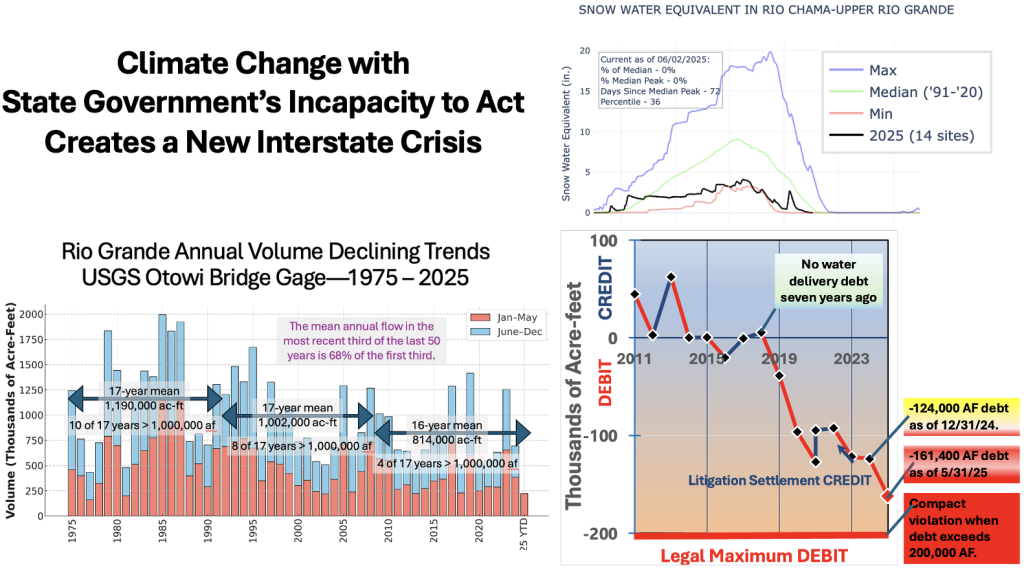
Active Water Resources Management(AWRM): This approach administers “wet water” in accordance with legal requirements, through either priority administration or shortage-sharing agreements that equivalently limit total water use. Unlike the Office of the State Engineer’s administration of “paper water” (rights and permits that may exceed actual water availability), AWRM is grounded in real water use and availability, ensuring that legal objectives are met without exceeding the resource’s natural limits. Active Administration of water by the State Engineer, based on actual available water, was authorized by a straightforward 2003 water law—upheld by the New Mexico Supreme Court in 2012—that recognized the urgent need for water administration and compact compliance. However, AWRM has yet to be fully implemented due lack of political will and limited staffing and regulatory capacity. As a result, annual water depletions in the Lower Rio Grande are approximately 9,000 acre-feet above New Mexico’s allowable share of releases from Elephant Butte Reservoir. In the Middle Rio Grande, average annual water depletions have exceeded the legal limit by 26,000 acre-feet per year on average since 2018, setting the state up for further interstate litigation. Immediate, full implementation of AWRM is crucial. The 2023 Water Security Planning Act further supports AWRM by allowing water planning regions to voluntarily develop shortage-sharing plans as a central component of their regional water security strategies.
Modernization for Resilience: New Mexico’s state water agencies, tasked with managing our precious water resources and protecting our water rights, need adequate funding and staffing to operate effectively. These agencies must be empowered to modernize their operations by updating their business processes, enhancing data collection and verification methods, and replacing dysfunctional information technology infrastructure. The success of New Mexico’s water security agenda—and the effective implementation of the great laws already enacted—depends on this modernization. Key areas for improvement include:
Adopting modern business practices and information safeguards
Significantly enhancing quality control for water data collected, maintained, and managed by the Office of the State Engineer (OSE) and Interstate Stream Commission (ISC)
Ensuring reliability in water use measurements and data collection
Timely generation of integrated water use data to support effective water planning and administration
Fulfilling responsibilities assigned by the Water Data Act
Administering “wet water” (actual water available) to meet legal and management requirements
Equipping OSE/ISC with modern information technology essential for agency staff to effectively fulfill their statutory responsibilities.
Water Education: Building widespread public awareness and understanding of New Mexico’s water challenges and solutions is essential to achieving water security. This involves creating and implementing comprehensive educational programs that reach diverse communities across the state. These programs should leverage multiple platforms—community gatherings, schools, workshops, webinars, and online resources—to share knowledge about water conservation, efficient water use, and the importance of active public engagement in water management decision-making.
An informed and engaged public is crucial for achieving water security. While Water Advocates play a vital role and believe in the power of public education to drive change, achieving this goal requires the collective efforts of water governance bodies, environmental organizations, and engaged citizens to make this a reality. Water education is a primary objective of our advocacy, and these programs should aim to:
Be accessible: Reach diverse audiences by using a variety of platforms—workshops, webinars, online resources, and community events—that reach diverse audiences and cater to different learning styles.
Be comprehensive: Address a broad range of topics, including water conservation, efficient water use, water rights, and the impacts of climate change on water resources—as well as the results of inaction.
Be engaging: Employ interactive and participatory approaches to learning, such as hands-on activities, simulations, and community discussions, to make learning memorable and impactful.
Be inclusive: Ensure that materials and programs are culturally appropriate and accessible to everyone, including individuals with limited English proficiency or disabilities.
Empower action: Equip individuals with the knowledge and tools to become active stewards of water resources in their homes, communities, and workplaces.
By fostering public awareness and understanding of water issues, we can empower New Mexicans to play an active role in shaping a sustainable water future for the state.
All the Above Actions and Fully Funded Program Lead to Achieving Water Security
Water security forms the foundation of a thriving New Mexico. As stated above, achieving water security requires a multifaceted approach, encompassing responsible management, forward-thinking planning, and collaborative action.
Aquifer Resilience: Water Security for New Mexicans relying on groundwater. With a comprehensive understanding of this vital groundwater resource, achieved through the Aquifer Mapping programs and groundwater resilience planning, our water agencies can make informed decisions about the management of aquifer usage and recharge. A resilient aquifer can maintain its essential functions—providing water for people, ecosystems, and economies—even under changing conditions. Where aquifers are tributary to rivers, higher water security is attained when a coordinated plan is implemented to manage both surface and groundwater resources, preventing excessive groundwater pumping that damages aquifers and hinders compact compliance.
Interstate Stream Compacts Compliance: – Achieving water security for New Mexicans reliant on interstate stream water requires meeting depletion limits and delivery requirements specified in enforceable compacts. The Active Water Resources Management (AWRM) authorizing statute, along with supporting State Engineer rules and the 2012 NM Supreme Court unanimous decision, provides a strong legal framework. Effective application of AWRM in the Lower and Middle Rio Grande —whether through priority administration or regional shortage-sharing agreements—will enhance resilience in these basins’ water supplies. Compliance with Colorado River Basin compacts, however, is more complex and can best be improved through regional water security planning and vigorous state advocacy in intergovernmental forums. Compliance with all interstate obligations should be actively managed, monitored, and publicly reported.
Public Engagement and Awareness: New Mexico will always have to live with scarce water resources and the challenges of increasing aridity, making public engagement and education critical. Regional water security planning will foster engagement from stakeholders, communities, and the general public through statewide and regionally focused educational campaigns. New Mexicans deserve clear information on the realities of their water resources; consistent public education can help advance awareness and acceptance that current water management practices must evolve for long-term water security.
Crisis Avoidance and Preparedness: Water Security is strengthened when state agencies and communities understand water resource trends and impending insecurity early, allowing for timely actions to avert crises or plan for their impacts. Preparedness is also bolstered when the state government has advance plans, resources stockpiled, and funds set aside to provide meaningful assistance in the face of unanticipated water crises.
This essay criticizes the New Mexico Governor’s “Strategic Water Supply” concept and the deceptive ‘feasibility study’ draft prepared by Eastern Research Group, Inc. (ERG). The Governor’s concept is fundamentally flawed. The ‘feasibility study’ fails to disclose key challenges, such as the massive energy and carbon footprint required to desalinate Permian Basin produced water to meet the Governor’s goal of 100,000 acre-feet of new water by 2028.
Desalination would require the energy output of multiple San Juan Generating Station-sized power plants to produce much less new water than the Governor’s arbitrary goal of 100,000 acre-feet per year of new water by 2028, while also producing an equal volume of highly concentrated waste requiring safe disposal. The feasibility study merely hints at the energy and carbon footprints . It omits critical analysis of the great difficulty and expense of the infrastructure that would be required to extract large volumes of water, brackish or not, from deep aquifers below 2500 feet. The study merely assumes the voluminous concentrated waste can be safety disposed forever.
The essay highlights concerns about the lack of transparency and potential conflicts of interest surrounding the ERG’s $1 million sole-source contract, as well as the political origins of the project. Drawing parallels with the Gila Diversion Project boondoggle, the essay illustrates how political motives and self-interest override ethical behavior and honest determination of feasibility, resulting in wasted public funds and resources.
The NM Produced Water Research Consortium since its 2019 creation by the Environment Department and New Mexico State University has not yet begun a scientific research program of field pilot testing. Environment Department experts testified in August 2024 that NMED has no produced water field testing results yet from the Consortium and that its database contains not a single produced water data characterization data point. The feasibility study ignores that without data, the Environment Department and Water Quality Control Commission have no basis for the effluent and discharge standards and the regulation of all off-oil-field existence and use of treated or untreated produced water and its byproducts. Permits for off-oil-field transportation, handling, storage, and use are based on regulations, which are based on scientific standards.
The essay underscores the opportunity costs and ethical considerations of focusing on desalination over more urgent water management issues, such as full implementation of the 2019 Water Data Act and the 2023 Water Security Planning Act, coming into compliance with Rio Grande Compact water depletion legal limits routinely exceeded in the Middle and Lower Rio Grande, and providing incentives to slow New Mexico’s ruinous overuse of groundwater. The author argues that the Governor’s plan diverts legislative and agency attention from these pressing matters, thereby jeopardizing the long-term water and economic security of New Mexicans and the needs of future generations.
Introduction: A Fatally Flawed Concept
The so-called ‘Strategic Water Supply’ concept is fundamentally flawed. The evidence is clear and compelling, but you won’t find it in the New Mexico Strategic Water Supply Feasibility Study Review Draft, released by New Mexico Environment Department (NMED) Cabinet Secretary James Kenney at the September 18, 2024, Legislative Finance Committee meeting. The Governor’s explicit goal is to treat produced water and deep brackish groundwater to produce 100,000 acre-feet of “new water” by 2028 for new high water use factories.
You won’t learn from the Feasibility Study Review Draft that desalination of Permian Basin fracking wastewater, the explicit 2028 goal of the Governor’s 50-Year Water Action Plan, would require all the energy from multiple San Juan Generating Station-sized power plants to produce a maximum of 65,000 acre-feet of treated water and an equal amount of concentrated, hazardous waste. You also won’t learn that desalination of 100,000 acre-feet per year of deep brackish water would require the equivalent of building three and a third El Paso Kay Bailey Hutchison desalination projects. According to the Review Draft, the El Paso project is the largest inland desalination plant in the world. Its capacity is 30,000 acre-feet per year. The source water in the Hueco Bolson, is in near-surface aquifers, not the unknown deep brackish aquifers below 2500 feet.
The Draft Review Report is not a Feasibility Study
The draft review report was prepared by Eastern Research Group, Inc. (ERG) following its eyebrow-raising $1 million sole-source contract award by James Kenney. The report cover says, “Developed By: New Mexico Environment Department (&) Eastern Research Group, Inc.” It’s unlikely this report was written or edited by NMED’s top five experts on produced water. Their science and opinions are conspicuously absent from the draft review report. I have read all their sworn written testimony and listened in-person to their oral testimony, including days of their cross-examination at the Water Quality Control Commission produced water reuse rules hearing, May 13-16, 2024.
The ERG report fails to tell the whole truth or provide any critical review of the evidence. Readers will find some true statements in the report, but the evidence is presented without objective evaluation. The section on deep brackish water aquifers is either embarrassingly misinformed and uncritical or intentionally misinforms. Other critical issues are completely omitted, such as the energy requirements for desalination of produced water and its significant carbon footprint.
My opinion of the ERG report changed as the one month review period was ending. The report didn’t analyze or quantify energy requirements and the carbon footprint. Using identical language in three places, the report implies the emissions would be large enough to conflict with the State’s carbon emissions goals. I decided to investigate.
The Energy Reality of Desalination: What the ERG Report Doesn’t Tell You
I spent an afternoon the day before public comments were due estimating the energy required to desalinate 100,000 acre-feet per year of Permian Basin produced water using ‘thermal methods.’ Think of ‘thermal methods’ as fancy methods of distillation. First, I calculated the latent heat of vaporization of 100,000 acre-feet of water at atmospheric boiling temperature as an estimate of the energy required for atmospheric distillation. As an alternate approach, I calculated the energy required to heat the water under very high pressure to around 650 degrees Fahrenheit, where the latent heat of vaporization becomes very small. I dug further into references and checked and rechecked my calculations. My rough bracketing estimates, based on equations and constants of physics and thermodynamics, didn’t change.
Before going public with my conclusion of immense energy requirements, I verified it by calling an expert in New Mexico produced water issues who is NOT a member of the Water Quality Control Commission. Because its produced water rules decisions are pending; ex parte communications with Commissioners is forbidden until the case is over. The expert I called was already aware of the issue and readily agreed with my conclusion: desalinating the Permian Basin produced water that has been pumped down saltwater disposal wells annually in New Mexico, one billion barrels a year, would require as much energy as multiple San Juan Generating Station-sized base load power plants.
Desalinating all the produced water pumped down saltwater disposal wells annually since 2019, one billion barrels a year (alternate units of 159,000,000,000 liters per year or 129,000 acre-feet per year) would only yield 64,400 acre-feet of treated water while producing an equal amount of concentrated, extremely hazardous waste. That’s because the expected maximum possible recovery is 50%.
Disinformation and Omission: Manipulation in the Report
Given the number and importance of striking errors and omissions, an informed reader of the ERG draft review report must conclude that the authors are either lacking expertise or deliberately omitting key information. Given the report’s tone, half-truths, and other evidence, I believe the latter is more likely.
This is disinformation, as defined in the Scientific American September 2019 issue, “Truth, Lies, and Uncertainty.” Disinformation is the deliberate spread of false information with the intent to harm.
From Scientific American September 2019 issue entitled “Truth, Lies, and Uncertainty”, in this article: https://www.scientificamerican.com/article/misinformation-has-created-a-new-world-disorder/
The Gila Diversion Project: Wasteful Largess That Legislative Leadership Remembers
In that vein, the ERG draft review report resembles the New Mexico Interstate Stream Commission/Bureau of Reclamation’s fraudulent draft Environmental Impact Statement for the Gila Diversion Project, formally known as the New Mexico Unit of the Central Arizona Project. The Gila Diversion Project wasted over $17 million in state funds and soaked up scarce human resources over more than a decade, all while avoiding a feasibility study or full disclosure of data and models. An honest feasibility study at the outset would have prevented years of waste and profiteering by consultants, lawyers, and revolving door state agency executives, who fed at this project’s public money trough.
It’s important to note that the “New Mexico Unit” was authorized through a Washington, D.C., political horse trade in 1968 and then revived by a similar deal in 2004. New Mexico Senator Pete V. Domenici was the NM 2004 dealmaker, and his son, Pete V., Jr., made about half a million dollars keeping this fraudulent project alive as attorney for local project boosters, funded by the Interstate Stream Commission (ISC) from 2014 through 2020. The ISC finally ceased wasting money on the Gila Diversion Project in 2020 after my colleague Peter Coha and I exposed that the draft Environmental Impact Statement materially misrepresented and omitted what Reclamation’s computer model simulations showed, and that the model itself was intentionally biased. He and I later published this NM Water Resources Research Institute annual conference poster which summarized the facts, our work, and our irrefutable conclusions.
Now we have the Governor’s ‘Strategic Water Supply.’ Like the Gila Diversion, its,
origins are political and politically declared goals are unvetted,
powerful proponents are deceptive,
feasibility is an important initial question, but is not fairly addressed,
contractors tailor their work to support their customers desires, and
proffered data and contractor explanations are not trustworthy.
The Consortium Won’t Address Feasibility
The NMSU Board of Regents and the Environment Department have repeatedly agreed by their signatures in 2019, 2021 and 2022 that the New Mexico Produced Water Research Consortium, as their joint creation, will use the framework of Module 3: Produced Water Reuse and Research Needs Outside Oil and Gas Operations of the Groundwater Protection Council’s authoritative and peer reviewed Produced Water Report Regulations, Current Practices and Research Needs. This manual of best practices recommends starting with a feasibility study. Module 3 begins as follows:
“The phases of the framework include:
Phase I: Preliminary assessment of the proposed program to determine whether the reuse scenario is likely to be feasible and if additional analysis is worth investment. A basic screening compares known characteristics of the produced water to expected water quality needs and reviews practical considerations such as public perception, regulation, logistics, economics, and benefits, to decide whether the program merits further in-depth analysis.”
NMED’s produced water webpage links to three letters instructing and warning the Consortium that any discharge of produced water, treated or not, is forbidden. The letters are increasingly blunt. The 2019 and 2022 versions of the NMED and NMSU Board of Regions agreements linked on the NMED produced water webpage have a totally different tone, with the last signed version requiring explicit steps and corrections by NMSU.
What we have instead of a feasibility study from the Consortium is documentation of the Consortium’s systematic failures from the until-recently-secret NMSU Independent Review Committee’s scathing report. NMED expert witnesses’ and the Consortium Director’s sworn testimony at the May 13-17, 2024, produced water reuse rules hearing confirmed that the Consortium has provided NMED no reliable data on produced water sampling and analysis. Scientifically valid field pilot testing has not begun. The testimony also revealed that the Consortium has not responded to the NMSU Independent Review Committee’s corrective recommendations.
The record shows that the NMSU Independent Review Committee, a highly qualified group of three, was commissioned by a written agreement between NMED Secretary Kenney and the NMSU Board of Regents and given its mission to address NMED’s core concerns. The ERG Review Draft either ignores or is wrong about the core issues identified by the Independent Review Committee. The committee’s December 23, 2022, report says the Consortium is not doing what it was created to do: conduct the research to show the treated water is safe and require stringent quality control of all research conducted by the public-private organization to establish credibility and support sound regulations and public trust.
“Some don’t appreciate the difficulty that NMED will have regulating this. Produced water is a contentious issue. The public will complain no matter what NMED does, so they (NMED) have to have air-tight science with chain-of-custody, peer review, no conflicts of interest, etc., to back up the regulatory process.”
This report that falsely calls itself a feasibility study is rife with errors and omissions. The report’s coy hint regarding energy and carbon footprint is ERG’s admission they know about energy and carbon footprint problems but chose to overlook them. NMED’s actions raise distrust. Why did NMED commission ERG to produce this report? Why is the report’s theme essentially the opposite of the internal review committee’s expert observations and advice that the regulators strive for credibility. Why does the report ignore recent sworn testimony before the Water Quality Control Commission about NMED’s proposed produced water reuse rule that revealed the status quo of statutory prerequisites?
The Role of Eastern Research Group: Questions of Influence and Ethics
The Eastern Research Group has unusual credentials and influence, raising questions about how it came to write the report and if its report supports public trust. After the 2023 Legislature, former Deputy Secretary of the Environment Department Rebecca Roose resigned from state employment and was later hired or contracted by ERG. Shortly afterward, Governor Lujan Grisham appointed Roose as her water policy advisor and infrastructure program director.
Roose, an attorney, wrote the Governor’s 50-Year Water Action Plan. She and Secretary Kenney were the Governor’s key spokespeople throughout the 2024 Legislature for the Governor’s demand that the Strategic Water Supply be authorized to borrow $500,000,000. A last-minute “dummy” bill SB294 to fund the Strategic Water Supply appeared, died, was resurrected, and died again in the final two days of the session, reportedly motivated by the Governor threat to veto all capital outlay funding unless her funding bill was heard. I attended that hearing, and a do-over the next day. I was appalled by Kenney’s and Roose’s presentations and answers to Committee members questions. That month, Kenney signed a no-bid $1 million sole-source contract with ERG.
This history raises ethical concerns. Why is the NMED sole-source contractor, Eastern Research Group, writing a report that misinforms New Mexicans and contradicts what our state’s own experts know? What makes ERG so uniquely qualified to win a $1 million no-bid contract? Why does their so-called feasibility study cover up the most critical facts?
[At the time this essay was in final review and editing, I received a copy of the ERG million dollar agreement signed in February 2024. The scope of work description in ERG’s contract is to help NMED establish the New Mexico’s surface water wastewater effluent discharge permit system. It does not include the preparation of the feasibility study ERG wrote for NMED. This emphasizes concerns about ERG’s sole-source services procurement, and illustrates dilution of needed effort to pursue this boondoggle.]
The Governor’s 50-Year Water Plan Dances Around Core Issues
To be fair, the Governor’s 50-Year Water Action Plan does include two essential focus areas: conservation and watershed health, both of which are crucial for the state. However, these alone are insufficient. What’s missing are strong initiatives that are prerequisites to or essential for wet water management, such as the full implementation of the 2019 Water Data Act and the 2023 Water Security Planning Act, and New Mexico’s compliance with the Rio Grande Compact.
It doesn’t call for action to limit depletions in the Middle Rio Grande, which should be among the State’s highest water priorities. The State Engineer’s ongoing lack of wet water administration in the Middle Rio Grande leaves the state vulnerable to another lawsuit from Texas for new violations that with emergency attention now can be avoided. Such a suit could begin, without immediate state action to limit diversions in the Middle Rio Grande, while the 2012 Texas lawsuit pertaining to New Mexico’s groundwater overuse in the Lower Rio Grande remains undecided. The United States Supreme Court has original jurisdiction. That is an ugly scenario neglected by the Governor’s “50-Year” priorities.
Another critical gap in the Governor’s plan is not addressing overuse of groundwater, which leads to drained aquifers like the Ogallala Aquifer. Conservation efforts alone will not reverse this trend. To illustrate where this issue stands, a legislator asked if New Mexico administers groundwater according to the volume of water remaining in the aquifer or to not allow pumping below a certain depth. The answer is neither. We don’t even know the volumes of groundwater remaining after more than a century of use. Existing groundwater policy is in reality, first in time is first in right; if you’ve pumped, you can keep pumping that amount, and pump it till it’s gone. No state law protects aquifer remnants from any type of use except the 1930s law that protected the Roswell artesian aquifer system. Legislators then knew that overuse and waste would ruin the artesian aquifer. What they didn’t know, but we do now, is that unregulated waste and overuse will ruin any aquifer, especially where recharge is minimal or none.
Opportunity Costs: The Real Impact of the Governor’s Badwater Emphasis
One thing is clear: the Governor’s “new water” emphasis, announced at the 2023 Dubai climate conference, is based on uninformed or misinformed opinions. Her ideas are causing significant opportunity costs by diverting scarce legislative attention and agency resources from addressing the most critical water laws, policies, and actions that will have long-lasting positive impacts on New Mexico’s water future.
The opportunity cost of the Governor’s misplaced priorities is that these critical needs are not being addressed quickly enough. Her plan consumes too much of the Legislature’s limited capacity to address water governance and does not prioritize essential actions to adapt to New Mexico’s growing aridity. Furthermore, the plan fails to modernize and equip state water agencies with essential capacity including providing agency staff with modern business practices and information systems and computer tools capacity that would dramatically improve their efficiency and the quality of their work.
Additionally, scarce NMED resources are being diverted from essential tasks, such as implementing a state surface water discharge pollution prevention permitting system, which is urgently needed after the US Supreme Court ruled that many of New Mexico’s rivers and streams are no longer subject to federal protection.
These opportunity costs will ultimately lead to water and economic insecurity if left unaddressed. The current path, if continued, sets New Mexico on a course toward a future of increasing vulnerability. The state has time to correct its course, but every year that passes without action reduces what would be possible if we acted now. Phil King, a NM water resources expert, retired NMSU civil engineering professor for 31 years, and now senior advisor to the Office of the State Engineer and Interstate Stream Commission, says we face boundless opportunity. What he means, is if we tried as hard as we could, we couldn’t take all the positive steps available. Worse, he points out, our opportunities diminish each year the status quo continues. Thus, the opportunity cost of this political initiative is a forever-lost part of New Mexico’s more resilient water future.
Ethics
The Water Security Planning Act requires scientific integrity in water regional water planning. New Mexico needs that legal requirement to apply to all state-funded water planning and water projects. The Legislature should require vetting of concepts including a rational and honest showing of feasibility and a realistic plan of any concept requiring the state’s massive funding.
The people deserve the whole truth ethically delivered from their Environment Department Secretary and other top water officials.
The Legislature must prioritize scientific rigor and integrity of decision-making over unfounded assumptions without rational plans in its water policy and water program funding decisions.
The Legislature should have the integrity to fund implementation of recent badly needed and great laws that it has passed or authorized. In my view, these include,
active administration of wet water on the Rio Grande (2003 law compiled at Section 72-2-9.1 that is the statutory authority for Active Water Resources Administration, General Rules unanimously upheld by the NM Supreme Court, 2012),
water data from every state-funded endeavor is available publicly with metadata (2019 Water Data Act),
water planning regions throughout NM must understand their region’s water future without action and determine what they want their region’s water future to be, and prioritize the vetted programs, policies and infrastructure projects to get there (2023 Water Security Planning Act).
It is these priorities that are missing from the Governor’s priorities. The ‘Strategic Water Supply’ emphasis as I have reported it it here I believe is unethical. The neglect of providing the resources necessary for good progress toward goals already set and authorized is not right. The false feasibility study and the neglect of the basic fundamentals of better wet water governance require legislative leadership and members’ attention.
Closing
These are my professional conclusions and opinions and I alone am responsibile for them. This essay summarizes my detailed public comments submitted on October 18, 2024, regarding the ERG draft review report. I sent them via the NMED webpage and directly by email to Secretary Kenney, since the webpage didn’t confirm receipt. Secretary Kenney acknowledged receipt before 6 a.m. on October 19, for which I thank him. I look forward to the Environment Department’s response.
/s/ Norm Gaume, P.E. (ret.), Licensed Water Engineer, President, New Mexico Water Advocates.
Glossary (Alphabetical Order)
Acre-Foot: A unit of volume commonly used in the United States to measure large-scale water resources, particularly in agriculture and water management. One acre-foot equals approximately 325,851 gallons (1,233 cubic meters) and represents the amount of water needed to cover one acre of land to a depth of one foot.
Badwater: As used in this essay, badwater means oilfield produced water or deep brackish groundwater below 2500 feet.
Brine: A highly concentrated solution of salt in water. Brine management is a major environmental challenge in desalination.
Concentrated Waste Streams: The byproduct of treating produced water or brackish water during desalination and other purification processes. These waste streams contain high levels of hazardous contaminants that require special handling and disposal.
Desalination: The process of removing salts from brackish or seawater. Desalinating highly saline produced water from the Permian Basin requires extensive additional treatment before and after desalination to produce safe water.
Disinformation: The intentional spread of false or misleading information to deceive or harm.
Eastern Research Group (ERG): A private multidisciplinary consulting firm headquartered in Massachusetts.
Energy Footprint: The total amount of energy consumed by a process or system. In the context of desalination, the energy footprint refers to the amount of energy required to treat water.
Groundwater Protection Council: A nonprofit organization that brings together state groundwater regulatory agencies across the U.S.
Latent Heat of Vaporization: The amount of energy required to convert water from a liquid at its boiling point to a gas.
Kay Bailey Hutchison Desalination Plant: The world’s largest inland desalination plant, located in El Paso, Texas.
NM Produced Water Research Consortium: A Public/Private partnership established by a 2019 agreement between NMED and the New Mexico State University Board of Regents to perform and report research to serve as the scientific basis for produced water reuse standards, regulations, and permits.
NMED (New Mexico Environment Department): The New Mexico Environment Department is a state regulatory agency responsible for overseeing pollution prevention and environmental quality regulations.
NMSU Independent Review Committee: An committee of three national laboratory and academic experts formed by a November 10, 2022, agreement between NMED and the NMSU Board of Regents to evaluate the effectiveness of the New Mexico Produced Water Research Consortium,reports its findings, and disband.
Ogallala Aquifer: One of the largest aquifers in the world, underlying parts of several U.S. states, including eastern New Mexico. The aquifer has been mined to the point that Eastern New Mexico municipalities and Eastern New Mexico University have run short of water.
Permian Basin: A large oil-producing region in the southwestern United States relying on unconventional wells to produce over 98% of New Mexico’s oil and produced water.
Produced Water: Contaminated, saline water brought to the surface during oil and gas extraction processes. Permian Basin produced water is highly saline and heavily contaminated with hydrocarbons salts, chemicals, and other pollutants, known and unknown, with dangerous concentrations of acutely toxic carcinogens and radionuclides.
Reverse Osmosis (RO): A common desalination technology that uses a membrane to remove ions, molecules, and larger particles from water by applying pressure to the water on one side of the membrane. RO is often used for lower-salinity brackish water and seawater desalination.
Rio Grande Compact: An interstate agreement governing water allocation from the Rio Grande among Colorado, New Mexico, Texas, and the United States for delivery to Mexico. It requires sharing shortages and allocates water in years of plenty. The agreement is enforced by the US Supreme Court, where 2012 litigation brought against New Mexico by Texas and the USA continues.
San Juan Generating Station: A coal-fired power plant in New Mexico with 850-megaWatt capacity, .
Strategic Water Supply: A concept used by the New Mexico Governor’s 50-Year Water Action Plan, referring to desalinating deep brackish groundwater or treating fracking wastewater for use by high tech, water intensive factories like chip factories, solar cell manufacturing, and data centers.
Thermal Desalination: A process used to remove salts from water by heating it to produce water vapor, which is then condensed to form freshwater. Thermal desalination is energy intensive. Thermal desalination of produced water requires extensive pre- and post-treatment and produces a concentrated waste stream.
Vacuum Membrane Distillation (VMD): A desalination technique where water is heated, and the vapor is passed through a membrane under vacuum conditions. This method is often used for highly saline or contaminated water and is more energy-efficient compared to traditional distillation, although still energy-intensive compared to other processes like reverse osmosis.
The New Mexico oil and gas industry in the Permian Basin has run out of cheap places to dispose of its fluid oil and gas waste, aka ‘fracking wastewater’ or ‘produced water.’ ‘Produced water’ is industry’s name for the most complex and hazardous high-volume wastewater in the oil-producing states.
The oil and gas industry, New Mexico’s Governor, and the Environment Department executives seek to allow treatment and industrial reuse of fracking wastewater without permits. The oil industry wants to be able to discharge, too. State government says discharge is not allowed but wants industrial reuse now with no data, no oil and gas disclosure of poisons, pollutants and trade secret fracking chemicals, and no public notice whatsoever. The currently proposed Environment Department rule would require nothing more than a few unenforceable promises from the proponents when located on private property from which the public is excluded.
How does New Mexico’s statewide need for water compare with the oil and gas industry’s need for waste disposal? Treatment of all the waste at a cost likely exceeding $1 billion per year could not meet current irrigation needs in Lea and Eddy counties alone.
Disposal of fracking wastewater through reuse or discharge is urgent for the Permian Basin operators, who generate about 98% of this waste and are quickly running out of room for current disposal methods through high-pressure saltwater disposal wells to the shallowest geological formations deemed suitable. Much of the disposal capacity is now offline because the high-pressure injection wells are causing earthquakes.
In 2024, the Legislature refused to authorize the Governor’s half-billion-dollar borrowing authority for a so-called Strategic Water Supply, to provide “advance market commitments,” which means state financial guarantees for industry to build treatment plants and make ‘treated’ water available.
The New Mexico Environment Department proposed reuse rules for fracking wastewater in 2023. The Water Quality Control Commission held a hearing on them from May 13th-17th. The hearing will resume on August 5th for up to eight days. Very useful information has come forward. Incisive testimony proving the harm of fracking wastewater reuse was filed with the Commission. Those witnesses will be heard and cross examined.
Oil and Gas Gaslighting
The oil and gas industry is gaslighting everybody. At a Chevron-sponsored fracking wastewater propaganda event on June 5th, its New Mexico government affairs person, Christian Isley, claimed that New Mexico should adopt a mindset of abundance due to the potential of the reuse of treated produced water. This claim falls apart under simple fact-checking.
On August 7th, the NM Chamber of Commerce is a co-sponsor of the next Chevron propaganda event at the Albuquerque North Valley winery, invitation only, legislators invited, free drinks. Ms. Missi Currier, President and CEO of the New Mexico Oil and Gas Association (NMGOA), is leading a one-hour panel discussion. The panel topic: ‘The Need to Reuse Produced Water: Water Scarcity and Current Regulatory Status.’ All panelists are oil industry executives. See below.
Water Shortfalls vs. Potential Produced Water Reuse Volume
How does New Mexico’s need for water compare with the oil and gas industry’s need for disposal? It’s an incredibly expensive and risky pittance. New Mexico’s total annual water use is about three million acre-feet. Climate change is projected to reduce our water supplies by 25% by 2070. Our aquifers are being dewatered, and river flows are declining. For example, flows in the Rio Grande entering the Middle Rio Grande have decreased by hundreds of thousands of acre-feet per year from the 1980s and 1990s. Evapotranspiration due to the hotter, continually warming climate is drying everything out, requiring more water for life.
From 2019 to 2023, the oil and gas industry annually injected about one billion barrels of fracking waste into saltwater disposal wells in southeast New Mexico. If all this waste were treated for reuse (unlikely) with a 50% recovery rate (also unlikely), it would yield a maximum of 64,500 acre-feet per year—insufficient to meet current irrigation needs in Lea and Eddy counties alone. Moreover, treating this waste would cost upwards of $15,000 per acre-foot, totaling about $1 billion per year.
Frackers PFAS Falsehoods
In her May 3rd and May 5th guest editorials in the Carlsbad Current-Argus and Albuquerque Journal, NMOGA President and CEO, Missi Currier, lied about PFAS in fracking wastewater, saying, “Concerns that the oil and gas industry introduces Per- and Polyfluoroalkyl Substances – or PFAS – into its produced water are unwarranted. To be clear, the oil and gas industry is not a source of PFAS in produced water.”
Sworn technical testimony proves her statements are false. Environment Department technical witnesses, the NMSU Produced Water Research Consortium director, and New Energy Economy’s expert witnesses testimony provide evidence to the contrary.
An April 23, 2023, report by Physicians for Social Responsibility documents the use of thousands of pounds of trade-secret PFAS fracking additives in New Mexico. PFAS chemicals (over 15,000 chemically engineered varieties) are highly toxic and persist in the environment and human bodies, leading the EPA to establish new federal drinking water limits in April 2024 for two PFAS chemicals at 4 parts PFAS per 1,000,000,000,000 (trillion) parts of water. Adding 1.5 ounces of PFAS to 100,000 acre-feet of water would pollute the water to violate the limit.
The oil and gas industry in New Mexico uses thousands of pounds of trade secret PFAS industrial surfactants in the fracking fluid it injects under extreme pressure to hydraulically fracture the oil-bearing rocks and keep the fracked cracks open and flowing. Mr. Hightower testified that some members of the oil and gas industry are trying to stop PFAS uses but each operator makes its own decisions in the absence of any prohibition. NMED testimony says the ‘forever’ PFAS chemicals will keep coming back out in the fluid waste for the life of the well.
Despite the huge hazardous dangers, governments have not taken action to stop the known use of PFAS in hydraulic fracturing. New Mexico regulators publicly announced in June 2023 they planned a 2024 hearing on PFAS use, but it was canceled.
Take Action
Sign up to give a 3 min public comment in person or virtual–a variety of times are available Monday Aug 5th – Friday 9th on the Wastewater Reuse rule before the Water Quality Control Commission
The rule would authorize fracking waste reuse in “demonstration projects” or “industrial projects” with the eventual goal of reusing fracking waste for “agriculture, irrigation, potable water supplies, aquifer recharge, industrial processes or environmental restoration.”
The rule does not delineate any scientific treatment standards to safeguard public health and the environment. Toxic fracking waste (aka produced water) contains toxic chemicals, both known and unknown, PFAS and radiation levels that endanger all of us. Reuse of fracked waste poses an enormous undue risk to our land, water and health in New Mexico!
We need farmers, gardeners, healthcare workers, students, artists, parents and more to speak out and protect our water! In May, over 50 people spoke out to Defend NM Water against the reuse of radioactive fracking waste – bravo! We want to reach that level of engagement and to hear voices from across the state next week August 5th-9th.
Tell your story about how this might affect you, your family, your hope for New Mexico, or your disgust with what you have learned. Ask the Water Quality Control Commission to do their job as expert technical regulators, as set forth in law. The commissioners listened intently to public comment during two hours they set aside each hearing day. They were listening and were moved. They need to hear more.
Public Comment: IN-PERSON: NM STATE CAPITAL, 411 South Capitol St. Room 322
New Mexico state law since 2019 has required contaminant standards for the reuse of treated fracking wastewater. It requires regulations and permits for any handling, treatment, storage, transportation, or treatment for the disposition by reuse for non-oil industry purposes. The standards and regulations must be based on scientifically developed evidence. The permitting process applies those standards and regulations to project-specific facts. Regulators must consider public comment as part of permitting.
Proceeding without these requirements would be illegal. The Environment Department political rule now before the Water Quality Control Commission does not align with the law.
Research Requirements:
Five years ago, the NMED and New Mexico State University agreed to create the New Mexico Produced Water Research Consortium. The Consortium’s purpose is to conduct the research NMED requires to meet its statutory requirements set forth in the 2019 Produced Water Act. State law mandates that adequate science and facts form the basis for the state’s determination of fracking waste reuse standards, regulations, and permit requirements.
The most recent November 2022 version of their 2019 agreement is posted on the NMED website here. It appoints three members of an expert Independent Review Committee, who conducted an audit of the Consortium’s performance. The Committee’s report, consisting of a three-page letter and a PowerPoint slide deck, is available here.
Consortium Performance is Unacceptable to NMED, but Nothing Has Changed. The Independent Review Committee’s report was required by the NMED/NMSU agreement to be confidential. I obtained it through a public records request from the NMSU Office of General Counsel when NMED had previously responded to me that they did not have it, which I find incredible.
The report makes these observations about the Consortium and its management.
“There is a difference of expectations from stakeholder groups and opinions of its progress to date.
Industry seems to be generally satisfied with the Consortium; while feedback from NMED is that they are not.“
The research … has been focused on technology development, has not generated the data needed for developing regulations.“
Industry is adept at seeking/developing new technologies. does not need the consortium to do that. The need is to demonstrate that the product water is safe for the intended use.
Some don’t appreciate the difficulty that NMED will have regulating this. PW is a contentious issue. The public will complain no matter what NMED does, so they (NMED) must have air-tight science with chain-of-custody, peer-review, no conflicts of interest, etc., to back up the regulatory process.”
This previously secret report concludes,
“The NM State Legislature directed NMED to develop regulations for Produced Water, and the Consortium is an important part of that process. It is unlikely that the Consortium can accomplish its stated mission of generating the data needed to support the development of regulations if it has inadequate funding, an unclear organization structure and lack of clarity in expectations in research and outcomes. The recommendations of the Committee or some similar actions are needed if the Consortium is to continue.“
Back to the Law.Now it’s up to the New Mexico Water Quality Control Commission (WQCC) to promulgate rules that follow the law. The WQCC must reject the Environment Department’s proposed political rule allowing industrial projects reuse without a permit based on merely an unenforceable promise of no discharge. This is both illegal and foolish due to state government’s absence of effective enforcement and the oil and gas industries’ record. Illegal spills of produced water in the oil field occur multiple times daily without state penalty. The failure of oversight agencies to hold Oil and Gas polluters accountable for their continuous and unabated spills is unacceptable. This toxic waste must not be transported for reuse outside of the oil patch.
Recommendations:
New Mexicans deserve transparency and proactive measures to protect their water and health from these toxins. The New Mexico Water Quality Control Commission must reject the Environment Department’s proposed rule allowing industrial reuse. The public must be protected by a simple WQCC rule that does four things in the absence of real science and reliable, trustworthy data:
Prohibits the reuse of treated or untreated produced water for activities unrelated to the exploration, drilling, production, treatment or refinement of oil or gas without a permit.
Prohibits state certification of any federal discharge permit for treated fracking waste.
Prohibits industrial fracking waste reuse and demonstration projects without a permit.
Requires permits for laboratory or pilot scale research pertaining to treatment for reuse.
Illegal Conflict of Interest:
WQCC Commissioner Krista McWilliams stated for the Commission record at the beginning of the Commission’s hearing on the NMED proposed political reuse rule that she has no conflict of interest in the rulemaking. However, this NMOGA video and other evidence submitted with New Energy Economy’s complaint to the New Mexico Ethics Commission shows Commissioner McWilliams’ association with the NMOGA, a party in the rulemaking, a conflict prohibited by the Water Quality Act, and a financial conflict of interest prohibited by the Governmental Conduct Act now enforced by the Ethics Commission.
The NM Ethics Commission has issued a finding of probable cause and appointed a hearing officer. New Energy Economy has filed a motion with the WQCC, to be heard on August 5th, to disqualify Commissioner McWilliams.
The Politics of Building Water Resilience versus Water Neglect
We face a multifaceted water crisis – overuse, dwindling aquifers, insufficient political action – all exacerbated by a warming climate.
Introduction
Building water supply resilience throughout New Mexico demands prompt effective leadership. While growing public awareness and initial state actions to adapt to a hotter climate are encouraging, political inertia is a major barrier. This essay emphasizes the urgent need for responsive political leadership to address our state’s hydrologic realities.
Growing Public Awareness and Political Realities
Paraphrasing NM water expert Dr. Phil King, “we have boundless opportunity” because our situation is so dire and we are doing so little to timely adapt. The good news is that there is increasing public awareness, supported by hardworking state water agency staff. However, NM’s political reality is far from responsive to climate and unsustainable water use challenges. New Mexico lawmakers must support effective water resilience improvement initiatives across the state if New Mexico is to survive. ¡Sin agua no hay nada!
Issues and Political Challenges
A few state and local elected politicians understand the consequences of failing to adapt, the urgency of New Mexico’s water crisis, and are taking action. Others, including our Governor, either do not recognize the crisis or find it politically unacceptable to address. We are long on neglect and disinformation. We are short on legislative appropriations and gubernatorial leadership to accelerate state government fulfillment of its critical, unique role in water management and governance, and helping local governments identify, develop, and implement theirs.
Dress for Success; Minimize Opportunity Costs
What is needed for success? We must focus our efforts on stewardship of the irreplaceable resources we have: Surface Water, Groundwater, and appropriate Flood Management. We must build effective collaboration among many and diverse stakeholders, ensure permanent and adequate staffing to do the necessary work, and lobby to secure funding sufficient to the task.
The concept of treating fracking wastewater and transporting it for use as a water supply is a dangerous fantasy marketed to the public with industry and official disinformation. Desalination of brackish groundwater may be needed but is feasible only where 1) large volumes of readily extracted brackish or saline water resources exist, 2) disposal of the concentrated brine is feasible, and 3) water users can afford or secure subsidies for expensive water.
Remember, New Mexico hasn’t done its homework. We don’t know how much good quality groundwater we have left, and know less about New Mexico’s brackish aquifers.
The State of New Mexico instead must focus on stewardship of the good water that we have. We deserve to know how much good groundwater we have left and how fast it is declining. Implementing the 2022 New Mexico Water Policy and Infrastructure Task Force vetted consensus recommendations is a great place to start. Increased state and local capacity to do this work requires State funding.
Legislative Finance Committee’s Role
Those in charge of the Legislative Finance Committee wield the real power and are a real barrier. LFC leaders and members ignore and even mock the legislature’s Water and Natural Resources Committee that focuses on water and natural resources policy in between legislative sessions. The question is whether LFC voting members and leaders have adequate knowledge of the crisis but find it politically inconvenient to address, or choose the status quo knowing the consequences, or if they lack adequate knowledge.
Bottom line: The Legislative Finance Committee and the Senate and House Finance Committees are budgeting for water as if it were a nuisance problem, rather than a full blown, slow rolling, crunching crisis. The State Engineer/Interstate Stream Commission’s June 28, 2024 letter to the Middle Rio Grande Conservancy District demonstrates one example of New Mexico’s jeopardy. The crisis of Portales, other municipalities and rural regions, and Eastern New Mexico University running out of Ogallala water is another.
Increases in the personnel budgets were allowed for NMED and OSE/ISC in the current fiscal year. NMED chose to use the extra funding to competitively pay its existing staff. The OSE/ISC chose to fund new positions. I have now heard both agencies discuss their reasons. My question is this: Why are the bean counters requiring this choice?
Both agencies require more staff to do the agencies’ work. Neither can attract and retain talented staff if the pay is not competitive. Why, can’t they have both? And why can’t our public employees have modern information technology? The Governor and the Legislature have the money. Do they lack knowledge? They certainly lack political will to lead us appropriately given the consequences of inaction.
Water can’t wait. A resilient and sustainable water future requires our state water agencies to have adequate numbers of qualified staff and tools to maximize the staff’s productivity given the magnitude of what they and our local governments must do if New Mexico is to achieve water resilience for the long-haul. Why, when funding is plentiful and the water future looks dire are we failing to recognize its importance in state budgets? If New Mexico doesn’t take care of its water, many of our children and grandchildren will not find their future in New Mexico because to use up our water really means we are using up what makes our lives possible.
LFC Water Subcommittee Members and Witnesses, Carlsbad, NM, June 11, 2024
Beginning with the End in Mind
During an engaging conversation with a Legislative Finance Committee staff budget analyst, I was challenged to identify the five most crucial goals New Mexico must strive to meet in the next decade to secure its water future amid increasing aridity. This approach, inspired by Stephen Covey’s principle of “beginning with the end in mind,” and discussion within the Water Advocates led me to these draft goals.
Five Water Governance Goals for 2035 – Draft for Discussion and Refinement
Aquifer Resilience: Sustainable groundwater programs are in place across New Mexico pursuant to law. Areas in crisis, such as the region served by the Ogallala Aquifer, have fully implemented their programs to protect municipal and institutional water supplies.
Modernization for Resilience: State water agencies have utilized reliable levels of funding/staffing to build their capacities to manage water effectively. They have modernized their business processes, data collection and verification, and information technology. The 2019 Water Data Act has been fully implemented. All state-funded water data is being made available online.
Regional Water Planning: Each region is implementing their regional water security plans, prepared and approved in accordance with the 2023 Water Security Planning Act. in. All regions have received effective state support to secure federal and state matching funds to implement their prioritized programs, policies, and projects.
Interstate Streams Compacts Compliance: Active Water Resources Management has been implemented in the Lower and Middle Rio Grande with Alternative Administration plans for conjunctive use of surface water and groundwater. The plans were developed regionally and approved by the State Engineer.
Water Workforce Development: A skilled water workforce development program is in place. It has produced initial cohorts of graduates bolstering local capacity as water systems governing board members, operators, managers, planners, engineers.
The Water Advocates will present the final version of the five 2035 goals, with interim 2030 goals and the year 1 and year 2 authorization and funding needs at the LFC water subcommittee’s September 17-19, 2024, meeting, if allowed, and to the Water and Natural Resources Committee.
Conclusion
By setting a few high-level water governance outcomes needed by 2035, we can then focus on the first steps to get there, beginning with the end in mind. The Water Advocates seek a much more resilient water and economic future for New Mexico. The Governor and the Legislature must, but have not, recognized that achieving water and economic security requires transformative change.
Your thoughts and recommendations for refining these goals are welcome. The Water Advocates seek opportunities to present them to interim committees in September, in time for budgeting and bill drafting.
Take Action
Demand that the candidates for the NM Legislature, that are running to represent you, recognize New Mexico’s water crisis and pledge to make sustainable water management a priority. Write the Governor and ask her to get serious about water, as she has promised in writing. Learn more by attending our monthly workshops and bringing a friend. Speak up, speak out.
Glossary
Alternative Administration Plans: Strategies for managing water resources in response to changing conditions, optimizing surface and groundwater use.
Aquifer: An underground layer of water-bearing rock or materials from which groundwater can be extracted.
Aquifer Resilience: Sustainable management and planning of regions’ use of groundwater resources.
Badwater Treatment: Treating fracking wastewater, or water that is contaminated by industrial processes or naturally occurring high mineral content.
Conjunctive Use of Surface Water and Groundwater: Coordinated use of both surface water and groundwater to maximize water supply reliability and sustainability.
Elephant Butte Dam: A federal dam on the Rio Grande in southern New Mexico that provides essential water storage, irrigation supplies, flood control, and deliveries to the New Mexicans, Texans, and the Republic of Mexico downstream. It is the boundary between the Middle and Lower Rio Grande segments.
Fracking Wastewater, aka Produced Water. The highly saline, oily ancient water released by the Oil and Gas Industry’s hydraulically fracturing rocks for oil and gas with unconventional wells the rate of four to seven barrels of fracking waste for every barrel of oil. It contains toxins, carcinogens, mutagens, radionuclides, and potent poisons that originate in the oily water and the trade secret fracking additives. Ninety-eight percent of NM produced water is from the Permian Basin. It is 10 to 20% salt, more saline than ocean water.
Interstate Streams Compacts: Agreements between states and the USA to share the water of a river or stream to ensure fair distribution and prevent conflicts.
Middle Rio Grande: A segment of the Rio Grande Basin through central New Mexico from the highway bridge to Los Alamos to Elephant Butte Dam.
Regional Water Security Plans: Comprehensive plans ensuring long-term water resource availability and quality, continuously adapted and updated, per the 2023 Water Security Planning Act.
Water Data Act (2019): Legislation intended to transform the collection, management, reliability, and accessibility of New Mexico water data.
Water Policy and Infrastructure Task Force: A group of 9 state officials and 20 diverse public members appointed by the State Engineer that developed a comprehensive set of water policy and action recommendations in 2022.
Water Workforce Development: Initiatives for training professionals in water infrastructure and management roles.
The New Mexico Bureau of Geology and Mineral Resources (NMBGMR) is recognized nationally as a leading state geological and water science agency, and is responsible by law for multiple essential missions leading New Mexico’s historical and contemporary water science. The NMBGMR has consistently excelled despite constrained resources.
The 2019 Legislature directed the Bureau to spearhead implementation of the New Mexico Water Data Act. Overwhelming interest in the May 10, 2024, annual New Mexico Water Data Workshop, with a full day of events from 8 AM to 5 PM, featuring parallel tracks with a multitude of speakers in the afternoon is evidence of success. The workshop is at capacity.
At this year’s workshop, I will address an ongoing issue during the morning plenary: the systematic underfunding of New Mexico’s water agencies by the Executive and Legislature. Despite the complete backing of the State’s Department of Higher Education for the NMBGMR’s budget expansion, which is vital to provide the foundation of science-based water management plans, the Governor’s Office and the 2024 Legislature approved exactly half of the Bureau’s request to do the essential work of providing data for water management and planning.
Chronic underfunding underscores a disregard by the Legislative Finance Committee and the House Appropriations and Finance Committee to fund water governance for the 21st Century. The legislature’s various finance committees and professional budget staff don’t work with the Legislature’s water committees, while the Governor’s office prioritized investments in badwater reclamation over managing and being stewards of our vital water resources. Such neglect demonstrates a profound lack of understanding, much less commitment, to the principles of effective water governance. Transformative change is essential for the health, safety, and welfare of living and future generations of New Mexicans.
The 2023 Water Security Planning Act explicitly links the implementation of the 2019 Water Data Act to regional water planning, yet both the Executive and the 2024 Legislature have failed to provide necessary funding, continuing a trend of ignoring the financial needs for implementing state water laws.
The 2019 Water Data Act mandates that all state-acquired water data be publicly available and managed properly. Unfortunately, this has not been a priority, with the Energy, Minerals, and Natural Resources Department being the only one of four Water Data Act “Directing Agencies” to cite its obligations under the Act in its fiscal year 2025 budget request.
The “Directing Agencies” collect, process, use, and own water data. Their 2019 Water Data Act roles include making their data internally and publicly available so it can be used! I am not familiar with the NMED efforts to comply with the Act, if any. The Office of the State Engineer and the Interstate Stream Commission may be making progress with the resources departing State Engineer Mike Hamman has succeeded in getting, but they face major problems. Their staff doesn’t essential infrastructure like adequate computer hardware, which is currently limiting their productivity. My guess is a finance person somewhere decided to prohibit the agencies from even requesting what they needed during the most recent budget cycle.
Office of the State Engineer (OSE) and the Interstate Stream Commission (ISC) have these glaring opportunities to improve compliance with the Water Data Act but the hardworking professional staff don’t have the resources or management direction to accomplish them and are frustrated by the wholly inadequate resources requested by the Governor’s budget and appropriated by the 2024 Legislature.
The OSE is heavily investing in water metering and data collection in the Lower Rio Grande, which is crucial for a pending SCOTUS decree. However, the OSE does not make the resulting data accessible as mandated by the Water Data Act.
OSE public data is not dependable. The OSE maintains water data without adequate quality control. Due to public demand, the OSE has made some of its data available on-line. Some of the on-line data are very poor quality but are made available without appropriate metadata and caveats.
Water use data are critical to water planning. The OSE still publishes its once-every five years “water use report” as it has done for decades. The report that will poorly document water use from 2016 through 2020 is not yet available. Data users don’t find these reports very useful. Staff responsible for these reports defend the outdated methodologies adopted in the last century used to prepare them in the absence of reliable hard data. The reports consider consumptive and non-consumptive water uses together, which becomes the basis of misleading graphics and interpretations by others, including internal users who prepare public presentations.
OSE and ISC professional staff laborious assemble essential water data and maintain it in spreadsheets accessible only to themselves. Agency policies and managers do not encourage them to make their data available on-line where it would be accessible internally and outside the agencies.
The ISC interstate stream compact data are essential for water management and planning. This specific case is an example of #4. The 2019 Water Data Act requires these and all other state-funded water data to be online and accessible through the New Mexico Water Data Catalogue.
Vital water data mismanagement due to lack of sufficient Directing Agencies’ executive support and Executive and Legislature negligence and disregard of true priorities will continue to hamper effective water governance planning and management long after adequate funding to really tackle this essential task is first and then annually thereafter made available..
New Mexico is at a crossroads. Without a significant shift towards a water governance framework that recognizes and integrates hydrologic and climate realities with actionable data informing and motivating real action, parts of the state risk becoming uninhabitable.
This shift requires a departure from the Legislature’s practice of passing laws without funding their implementation. It is imperative that the Governor’s Office and the Legislature fully commit to funding the necessary changes outlined in the 2019 Water Data Act and the 2023 Water Security Planning Act. Only through such transformative changes can New Mexico hope to secure a sustainable water future for all its regions and residents.
New Mexico’s water governance crisis threatens our very survival. This situation demands urgent, transformative change, yet political strife at the highest levels is getting in the way, threatening to block urgently needed actions by the State. Despite earnest, professional efforts to initiate the transformative changes necessary for our survival, New Mexico risks evaporating its people along with its diminishing water and economic security. We must wake up to this reality and adapt to the increasing aridity affecting our watersheds, as echoed by experts in the Leap Ahead Analysis.
It’s time for New Mexico to wake up!
Like a contributing author of the Leap Ahead Analysis recently said, for 40 years we’ve ignored the clear warnings of science and failed miserably to mitigate greenhouse gases. Now, we’re left with no choice but to adapt to the drying and significant aridity intensifying in New Mexico, affecting our watersheds the most. Only that choice to adapt makes any sense to those who like me, love New Mexico and want to see it left habitable for future generations of New Mexicans.
Legislative Inaction on Water Security
As the 2024 NM legislative session reaches its midpoint, vital Water Security and Economic Security funding is at risk due to ongoing disputes between the Executive and Legislature. This squabbling if it continues will cause us to miss out on federal funding and opportunities to address the very basics of improving New Mexico’s water governance. The State is ignoring the NM Water Ambassadors’ priorities, grounded by the State-Government-chartered 2022 Water Policy and Infrastructure Task Force’s analysis. This is disastrous.
Public Criticism and Action
The website h2oreportcardnmgov.com, a grassroots-funded initiative by the Water Advocates for New Mexico and the Middle Rio Grande, aims to increase government accountability by bringing public pressure to bear on our elected State Government leaders. The website demands State Government begin responsible water management of wet water, not permits and paper, to provide for the public health, safety, and welfare of all New Mexicans. The site offers resources for citizens to engage with their legislators to respectfully demand their attention to vital role of water in everything, in all of life.
A Call to Engage and Demand Action
We urge that you respectfully demand by copying and customizing our pre-written letter requesting New Mexico’s state government leaders and your legislators to wake up and address this crisis. The law requires water planning. It requires us to use “the best science, data and models relating to water resource planning … with scientific integrity and adherence to principles of honesty, objectivity, transparency and professionalism in developing, vetting and prioritizing proposals.” The State must fund the very basics of water governance or none of this can happen. Additionally, our elected leaders must realize that when it comes to funding water projects, what is good for the goose is good for the gander.
We need our leaders to fund essential water projects, not speculative ventures. The future of New Mexico depends on our ability to adapt to a water-scarce environment, requiring cooperation and decisive action from our state leaders.
The Urgency of Now
We cannot change the past, but we must and can change the future. It’s imperative that the 2024 Legislature funds urgent water priorities before the session ends. New Mexico will not survive continued State government neglect. It’s time – past the time – for our leaders to step up.
Please, leaders of the State of New Mexico government: fulfill the critical roles only the State can play to secure New Mexico’s water future – our future.