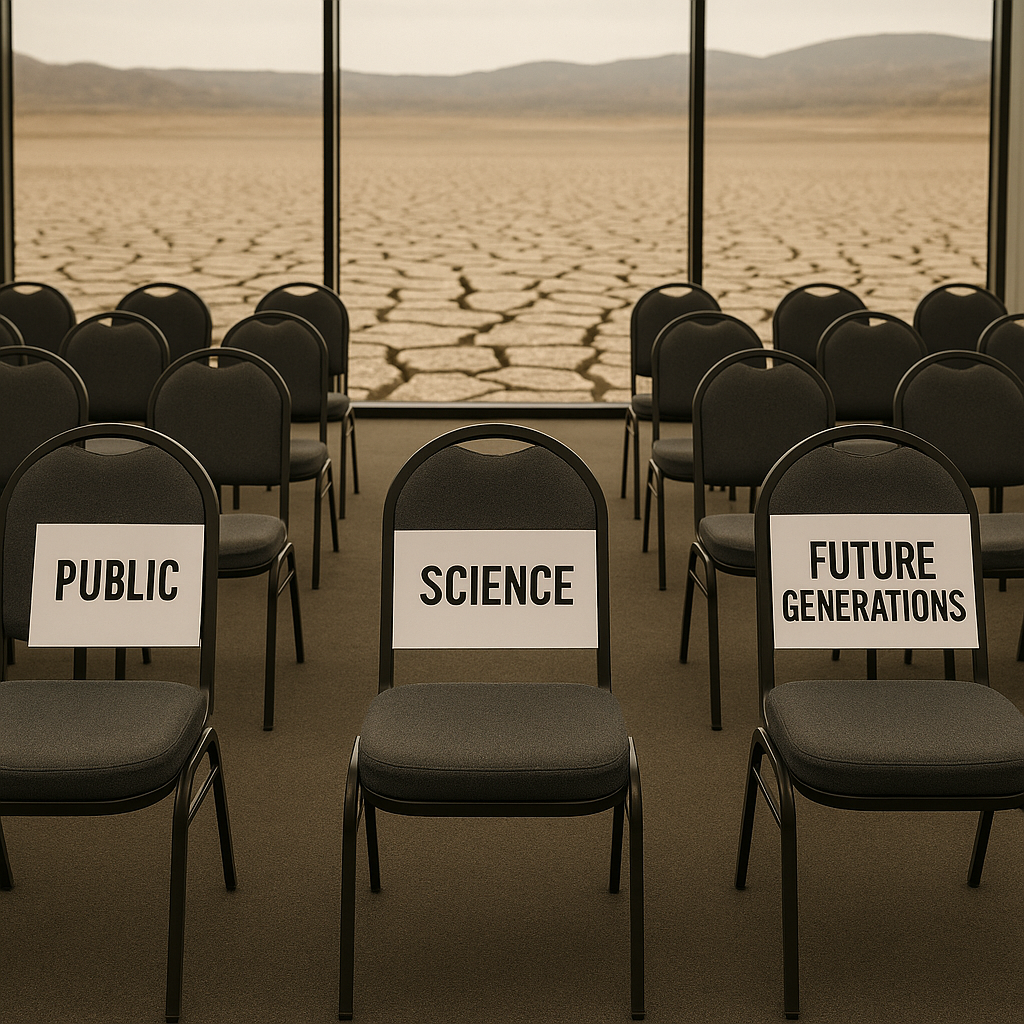
The Middle Rio Grande Water Advocates in New Mexico are an active group focused on water conservation, policy, and advocacy. They work towards ensuring a sustainable water future for the region through various initiatives, legislative advocacy, and public education.
Last month’s New Mexico Water Advocates workshop drew strong interest and attendance when Gretel Follingstad, PhD, and Maurice Hall, PhD, of the Environmental Defense Fund delivered a clear-eyed, compelling look at the New Mexico 360 Groundwater Report — and the urgency behind it. If you missed it, the video recording and presentation slides are available here.
The bottom line: groundwater supplies more than three-quarters of New Mexico’s drinking water, yet aquifers across the state are being depleted faster than they recharge — and another dry winter makes that reality harder to ignore.
The conversation continues in March. The New Mexico Groundwater Alliance is hosting two free webinars featuring additional report co-authors.
Thursday, March 5 | 12:30 PM MTNM Groundwater Data, Science & Administration Tools Featuring Adrian Oglesby, JD (Utton Transboundary Resources Center, UNM) and Stacy Timmons (NM Bureau of Geology & Mineral Resources), moderated by Gretel Follingstad, PhD. 👉 Register here
Monday, March 23 | 5:00 PM MTNM Case Studies of Groundwater Management Featuring Ladona Clayton (Ogallala Land & Water Conservancy), Dr. Phil King (King Engineering & Associates), Ramón Lucero (RCAC), and Aron Balok (Pecos Valley Artesian Conservancy District), moderated by Gretel Follingstad, PhD. 👉 Register here
February 18, 2025. Despite worsening scarcity, compact obligations, illegal water overuse, and the requirement to implement binding settlements, the Senate Finance Committee reduced funding for the Office of the State Engineer and Interstate Stream Commission — the only agencies with authority to manage the state’s water.
State Water Institutions Left Underfunded as Crisis Deepens
The Senate Finance Committee amended next fiscal year’s state budget in a manner that fails to provide the Office of the State Engineer (OSE) and Interstate Stream Commission (ISC) with the resources needed to confront New Mexico’s escalating water crisis. These agencies are the State’s primary institutions for managing water rights, ensuring interstate compact compliance, implementing settlements, protecting river systems, and planning future supply — functions no other entity has legal authority to perform.
Budget Decisions Disregard New Mexico’s Inability to Manage Its Water
The House-approved committee substitute budget already fell far short of what OSE/ISC identified as necessary to address mounting water governance failures, including compact compliance risks, groundwater depletion, and settlement obligations. The agencies requested approximately $132.78 million in special appropriations and program expansions, while the House-passed committee substitute provided about $73.05 million. The Senate Finance Committee authorized seven additional staff but without the $150,000 requested for office space and removed an additional $4.55 million from the House total. The cuts reject the State’s need to carry out essential statutory duties — enforcing water rights, reducing unlawful depletions, implementing the Lower Rio Grande Settlement, replacing the mission-critical water rights database software, and planning for worsening scarcity. The Senate also cut the aquifer mapping program appropriation from the $22.5 million to $10 million.
Committee Chair George Muñoz publicly acknowledged that key budget decisions were shaped through committee members’ rolling discussions outside public hearings and were changed at the last minute. The resulting proposal — including the unexpected removal of a 1% pay increase for teachers and state employees — surprised legislators and highlighted concerns about a back rooms process that also produced major funding decisions affecting the State’s ability to manage its water crisis.
To be frank, it’s our opinion that Sen. Muñoz’s arrogant disregard of New Mexico’s water crises in creating “his” budget is worse than mere fiscal malpractice. Fiscal malpractice means failing to meet State obligations now at the cost of enormous risk and exorbitant future costs. Senator Muñoz is doing more than mismanaging a budget—he is actively undermining the water security of every community in this state.
Evidence of the Senate Finance Committee’s arbitrary decision-making is revealed in the answers to Senator Soules’ (D-Las Cruces) questions of Chairman Muñoz. See the February 16 recording of the Senate Floor debate. The recording can be found here. Senator Soules’ questions begin at 12:26:25. Other Senators also objected to the process and the outcome.
The Outcome For Water
The table linked here provides the Water Advocates’ detailed analysis of the Office of the State Engineer and Interstate Stream Commission’s funding requests and the Legislature’s revisions, comparing the agencies’ original line-item requests with the Executive Budget, the House-approved committee substitute, and subsequent Senate changes.
Without sufficient funding and institutional capacity, OSE and ISC cannot enforce water rights at the scale required, implement interstate and tribal water settlements, reduce depletions, modernize critical data systems, or conduct the long-term planning needed to adapt to declining supplies. These responsibilities cannot be shifted to local governments or private actors; they rest solely with the State.
The funding shortfalls represent a failure to support the institutions responsible for protecting New Mexico’s water future at a time of intensifying drought, climate heating, and chronic overuse of rivers and aquifers. New Mexico cannot manage 21st-century water realities with 20th-century institutional processes, information technology, and thinking.
The funding shortfalls represent a failure to support the institutions responsible for protecting New Mexico’s water future at a time of intensifying drought, climate heating, and chronic overuse of rivers and aquifers. New Mexico cannot manage 21st-century water realities with 20th-century institutional processes, information technology, and thinking.
The 2026 Legislature has once again failed to strengthen the State’s water management system while there is still time, allowing underfunding to compound risks and invite Texas and the U.S. Supreme Court to determine how New Mexico manages the Middle Rio Grande.
The Lower Rio Grande settlement imposes onerous requirements, firm deadlines, and new Texas state-line delivery violation penalties promptly payable in actual water deliveries.
Statewide groundwater overuse — including along the Rio Grande — must be reduced, or New Mexico will suffer permanent and irreversible damage.
Corrections: edited Feb. 19 at 10:40 am to conform to this table included in today’s Interstate Stream Commission staff report that Director Riseley-White presented to the Commission this morning. She said the State Engineer did get seven new positions to administer water in accordance with several Indian Water Rights Settlements and in the Middle Rio Grande to prevent a Rio Grande Compact violation. The ISC Staff Report is online and can be found clicking here and drilling down three layers.
Feb 20, 2026. Added the italicized last sentence of the second paragraph. The Senate Finance Committee also cut that appropriation to less than half the amount approved by the house.
The Senate Must Act—Now—to Prevent a Deepening Water Crisis
New Mexico’s water future now rests with the Senate Finance Committee.
HB2, as sent from the House, funds less than half of the State Engineer’s urgently needed requests to carry out existing statutory duties. These are not new programs. They are the core responsibilities the Legislature has already assigned to the Office of the State Engineer and the Interstate Stream Commission—responsibilities tied directly to interstate obligations, Indian water-rights settlements, and protection of the public welfare. The Senate is now the last line of defense against compounding legal, financial, and operational risk.
New Mexico is legally bound to comply with the Rio Grande Compact, implement federally approved Indian water-rights settlements, enforce existing water rights, and carry out laws the Legislature has already enacted. Underfunding does not make those obligations disappear. It postpones action, raises exposure to litigation, and dramatically increases long-term costs.
The Senate Finance Committee must confront this reality directly.
Where HB2 Falls Critically Short
Rio Grande Compact Compliance The State Engineer requested $50 million to implement the Lower Rio Grande settlement, reduce ongoing Middle and Lower Rio Grande depletions, and ensure water reaches Elephant Butte Reservoir and the new El Paso compact gage. HB2 provides less than half that amount. Partial funding delays corrective action and sharply increases the risk of Compact violation—now projected within two to three years in the Middle Rio Grande.
Indian Water-Rights Settlements The State’s cost share unlocks several billion dollars in federal settlement funding and implements agreed-upon projects that benefit both Tribal and non-Tribal water users. HB2 provides only $10 million of the $35 million request, despite this being an ongoing, binding obligation.
Water Security Planning and Modernization The Legislature unanimously enacted the Water Security Planning Act in 2023. HB2 cuts the funding needed to implement that law and denies FY27 funding to continue replacement of a fragile, 30-year-old water-rights database that is at risk of failure.
River Conveyance and Core Staffing HB2 eliminates funding for extraordinary Middle Rio Grande channel improvements—even though 2025 demonstrated that preventable conveyance losses directly undermine Compact deliveries. It also zeroes out critical field and settlement staff needed for enforcement, wet-water administration, and compliance—functions no other entity can perform.
The Cost of Delay Is Not Abstract
Failure to act now threatens communities, agriculture, Tribal settlements, interstate relations, and New Mexico’s economy. Deferring action guarantees higher costs later—financially, legally, and operationally.
Call to Action
The Senate Finance Committee must provide full funding for the State Engineer’s requested water resources management special appropriations and expansions that the House left out of HB2.
If you care about New Mexico’s future, contact Committee members today and demand the Senate fully fund these core State water management responsibilities. Only the State has the authority and resources to comply with the law by carrying them out. Committee members are listed here.
On August 29, 2025, the Lower Rio Grande litigation parties and “friends of the court” filed a proposed settlement with the U.S. Supreme Court’s Special Master in the interstate water lawsuit brought by Texas against New Mexico in 2013. The United States later joined the litigation to assert its claims against New Mexico. In 2023, the U.S. Department of Justice objected to a proposed settlement between the three Compact States, stating that New Mexico must be specifically required to timely meet its commitments. The Supreme Court rejected it.
The “canalized” Lower Rio Grande in the Mesilla Valley. Photo credit: El Paso Water
A revised settlement was filed in August 2025. It consists of a proposed Consent Decree and four implementing agreements between the litigants and the irrigation districts in both states. Following a Special Master hearing in Philadelphia, state water officials informed legislative committees in November that they expect the Special Master to recommend approval to the Supreme Court. If approved, the Court will issue a final decree making the agreements binding and enforceable. The Supreme Court practice is to create a continuing Special Master position to perform decree accounting and report or oversee compliance.
The Consent Decree and four implementing agreements exceed 130 pages and are highly technical. This New Mexico Water Advocates summary explains, in straightforward terms, what the settlement requires, what it authorizes, and how the parties are to carry it out. It identifies who must act, under what conditions, by when, and with what consequences. The settlement would significantly change water management downstream of Elephant Butte Dam.
New Mexico Water Advocates invites readers provide comments regarding errors or important material missing from this summary.
When the Interstate Stream Commission (ISC) asked for public comment on its proposed rules for regional water security planning, the responses were nearly unanimous in criticism.
From acequia associations to wildlife agencies, counties to citizens, the message is clear: the rules fail to meet the Water Security Planning Act’s promise of regional, science-based, locally led, and participatory planning. Critics call the draft “unreadable,” overly legalistic, and designed to centralize power in staff hands rather than empower local councils.
The breadth of opposition from technical experts, grassroots leaders, farmers, and scientists alike underscores the fundamental problem: both the rules and the process to adopt them lack legitimacy.
Everyone Feels Excluded
Farmers fear losing water; environmentalists fear losing rivers. Scientists want rigor. Local officials want fairness. The Proposed Rules require improvement.
When every constituency feels unheard, the failure lies not in disagreement but in design.
A Deeply Flawed Rulemaking Process
Subject to available funding, the commission shall establish and conduct a regional water security program pursuant to the provisions of the Water Security Planning Act. NMSA 1978 Section 72-14A-4 (A) (2023)
Seventy-three public comments were submitted by the ISC’s September 27 deadline. The ISC’s rulemaking procedure drew as much criticism as the rule itself. Observers expect the upcoming October 15–17 hearing to expose not only weak content but deep procedural flaws that fail to provide opportunities for participation the State Rules Act requires.
No Analytical Rationale
Filed July 17, 2025, the proposed rule came with no analytical rationale or evidentiary record explaining why any provision was chosen. The law requires a “rational connection between facts and choices,” but neither the factual basis nor the evaluated alternatives are visible.
The record consists only of the rule text, legal process documents, public comments, and prefiled staff testimony. The exhibits accompanying the testimony are historical; many of them would have justified the 2023 Act but are irrelevant to the Proposed Rule. They are limited to old handbooks, reports, and more recent open house presentations and summaries. None are directly cited in the staff testimony. Without linkage, they serve as background, not evidence.
No alternatives considered by staff were analyzed; no technical reasoning was disclosed. The public was asked to comment blindly. Commissioners are asked to decide without knowing the staff’s reasons for constraining key provisions of the Proposed Rule.
Staff’s testimony, filed after public comments closed, does not answer the basic question: Why are the rules written as they are? Instead, the testimony recounts history and asserts sufficiency, offering no transparent foundation.
Now the Commission Must Lead
Staff and contractors designed and controlled every stage of drafting, revision, and internal review, withholding their reasoning. The resulting Proposed Rule does not provide the clarity or rigor needed to ensure planning is meaningful and state funds are not wasted. The Proposed Rule is riddled with passive-voice constructions, misplaced modifiers, negative language, and ambiguity in direct violation of specific drafting standards for Rules.
When Commissioners and the public lack access to underlying rationale for the vague and ambiguously drafted Proposed Rule, meaningful oversight becomes impossible. The staff-centric process embedded in the staff’s Proposed Rules to implement the Act contradicts the Act’s vision of transparent, Commission-adopted rules to require meaningful decentralized regional water security planning without excessive staff gatekeeping.
Non-Evidentiary Hearing
The hearing itself will be non-evidentiary, disallowing sworn testimony and excluding the presentation of expert witness testimony or other evidence by interested parties. Questions will be permitted only from Commissioners, and the public will have no opportunity to challenge, clarify, or rebut statements made during the proceeding.
Worthwhile water planning must integrate hydrology, climatology, law, economics, and the social sciences. Establishing the technical and social planning program the law requires is a technical matter. Integrity requires the Commission’s understanding of transparent reasoning and its consideration of evidence commission members find credible.
A non-technical hearing format is inadequate for the complex, interdisciplinary water security planning program Rules. The non-technical hearing record will be a transcript of opinions, not evidence, leaving the Commission’s decisions vulnerable to challenge.
Compressed Schedule
Staff have filed thousands of pages into the record. Only the State Engineer and ISC staff may present evidence and testimony at the hearing. The public comment period closed September 27. Staff expert testimony was filed on October 1. The hearing starts two weeks later.
This hearing structure and the compressed schedule violate due process requirements expressed in “case law.” The State Rules Act specifically requires adherence to “case law.”
Selective and Unexplained Revisions
Staff testimony responds selectively to a few comments and revises portions of the draft accordingly; it fails to identify why certain comments were singled out for a staff response and doesn’t cite criteria or evidence. Such opacity erodes trust and risks rendering the rule arbitrary under judicial review.
Some of the 73 public comments advocated for specific water governance outcomes. Most comments were broadly critical. Some provided detailed critiques, with many suggestions. A handful said the proposal was okay.
Scientists Want Science
Beyond process, agencies fault the rule’s substance. The New Mexico Department of Wildlife urged that councils be required, not merely encouraged, to use best available science regarding species and habitats.
Rio Grande Return and others noted that wetlands are omitted entirely.
A major coalition, New Mexico Wild, Audubon Southwest, Amigos Bravos, and Western Resource Advocates, warned that “may consider” clauses turn mandates into options. They called for a defined procedure to consider the needs of future generations, as the law explicitly requires, and for measurable accountability. Others called for the mandatory ‘considerations’ to be made substantive and reviewable, not simply be repeated from the Act without implementable substance.
Local Voices Seek Fairness
Community water systems raised parallel concerns. The Eldorado Area Water & Sanitation District questioned how priorities could be fairly considered and ranked across huge regions. Others said funding and prioritization criteria remain unclear. “Readiness” the only ranking criteria is undefined
Projects labeled ‘ready’ would be prioritized to outrank long-term programs and policies to balance water uses with water supplies, advance the public welfare, or protect water for future generations. Those efforts can’t be “ready” when proposed. They will require more time and resources, but they align with the law’s purpose.
Traditional Communities Demand Protection
Acequia leaders said the draft ignores centuries-old governance. The New Mexico Acequia Association warned that traditional uses remain unprotected and representation uncertain. The Cattle Growers’ Association voiced the same worry: that urban priorities would override rural needs without safeguards. Irrigators and Pueblos asserted their senior rights.
How Not to Implement Transformative Law
Unless the ISC reopens the record, files its missing rationale, and allows a fair process founded on rationale and evidence, this proceeding will stand as a case study in how not to implement transformative legislation.
Aquifers are vanishing. Climate stress is growing. Decentralized water planning is the path forward.
New Mexico faces a stark and accelerating water crisis. In many parts of the state, aquifers are being depleted to support uses that cannot be sustained, especially agriculture dependent on non-recharging groundwater. This extraction is not just borrowing from the future:it is stealing from it.As climate change reduces snowpack, accelerates evaporation, and intensifies drought, the state’s water supply is shrinking.
Though aware of the situation, our political leaders seem unwilling or unable to confront its urgency, while the consequences of delay grow more severe by the year.
An “all hands” commitment to water resources planning (or more simply “water planning”) is how we propose to confront this reality.
Rio Grande at Albuquerque, no pools in sight, late July 2025. Photo credit: Wesley Noe
Water planning is about solving problems. Good planning helps us understand our water supply and uses, face hard choices, anticipate future conditions, and make informed decisions to secure a livable and just future for New Mexicans.
The choices we make in the next few years will determine whether many communities across New Mexico have water security, or whether too many will face escalating crises. The time for planning is not someday. It is now.
Purpose of Water Resources Planning
Water resources planning is a forward-looking, problem-solving process to ensure the sustainable, equitable, and efficient use and management of water in the face of increasing and permanent scarcity. Its purpose is to identify and address water challenges, especially those driven by climate change, aquifer depletion, legal obligations, and shifting demands. It does this by thoughtfully and carefully integrating science, law, governance, and public values.
Water planning in New Mexico must take place in conformity with state and federal laws, while also confronting a basic truth: Many essential water needs and uses are not protected by law. Drinking water and sanitation for all, reliable supplies for communities, schools and hospitals, our beloved rivers and the sacred needs that they supply—these uses have no claim to water rights or have rights with low priority under law. Yet these needs are not going away. and raise the fundamental question: how to share shortages fairly. Thus, planning involves negotiating the rules for who gets what, when and how.
Drained aquifers cannot be brought back. Adaptive action is the only way to avoid catastrophic and irreversible loss. Urgency in understanding local situations now through planning will reduce the number of future New Mexico communities that will run out of water. Decentralization is essential. The problems are local and regional. Planning must be too.
Key Goals
1. Balance Supply and Demand
Assess available water under changing climate conditions and align this reality with current and future demands for people, farms, ecosystems, and economies. This requires a reliable understanding of the planning region’s water supplies and water uses.
2. Balance Competing Needs
Navigate the intersecting and often conflicting demands of:
• Urban and rural communities
• Agriculture
• Environmental protection
• Economic development
In New Mexico, this includes confronting the consequences of continued agricultural uses and proposed economic development new uses that mine groundwater at the expense of communities and future generations who will be left without. Planning must grapple with these intergenerational trade-offs and define transitions toward sustainable use.
Water measurements and hydrogeologic science developed and applied with scientific integrity must define a framework upon which the social methods of water planning. Water planning overlays the law, legal uncertainty, economics, and values on the facts. A beginning common ground between diverse interested parties can be built on understanding facts and the legal situation in a process where the parties learn about the problems that planning must address and get to know each other.
Irrespective of the diversity of belief systems held by members of a community, it is essential that planning be built on a framework of agreed upon hydrological, hydrogeological, and meteorological data. (You are entitled to your own opinions but not your own facts!) Face to face communication among members of a planning group is essential in building the trust needed to get beyond “head in the sand” refusal to listen or to entertain opposing points of view. That trust is key to building a workable plan.
The work of planning is social and probabilistic, not deterministic. A major social component is breaking through the head-in-the-sand attitude that is apparent in so many localbusiness leaders and public officials. It may bedifficult to bring recalcitrant parties to the table, but easier as they come to understand therisks they and their interests face by simply being members of the community. Their participation is needed to help find solutions.
3. Promote Long-Term Sustainability
Acknowledge the limits of natural recharge. Many New Mexico aquifers are essentially non-recharging, and climate change is reducing recharge further due to accelerating evapotranspiration. Planning must reflect these realities and support strategies to limit further depletion, extend critical supplies, and protect water security for future generations. Planning should support monitoring systems and adaptive governance frameworks to respond to depletion trends and new data.
4. Manage Risks and Uncertainty
Prepare for droughts, floods, compliance with legal constraints like the Rio Grande Compact, and intensifying climate volatility. Regional water budgets and enforceable demand management agreements are tools that might be produced through regional water planning to address uncertainty.
5. Protect Ecosystems and Water Quality
Safeguard river health, aquifer integrity, and clean water supplies through integrated, science-based planning. Planning should address nature-based solutions—such as increased natural infiltration of stormwater runoff, watershed restoration, ecological flow targets, and aquifer recharge zones—as climate adaptation strategies.
6. Guide Investment
Make sound decisions and recommendations for infrastructure spending. Prioritize projects, programs, and policies for implementation. Well-prepared regional plans will unlock access to state and federal infrastructure funding. Technical assistance should be provided to ensure all regions, especially underserved and rural areas, are competitive and ready.
7. Ensure Equity and Public Benefit
Plan to meet the needs of all people, not just those with the most power or resources. Respect and integrate tribal, cultural, and historical water rights in all decisions. This includes supporting capacity-building for Tribal and rural communities to ensure their voices, rights, and knowledge systems are equitably integrated into planning and governance processes.
8. Inform Policy and Governance
Provide a science-based framework to guide laws, public funding, institutional design, and transparent decision-making. Planning must support governance that is lawful and enforceable, while also addressing essential and sacred water requirements—like those for communities, hospitals, schools, ecosystems—that are often subordinate under existing water rights but are indispensable to a functioning society.
Without a clear planning framework and enforceable rules, these essential needs will remain vulnerable. Some will go unmet. The window for proactive, science-informed policy is rapidly closing. We must choose between managed transition and unmanaged collapse. Sound regional planning based on truth, urgency, and local leadership is the foundation for New Mexico’s water future.
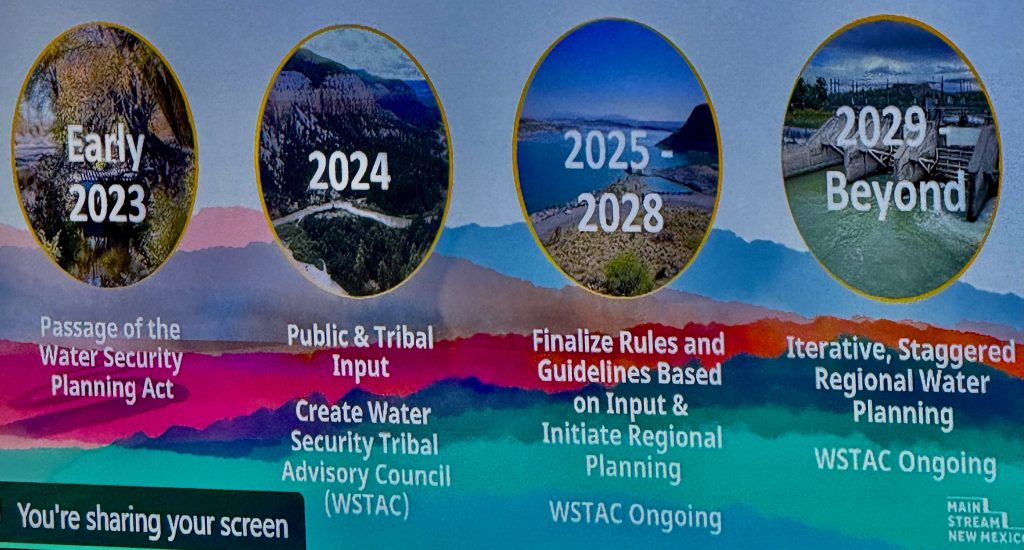
ISC Commission members have the power to unlock access to funding so that across NM regions and regional leaders can begin now, instead of dates far into the 2030s, to begin to fulfill their lawful decentralized responsibilities.
ISC staff presentation to the Commission on June 18, 2025. Water Advocates photo
What becomes possible when our agencies are well-funded, our water security laws are fully implemented, and we all work together? The Water Advocates envision a future where New Mexico thrives in harmony with its arid environment. When this vision is realized, New Mexico will be a state where:
Diverse cultures flourish: Indigenous and traditional water practices are honored and integrated with modern solutions, ensuring cultural continuity and resilience.
Economic prosperity is sustained: Water is used wisely to support a diverse economy, including agriculture, industry, and tourism, while prioritizing the needs of communities.
Food Security is strengthened: Water is prioritized for local food production, enhancing food security across the state.
Natural ecosystems are protected: Healthy rivers, wetlands, and riparian areas support biodiversity and provide critical ecosystem services.
Communities are resilient: Water resources are managed equitably and sustainably empowering communities to withstand drought and the impacts of climate change.
Achieving this future requires a collective commitment to good water governance, active engagement in New Mexico’s water security agenda, and inclusive participation. By embracing this vision, New Mexico can secure a vibrant and water-secure future for generations to come.
Now is the time to build on the foundation of good water law already on the books. Fully funding the implementation of key legislation—is crucial for securing our water future. These acts provide a framework for addressing critical water challenges, yet their full potential can only be realized if state water agencies have the capacity to fully implement them. Here are the essential elements of our water security agenda emphasizing the urgent need for accelerated progress.
The 2023 Water Security Planning Act: Passed unanimously in its first year, this act emerged as a direct recommendation of the 2022 Water Policy and Infrastructure Task Force. Endorsed by the Governor, the State Engineer, and legislators, the Act received unanimous support in committee hearings and both legislative chambers. Its goal is to establish a statewide set of regional water resilience plans, grounded in robust data and each region’s unique hydrologic reality. Effective water planning requires good water data and water models, both of which state water agencies are mandated to provide under this law.
The 2019 Water Data Act: This act addresses the critical need for comprehensive and accessible water data to support effective water management across New Mexico. Currently, data availability varies significantly across the state, limiting planning and decision-making capabilities. The Act mandates a modern, integrated approach to water data management, spearheaded by the New Mexico Bureau of Geology and Mineral Resources alongside other state agencies. Full implementation of the Act—including through data collection, analysis, and public accessibility, is essential for sustainable water use and building a resilient future for New Mexico.
Aquifer Mapping Program: Led by the Bureau of Geology and Mineral Resources, New Mexico’s designated water science agency, this program received legislative funding in the early 2010s. It involves extensive aquifer research and monitoring to determine the quality and quantity of both fresh and brackish groundwater, estimated remaining water resources, and project longevity under current usage rates. This initiative requires drilling about 100 dedicated aquifer monitoring wells statewide, maintaining and interpreting the data to build actionable knowledge of New Mexico’s groundwater resources. Given New Mexico’s reliance on groundwater more than any other state, this comprehensive, decade-long initiative is crucial.
Active Water Resources Management(AWRM): This approach administers “wet water” in accordance with legal requirements, through either priority administration or shortage-sharing agreements that equivalently limit total water use. Unlike the Office of the State Engineer’s administration of “paper water” (rights and permits that may exceed actual water availability), AWRM is grounded in real water use and availability, ensuring that legal objectives are met without exceeding the resource’s natural limits. Active Administration of water by the State Engineer, based on actual available water, was authorized by a straightforward 2003 water law—upheld by the New Mexico Supreme Court in 2012—that recognized the urgent need for water administration and compact compliance. However, AWRM has yet to be fully implemented due lack of political will and limited staffing and regulatory capacity. As a result, annual water depletions in the Lower Rio Grande are approximately 9,000 acre-feet above New Mexico’s allowable share of releases from Elephant Butte Reservoir. In the Middle Rio Grande, average annual water depletions have exceeded the legal limit by 26,000 acre-feet per year on average since 2018, setting the state up for further interstate litigation. Immediate, full implementation of AWRM is crucial. The 2023 Water Security Planning Act further supports AWRM by allowing water planning regions to voluntarily develop shortage-sharing plans as a central component of their regional water security strategies.
Modernization for Resilience: New Mexico’s state water agencies, tasked with managing our precious water resources and protecting our water rights, need adequate funding and staffing to operate effectively. These agencies must be empowered to modernize their operations by updating their business processes, enhancing data collection and verification methods, and replacing dysfunctional information technology infrastructure. The success of New Mexico’s water security agenda—and the effective implementation of the great laws already enacted—depends on this modernization. Key areas for improvement include:
Adopting modern business practices and information safeguards
Significantly enhancing quality control for water data collected, maintained, and managed by the Office of the State Engineer (OSE) and Interstate Stream Commission (ISC)
Ensuring reliability in water use measurements and data collection
Timely generation of integrated water use data to support effective water planning and administration
Fulfilling responsibilities assigned by the Water Data Act
Administering “wet water” (actual water available) to meet legal and management requirements
Equipping OSE/ISC with modern information technology essential for agency staff to effectively fulfill their statutory responsibilities.
Water Education: Building widespread public awareness and understanding of New Mexico’s water challenges and solutions is essential to achieving water security. This involves creating and implementing comprehensive educational programs that reach diverse communities across the state. These programs should leverage multiple platforms—community gatherings, schools, workshops, webinars, and online resources—to share knowledge about water conservation, efficient water use, and the importance of active public engagement in water management decision-making.
An informed and engaged public is crucial for achieving water security. While Water Advocates play a vital role and believe in the power of public education to drive change, achieving this goal requires the collective efforts of water governance bodies, environmental organizations, and engaged citizens to make this a reality. Water education is a primary objective of our advocacy, and these programs should aim to:
Be accessible: Reach diverse audiences by using a variety of platforms—workshops, webinars, online resources, and community events—that reach diverse audiences and cater to different learning styles.
Be comprehensive: Address a broad range of topics, including water conservation, efficient water use, water rights, and the impacts of climate change on water resources—as well as the results of inaction.
Be engaging: Employ interactive and participatory approaches to learning, such as hands-on activities, simulations, and community discussions, to make learning memorable and impactful.
Be inclusive: Ensure that materials and programs are culturally appropriate and accessible to everyone, including individuals with limited English proficiency or disabilities.
Empower action: Equip individuals with the knowledge and tools to become active stewards of water resources in their homes, communities, and workplaces.
By fostering public awareness and understanding of water issues, we can empower New Mexicans to play an active role in shaping a sustainable water future for the state.
All the Above Actions and Fully Funded Program Lead to Achieving Water Security
Water security forms the foundation of a thriving New Mexico. As stated above, achieving water security requires a multifaceted approach, encompassing responsible management, forward-thinking planning, and collaborative action.
Aquifer Resilience: Water Security for New Mexicans relying on groundwater. With a comprehensive understanding of this vital groundwater resource, achieved through the Aquifer Mapping programs and groundwater resilience planning, our water agencies can make informed decisions about the management of aquifer usage and recharge. A resilient aquifer can maintain its essential functions—providing water for people, ecosystems, and economies—even under changing conditions. Where aquifers are tributary to rivers, higher water security is attained when a coordinated plan is implemented to manage both surface and groundwater resources, preventing excessive groundwater pumping that damages aquifers and hinders compact compliance.
Interstate Stream Compacts Compliance: – Achieving water security for New Mexicans reliant on interstate stream water requires meeting depletion limits and delivery requirements specified in enforceable compacts. The Active Water Resources Management (AWRM) authorizing statute, along with supporting State Engineer rules and the 2012 NM Supreme Court unanimous decision, provides a strong legal framework. Effective application of AWRM in the Lower and Middle Rio Grande —whether through priority administration or regional shortage-sharing agreements—will enhance resilience in these basins’ water supplies. Compliance with Colorado River Basin compacts, however, is more complex and can best be improved through regional water security planning and vigorous state advocacy in intergovernmental forums. Compliance with all interstate obligations should be actively managed, monitored, and publicly reported.
Public Engagement and Awareness: New Mexico will always have to live with scarce water resources and the challenges of increasing aridity, making public engagement and education critical. Regional water security planning will foster engagement from stakeholders, communities, and the general public through statewide and regionally focused educational campaigns. New Mexicans deserve clear information on the realities of their water resources; consistent public education can help advance awareness and acceptance that current water management practices must evolve for long-term water security.
Crisis Avoidance and Preparedness: Water Security is strengthened when state agencies and communities understand water resource trends and impending insecurity early, allowing for timely actions to avert crises or plan for their impacts. Preparedness is also bolstered when the state government has advance plans, resources stockpiled, and funds set aside to provide meaningful assistance in the face of unanticipated water crises.
The New Mexico Environment Department (NMED) has access to millions of dollars in loans to help with these and other types of water system projects. These loans are available to community water systems as well as non-profit, non-community water systems (for example, at a school or a camp). The loans come from the Drinking Water State Revolving Fund. That is a federal-state program that provides low-cost financial assistance to water systems for a wide range of drinking water projects.
These loans offer excellent terms:
Communities with a low median household income can qualify for 0% interest, and up to 75% of the loan principal may be forgiven.
For regionalization projects, up to 90% of the loan principal may be forgiven.
For green projects – like water conservation, increased efficiency, and green infrastructure – even more of the loan principal may be forgiven.
Loans for removing “emerging contaminants” from water systems – including PFAS and manganese – may be 100% forgiven. The six lists of emerging contaminants are here: https://www.epa.gov/ccl
Getting started is easy. Your water system administrator just needs to:
Submit a simple pre-application, using this form: https://forms.office.com/g/fnjniAZzRL
Provide some additional documents when NMED’s Drinking Water Bureau staff request them.
Complete a full loan application for the New Mexico Finance Authority after the pre-application is placed on the Fundable Priority List.
Help is available!
If your water system administrator isn’t sure exactly what is wrong with your water system, staff from the New Mexico Rural Water Association may be able to come out and troubleshoot.
The Rural Community Assistance Corporation and the Southwest Environmental Finance Center may be able to help the administrator with the application process.
The Infrastructure Support Team at NMED’s Drinking Water Bureau is available to answer questions. Please contact them at: NM**************@******nm.us
And if the pre-application isn’t placed on the Fundable Priority List the first time around, NMED staff will provide recommendations on how to strengthen it before it is re-submitted.
You can find links to the pre-application and the checklist on that site, too. Thanks to the New Mexico Environment Department for this information and work to help New Mexico communities
The legislature’s Water and Natural Resources Committee conducted its only water-focused meeting this year July 25-26 at Sandia Pueblo. Legislators heard from expert panels on topics selected by the Committee leadership. Three panels, numbers 5, 9, and 11 below, supported the need for Water Governance Reform in New Mexico. Water Governance Reform is an overarching advocacy theme of the Middle Rio Grande Water Advocates.
Sandia Pueblo hosted the sessions
Members of multiple panels recommended bold action by the Legislature to face our future with considerably lower water supplies. Common themes included,
substantially bolstering state water management agencies’ capacity,
the requirement for the State Engineer to implement Active Water Resources Management to reduce water use through collaborative shortage sharing agreements, and
the need for robust and meaningful regional and community water planning to equitably improve the resilience of water supplies and water users.
Panels of water experts and agency leaders spoke on each of the topics listed below. Water Advocates president Norm Gaume presented on panels 9 and 11. Videos of the presentations and legislators’ questions and comments have been released, and are available at the links below. The agenda and handouts are available on the Water and Natural Resources Committee webpages.
The morning session on July 25 included panels: . 1. Opening prayer and introductions of the legislators (starts at 9:13am) . 2. History, Present and Future of Native American Water Use (starts at 9:31am) . 3. Status of Indian Water Rights Litigation and Settlements (starts at 10 :39am) . 4. Water Pipeline to To’hajiilee (starts at 11:33am)
The afternoon session on July 25 included panels: . 5. Water Management in an Era of Decreasing Supply; Increased Use and the Effect of Groundwater Depletions and Climate Change (starts at 1:03pm) . 6. The Legal and Regulatory Framework of Environmental Flows in New Mexico (starts at 2:52pm) . 7. The Strategic Water Reserve: Status, Needs and Reform (starts at 3:23pm) . 8. Risk of Flooding from Wildfires (starts at 3:43pm)
The morning session on July 26 included panels: . 9. Water System Governance and Reform (starts at 9:11am) . 10. Water Use in Cannabis Production (starts at 10:38am)
The afternoon session on July 26 included panels: . 11. Middle Rio Grande Water Use and Compliance with the Rio Grande Compact (starts at 1:01pm) . 12. New Mexico Unit Fund: Process Access and Status (starts at 2:33pm) . 13. Update on Texas v. New Mexico (closed session, no video)


 Committee Chair George Muñoz