The Rio Grande at Its Driest: What 85 Years of Compact Data Show
Every year since 1940, federal and state water managers have accounted for the Rio Grande waters flowing past the Otowi highway bridge to Los Alamos. That annual volume determines how the river’s flow is allocated under the Rio Grande Compact — which is federal and state law that governs water sharing among Colorado, New Mexico, and Texas. The amount of water New Mexico must deliver for all uses downstream of Elephant Butte Reservoir — in New Mexico, Texas, and Mexico — depends directly on how much water arrives at Otowi. The gauge is, in the most literal sense, where the Middle Rio Grande’s annual water entitlement and delivery obligations are set.
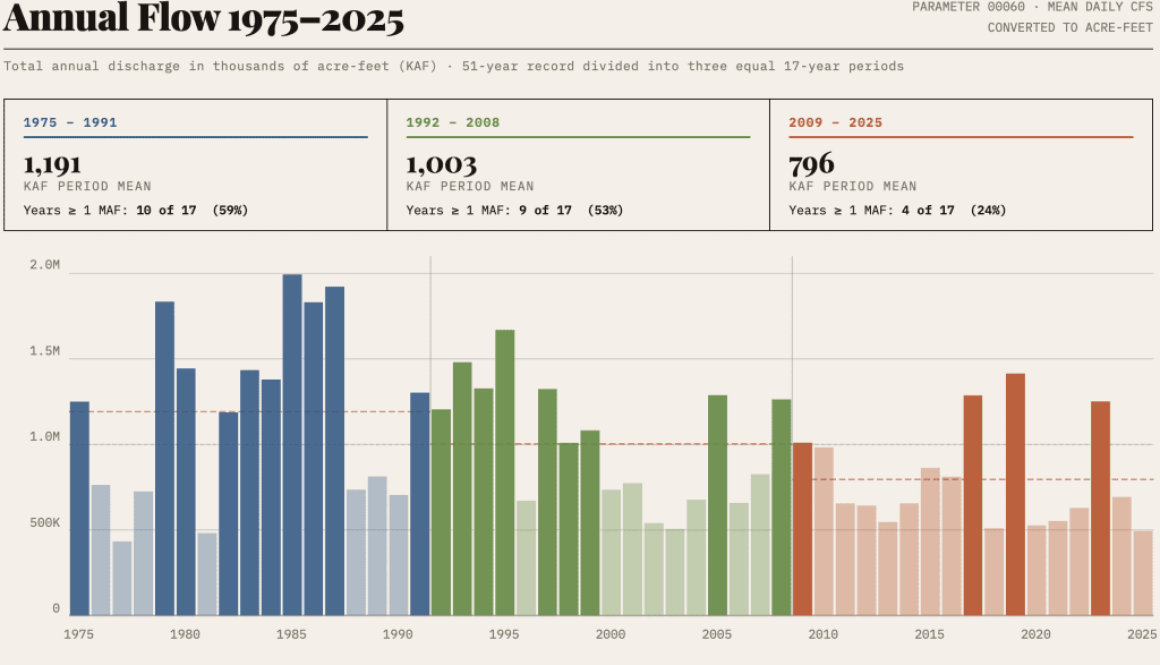
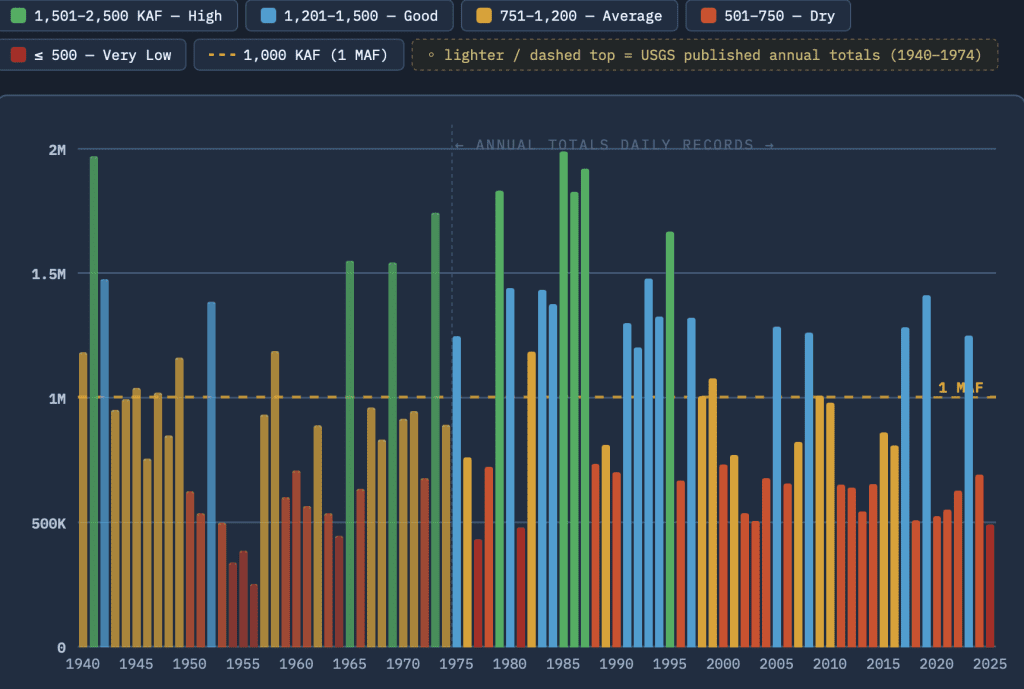
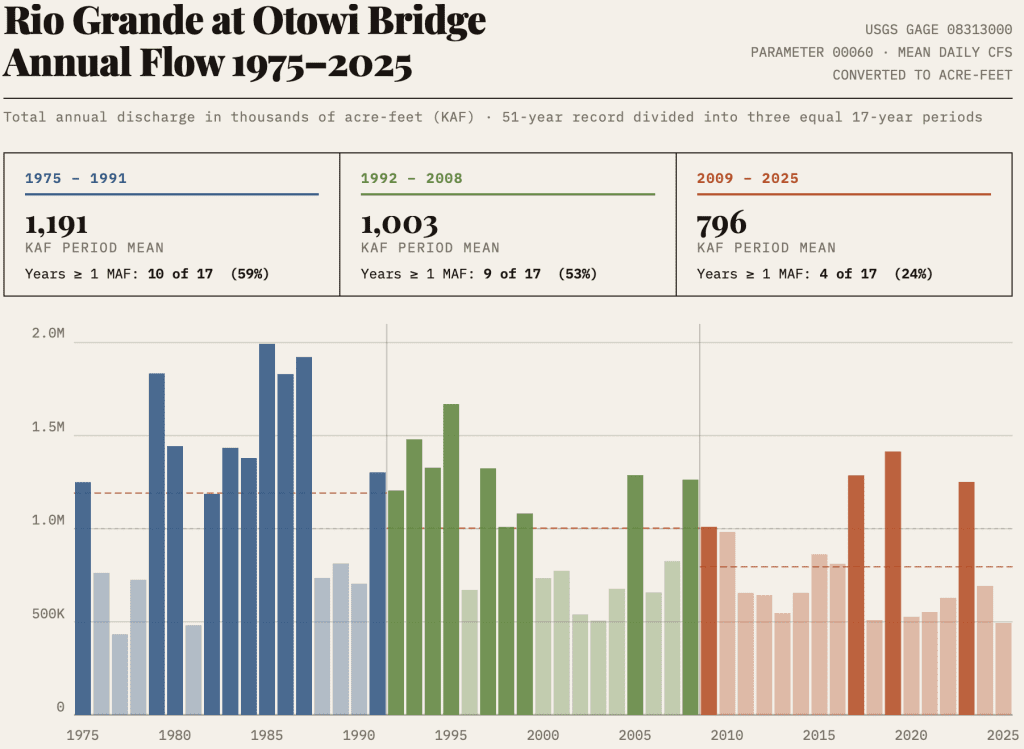
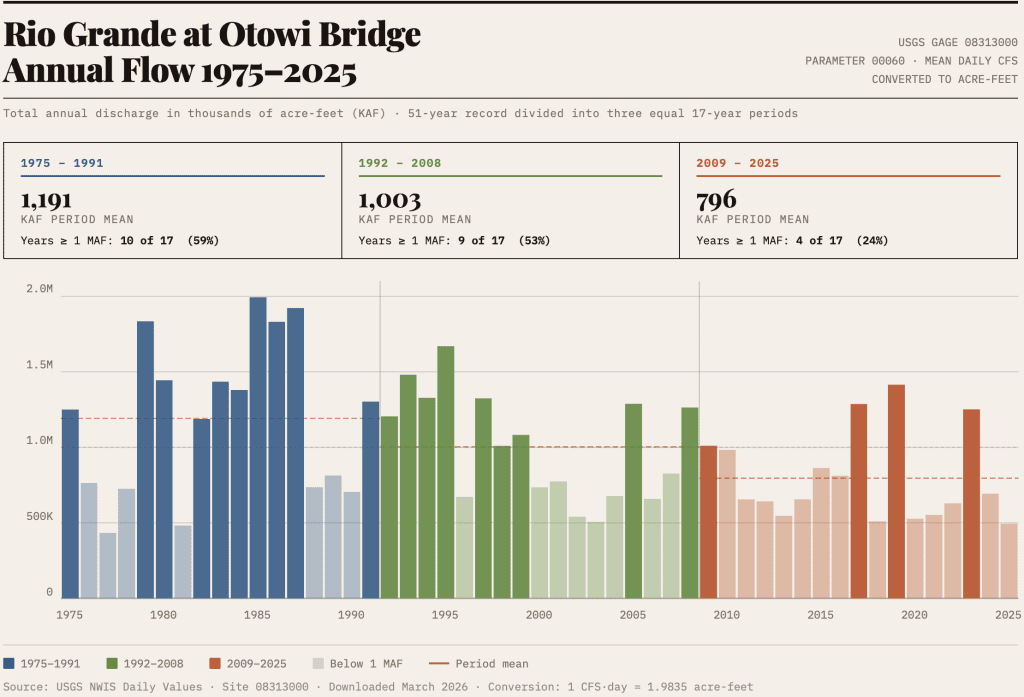
Each of the three graphics below reveals important facts that are not well known.
The current drought is not without precedent — the infamous drought of the 1950s was comparably severe
The first graphic spans the complete Compact era from 1940 to the present. It shows that the current drought is not without precedent — the infamous drought of the 1950s was comparably severe.
New Mexico has lost roughly one third of its Rio Grande water supply over the past fifty years
The second graphic examines the most recent five decades and reveals an alarming fact: New Mexico has lost roughly one third of its Rio Grande water supply over the past fifty years. The 1980s and 1990s were anomalously wet — a period that filled reservoirs and fostered a false sense of the river’s water supply blessings. Since then the basin has trended sharply dryer. El Vado and Elephant Butte Reservoirs have been essentially emptied, and Abiquiu Reservoir has been drawn down by roughly half — all in an effort to sustain water supplies and meet new federal endangered species requirements.
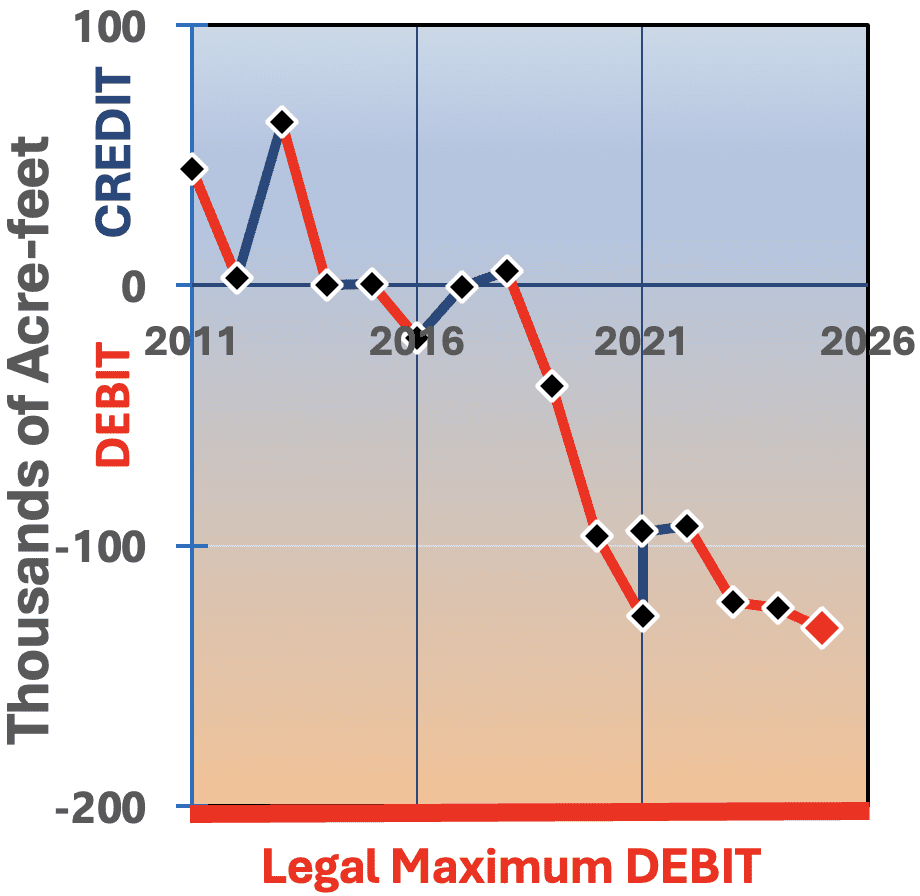
It has not been enough. New Mexico entered the current dry era holding substantial accrued delivery credits under the Compact. All credits have been consumed. Since 2018, New Mexico’s cumulative delivery deficit has risen to -132,000 acre-feet. This is a legally binding State of New Mexico water debt to Lower Rio Grande that has accrued over the last seven years.
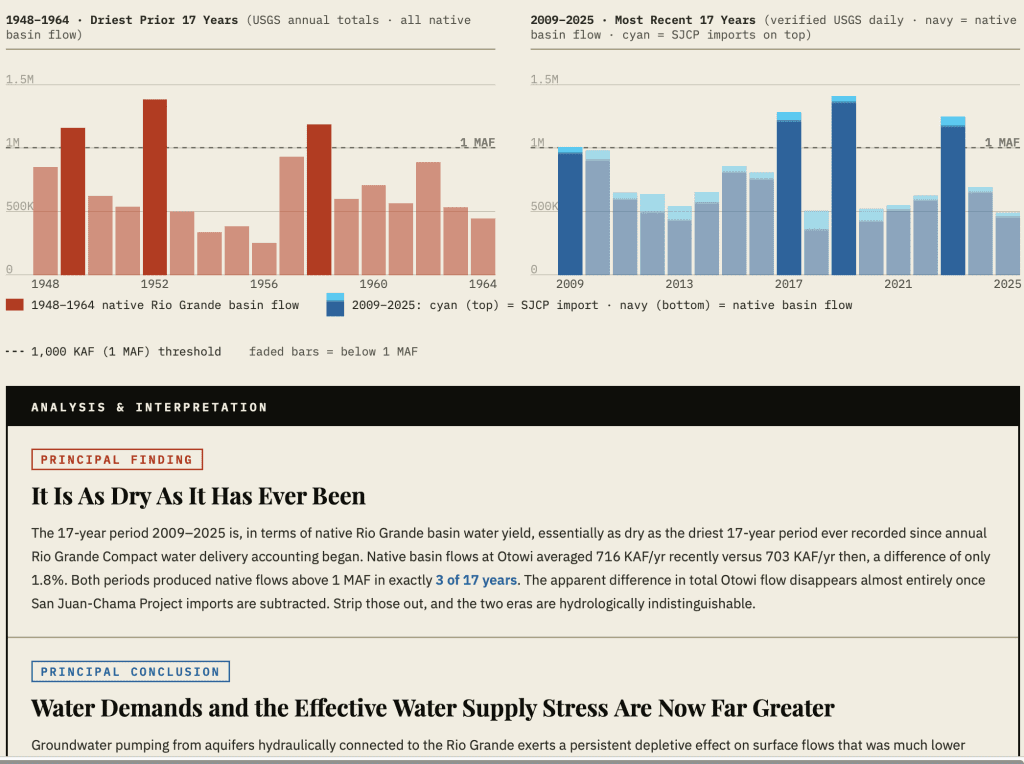
The third graphic completes the analysis by placing the most recent 17 years in direct comparison with the driest 17-year period previously recorded under the Compact, with full accounting of San Juan-Chama Project imports, contractor entitlements, and the graphically alarming storage history of Heron Reservoir.
The data support two conclusions that the third graphic documents in detail.
Principal Finding:
The 17-year period 2009–2025 is, in terms of native Rio Grande basin water yield, as dry as the driest 17-year period ever recorded since annual Rio Grande Compact water delivery accounting began. Native basin flows at Otowi averaged 716,000 acre-feet per year over the recent period versus 703,000 acre-feet per year from 1948–1964 — a difference of only 1.8%. Both periods produced native flows above one million acre-feet in exactly three of seventeen years. Strip out San Juan-Chama Project imports, and the two eras are hydrologically indistinguishable.
Principal Conclusion
The effective water-supply stress today is far greater than the raw Otowi flow numbers suggest, or than it has ever been
Groundwater pumping from aquifers hydraulically connected to the Rio Grande exerts a persistent depletive effect on surface flows that was much lower during 1948–1964 historic dry period, making the effective water-supply stress today far greater than the raw Otowi flow numbers suggest or than it has ever been.
During the 1948–1964 historical driest period, the Middle Rio Grande corridor had far fewer people and cities were much smaller: Albuquerque’s population in 1950 was roughly 97,000; today the metropolitan area exceeds 900,000. Municipal, industrial, agricultural, and riparian water demands are dramatically greater today, and rising temperatures have increased evapotranspiration throughout the basin. Decades of heavy pumping from the hydraulically connected shallow alluvial aquifer and the underlying Santa Fe Group aquifer have drawn down water tables along certain reaches of the Middle Rio Grande, causing greater losses from the river.
The third graphic is the most important. It presents this evaluation’s bottom line findings and conclusions, including the stark storage history of the San Juan Chama Project and the recent diminishment of its annual contributions to a reliable Middle Rio Grande water supply.
Please click each graphic in sequence to see the situation and pay particular attention to the third.
Please be sure to click this thumbnail for the principal finding and conclusion including an alarming graphic pertaining to the reliability of San Juan Chama Project imported water supplies.
If analyses similar to this one are publicly available, I am unaware, so I invested the time to laboriously assemble the data. One element of the third graphic, for example, required specific data from the second page of 17 Rio Grande Compact annual accounting sheets posted as PDF images on the OSE/ISC website. The same documents are available as images from Colorado and Texas institutions.
No compact state, or the Bureau of Reclamation, or the Rio Grande Compact Commission has produced a digital dataset suitable for analysis of this rich data set. Note that the Interstate Stream Commission’s 2019 Water Data Act responsibilities would have the agency assemble all the pertinent annual terms for historical Rio Grande Compact accounting into a digital data set.
Comments and questions are welcomed.
Certification
I produced this short essay and the three HTML graphic web pages for public information using AI tools. I believe this essay and the HTML graphics presented herein are entirely accurate.
February 18, 2025. Despite worsening scarcity, compact obligations, illegal water overuse, and the requirement to implement binding settlements, the Senate Finance Committee reduced funding for the Office of the State Engineer and Interstate Stream Commission — the only agencies with authority to manage the state’s water.
State Water Institutions Left Underfunded as Crisis Deepens
The Senate Finance Committee amended next fiscal year’s state budget in a manner that fails to provide the Office of the State Engineer (OSE) and Interstate Stream Commission (ISC) with the resources needed to confront New Mexico’s escalating water crisis. These agencies are the State’s primary institutions for managing water rights, ensuring interstate compact compliance, implementing settlements, protecting river systems, and planning future supply — functions no other entity has legal authority to perform.
Budget Decisions Disregard New Mexico’s Inability to Manage Its Water
The House-approved committee substitute budget already fell far short of what OSE/ISC identified as necessary to address mounting water governance failures, including compact compliance risks, groundwater depletion, and settlement obligations. The agencies requested approximately $132.78 million in special appropriations and program expansions, while the House-passed committee substitute provided about $73.05 million. The Senate Finance Committee authorized seven additional staff but without the $150,000 requested for office space and removed an additional $4.55 million from the House total. The cuts reject the State’s need to carry out essential statutory duties — enforcing water rights, reducing unlawful depletions, implementing the Lower Rio Grande Settlement, replacing the mission-critical water rights database software, and planning for worsening scarcity. The Senate also cut the aquifer mapping program appropriation from the $22.5 million to $10 million.
Committee Chair George Muñoz publicly acknowledged that key budget decisions were shaped through committee members’ rolling discussions outside public hearings and were changed at the last minute. The resulting proposal — including the unexpected removal of a 1% pay increase for teachers and state employees — surprised legislators and highlighted concerns about a back rooms process that also produced major funding decisions affecting the State’s ability to manage its water crisis.
To be frank, it’s our opinion that Sen. Muñoz’s arrogant disregard of New Mexico’s water crises in creating “his” budget is worse than mere fiscal malpractice. Fiscal malpractice means failing to meet State obligations now at the cost of enormous risk and exorbitant future costs. Senator Muñoz is doing more than mismanaging a budget—he is actively undermining the water security of every community in this state.
Evidence of the Senate Finance Committee’s arbitrary decision-making is revealed in the answers to Senator Soules’ (D-Las Cruces) questions of Chairman Muñoz. See the February 16 recording of the Senate Floor debate. The recording can be found here. Senator Soules’ questions begin at 12:26:25. Other Senators also objected to the process and the outcome.
The Outcome For Water
The table linked here provides the Water Advocates’ detailed analysis of the Office of the State Engineer and Interstate Stream Commission’s funding requests and the Legislature’s revisions, comparing the agencies’ original line-item requests with the Executive Budget, the House-approved committee substitute, and subsequent Senate changes.
Without sufficient funding and institutional capacity, OSE and ISC cannot enforce water rights at the scale required, implement interstate and tribal water settlements, reduce depletions, modernize critical data systems, or conduct the long-term planning needed to adapt to declining supplies. These responsibilities cannot be shifted to local governments or private actors; they rest solely with the State.
The funding shortfalls represent a failure to support the institutions responsible for protecting New Mexico’s water future at a time of intensifying drought, climate heating, and chronic overuse of rivers and aquifers. New Mexico cannot manage 21st-century water realities with 20th-century institutional processes, information technology, and thinking.
The funding shortfalls represent a failure to support the institutions responsible for protecting New Mexico’s water future at a time of intensifying drought, climate heating, and chronic overuse of rivers and aquifers. New Mexico cannot manage 21st-century water realities with 20th-century institutional processes, information technology, and thinking.
The 2026 Legislature has once again failed to strengthen the State’s water management system while there is still time, allowing underfunding to compound risks and invite Texas and the U.S. Supreme Court to determine how New Mexico manages the Middle Rio Grande.
The Lower Rio Grande settlement imposes onerous requirements, firm deadlines, and new Texas state-line delivery violation penalties promptly payable in actual water deliveries.
Statewide groundwater overuse — including along the Rio Grande — must be reduced, or New Mexico will suffer permanent and irreversible damage.
Corrections: edited Feb. 19 at 10:40 am to conform to this table included in today’s Interstate Stream Commission staff report that Director Riseley-White presented to the Commission this morning. She said the State Engineer did get seven new positions to administer water in accordance with several Indian Water Rights Settlements and in the Middle Rio Grande to prevent a Rio Grande Compact violation. The ISC Staff Report is online and can be found clicking here and drilling down three layers.
Feb 20, 2026. Added the italicized last sentence of the second paragraph. The Senate Finance Committee also cut that appropriation to less than half the amount approved by the house.
New Mexico’s Water Crisis and Surging Energy Demand Are Linked
New Mexico is living through a historic water crisis. Drought, declining snowpack, overdrawn aquifers, and Rio Grande shortfalls are no longer abstract future risks—they are present-day constraints on our economy, agriculture, and public health. At the same time, electricity demand is surging, driven not by local households or small businesses or increased population demand (recent reports indicate that New Mexico’s population is on the decline) but by energy-intensive data centers powering artificial intelligence and cloud computing. These two crises—water scarcity and explosive energy demand—are inseparable. That is exactly why New Mexico must reject Blackstone’s proposed private-equity buyout of Public Service Company of New Mexico (PNM).
Data centers are among the most energy- and water-intensive industrial facilities in existence. According to the Science and Environmental Health Network, data centers require 15 to 100 times more electricity per square foot than typical commercial buildings, and an average data center can consume 300,000 gallons of water per day, with hyperscale facilities using far more. (See, Data Centers and the Water Crisis, August 2025.) Water is consumed directly for cooling servers and indirectly through electricity generation, wastewater treatment, and—critically—gas extraction. (See, “US leads record global surge in gas-fired power driven by AI demands, with big costs for the climate,” January 2026.)
In arid regions like New Mexico, this water is often permanently lost from the local hydrologic cycle through evaporation or contamination.
Blackstone’s Dual Role: Utility Ownership and Data-Center Expansion
Blackstone is not a passive financial investor in this ecosystem. Through its infrastructure arm, Blackstone owns QTS, one of the largest data center developers in the world. Blackstone’s own disclosures show dozens of QTS facilities across the U.S., many with gross power demands ranging from 40 to more than 100 megawatts per site—equivalent to the electricity consumption of mid-sized cities. Just one QTS data center consumes roughly as much electricity as all of Santa Fe. And Blackstone has many.
How Utility Profit Incentives Shift Costs to Ratepayers
This matters because utilities like PNM make money by building infrastructure. Under New Mexico law, utilities are guaranteed a return—about 9.45 percent—on capital investments that ratepayers must repay over decades. Blackstone’s business model depends on massive expansion of generation, transmission, and distribution to serve hyperscale customers like data centers. That expansion will be paid for by New Mexicans, not by Blackstone’s billionaire investors, which will cost skyrocketing rates.
That expansion will be paid for by New Mexicans, not by Blackstone’s billionaire investors.
The Hidden Water Costs of Gas-Fired Power and Fracking
Water is the hidden cost in this equation. Power plants—especially gas-fired plants increasingly built to meet data-center demand—are among the largest water users in the country. Nationally, thermoelectric power generation accounts for about 40 percent of all water withdrawals. (See, U.S. Geological Survey, Thermoelectric Power Water Use, 2019.)
If data centers rely on gas, water demand explodes further through hydraulic fracturing, which uses millions of gallons per well, much of it permanently lost or contaminated. The Science and Environmental Health Network estimates that 75 percent of a data center’s water footprint is indirect, embedded in energy generation and fuel extraction.
New Mexico cannot afford to socialize these costs. Recent reporting shows that as AI data centers target the water-scarce borderlands, the state is being pushed toward expensive, energy-intensive solutions like desalination—essentially using massive amounts of electricity to manufacture water for industrial users, while communities shoulder the risk and expense (See, As AI Data Centers Target the Water-Scarce Borderlands, New Mexico Invests in Desalination, October 2025).
What the PNM Buyout Means for New Mexico’s Water Future
Allowing Blackstone to own PNM would lock this cycle into place. Blackstone would control both sides of the equation: a monopoly electric utility with captive ratepayers and a sprawling portfolio of data-center companies hungry for power. That creates irresistible incentives for self-dealing, overbuilding, and regulatory capture—while leaving the Public Regulation Commission outmatched by the world’s largest private-equity giant with vast financial and legal resources.
Energy policy is water policy. In a desert state facing deepening drought, decisions about who controls our electric grid will determine who controls our water future. Blackstone’s private-equity buyout of PNM is not just a financial transaction—it is a gamble with New Mexico’s most precious resources. We should say no.
Speak out on February 5th from 4:00–7:00 p.m. at the Public Regulation Commission Roadrunner Conference Room, located at 4100 Osuna Rd NE, 1st Floor, Albuquerque, NM 87109. Sign up here. There will be other opportunities to speak as well; for more information go to NewEnergyEconomy.org
The Clear Horizon Act pilgrimage is East of the Manzano Mountains now, close to Cibola National Forest with its elevation varied flora & fauna zones. The Forest Service just announced a Revised Gas & Oil leasing rule rolling back protections permitting extraction of Oil & Gas in these precious ecosystems. This underscores the critical role Sen. Mimi Stewart’s Senate Bill 18, the Clear Horizon Act could play in regulating pollution to keep water & air near extraction sites clean, protecting NM’s land, water and health of natural ecosytems and NM residents near extraction sites.
There had to be a rotation of pilgrims, as Jim had to leave to help his wife, hospitalized with pneumonia, and Rev. Clara had to resume her church duties for a short time. James & Joyce Skeet of the Future Water Ancestors, Sierra Club & Global Warming Express folks have been walking with Desiree Bernard, NM/El Paso IPL executive Director, who is valiantly, in sun, snow and cold walking & sleeping during the entire route from Carlsbad, NM to the NM Capitol Roundhouse. At 1 point when she was walking alone ranchers came to check that she was all right.
Rev. Clara reported that though walking in Artesia’s toxic atmosphere was horrible. Pilgrims learned that people who reside there with governance that does not permit dialogue about its pollution, were greatly relieved that the pilgrims are going to share information about their situation with NM legislators & hopes for passage of the Clear Horizon Act. Artesia drivers honked, giving thumbs up, which must be because a local paper actually reported that the pilgrims were walking there. Further on near Corona, they spotted with great relief renewable energy systems. People along their route have been friendly and interested in why they are making this winter 340 mile trek.
The attachments detail information about the Clear Horizon Act. Senate Bill 18. Desiree asks that you contact your legislators and check where SB 18 is when you read this to plead that it is passed to protect clean air & water statewide. It was likely heard in the Senate Conservation Committee today. If you are a person of faith, add prayers that Senate committee members are moved to pass SB18 to prevent degradation of NM’s natural life & to protect the health of fauna and humans.
This is a long-form reference article. It documents what recent science shows about groundwater depletion in the Rio Grande–Bravo Basin and explains why New Mexico’s groundwater crisis is no longer a matter of insufficient data, authority, or technical capacity, but of governance. What follows provides the supporting evidence, context, and institutional history behind this conclusion.
What the Science Now Shows
In the first comprehensive basin-wide assessment of consumptive water use and replenishment, the study Overconsumption Gravely Threatens Water Security in the Rio Grande–Bravo Basin quantifies unsustainable use at sub-basin scales (smaller, localized areas) from the San Luis Valley in Colorado, through New Mexico, and on both sides of the international border to the river’s terminus at the Gulf of Mexico. A November New Mexico Water Advocates article first directed readers to this research. This article reports on its findings and explains their implications for water management decisions in New Mexico and across the basin. Together with prior reporting by New Mexico Water Advocates, the study provides a documented scientific foundation for examining why groundwater governance in New Mexico has failed to keep pace with what is already known.
The study authors’ basin-wide accounting of water use in the Rio Grande–Bravo Basin concludes that more than half (about 52 %) of all water consumed in the basin is unsustainable, meaning it is withdrawn faster than it can be replenished. The study finds that irrigated agriculture accounts for roughly 87 % of all direct consumptive water use, making it by far the dominant driver of depletion. Within that agricultural use, forage crops grown primarily for livestock feed—especially alfalfa and other hays—account for approximately half of total agricultural consumption, far exceeding the water use of food crops for direct human consumption. This pattern of overconsumption threatens long-term water security for millions of people who depend on the Rio Grande and its connected aquifers.
The New Mexico context for the report’s basin-wide findings is provided by the Office of the State Engineer’s 2020 Water Use by Categoriesreport, which estimates that irrigated agriculture accounted for approximately 78 percent of total statewide water withdrawals in 2020.[i] New Mexico facts are consistent with the Rio Grande–Bravo Basin finding that irrigated agriculture is the dominant driver of water demand and depletion. These facts reinforce the conclusion that New Mexico’s groundwater challenges are structural and governance-related rather than informational.
While municipal and industrial uses account for a comparatively small share of consumptive demand, hundreds of thousands of acres of irrigated hay and forage, much of it supplied solely from groundwater, are a primary contributor to agricultural consumptive use in the state. This state-level pattern mirrors the basin-wide findings and reinforces that unsustainable groundwater depletion in New Mexico is already well documented. The biggest challenge is not scientific uncertainty, but the willingness and capacity to govern groundwater use for greater longevity and security.
What This Means for Groundwater Governance
This scientific clarity matters. It demonstrates that we now have sufficient information to begin governing New Mexico groundwater use responsibly, rather than waiting for better information and complete characterization of every aquifer.
This point corrects a common misconception. Groundwater management does not require complete scientific certainty before action can begin. Basin-wide water balance and depletion trends are already documented at scales relevant to governance. The science and the Office of the State Engineer’s water use reports define the problem; the primary challenge is the Office of the State Engineer’s institutional follow-through.
The Role of the New Mexico Bureau of Geology and State Water Resources Agencies
Ongoing hydrogeologic investigations by the New Mexico Bureau of Geology and Mineral Resources remain essential. The Aquifer Mapping Program is far more than mapping. With meaningful funding in the current fiscal year,[ii] the Bureau has already flown aerial resistivity surveys over critical aquifers, generating data that inform where wells should—and should not—be drilled. The Bureau will oversee drilling and instrumentation of permanent characterization and monitoring wells to define vertical aquifer structure, discrete water quality zones, faults, and other barriers to groundwater flow. This drilling will also help determine the volume and potential yields of deeper brackish and saline formations beneath freshwater zones. Together, these efforts provide the foundation for systematic, long-term groundwater monitoring that will steadily reduce uncertainty about aquifer behavior and define both the possibilities and limits of brackish water development.
The Office of the State Engineer and the Interstate Stream Commission are the agencies legally responsible for administering water rights, enforcing limits, and planning for sustainable water use. Scientific programs strengthen their technical foundation, but the desire for more complete science should not be a reason to forego initiating governance actions. The current agency approach appears to defer meaningful groundwater governance until regional water security planning recommendations are completed, even in areas where community water supplies are already threatened by continued agricultural pumping. Deferring enforceable limits under these conditions is a decision to allow ongoing aquifer depletion to continue unchecked, increasing the likelihood of irreversible impacts to local communities, higher costs, and accelerated decline.
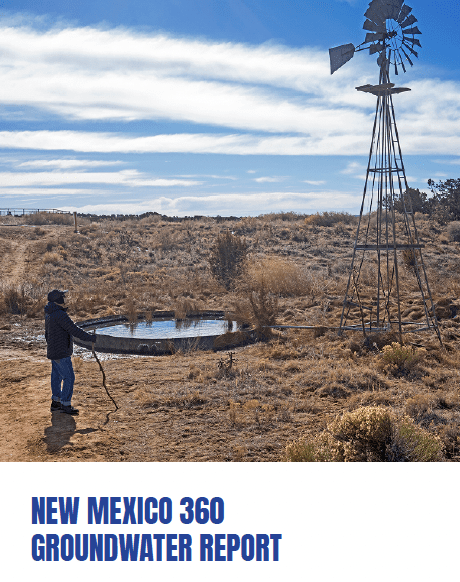
The January 2026 New Mexico 360 Groundwater Report, published by the New Mexico Groundwater Alliance, makes clear that the State Engineer already has legal authority to preserve groundwater supplies by limiting pumping. That authority includes conditioning, limiting, or denying groundwater permits; regulating pumping in fully appropriated and mined basins; requiring metering and reporting; and managing groundwater pumping to protect connected surface waters and meet interstate compact obligations.
The regional water security planning program, unanimously authorized by the 2023 Legislature, has yet to gain traction through formally adopted rules. The Interstate Stream Commission will promulgate the rules and must then issue guidelines. After that, it can make state funding grants to regions, which must form regional councils to organize themselves to oversee preparation of their region’s plan. Plans won’t be drafted, approved by the councils and subsequently by the ISC, and funded for implementation for many years. This makes the promise of water planning an insufficient basis for delaying near-term groundwater governance, given that aquifers are already being drained by agricultural pumping to the detriment of communities.
The Real Bottleneck: Chronic Governance Incapacity
New Mexico’s experience demonstrates that groundwater can be managed effectively when the State or local institutions choose to do so—but that such management has been applied unevenly, episodically, and without being institutionalized statewide. Almost all groundwater management has been reactive to crises. For example:
Pecos Valley Artesian Conservancy District – The clearest example of long-standing active groundwater management is the Pecos Valley Artesian Conservancy District (PVACD), created in 1932 in response to catastrophic loss of artesian pressure in the Pecos Valley around Roswell and Artesia. There, groundwater use has been actively regulated for decades to prevent collapse of the aquifer system. That experience shows that sustained groundwater governance is possible in New Mexico when depletion is undeniable and consequences are unavoidable.
Pecos River – Pecos River water management now seems routine, but it has been difficult, costly to taxpayers, and entirely reactive. Farmers went to jail for sabotaging the operation of water meters required by court order. New Mexico lost a Texas lawsuit in the U.S. Supreme Court and is now subject to a Pecos River Compact 1987 Amended Decree that it came extremely close to violating annually for more than a decade. A State-driven collaboratively developed solution became state law in 2001. It required arrangements to get more water through the last dam in New Mexico and pause farming on productive farmland in the Carlsbad Irrigation District and the PVACD. It succeeded, but increasing water scarcity driven by global warming may require action beyond the settlement.
Lower Rio Grande – A second form of groundwater management is now emerging in the Lower Rio Grande as a result of a 2013 Texas lawsuit before the U.S. Supreme Court. The pending Consent Decree and Settlement agreements focus squarely on New Mexico’s groundwater pumping from the irrigated valley floor’s alluvial aquifer, which is well connected to the Rio Grande. The Settlement requires that the State of New Mexico maintain groundwater levels adjacent to and beneath the river high enough to prevent the portion of the river’s flow legally allocated to Texas and the United States from instead sinking into the New Mexico riverbed. The State must meet mandatory downstream delivery obligations under tight compliance deadlines.
Notably, drinking water purveyors (community water utilities) depend on rights that the state water rights adjudication court has determined are junior to the irrigators’ 1903 priority rights to a full supply, whether from the river or groundwater. In recent years, the New Mexico share of Caballo Dam releases has not enough to satisfy the irrigators’ senior rights to a full supply. The State Engineer will be compelled to administer water in the Lower Rio Grande to prevent illegal underdelivery of water to El Paso as required by the Settlement.
Middle Rio Grande – The Middle Rio Grande presents an even more complex picture. The Albuquerque Bernalillo County Water Utility Authority proactively prevented a groundwater-overdraft disaster from the excellent aquifer it’s built over. The solution was implementing direct use of its imported surface-water rights. Groundwater levels underneath Albuquerque partially recovered and stabilized, stopping the risk of aquifer compaction that would cause differential subsidence across faults that traverse the city. Albuquerque’s achievement matters—and it contradicts the notion that New Mexico acts only after collapse.
This was a local utility response, not basin-wide governance. Conjunctive-use benefits projected in the Authority’s 100-year plan have not materialized as assumed. The volume of available surface water treated and delivered to customers is far below the plan’s assumptions. Current Middle Rio Grande surface and groundwater uses will cause a new Rio Grande Compact violation in two to three years, while the ABCWUA says publicly it will supply new high-water use industry that the State and the City of Albuquerque are recruiting. The effective ABCWUA position is that it is preferable to be upstream with junior deep wells than downstream with senior surface water rights. Santa Fe also implemented a direct river diversion for drinking water, but its motivation was to prevent running out of water. Los Lunas has been and is recruiting high water use industry to fully use their water rights, and now seeks to transfer additional water rights that may be legally abandoned into their wells. Former State Engineer Mike Hamman clearly recognized the necessity of basin-scale conjunctive management in the Middle Rio Grande, but several years later, no progress is apparent.
Taken together, these examples show that New Mexico’s groundwater management successes are isolated, situational, and non-systemic. The problem is not scientific uncertainty, lack of authority, or technical infeasibility. The problem is the failure to institutionalize groundwater governance before crisis, litigation, or compulsion makes inaction untenable.
The State’s Water Resources Management Imperatives
New Mexico’s groundwater crisis is not the result of scientific uncertainty or the absence of legal authority. It is the result of governance failure—decisions by elected and appointed leaders to defer action even as the consequences become unavoidable.
The scientific paper by Richter et al. reinforces what has been understood for decades: aquifers are finite, groundwater depletion is measurable, and continued overpumping leads to permanent losses of water supply, water quality, and economic security. These are physical limits. They do not yield to delay, political convenience, or administrative caution.
New Mexico already has the legal authority to manage groundwater use. Under existing law, the State Engineer can condition, limit, or deny groundwater permits; regulate pumping in fully appropriated and mined basins; require metering and reporting; and manage groundwater pumping to protect connected surface waters and interstate compact obligations. No new statutory authority is required to begin managing groundwater based on aquifer conditions.
Gaps in aquifer characterization and monitoring remain real and must be addressed. But neither the science nor the law supports using those gaps as an excuse to postpone management. Data development and management must proceed together. Waiting for perfect information while aquifers decline only increases costs and reduces or eliminates future options.
Despite this, New Mexico continues to rely on administration that is largely disconnected from aquifer conditions. Groundwater permits are issued and administered without enforceable limits tied to aquifer longevity, even where declines are severe and well documented. Outside the one managed basin, groundwater governance remains the exception rather than the rule.
What Is at Stake—and Who Is Responsible
New Mexico’s groundwater crisis persists not because the State lacks financial resources, but because the Legislature has repeatedly chosen not to appropriate them at the scale required. The legal authority to manage groundwater exists. What is missing is the sustained investment needed to build and maintain the institutional capacity to use that authority effectively.
Across state government, funding for water resources planning, groundwater science, monitoring, enforcement, and long-term management remains inadequate. Agencies are expected to address widespread aquifer depletion with fragmented data systems, insufficient staffing, and short-term appropriations that fall far short of the problem’s scope. This chronic underfunding ensures continued incapacity, regardless of statutory authority.
That incapacity is not accidental. It reflects legislative choices. Year after year, the Governor recommends and the House and Senate Finance Committees set budgets that do not provide the resources necessary for groundwater management.
More fundamentally, New Mexico has not been willing to explicitly acknowledge groundwater management as a core governing responsibility that requires a defined program and durable capacity. Without naming groundwater management as a priority, the Legislature avoids the obligation to fund it, and agencies are left unable to deliver it.
The consequences of this failure are already visible. Households are hauling water because wells have gone dry. Communities dependent on groundwater face rising costs, declining water quality, and increasing long-term risk. New Mexico has many ghost towns—once viable communities that declined when the resources they depended on were exhausted. Groundwater-dependent communities face the same risk if groundwater depletion for irrigation continues unchecked.
Preventing that outcome is a matter of choice. The constraint is not science, not legal authority, and not the absence of money. It is the absence of political will to name groundwater management as a governing responsibility—and to fund the capacity required to carry it out. New Mexico’s future requires top elected and appointed officials to name and describe our groundwater sustainability crises, face the sacrifices required to increase groundwater longevity, and build the state institutional capacity needed to confront and solve those crises.
[i] Office of the State Engineer / Interstate Stream Commission, 2020 Water Use by Categories, summarized at mainstreamnm.org , “How data can inspire action: A closer look at the Water Use by Categories report” (Jan. 2025). The report estimates approximately 2.97 million acre-feet of withdrawals for irrigated agriculture out of roughly 3.81 million acre-feet of total statewide withdrawals in 2020 (≈ 78 percent). Irrigation withdrawals are not directly metered in most areas and are estimated using crop acreage, irrigation requirements, and other standard water-use accounting methods. The report presents withdrawals, not consumptive use.
[ii] The Bureau of Geology requested $29 million for this year and the next two to initiate their planned $175 million aquifer characterization plan, but the Governor, the House Appropriations and Finance Committee, and the Senate Finance Committee successively reduced their appropriation to $7.5 million. The Bureau may receive a $22.5 million budget this year, having demonstrated strong performance.
New Mexico’s Groundwater Reality and the Urgent Need for Action
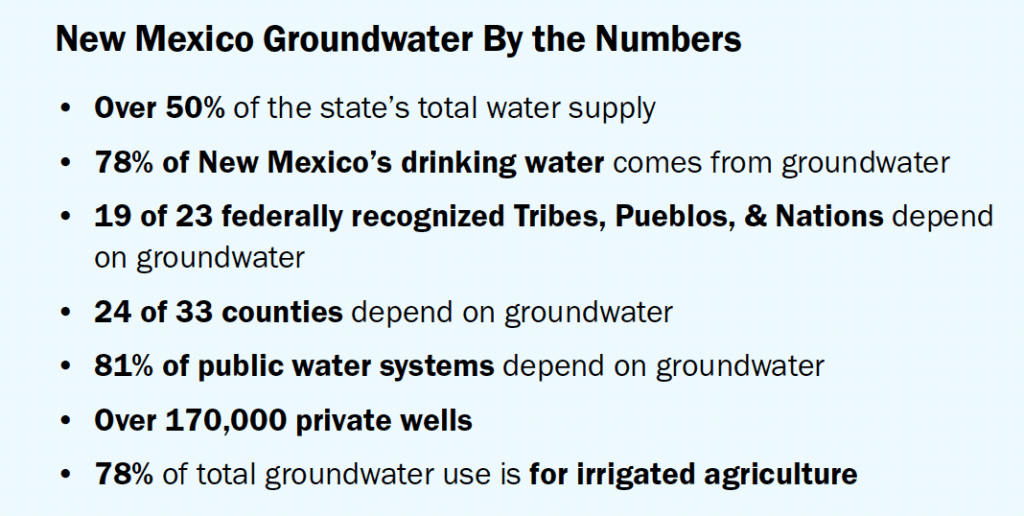
Groundwater is the backbone of New Mexico’s water supply. It provides more than half of all water used statewide, supplies drinking water for most communities, and sustains agriculture, industry, and ecosystems across large areas of the state. Yet in many regions, groundwater pumping has vastly exceeded natural recharge. Climate change is intensifying the risks.
The January 2026 New Mexico 360 Groundwater Reportoffers the most comprehensive, statewide synthesis to date of New Mexico’s groundwater conditions, management tools, and future challenges. Prepared by the New Mexico Groundwater Alliance with contributions from scientists, legal experts, and water managers, the report integrates data, experience, and case studies to make sound recommendations.
The authors document a clear and troubling trend: as surface-water supplies decline due to warming temperatures and prolonged drought, dependence on groundwater is increasing. In many New Mexico basins, withdrawals vastly exceed recharge year after year, resulting in falling groundwater levels, higher pumping costs, and degraded water quality. Excessive pumping from aquifers interconnected with rivers depletes the rivers and interferes with meeting interstate compact obligations. The authors also identify persistent data and governance gaps—limited metering, uneven monitoring, and incomplete aquifer characterization.
The report identifies serious gaps in aquifer characterization and monitoring that must be addressed to support durable groundwater management. It does not suggest waiting to act; it underscores that continued inaction—under the guise of needing more data—will only accelerate depletion and foreclose future options.
Practical Steps New Mexico Must Implement
The report does not stop at diagnosis. It identifies practical, New Mexico–specific pathways forward. The authors present case studies from the Pecos Valley, the Lower Rio Grande, the Southern High Plains, and other regions to demonstrate that locally driven groundwater management—when supported by state policy, reliable data, and sustained investment—can slow depletion and improve long-term resilience. The report emphasizes treating aquifers as critical infrastructure that provides irreplaceable services to water users. The report urges accelerating aquifer mapping and monitoring, expanding groundwater metering, and fully integrating groundwater into regional water security planning.
These findings are directly relevant to decisions now facing New Mexico policymakers, water managers, and communities, including implementing the 2023 Water Security Planning Act and confronting unanswered needs for groundwater governance and enforcement.
A Water Advocates Perspective
New Mexico still lacks aquifer-based limits on groundwater depletion. The report points out that the State Engineer has the authority, but has not acted. At the 2023 Water Leaders Conference, a state legislator asked a basic question: does the State Engineer manage groundwater pumping based on how much water remains in an aquifer, or the rate at which it is declining? The panelists didn’t provide the factual answer, which is neither of those.
New Mexico water law and State Engineer permits allow pumping up to the paper right regardless of aquifer condition, even where declines are severe and well-documented, as the Clovis and Portales groundwater supply crisis demonstrates,
True management of New Mexico groundwater resources for longevity and security does not exist, except for one New Mexico artesian aquifer where pumping is controlled by the Pecos Valley Artesian Conservancy District. The District, managed by a report co-author, was initially created by a Roswell district judge’s order in January 1932. That’s because the impacts of uncontrolled uses were quite obvious. Non-artesian aquifers impacts of uncontrolled uses are generally not observed until wells run dry.
The growing number of New Mexico households hauling water because their wells have gone dry is direct evidence that aquifers are being depleted. Last fall, a Clovis-area irrigator—who is also an elected state legislator and a member of the Water and Natural Resources Committee—informed the committee that he has invested in new technology. He stated that its purpose is to fully exhaust the groundwater beneath his land.
How Other Western States Are Managing Their Groundwater
The New Mexico Groundwater Alliance news release included a supplemental document reviewing the groundwater management frameworks of other Western states. While none has solved groundwater depletion everywhere, many have established recognizable systems—defined basin goals, monitoring tied to aquifer conditions, enforceable limits, and clear triggers for action when withdrawals exceed supply.
New Mexico has not. This absence is reinforced by current budget decisions. The State Engineer’s FY27 special appropriations and program expansion requests focus on compact compliance, settlements, and enforcement, but the word groundwater or any description of the need for groundwater programs does not appear.
Preregister to Hear From the Report’s Principal Author
At 6:30 pm on February 19, Santa Fe native Gretel Follingstad, Ph.D., the report’s principal author and an outstanding presenter, will discuss what the data show, what remains uncertain, and what New Mexico must do next to address the ever-worsening groundwater crisis. The disconnect between hydrologic reality and administration is precisely why this report matters—and why this presentation should not be missed.
The State’s choices are not serving New Mexico’s water future. Continuing to allow groundwater to be mined until it is gone will end poorly—for communities, local economies, and the State.
As the new year begins, New Mexico’s water challenges are clear, but the State’s responses remain unsettled. The questions now confronting New Mexico are not about whether scarcity exists or whether legal authority is lacking, but about how effectively decisions are being made and why all meaningful discussions to tackle the problems are occurring behind closed doors. Year-end Rio Grande Compact compliance, the implementation of recent state water laws, agency priorities and capacity, and the Governor’s and Legislative Finance Committee’s budget choices together frame the current state of the State’s water—and the water governance choices now facing New Mexico.
New Mexico has the legal tools, but has not mustered the political will or built the management systems to stop excessive and illegal water uses. That will change. The consequences of continued neglect are unbearable.
I. Rio Grande Compact Compliance Emergencies as Indicators
Water uses in the Middle Rio Grande have consistently over-depleted the Middle Rio Grande’s share, shorting the Lower Rio Grande. Similarly, excessive water uses in New Mexico downstream of Elephant Butte Dam are shorting Texas. Both situations have persisted for many years and are now entangled but distinct emergencies.
Our State is required by the Lower Rio Grande settlement and consent decree now pending U.S. Supreme Court approval to,
substantially reduce New Mexico groundwater pumping,
maintain a sufficiently high groundwater table that the river can function, and
comply with a new annual water delivery requirement to El Paso.
Meeting the new mandatory compliance requirements will be very expensive and demanding. Penalties built into the pending settlement remove noncompliance as an option.
Separately, chronic overuse of water in the Middle Rio Grande has caused New Mexico’s water delivery debt to Elephant Butte Reservoir to increase from a net credit in 2018 to -131,900 acre-feet at the end of 2025. [This preliminary result is from the Bureau of Reclamation. The official result will be determined by the Rio Grande Compact Commission this spring.] New Mexico will violate the Rio Grande Compact if New Mexico allows the cumulative water delivery debt to reach 200,000 acre-feet. Texas, being Texas, will sue, as is their custom, culture, and tradition.
The author’s recent public records requests reveal recent private meetings between the agencies and the two major state-created water purveyors in the Middle Rio Grande. The progress at this time is apparently limited to initial discussions of the participants positions.
Both compact problems reflect that New Mexico’s water management institutions are not doing their jobs to regulate illegal water overuse. The results of this neglect are:
huge taxpayer burdens,
legal jeopardy for the State,
danger for water users, and
disregard for the river and species who depend on it.
The State Engineer and the Interstate Stream Commission are not prepared and don’t have the capacity or budget to deal with either Compact compliance emergency.
II. Legal Authority Is Not the Limiting Factor
The Legislature passed a new water law in 2003 that had been drafted and proposed by the NM Attorney General. The Governor signed it. It declares,
[T]he adjudication process is slow, the need for water administration is urgent, compliance with interstate compacts is imperative and the state engineer has authority to administer water allocations in accordance with the water right priorities recorded with or declared or otherwise available to the state engineer. Section 72-2-9.1 NMSA 1978.
In 2004, State Engineer John D’Antonio put rules in place to implement this new law. Following eight years of litigation, the New Mexico Supreme Court in 2012 unanimously upheld these rules. None of the five State Engineers that have held that office since 2012 has implemented the Active Water Resources Management program created by these rules. The fact of having five State Engineers in office since 2012 is part of the problem.
CENTER-PIVOT IRRIGATION CURRY COUNTY RANCH, NOW ABANDONED – PHOTO CREDIT DANNY FISH
Similarly, the 2019 Water Data Act, the 2023 Water Security Planning Act, and the 2006 Aquifer Mapping Program have languished. The Office of the State Engineer over decades has allowed virtually complete depletion of the Ogallala Aquifer in New Mexico for irrigation, leaving New Mexico communities that depend solely on that aquifer in jeopardy. Similar outcomes are in progress elsewhere across New Mexico.
Although inadequate funding and capacity are a big part of the problem, other overarching reasons include the Governor’s and Legislature’s lack of political will to see the State’s water is effectively managed as an essential scarce resource. We don’t even measure water uses, much less manage them. The management and culture of the agencies is a problem also. Their actions are tentative and cautious. They are slow to make decisions, take initiative, and effectively manage projects to timely completion.
III. Agency Capacity: Signs of Progress and Persistent Gaps
The New Mexico Bureau of Geology is our water science agency. Its scientists do first class work. They hit the ground running this fiscal year, utilizing a $7.5 million appropriation this year (the Governor recommended $29 million) to accelerate the Aquifer Mapping Program. Their progress report and budget needs presentation to the Legislature in November included a detailed briefing on the high-tech groundwater assessment technology and work already completed.
In contrast, the Interstate Stream Commission has not yet put required rules in place to implement the 2023 Water Security Planning Act. Those rules will become effective more than three years after this landmark law passed unanimously. The Office of the State Engineer desperately needs to begin enforcing against illegal water use, and modernizing its business processes and its obsolete information technology.
The OSE didn’t even request funding from the 2026 Legislature to continue building a new real-time water use data and reporting system that the 2025 Legislature funded at one-sixth of the OSE’s requested amount. Control of ruinous groundwater depletion like the Ogallala in other locations that depend on fossil groundwater doesn’t appear to be a priority. A Clovis area legislator and irrigator said technology now allows essentially all the water to be extracted. He said he is doing exactly that.
IV. Budgets as the State’s Policy Signal
State budgets are choices, not merely accounting. The OSE/ISC requested $130 million in extraordinary appropriations and six new positions for FY27. The Governor’s budget recommendation included most of the $130 million but not the new positions. The Legislative Finance Committee’s water resources management budget recommendation is unresponsive to the crises. Why do the State’s top elected leaders pass good laws unanimously but choose not to see them implemented?
V. 2026 Is a Test
The year ahead will determine:
Whether authority is exercised,
Whether transparency improves,
Whether elected state leaders equip the water agencies to manage scarcity, and
How well and responsively the agencies’ appointed leaders will manage their agencies’ work.
New Mexico’s water crises are certain. Whether the State responds effectively remains the open question.
1/12/25 – 2/5/26 from Carlsbad, NM to the State Capitol in Santa Fe, NM on Climate Action Day – 320 miles, 12,425 ft./elevation, 25 days
This Sacred & Moral Pilgrimage is an offering of bodies & feet of 3 Interfaith Power & Light (IPL) Leaders who will walk 7-9 miles a day to witness communities who suffer from effects of fossil fuel extraction through polluted air and water. The pilgrims will be fueled by the prayers and voices of many New Mexicans calling for a livable & sustainable climate for all New Mexicans now & in the future. You can follow their progress at https://www.nm-ipl.org .
This trek echoes that of the father of George Munoz, Chair of the NM Senate Finance Committee, who walked to the Capitol in 1989. As mayor of Gallup, he was furious that his concerns about addiction in his beloved community were not being addressed. Now George Munoz, his son, has not taken seriously the concerns of New Mexican communities who need healthier air, land & waters. Walking this path is a call to address needs of New Mexicans living with extraction caused air & water pollution health problems, as well as water shortages.
The IPL pilgrims, honoring centuries of spiritual earth stewardship by NM Native & Hispanic ancestors, walk now to uplift the urgent need for a livable climate and a flourishing future all New Mexicans. As they walk, they will be wrapped in prayers of many, confessing through faith, complicity in greed, waste, exploitation & extraction of their Creator’s Earth. They walk, hoping we, the public & lawmakers, will acknowledge & understand the interdependent nature of our lives within all Creation. They pray that this will guide us in repairing & healing Earth’s wounds to support resiliency of all life of Earth’s creatures, plants, waters, land, & air .
Goals of this pilgrimage are to:
to secure a stable climate and livable future for all,
act boldly for a just transition from fossil fuels to cleaner energy,
hold industry accountable for pollution & waste, &
This pilgrimage is both confessional & prophetic; a call to act with courage, integrity & love for our shared home. It is a journey of hope, learning & work as a community, & witnessing a more just & sustainable future taking root.
The focus of this call to action for legislators is to join with climate coalition advocates in supporting the 2026 Clear Horizons Act to codify NM’s ambitious greenhouse gas reduction targets into law; establish a Community Benefit Fund for climate investments; & create an Innovation in Government Act for climate solutions.
NM/El Paso Interfaith Power & Light invites all New Mexicans & legislators to follow their pilgrimage in the Event Section of their website for details and registration for events. All are invited to join in the dinner at the start of their pilgrimage at United Methodist Church in Carlsbad and later with different stages of their journey’s end to the point of arrival at the NM State Capitol on Climate Change Day, where there will be tabling and speeches in the Rotunda of the NM Roundhouse.
Introduction: Scope of the Series and Purpose of This Article
The first article in this series of three provides a very brief review and summary from John Vaillant’s book Fire Weather, a 2024 Pulitzer Prize finalist.[1] Vaillant, a Canadian journalist, documents the evolving history of our knowledge linking emissions of greenhouse gases, particularly carbon dioxide (CO2), to climate warming and climate change. We summarized the scientific research that Vaillant presents in chapter 19, its resulting findings, and conclusions.[2]
This second article describes how the United States has reacted to that science, from teaching it to turning its back. The third article will address the morality and ethics of continued greenhouse gas emissions and New Mexico’s responses to increasing aridification.
Fire Weather also is the anchor for this second of three articles. Vailant’s book describes how popular publications reported on the science of climate change and how the politics and fossil fuel industries positions shifted. Popular publications including the New York Times, Washington Post, Life, American Scientist, and others in the 1950s began to report the linkage between fossil fuel emissions and climate. Stories addressed Guy Callendar’s 1938 publication, The Artificial Production of Carbon Dioxide and Its Influence on Climate, and Gilbert Plass’ use of infrared spectroscopy to first challenge and then to reconfirm in 1958 that the Earth’s long-wave, infrared radiation of heat to space is retained by atmospheric water vapor and industrial CO2 emissions. This work was further developed in other researchers’ publications.
Early Political Support for Climate Science: The International Geophysical Year (1956–1958)
Fire Weather describes that Roger Revelle, the director of Scripps Institution of Oceanography, testified before the Republican-dominated U.S. House Committee on Appropriations in March 1956 and again in May 1957 regarding research findings and funding needs required for each year’s upcoming work under the International Geophysical Year (IGY). The work sought data about “anything remotely measurable – from the most ancient glacial ice to the most ephemeral atmospheric gases.”
Vaillant quotes part of Revelle’s 1956 statement, “Human beings during the next few decades may, almost in spite of themselves, be doing something that will have a major effect on the climate of the earth … I refer to the combustion of coal, oil, and natural gas by our worldwide civilization, which adds carbon dioxide to the atmosphere … we are carrying out a tremendous geophysical experiment … If all of this carbon dioxide stays in the atmosphere, it will certainly affect the climate of the earth and this may be a very large effect.” Vaillant describes in considerable detail the committee discussions that occurred each year between Revelle and both conservative and liberal committee members. Congress provided the funding requested annually for both year’s work. Vaillant’s discussion concludes that in the time since those hearings, “annual CO2 emissions have increased fivefold from their already-climate-altering 1950s levels.”
Growing Public and Political Recognition of Climate Risk (1950s–Early 1960s)
Vaillant reports in chapter 20 that general and widespread recognition of the growing threats from greenhouse gas emissions and climate warming, both public and political, started during the 1950s. For example, in the early 1960s a series of films was shown in schools to educate children on how CO2 buildup in the atmosphere was causing climate warming. Frank Capra produced the films. Bell Telephone (AT&T) funded them.
Vaillant tells a story suggesting that Edward Teller, known as the “father of the hydrogen bomb,” may also have started the awareness of powerful oilmen and their supporters that the link between their products and global warming would threaten their business and investor earnings. Teller, speaking at a 1959 American Petroleum Institute (API) sponsored symposium, raised his concern regarding the continuing atmospheric release of CO2 and its interaction with solar radiation to cause atmospheric warming. He stated, “a temperature rise corresponding to a ten percent increase in carbon dioxide will be sufficient to melt ice caps and submerge New York. All the coastal cities will be covered … I think that this … is more serious than most people tend to believe.” Vaillant suggests this statement likely caused many of the 300 participants to begin to see climate science as a challenge to their profitability.
Industry Confirmation of Climate Risk and Internal Assessment (1965–Early 1980s)
Every Year Ends Higher Than It Started, CC BY-NC 4.0, Courtesy of sketchplanations
A 1965 report from President Johnson’s scientific advisory committee showed the Keeling Curve (as described near the end of the first article) to be steepening. Vaillant quotes that report: “By the year 2000 the increase in atmospheric CO2 … will almost certainly cause significant changes in the temperature and other properties of the atmosphere.”
Vaillant suggests that report caused the fossil-fuel industry to begin assessing such potential effects independently. This led the president of Bituminous Coal Research to release a 1965 report stating, “There is evidence that the amount of carbon dioxide in the earth’s atmosphere is increasing rapidly as a result of the combustion of fossil fuels. … Such changes in temperature will cause melting of the polar ice caps, which, in turn, would result in the inundation of many coastal cities, including New York and London.”
In 1966 the American Petroleum Institute contracted with the Stanford Research Institute for a scientific study of this relationship. That study concluded, “Significant temperature changes are almost certainly to occur by the year 2000” and that the industry must prioritize management of their emissions. Vaillant says the fossil-fuels industry response was to prioritize corporate and stockholder profits.
Vaillant reports that in 1979 Switzerland hosted the first World Climate Conference to “foresee and prevent potential man-made changes in climate that may be adverse to the well-being of humanity.” Leading to that conference, the American Petroleum Institute, Exxon, and most other major oil companies had established a collaborative and objective research team, which included federal scientists, called the CO2 and Climate Task Force. Hundreds of significant research publications resulted on essentially all aspects of the identified relationships and their potential effects.
These findings caused the New York Times to publish in all capital letters, “STUDY FINDS WARMING TREND THAT COULD RAISE SEA LEVELS.” A graph released by Exxon in 1982 showed that the adverse atmospheric warming effects from climate change would become obvious in the 1990s. Vaillant notes that, in fact, climate warming had started to produce noticeable material damages sufficient to cause major insurance companies to start attending global-warming meetings in the early 1980s.
Industry Reversal and the Rise of Organized Climate Science Denial (Mid-1980s–1990s)
In 1984, as scientific research and scientific consensus on the CO2 emissions effects mounted, Vaillant says the American Petroleum Institute and major fossil-fuel industry companies started to consider a need to re-evaluate and turn back their position on CO2 driving climate warming. The American Petroleum Institute, Exxon, and the other major oil companies disbanded their collaborative CO2-climate research group. This was in the days of Ronald Reagan, James Watt, and the Moral Majority, who Vaillant states were suspicious of science in general.
Vaillant’s story continues with NASA’s James Hansen presenting his 1988 testimony to Congress. Hansen plainly stated that climate change poses a clear and present danger to the planet and humanity. His conclusions were based on a hundred years of study and hundreds of recent publications. Subsequently, the term “global warming” appeared for the first time in a New York Times headline. The Intergovernmental Panel on Climate Change (IPCC) was created to coordinate international research and conclusions.
In this context, the American Association of Manufacturers, the API, Exxon, and other fossil fuel industry giants founded the deceptively named Global Climate Coalition (GCC) in 1988 to lobby against controls on behalf of fossil fuel producers and major users. Their loud public work sought to cast doubt on climate science and discredit James Hansen and other climate scientists as alarmists. Conservative attitudes about emissions-driven climate change turned had decidedly negative by the early 1990s.
International Climate Governance With Growing Industry Influence (2015–2023)
The United Nations Climate Change Conference (COP21) convened Paris, France, to negotiate the 2015 Paris Agreement.[3] It covers climate change mitigation, adaptation, and finance. The United States signed it on Earth Day, 2016. This treaty adopts a long-term goal to keep the rise in global surface temperature “well below 2°C above pre-industrial levels and pursuing efforts to limit the temperature increase to 1.5°C above pre-industrial levels.”
Vaillant reported the 24th Conference of the Parties to the United Nations Framework Convention on Climate Change (COP24) held during 2018 in Katowice, Poland, included nearly 1,800 fossil fuel industrial lobbyists, who worked against global interests, including efforts to secure financial support to low-income nations in efforts to transition to clean energy.[4] Five years later, Dubai hosted COP28, attended by 2,456 fossil fuels folks.[5]
U.S. Political Withdrawal from Climate Agreements and Institutions (2017–2026)
On June 1, 2017, President Trump announced the United States’ withdrawal from the Paris Agreement, but honored the three-year notice requirement. President Biden reinstated the United States’ participation in 2021. President Trump on January 20, 2025, cancelled the United States’ participation without advance notice.
In a January 6, 2026, social media post, the White House informed the nation that the President was ending the United States’ participation in the United Nations’ bedrock climate change mitigation treaty signed 34 years ago by all the countries of the earth. The United States is the first to renounce this world-wide agreement.
This article traces a clear historical record: climate warming science development of clear conclusions and warnings identified early, confirmed repeatedly, publicly communicated, and understood by political leaders and the fossil-fuel industry decades before organized opposition and denial took hold. The resulting delay has shaped today’s climate risks, governance failures, and policy conflicts—across the world and where we live.
The third and final article in this series turns from history to consequences and responsibility. It will examine how climate warming is reducing New Mexico’s water resources and how climate-induced renewable water supply reductions will constrain future water uses in our arid state. It will also address the moral and ethical dimensions of greenhouse gas emissions—who is put at risk and how the burdens will fall on bears on communities and future generations of New Mexicans.
Finally, this concluding article will outline a path forward for New Mexico and New Mexicans: one grounded in science, water realities, institutional accountability, and informed public choice. The purpose is to apply this information to decisions our elected leaders must make about water, energy, and stewardship in a warming climate.
End Notes
[1] Vaillant, John. 2023. Fire Weather. Alfred A. Knopf. 414 pp.
What a Winter Rio Chama Release Reveals About the Middle Rio Grande
Background: Why the Water Was Stored
Last spring, state and federal water agencies stored approximately 34,000 acre-feet of Rio Chama water to assure a full supply for the six Middle Rio Grande Pueblos’ prior and paramount water rights. Less than 5,000 acre-feet was ultimately used by the Pueblos, about 2,000 acre-feet was lost to evaporation over the storage period, and roughly 26,000 acre-feet remained in storage at the start of winter.
That remaining water was released this month in a planned winter block release.
The Release and River Operations
The release originated at Abiquiu Dam and appears clearly in the Cochiti Dam release as rapid step increases in flow, a sustained six-day release of approximately 1,400 cubic feet per second (cfs), and a more gradual step-down when the release ended. The Rio Chama release flowed into the Rio Grande upstream of Cochiti Reservoir, where Cochiti Dam operations reflected the combined inflows. Cochiti Dam released 2,000 cfs for six days, also. This was by far the highest flow since 2023.
USGS gage data provide a clear picture of the timing and shape of this release as it entered and traversed the Middle Rio Grande system.¹
What these Hydrographs Show
As the pulse moved downstream, it weakened, spread out, and arrived later at each successive river gage below Cochiti Dam. By the time it reached Elephant Butte Narrows, only a small fraction of the released water remained in the river channel.
This behavior is consistent with a river that is hydraulically well-connected to heavily pumped tributary aquifers and dried over extensive distances and durations during the record dryness of early- and mid-2025. Large volumes of groundwater were pumped this past summer by municipal supply wells, domestic wells in and near the floodplain, agricultural wells, and phreatophytic riparian vegetation. Together, those large uses lowered groundwater levels in both the shallow river alluvium and the deeper aquifers beneath metropolitan Albuquerque.
As the surface water of the Cochiti Dam block release moved downstream, increasing portions of the swollen river flow left the river channel. Driven by gravity, it seeped through the river’s bed and banks to recharge the connected but depleted shallow aquifer storage space. The gaps between adjacent upstream and downstream gages illustrate these losses, accumulating reach by reach.²
Why This Winter Releases Is Revealing
Winter conditions make this behavior easier to observe. Irrigation diversions are absent, riparian vegetation is largely dormant, and evaporation from the river surface is small. Under these conditions, losses observed between gages have no plausible destinations other than groundwater recharge and temporary bank storage.
The hydrographs also show delay. Peaks arrive days later downstream, and in some cases downstream flows briefly exceed the contemporaneous Cochiti Dam release. This reflects travel time and temporary storage in the river channel and adjacent aquifers, not the appearance of new inflow.³
What Counts for Compact Accounting
Only water that actually reaches Elephant Butte Reservoir and increases the net volume stored or released from there counts toward New Mexico’s water delivery obligations under the Rio Grande Compact. Compact deliveries are accounted as the sum of the net annual change in Elephant Butte storage and total annual releases from Elephant Butte Dam . Daily reservoir storage volume data needed to complete that calculation are not currently available online so this analysis relies on the reservoir inflow measurement instead. Official accounting results will be available only after the federal agencies approve their provisional data and the Rio Grande Compact Commission approves the accounting. Official results are expected in early spring 2026.⁴
In the meantime, Middle Rio Grande delivery debt continues to accumulate. At the real-time flows shown in the graphic above, today’s under-delivery is approximately 90 acre-feet.
End Notes and Disclaimers
¹ Data limitations. USGS streamflow data are provisional. Several gage locations on the Middle Rio Grande present difficult hydraulic and sediment conditions that limit measurement accuracy and precision. All observations and interpretations presented here should remain roughly accurate as the provisional data are reviewed and finalized. The author’s judgment is that the data set is internally consistent, which supports confidence in this early interpretation.
² Attribution of losses. Attribution of observed surface-water losses to groundwater recharge is based on hydrologic inference, system behavior, and the absence of significant winter surface-water diversions. This analysis does not represent a quantified groundwater balance or a formal causal determination.
³ Delay and return flows. Some delayed return of water from bank storage or groundwater back to the river may occur over time. The timing and magnitude of any such return cannot be determined from the available data. In any case, unless it adds measurably to the volume of water in Elephant Butte Reservoir this year, it won’t be counted in 2025.
⁴ Compact accounting. Daily or interim delivery estimates reflect the author’s qualifications. Those estimates are published here for timely science- and data-driver reporting to the NM Water Advocates readers. Official results are determined annually and are subject to Commission approval, usually in late March each year.



 Committee Chair George Muñoz


 The study authors’ basin-wide accounting of water use in the Rio Grande–Bravo Basin concludes that more than half (about 52 %) of all water consumed in the basin is unsustainable, meaning it is withdrawn faster than it can be replenished. The study finds that irrigated agriculture accounts for roughly 87 % of all direct consumptive water use, making it by far the dominant driver of depletion. Within that agricultural use, forage crops grown primarily for livestock feed—especially alfalfa and other hays—account for approximately half of total agricultural consumption, far exceeding the water use of food crops for direct human consumption. This pattern of

 Water uses in the Middle Rio Grande have consistently over-depleted the Middle Rio Grande’s share, shorting the Lower Rio Grande. Similarly, excessive water uses in New Mexico downstream of Elephant Butte Dam are shorting Texas. Both situations have persisted for many years and are now entangled but distinct emergencies.


 This trek echoes that of the father of George Munoz, Chair of the NM Senate Finance Committee, who walked to the Capitol in 1989. As mayor of Gallup, he was furious that his concerns about addiction in his beloved community were not being addressed. Now George Munoz, his son, has not taken seriously the concerns of New Mexican communities who need healthier air, land & waters. Walking this path is a call to address needs of New Mexicans living with extraction caused air & water pollution health problems, as well as water shortages.


 Vaillant’s story continues with NASA’s James Hansen presenting his 1988 testimony to Congress. Hansen plainly stated that climate change poses a clear and present danger to the planet and humanity. His conclusions were based on a hundred years of study and hundreds of recent publications. Subsequently, the term “global warming” appeared for the first time in a New York Times headline. The Intergovernmental Panel on Climate Change (IPCC) was created to coordinate international research and conclusions.


