At winter’s end early this year, the snowpack was low; the spring runoff forecast was dismal. Two federal agencies, the Bureau of Indian Affairs and the Bureau of Reclamation, stored all the native Rio Chama runoff in El Vado and Abiquiu to ensure a full supply for the six Middle Rio Grande Pueblos prior and paramount water rights. Of the approximately 34,000 acre-feet of water stored, 13% was used and 5% evaporated. Winter arrived again with 26,000 acre-feet remaining in storage.
Federal and state water agencies planned the release of this water. This article summarizes the fate of the release as the water flowed downstream.
A block release of the remaining 26,000 acre-feet of stored water began November 30. Water agencies intended that it flow unused into Elephant Butte Reservoir to reduce this year’s large underdelivery of the water that belongs to water users below Elephant Butte Dam. As of November 24, 2025, the Rio Grande Compact accounting model showed New Mexico’s deliveries were about 39,000 acre-feet short of the delivery obligation.
The hydrographs below show vividly what happens when water is poured down losing reaches of a river. We hope the OSE and ISC will collect a complete data set of this event, analyze it, and report their technical analysis and full data set.
Superimposed USGS hydrographs_Rio Chama winter block release. NM Water Advocates graphic
Let This Set of Hydrographs Tell Their Story
Let’s start with a summary of the MRG geography.. The Cochiti Dam releases drive the downstream responses, as the hydrographs above illustrate. The step increases in Cochiti Dam releases are in response to Abiquiu Dam releases to the Rio Chama upstream. The Abiquiu Dam releases flowed down the Rio Chama to its confluence with the Rio Grande, and down the Rio Grande into Cochiti Reservoir. Cochiti Dam releases were stepped up or down once daily to match the total inflows to the reservoir.
During the block release period, the Rio Grande below Cochiti Dam gage steps up rapidly to 2,000 cubic feet per second (cfs) for six days and then steps down. The Cochiti Dam release mimics the Abiquiu Dam release on the Rio Chama, which was sustained at 1,400 cfs for six days. The difference is water from the northern Rio Grande, measured at the Rio Grande at Embudo gage.
2025: An Extremely Dry Setup.
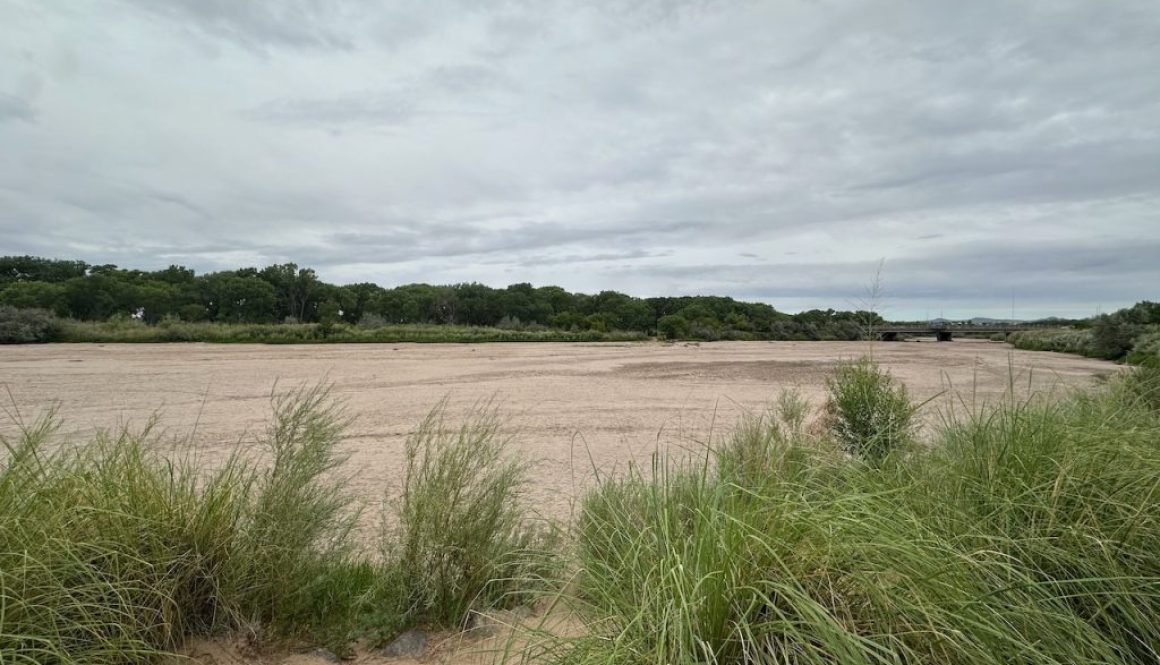
How much of the release made it to Elephant Butte? The answer begins with the conditions leading into the release. Rio Grande flows in 2025 set record lows. The runoff was small and brief. After the runoff ended prematurely in May, the riverbed was dry through Albuquerque and more extensively downstream for several months.
River water users did their best to meet their needs with increased groundwater pumping.
Floodplain and riparian vegetation— cottonwoods, willows, salt cedar, Russian Olive — drank from the wetted soil zones above the shallow groundwater table.
How Much Made It to Elephant Butte? Peak Flows at Downstream River Gages Reveal Large Losses
Individual hydrographs show consistently lower peak flows as the block release moved down the river. The pattern is clear.
Cochiti Dam release: Peak flows of 2,000 cfs were sustained.
Bosque Farms: The peak flow is much lower, delayed, and smoothed. Comparing the flow downstream of Albuquerque with the Cochiti Dam releases shows large losses through the Albuquerque reach.
San Acacia: The peak is lower still at this river gage at the head of the Socorro Valley, but not by a huge amount. The losses between Bosque Farms and San Acacia are relatively small.
San Marcial (floodway): The peak is further reduced and delayed. The river above San Marcial suffers especially high river losses. The river channel is perched several feet above the adjacent floodplain, trapped between levees on an elevated bed of accumulating sediment.
Elephant Butte Narrows: As of December 18, only a muted remnant of the original pulse has made it Elephant Butte Reservoir as of December 18.
Reclamation’s 1950s low-flow conveyance channel at San Marcial is added to the San Marcial river flow as the total surface flow moving downstream at that river location. Both flows come together before the Narrows gage.
Comparison of the San Marcial and Elephant Butte Narrows hydrographs shows significant intervening losses as the water flows down a temporary channel dredged by amphibious excavators to the Narrows. The channel is dredged through the top layer of the thick sediment beds that accumulated when the Elephant Butte Reservoir was routinely full and the pool reached almost all the way north to San Marcial.
Summary – What the Hydrographs Show
Each downstream gage captures a smaller and flatter version of the same release, indicating significant losses in every reach. Our calculations show the river lost more than 40% of the block release.
The Embudo gage provides a steady upstream reference.
The Abiquiu release provides a controlled input.
The Cochiti release shows their combined signal.
Everything downstream shows systematic attenuation clearly visible in the curves.
The Bottom Line
The block release was intended to move Prior and Paramount stored water downstream to Elephant Butte Reservoir.
The hydrographs show that much of the water never made it.
The Middle Rio Grande took it — into the channel, the banks, the shallow aquifer, and the steady flow to deep groundwater pumping zones.
Downstream river gages reproduce the Cochiti Dam stepped pattern, particularly the steps down. You can trace the first big drop. These data show a pattern that is consistent with what would be expected after a long season with a dry river, accelerated groundwater pumping, major riparian and domestic withdrawals from the shallow aquifer, and poor channel conditions.
This is more evidence that our current water uses can’t be sustained. Sobering thoughts to consider as a new, even drier year begins.
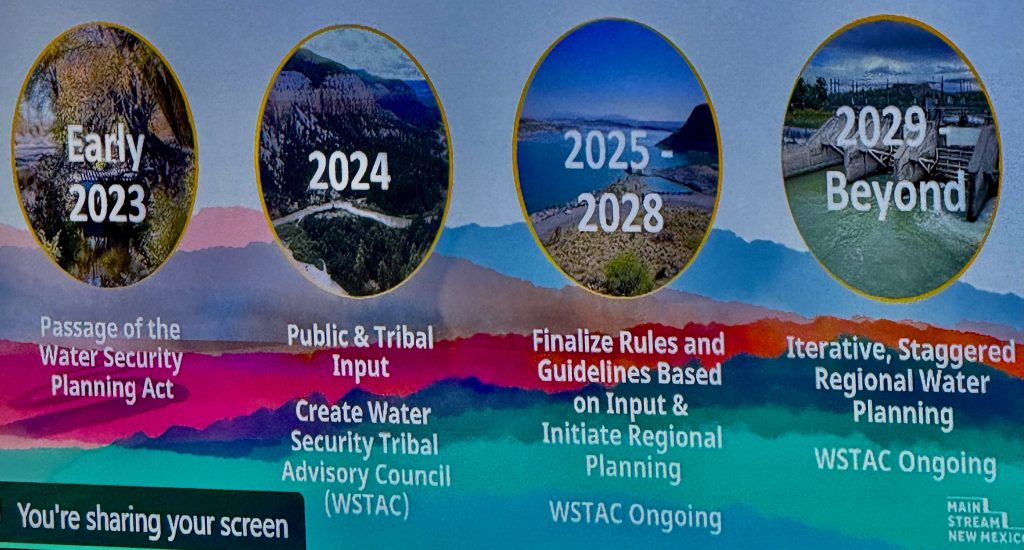
The ISC’s Rulemaking Hearing on New Mexico’s Water Security Planning Act
Record Closed
“Record closed.” Hearing Officer Felicia Orth declared it at the close of the Interstate Stream Commission’s three-day evidentiary hearing. The Commission now must decide what changes to make to staff’s July 17 proposal.
Closing the record means commissioners must rely solely on the evidence already submitted. Until deliberations are complete they may not discuss the rule with anyone, not even each other, except in an open public meeting.
The Act passed unanimously and was groundbreaking; will the rules be equally meaningful and unanimous? The Commissioners will decide. The Commission holds extraordinary power over how New Mexico will plan for its water future. Commissioners have a moral responsibility to ensure the regional water-security program they create fulfills its potential. The people who are working to improve the public welfare need nothing less.
Next Steps
The Commission outlined its next steps. First comes the court reporter’s hearing transcript. Next is the Hearing Officer’s report, described to the Commission at its September 18 meeting:
Commissioner Phoebe Suina: Please give an example of the report and how it would aid the Commission.
Hearing Officer Felicia Orth: Depending on what the record looks like, the report includes a summary of the evidence, a roadmap for deliberations, and maybe threshold questions to address before specific ones. In a rule with many sections, what other rulemaking bodies find useful is a compilation of the differences between sections—the “best and final offer” from each commenter, not interested parties—with citations to evidence in the record that support each version. My goal is to be helpful, not persuasive.
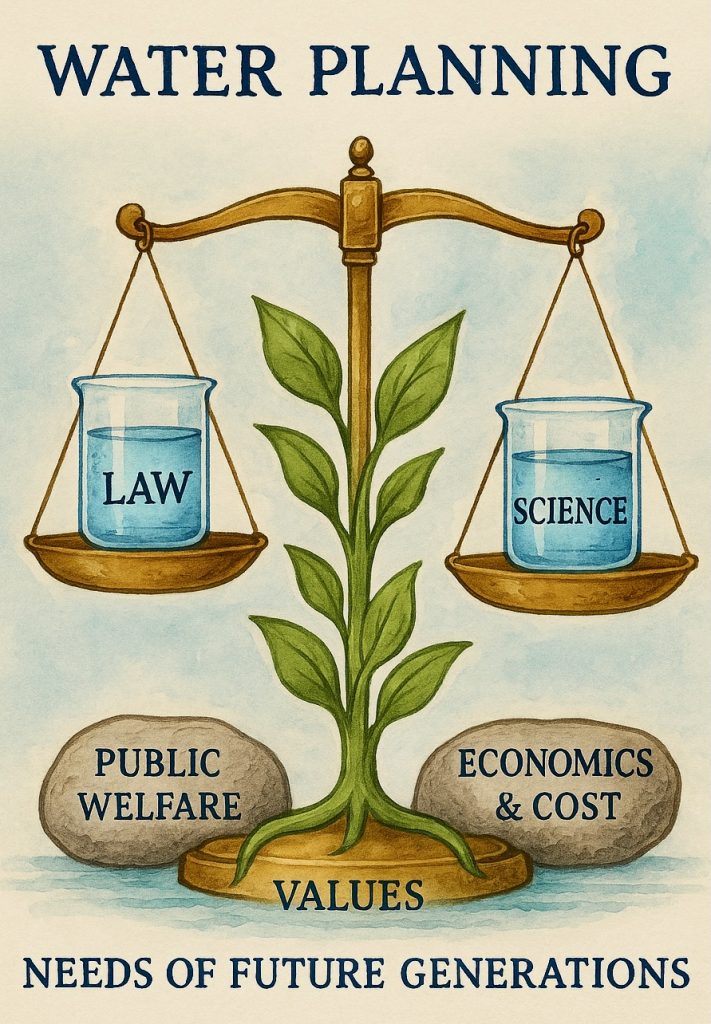
The Commission’s deliberations to finalize the rule will occur in December. The Commission must review the proposed rule line by line, identify what’s missing, and decide what to change or add. Hearing Officer Orth said she would be asking them to identify supporting evidence in the record.
Predictions:
Deliberations will require more than one day, likely concluding in early 2026.
The final rule will differ substantially from the staff’s July 17 draft.
Public Participation and Commissioner Engagement
Public comment and commissioner engagement were robust and well aligned. Pueblo Governors and officials from many Pueblos spoke thoughtfully and persuasively. I heard eloquent, rich statements of values and requests for inclusion and protection from acequias and parciantes, and land-grant officials and heirs. Professionals stressed the urgency of problem solving and the specific improvements required.
The public’s recommendations and commissioners’ thoughtful questions gave me not just hope but confidence. Hearing Officer Orth welcomed public comment, effectively disregarding the ISC staff attorney’s opinion that it should be limited. Commissioners were engaged, providing their thoughtful, diverse perspectives and asking many questions. I believe these exchanges of facts and values will strengthen the final rule so that regional water-security planning achieves its potential to confront the water crisis already underway—and the far worse conditions ahead.
Core Weaknesses of the Staff’s Proposed Rule
The staff’s draft rule misses the mark; it is unfinished, poorly written, and vague.
No guiding principle: Staff showed no consistent method for turning legislative mandates into a clear, functional rule. Most requirements are ignored, others copied as lists, and none made operational except for its top-down membership provisions. One commissioner called it a “laundry list.”
No vision or framework: The draft lacks a coherent vision of the water-security program or the framework these rules must serve. It reads as a disconnected set of administrative steps rather than a roadmap to achieve the Act’s purposes.
Inappropriate centralization: The draft makes a handful of ISC planning staff the indispensable gatekeepers for every regional effort, throttling progress and undermining regional responsibility and creativity that the 2023 Water Security Planning Act intends.
Failure to implement mandates: The rule does not operationalize the Act’s core requirements:
Commission responsibilities (§ 72-14A-4(C)(1) & (3)–(9)): including its duty to provide the best available science, data, and models, and to ensure regions utilize them and report the results with objectivity and professionalism.
Council responsibilities (§ 72-14A-5(B) & (C)): undermining the law’s mandate by failing to require regional councils’ meaningful and reviewable “consideration” of public welfare and the needs of future generations, and councils’ statutory authority to select their members.
Violates drafting standards: The rule fails the plain-English and structural standards that all administrative rules are required to meet.
Unless thoroughly rewritten and expanded, the final rule will fall short.
Next Steps and the Public Record
The record is closed, but the Commission’s work of agreeing on changes and additions remains to be done, transparently, in public. The Commission’s deliberations in December will determine whether the final rule honors the Legislature’s intent for science-based, community-centered water planning.
Every argument, citation, and recommendation the Water Advocates submitted is in the official record. These filings show how the Proposed Rule can be corrected to comply with the Water Security Planning Act and to produce a lawful, clear, durable framework for regional planning.
Readers can access the complete docket here, and the Water Advocates submittals for the record linked by name below.
Together with others’ testimony and comments, these documents form a consistent record: New Mexico needs clear, lawful rules grounded in science and reasoning. Vague rules are confusing—and therefore legally dangerous.
Summary
The Water Advocates appreciate Hearing Officer Orth’s welcome of public comment and her repeated insistence on transparency. The three-day hearing generated robust discussion and evidence that give the Commission strong guidance. Hearing Officer Orth will organize the record and propose a procedure for the Commission to do its job.
The Commission must transform the staff proposal into a clearer, less staff-centric, and more meaningful rule; one that advances planning with integrity and transparency accessible to all participants. The final rule must reflect local and regional hydrologic reality and give effect to the public welfare and the needs of future generations of New Mexicans.
I am optimistic they will together rise to the occasion.
Middle Rio Grande Compact Deliveries & Water Delivery Debt
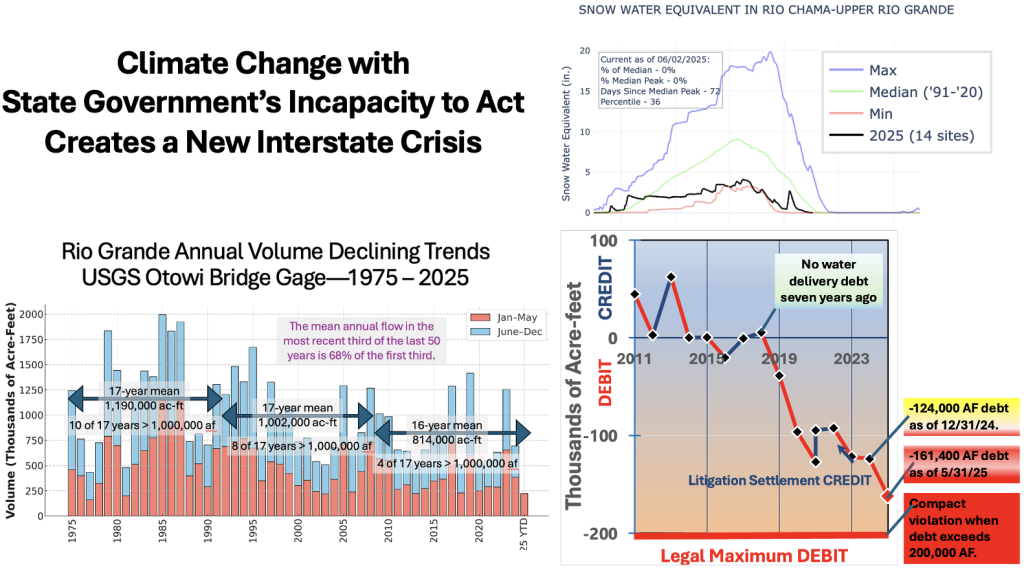
New Mexico’s water situation is deteriorating; under the Rio Grande Compact, NM is accruing historic water delivery debt. This reveals a clear leadership failure in protecting New Mexico’s water.
As would be expected with a dry Rio Grande riverbed aggravated by uncontrolled diversions and groundwater pumping, the September compact compliance news is bad. According to the Bureau of Reclamation’s water accounting model, New Mexico’s water delivery arrears increased to -52,100 acre-feet as of midnight on September 29. Reclamation can’t provide the end of September figures because the federal government is shut down.
Projection of Future Water Delivery Debt
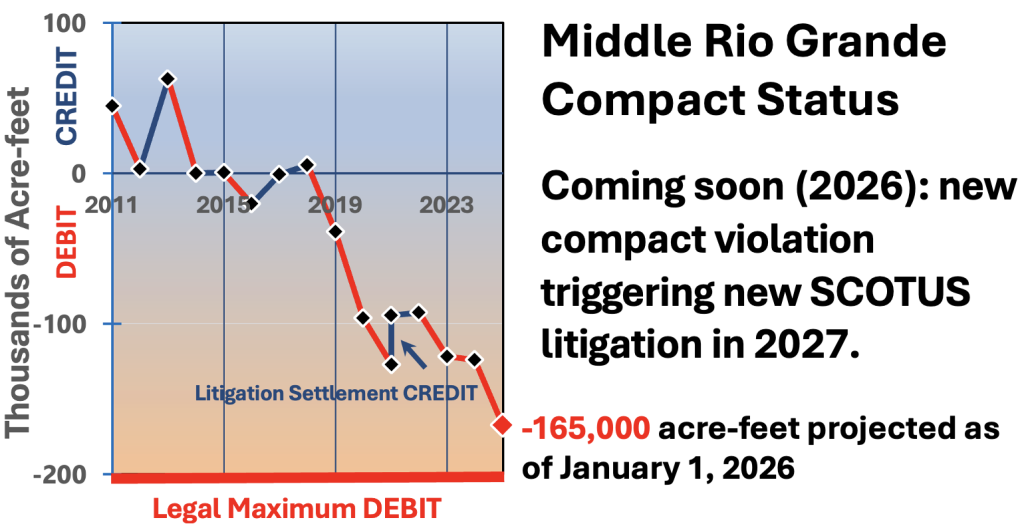
Unless we experience a weather miracle, namely the remnants of a hurricane crossing the Middle Rio Grande, I estimate that by the end of 2025, cumulative water delivery debt will be about -165,000 acre-feet. New Mexico’s increasing debt trend will look like this.
My experience as Interstate Stream Commission Director (1997-2002) and “engineer advisor” to the New Mexico Commissioner, Rio Grande Compact Commission and my license as a retired water resources engineer qualify me to publish this projection. Time will tell if it is accurate.
The Urgent Need for Courage & Transparency
The Interstate Stream Commission Director’s September 18 staff report cites only the official compact debt as of January 1, 2025:
Rio Grande Compact Status – New Mexico’s cumulative Compact debit status is 124,000 acre-feet and Article VII restrictions continue to be in effect.
Nothing was said at the Commission’s September 18 public meeting about the Water and Natural Resources Committee’s September 12th meeting. Legislators charged that New Mexico water agencies lack courage and urgency to confront the imminent new new compact violation and prevent it.
Preventing this imminent new Rio Grande Compact violation requires the leaders of these agencies to tell us the transparent truth. No major New Mexico water problem can be solved until it is publicly named and described.
The legislature recognizes that the adjudication process is slow, the need for water administration is urgent, compliance with interstate compacts is imperative and the state engineer has authority to administer water allocations in accordance with the water right priorities recorded with or declared or otherwise available to the state engineer.
The state engineer shall adopt rules for priority administration to ensure that authority is exercised.
This law and the associated regulations were written to manage the illegal overuse of water Lower and Middle Rio Grande. The New Mexico Supreme Court in 2012 unanimously upheld the regulations. Successive State Engineers have not upheld this law or invoked these regulations.
Budget Battles: Legislature vs. Water Protection
Governor Michelle Lujan Grisham requested $500,000 annually from the 2025 Legislature to enforce Middle Rio Grande water rights and confront the Middle Rio Grande water overuse problem. The House Appropriations and Finance Committee under Chairman Nathan Small’s leadership refused to include that request in the budget, instead choosing to direct millions of dollars to oilfield produced water and brackish water treatment. That decision shows legislators who rightfully criticized and mocked both agencies lack of urgency are collectively guilty of the same failures.
Legislative leaders and state budget appropriators: where is your leadership to protect New Mexico’s water?
New Mexico’s problem isn’t so much that some people take too much, although that’s a problem, too. It’s that all surface and groundwater uses together exceed with nature deplete more river water than the Middle Rio Grande’s legal share. Every extra diversion comes out of the water owed downstream. If we keep doing that, the question of how to get the Lower Rio Grande it’s entitled share to Elephant Butte will no longer be ours to decide. The U.S. Supreme Court will decide for us, with absolute discretion. They would order whatever it takes, even turning the Rio Grande into a controlled delivery canal like downstream.
That’s why it matters. That’s why we must eliminate Middle Rio Grande depletions of water owned downstream and work our way out of compact debt.
The Rio Grande Compact is a perfect barrier protecting the Middle Rio Grande from downstream users demands, but only if New Mexico complies.
Why Private Equity Control of Our Utilities Is a Dangerous Gamble
In the last two decades, private equity has transformed from a niche investment strategy into a global powerhouse. With over $12 trillion in assets under management—more than the GDP of every country except the U.S. and China—private equity firms touch nearly every sector of American life.
Turning over essential services—electricity and gas—to private equity firms like Bernhard Capital Partners (BCP) and Blackstone respectively risks profit maximization at the expense of customers, workers, water and our environment.
Private equity firms raise money from large investors—often public pension funds for firefighters, teachers, and state employees—and use it to acquire companies. Once they take control, their priority is to boost returns for investors, not to build sustainable operations or protect communities. This can mean cutting staff, raising prices, or extracting value through complicated financial maneuvers. These tactics are not theoretical. They have repeatedly harmed workers, patients, tenants, and customers across the country.
When private equity enters an industry, the evidence shows higher costs, lower quality, and weakened oversight. In nursing homes, for example, private equity ownership is linked to worse patient outcomes and higher mortality. In housing, Blackstone and its affiliates have been accused of fueling the global housing crisis by hiking rents, imposing heavy fees, reducing maintenance and instigating evictions. In utilities, the danger is even greater because people cannot simply switch to another provider.
Bernhard Capital Partners’ Troubling Record
Bernhard Capital Partners has no experience running a regulated gas utility. It has racked up violations with the EPA and OSHA and with state regulatory agencies in New York, Massachusetts, and Louisiana. Its track record should cause alarm for our communities.
Water treatment mismanagement. A BCP-operated company failed to properly operate and maintain a water treatment plant. “[A] large amount of sludge buildup was observed in the receiving stream,” according to regulators. “Bloodworms were also noted throughout the sludge within the receiving stream, which is indicative of stagnant water containing organic matter commonly associated with sanitary waste.” This is not a minor infraction—it reflects a breakdown in basic safeguards for public health and environmental protection.
Hazardous waste mishandling. A BCP subsidiary was cited for mishandling asbestos and other hazardous waste: failing to comply with notification and identification requirements, providing inadequate training to personnel, improperly processing, packaging, or transporting dangerous materials, and failing to minimize exposure. Such violations put workers at serious risk of illness and contamination.
Wage theft on public works projects. A BCP contractor was found to have shortchanged 84 employees on five public works projects by neglecting to pay full overtime and failing to report accurate payrolls. These violations resulted in a $222,141 penalty by the Massachusetts Attorney General. If a company cuts corners on workers’ pay in public projects, it raises questions about how it will treat utility workers and ratepayers under less scrutiny.
Blackstone’s Troubling Record
Blackstone, the world’s largest private equity firm, has its own long list of controversies—several of which implicate fundamental rights and public trust.
Privacy violations at Motel 6. In 2018 and 2019, Motel 6, owned by Blackstone, settled for $19.6 million after disclosing guest lists to U.S. Immigration and Customs Enforcement (ICE) without a warrant. This warrantless disclosure endangered immigrants and violated customer privacy rights.
Genetic data concerns at Ancestry. In 2020, Blackstone acquired a majority stake in Ancestry.com, gaining access to millions of people’s genetic information. This acquisition triggered widespread concern about how a profit-driven private equity firm might use or monetize sensitive data. Blackstone has fought class-action litigation over misuse of data belonging to people who never consented to genetic testing but were linked through biological relations.
Illegal child labor at Packers Sanitation Services. The U.S. Department of Labor found more than 100 children (ages 13-17) illegally working in dangerous conditions cleaning slaughterhouses for Packers Sanitation Services Inc., a Blackstone portfolio company. A teacher first raised the alarm after seeing a student with hydrochloric acid burns. The Labor Department fined the company $1.5 million for these violations.
These examples are not random. They show a pattern of disregard for basic human rights, public safety, regulatory standards, and legal obligations.
Gas and electric utilities are not like hotels, slaughterhouse contractors, or tech platforms. They are lifeline services, with long-term infrastructure that must be maintained for decades. The focus must be on reliability, safety, and environmental stewardship. When a private equity firm acquires a utility, the temptation to cut maintenance, self-deal, impose aggressive rate hikes is intense. Ratepayers and taxpayers ultimately bear the costs, whether through higher bills or environmental cleanup after failures.
One of the most dangerous and least visible risks of private equity ownership of public utilities is the explosion of “affiliate transactions.” Under this model, the parent company steers lucrative “procurement opportunities”— construction, consulting, management, IT, and even financing—to other firms it also owns. On paper these deals may look like ordinary vendor contracts, but in practice they are legal self-dealing schemes that drain millions of dollars from ratepayers into private equity pockets. Because these transactions are often buried under layers of subsidiaries and shell companies, the Public Regulation Commission (PRC) faces an almost impossible task in tracking and evaluating their fairness. The procurement maze makes it easy for private equity owners to charge inflated fees, extract hidden profits, and shift risk back to the utility while reducing transparency and accountability. In short, the very structure of private equity ownership creates incentives to overcharge and under-deliver, all while shielding critical information from the public and regulators.
Additionally, because the owners of both BCP and Blackstone don’t live here, there is little incentive for them to conserve water, protect our environment, or build climate resilient communities. Yet our utilities face these challenges—aging infrastructure, the need for decarbonization, and increasing risks from extreme weather. Handing control to firms whose DNA is spending capital to supercharge profits, not create community benefit, is reckless.
Our state regulators and elected officials have a duty to protect the public interest, not private equity profits. Approving the sale of our gas utility to BCP and our electric utility to Blackstone would hand over critical public services to two firms with documented histories of cutting corners, violating laws, and putting vulnerable populations at risk.
Instead of repeating the mistakes seen elsewhere we should demand transparency, robust oversight, and public ownership models that prioritize affordability, accountability, and sustainability.
Write to the PRC, sign petitions, call/write your legislators. Activism is the antidote to despair.
At the Southern tip of our state, community members of Sunland Park and Santa Teresa have been fighting for clean and safe drinking water for years, plagued with high levels of arsenic contamination in their drinking water, and a water authority that chronically fails to address this issue. Residents now face yet another battle for that fundamental right: BorderPlex Digital’s “Project Jupiter,” threatens to deplete what little usable water is left. Project Jupiter is a hyperscale, multi-data center project proposed in Santa Teresa, and at this time, one of the largest data center projects proposed in the nation.
Data centers require massive amounts of water to operate, while also using unfathomable amounts of electricity. In response to water usage concerns in a region that’s been in extreme drought for decades, Project Jupiter claims it will utilize a “closed-loop” system, supposedly requiring only a “one-time” draw from the local groundwater. However, the concept of a “one-time” draw of water for a data center just isn’t real. “Closed-loop” systems still require additional water supplies, due to the necessary recycling of the water over time, as well as the evaporative cooling processes utilized to cool the used-water. “Closed-loop” systems also use significantly more electricity than other data center cooling-systems, ultimately misusing more water in the process.
Organizers protest a proposed $165 billion data center campus that BorderPlex Digital Assets wants to build in Santa Teresa, New Mexico. (Diego Mendoza-Moyers / El Paso Matters)
Data centers, like Project Jupiter, are springing up across the nation and, once built, quickly become the largest consumer of water and electricity in each locality. A large data center can consume up to 5 million gallons of drinking water a day, totaling up to 1.8 billion gallons of water used in just one year. Currently, BorderPlex Digital plans to have at least four large data centers in operation for Project Jupiter.
Data centers are water guzzlers, and in a region like Sunland Park and Santa Teresa, where it is unclear how much groundwater remains, a development like Project Jupiter is untenable. Especially when we know that Project Jupiter has named the Camino Real Regional Utility Authority (CRRUA), the public utility serving Sunland Park and Santa Teresa, as the water and wastewater provider for the project – placing the local public water supply at risk.
Sunland Park and Santa Teresa caught national attention in late 2023, when local and state officials issued a week-long Do Not Drink Order for residents. A state investigation later uncovered that CRRUA had bypassed its arsenic treatment systems for at least a year and a half; dumped an “unknown” amount of caustic soda into the public water supply in November 2023, and ignored, community complaints of slimy, smelly, and discolored water with children, adults, and pets becoming ill from consuming the water – until a week later when CRRUA issued the Do Not Drink Order. Since then, CRRUA has struggled to come into compliance with federal and state water regulations.
But the failure of CRRUA, the City of Sunland Park, Doña Ana County, and the state of New Mexico to ensure Sunland Park and Santa Teresa residents have clean and safe drinking water started long before the water crisis of 2023. Sunland Park and Santa Teresa’s public water supply has exceeded the federal health limits for arsenic for decades, and CRRUA has intermittently shut off its arsenic treatment facilities and bypassed its treatment systems, sometimes for years at a time – while consistently failing to notify the public when their water is unsafe to drink and consume.
Since the days of the ASARCO-smelter plant, which operated nearby and left centuries-worth of toxins and arsenic in the soil and groundwater of Sunland Park and Santa Teresa, and the local landfill and a medical waste incinerator in Sunland Park that became a key environmental justice case in the 1990s, extractive and polluting industries have targeted Sunland Park and Santa Teresa. This has left community members without critical access to clean drinking water. Now, Project Jupiter threatens to repeat that harmful and discriminatory history and take advantage of what little usable water Sunland Park and Santa Teresa have left. Local community members have questions that remain unanswered, while local and state officials rush to push Project Jupiter forward quickly for the potential approval of tax breaks.
Project Jupiter is a threat to New Mexico’s scarce water supplies and if it goes through, is yet another act of systemic violence and injustice against New Mexico’s southernmost communities.
What you can do: Take action in support of Sunland Park and Santa Teresa communities by submitting a letter to the Doña Ana County Commission by the upcoming September 19th Public Hearing when $165 billion in Industrial Revenue Bonds for Project Jupiter will be voted on. Urge commissioners to vote no. Click here to send a letter which you can personalize. Thank you!
The Middle Rio Grande’s 2025 River Water Supply Has Collapsed
A Sobering Conversation
On Friday, August 1, a kind and knowledgeable hydrologist at the Bureau of Reclamation’s Albuquerque office responded to my questions about the Middle Rio Grande’s river water supply and our year-to-date Compact deliveries to Elephant Butte. The answers were sobering.
The Future Has Arrived Early
It’s time to stop talking about New Mexico’s projected 25% reduction in renewable surface and groundwater supply by 2070. That number, from the widely cited 2021 report by the New Mexico Bureau of Geology and Mineral Resources, now understates our crisis. The 2025 shortfall in river water supply is more than 50%.
The riverbed through metro Albuquerque is dry. The Bureau of Reclamation’s San Juan–Chama Project, which imports water from the Colorado River Basin, hit a record-low allocation in 2025. This year’s water for project contractors is down 69% from a full supply. That’s a massive shortfall for the Albuquerque Bernalillo County Water Utility Authority, which receives about half the water, and the Middle Rio Grande Conservancy District , which receives about a quarter.
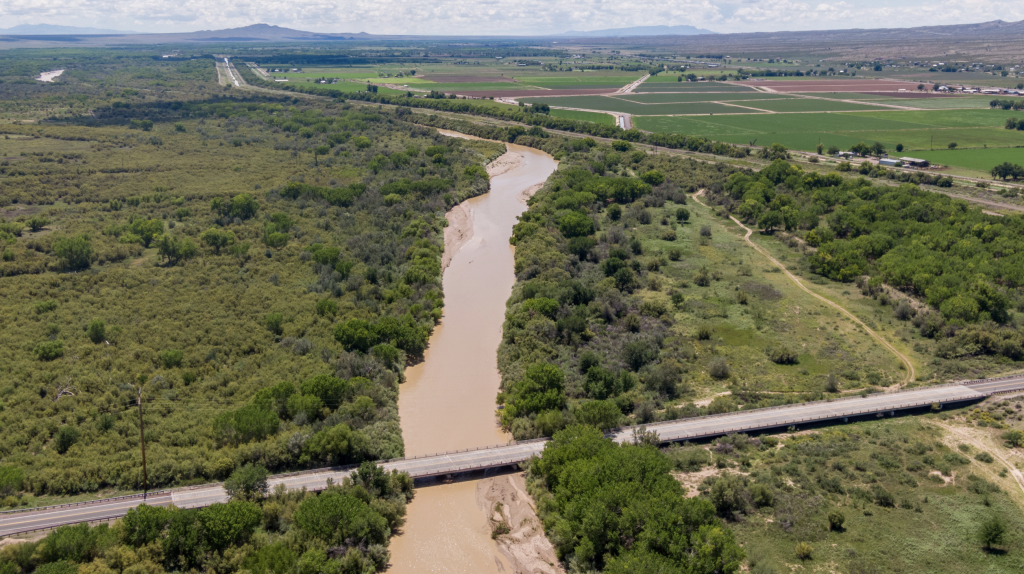
Data show the decline in river flows over the last 50 years, as illustrated in the chart below that I prepared in early June. The drone photo below the chart shows the river channel at the US380 highway bridge near San Antonio in August 2022, a relatively dry year. The river there had water then and the fields are green. This year, the fields may be green but due to rain and groundwater pumping. The river is dry.
Rio Grande at US380 Bridge near San Antonio NM, August 2022. Credit: The Water Desk. c Mitch Tobin
Compact Risk Is Flashing Red
At the May 15 Water Advocates workshop*, State Engineer General Counsel Nat Chakeres stated his belief that the Middle Rio Grande would avoid a Rio Grande Compact violation this year because the water delivery obligation to Elephant Butte is so low. I concur.
But unless the unusual 2025 monsoon delivers a lot more water across the dry watersheds to the river, the Middle Rio Grande’s accrued water delivery debt will rise to roughly 160,000 acre-feet—using up half of New Mexico’s remaining margin. That margin is our buffer before high-stakes interstate litigation returns.
If we exceed the 200,000 acre-foot legal cap on cumulative water delivery debt, we will once again face Texas in the U.S. Supreme Court—this time in another risky, high stakes case that will cost over $100 million and a decade or more to defend. The still ongoing 2013 lawsuit filed by Texas and joined by the United States over New Mexico groundwater pumping in the Lower Rio Grande cost more and is taking longer.
Texas’ formal attempt to bring Middle Rio Grande under deliveries into the ongoing Lower Rio Grande litigation failed, because we remain in compliance, that is, our water delivery debt doesn’t exceed the cap. The Compact creates a clear dividing line that isolates the Middle Rio Grande from the Lower Rio Grande, but only as long as the Middle Rio Grande remains in compliance.
What Must Be Done
We must acknowledge that our renewable water supply is shrinking now—not decades from now. And we must act accordingly. Either we take strong action to comply with the Compact, or we will be forced to devote our state’s water agencies to the enormous task of defending a new Supreme Court case—this time involving water for half of New Mexico’s economy and population. And we will be forced to comply, but with less leeway and discretion.
*Visit the “Past Events” tab at nmwateradvocates.org to access the May 15 workshop recording and slides.
Technical Notes:
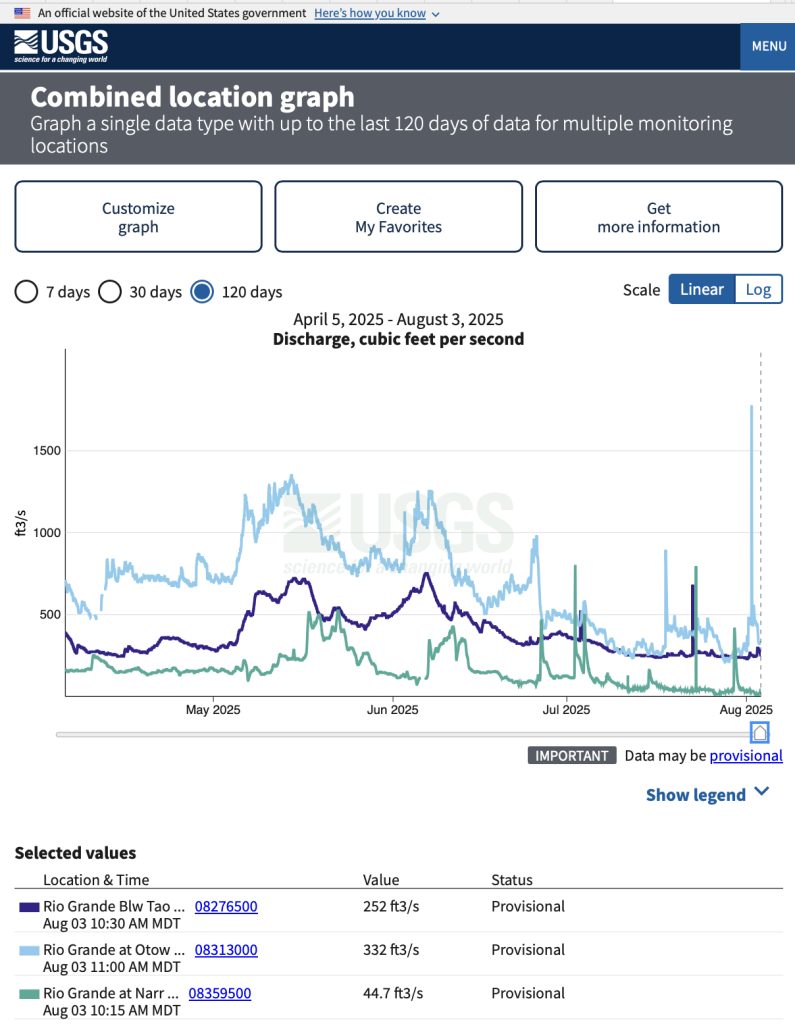
This U.S Geological Survey Chart
The light blue trace in the chart below is from the U. S. Geological Survey’s river streamflow gage at the Otowi Bridge on the Los Alamos highway. It measures Rio Grande Compact inflows to the Middle Rio Grande. San Juan-Chama water volumes are subtracted from the gage reading, which is also adjusted for changes in upstream reservoir native water storage.
The green trace measures the outflow from the Middle Rio Grande at the Narrows within Elephant Butte Reservoir, where the river is flowing in an accessible channel many miles upstream of where the stored water pool has retreated. This is a temporary gage and is useful. The Rio Grande Compact actual water delivery is calculated as the change in storage in Elephant Butte Reservoir plus the release through Elephant Butte Dam.
The dark blue trace shows the flow of the Rio Grande downstream from the Rio Pueblo de Taos. It measures Colorado’s stateline deliveries, tributary inflows and the flows including the Red River and the Rio Pueblo de Taos, and large springs in the upper Rio Grande Gorge. Most of the additional water measured at the Otowi gage (light blue) comes from the Rio Chama, the Rio Embudo, and inflows minus diversions upstream from Espanola.
Comparison of the light blue and green traces shows very little of the inflow to the Middle Rio Grande has made it through. The compact requirement is 57% on an annual basis.
Current Data from Reclamation
Reclamation’s hydrologist said the Otowi gage flows include delivery of 33,884 acre-feet of San Juan-Chama project water in 2025 year-to-date. MRGCD has used essentially all of its allocation.
Federal agencies stored 32,668 acre-feet of native Rio Grande water under conditions when the Compact does not permit storage to guarantee water to meet the “prior and paramount” irrigation requirements for certain Pueblo lands. Of that total, 2,100 acre-feet has been released as of the end of July. The current rate of release is 40 cfs. It has been as high as 60 cfs. All remaining water will be released for delivery to Elephant Butte after the end of the irrigation season. Ir’s rare that prior and paramount water is used because normally the minimum flow of the river is enough. A substantial amount may remain, or not, depending on the monsoon.
The Upper Rio Grande Water Accounting Model shows the Middle Rio Grande’s year-to-date underdelivery of water to Elephant Butte as of the end of July is – 39,000 acre-feet.
The Interstate Stream Commission (ISC) staff’s proposed rule to implement the 2023 Water Security Planning Act (WSPA) is structurally flawed, legally overreaching, and misaligned with the law’s purpose. The WSPA was enacted to support decentralized, data-informed, and science-based water security planning across New Mexico. Instead, the proposed rule concentrates inappropriate, poorly defined authority in the hands of ISC staff.
It presumes that internal staff policy decisions—many of which constrain regional initiative—should be embedded in rule, without ever being considered by the Commission. It contradicts the Act’s clear delegation of planning responsibilities to regional councils. It even instructs councils to proceed with planning whether or not data are lacking, undermining the scientific integrity that the WSPA mandates.
Despite taking two years to prepare, the proposed rule is vague, contradictory, and fails to meet drafting standards for state rules. The staff-proposed rule lacks clarity, misinterprets statutory intent, and fails to learn important lessons from failures of past ISC-directed regional water planning in New Mexico that used imaginary information.
This article outlines core flaws in the proposed rule and proposes a smarter path forward: pause the rulemaking, adopt interim guidelines that fund and support regional initiative, and return to the formal rule process only after meaningful engagement, learning, and course correction—grounded in statute and committed to decentralization. The Water Advocates described the flaws and pointed out the better way in public comments offered for the Commission’s consideration.
The proposed rule substitutes staff discretion for Commission-level decisions and undermines both scientific integrity and the decentralized authority that the Act assigns to regional councils.
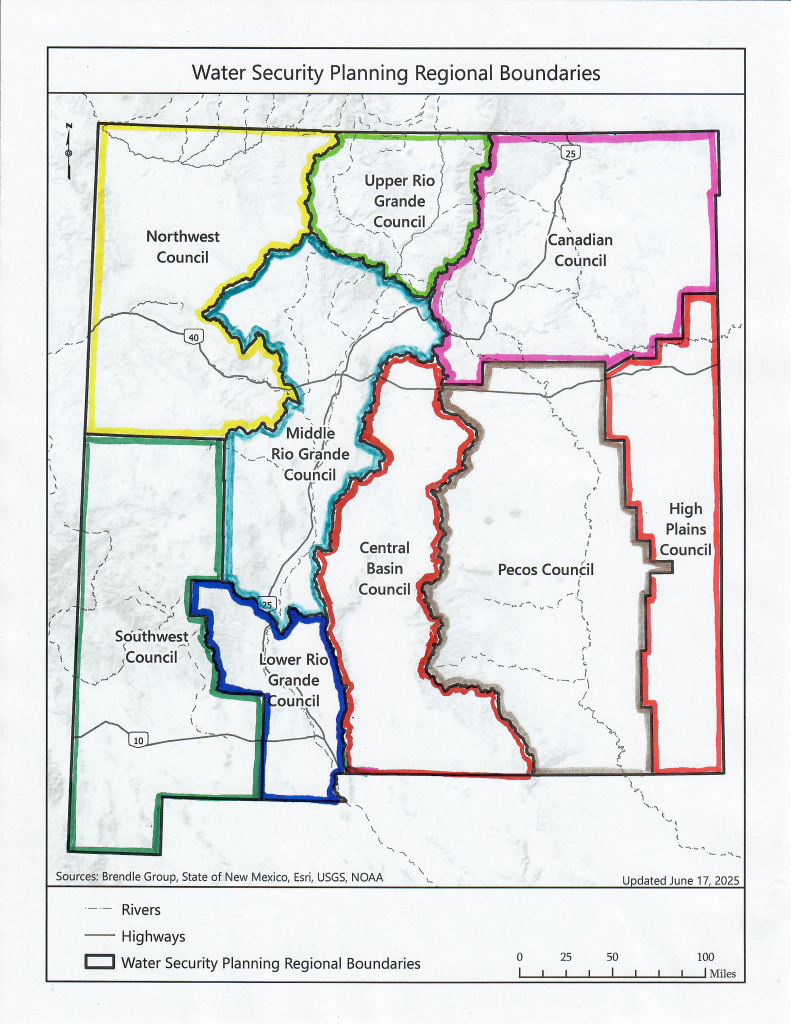
The Water Advocates Support the ISC’s definition of the regional water planning council areas, as shown. The boundaries make sense and are well examined by ISC staff and explained.
Centralized Control Where Regional Responsibility Is Required
At it’s heart, the WSPA is a commitment to decentralized planning: regional councils are charged with developing water security plans, while the state is to support councils’ work by providing technical and financial support with clear content and approval criteria. The Act requires the Commission to define council composition, support plan development, and approve plans based on established rules. Nowhere does it authorize the ISC staff to initiate the formation of regional councils or approve each council’s membership.
Yet the proposed rule does exactly that. Rule 10 A.(1) asserts that NMISC staff will invite government entities to select representatives and will convene the initial meeting of each council. This is a fundamental overreach. The WSPA assigns the duty of plan development to regional councils themselves. The Commission’s statutory role is to establish composition standards—not to centrally initiate, schedule, or approve when and how councils form. Rule 10(C) makes this overreach worse by stating that self-organized councils must be “confirmed by NMISC staff”—but confirmed according to what criteria? The rule provides no standards, thresholds, or procedural guidance.
The problem extends further. Staff would be granted authority to review and approve council composition when vacancies occur, with no defined criteria, timeline, or appeal process. Rule 12 empowers staff to substitute non-voting members for voting members if a “qualified or willing” representative cannot be identified—but fails to define either term or require Commission oversight. These and other provisions allow staff to shape council membership and authority with excessive discretion, undermining the WSPA’s statutory structure by assigning staff roles the law reserves for regional councils or the Commission itself.
Many regional leaders lack only a legitimate framework and resourcing strategy that honors their statutory roles and the decentralization mandate.
Failure to Meet Statutory Requirements
The WSPA includes several specific rulemaking mandates that the proposed rule fails to fulfill. Two are particularly critical:
Section 8(C)(1)(c) requires rules that establish a procedure for regional entities to develop and notify the Commission of regional public welfare concerns.
Section 8(C)(1)(e) requires rules that establish a procedure for regional entities to consider public welfare values and the needs of future generations.
The proposed rule establishes no procedure for Councils to raise such concerns to the Commission, and no structured process for evaluating those concerns in regional planning. These omissions are direct failures to implement core provisions of the statute.
Integrity of Planning
Scientific integrity is another area where the proposed rule falls short. The rule language evades the statute’s clear mandate that the Commission must both provide the best information and ensure it is used with scientific integrity.
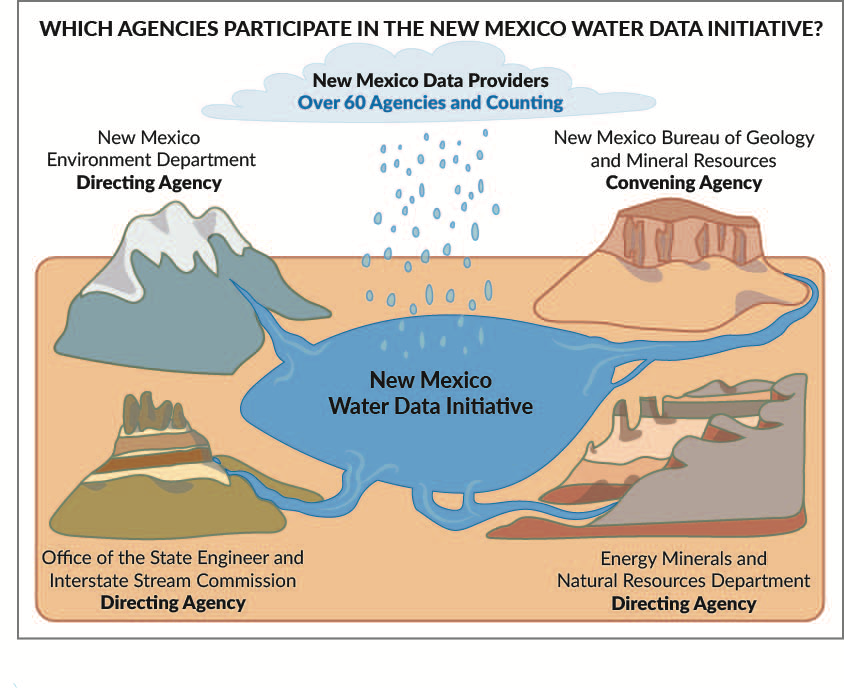
The Water Security Planning Act plainly requires the Commission to ensure “the best science, data, and models relating to water resource planning are available to the regional water planning [councils] and are used with scientific integrity and adherence to principles of honesty, objectivity, transparency, and professionalism.” It further requires the ISC to carry out this responsibility in collaboration with the Bureau of Geology and to do so through Bureau’s New Mexico Water Data Initiative.
Credit: NM Bureau of Geology and Mineral Resources
The proposed rule omits any reference to this specific ISC duty and makes no mention of the Water Data Act platform. The rule instead offers only vague references to “assistance with accessing” data. Worse still, the proposed rule says, “Councils may not delay the development of or updates to a plan due to lack of data.”
Water planning without water data is not water planning with integrity. The rule drafters may have had a more complex idea in mind, but the language is too terse to communicate the circumstances where Councils may not delay due to lack of data.
Nothing good came from the ISC’s 2018 regional water planning updates that ISC asked be completed without real data. New Mexico has seen the costs of ISC’s turning its back on scientific and decision integrity during the Gila River Diversion process from 2004 through 2020. The 2023 Water Security Planning Act explicitly corrects those problems, among its many changes. The proposed rule doesn’t operationalize these reforms.
New Mexico has seen the damage and waste caused by ISC politicized water planning that flaunted scientific integrity. ISC pursued a 4th iteration of the clearly infeasible Gila River Diversion project from 2004 until they finally stopped work in 2020. ISC modeling, public meetings, and reporting were deliberately misleading, professionally indefensible, and extremely wasteful, costing at least $16 million in federal funds and diverting many years of ISC’s limited staff resources to a boondoggle. The ISC even manipulated the Southwest New Mexico Regional Water Plan to prioritize the infeasible diversion project, causing that endeavor to be wasted, too. The Gila River Diversion Project case is the reason the 2023 Water Security Planning Act includes the bolded sentence quoted above.
Schedule
ISC staff presented this slide to the Commission 0n June 18, 2025. The ISC planning chief’s remarks indicated staff wants to deny six of the nine regions the opportunity to participate in state funded regional water planning until 2032 or after. The staff rule is silent on the schedule, delaying that discussion for a future Commission proceeding.
ISC staff presentation to the Commission on June 18, 2025. Norm Gaume photo
A Better Path Forward: Pause, Activate, Align
Given these failings, the Commission should immediately pause its current rulemaking process. The draft rule as written cannot be the foundation for a planning program that meets legal standards, inspires public trust, empowers regions to confront their water challenges, or expands the number of minds engaged in New Mexico’s water resources problem-solving.
Instead, the Commission should adopt an interim approach using its statutory authority to fund regional activities. The Commission can and should adopt simple, short-form interim guidelines (not a full rule) to activate regional initiative through flexible early-stage grants. These guidelines would:
Allow grants to eligible fiscal agents for existing or new groups formed by regional initiative to carry out early regional organizing work;
Support activities such as convening intergovernmental forums, convening inclusive regional meetings, identifying and engaging local stakeholders, initiating council formation consistent with WSPA-mandated composition rules, or conducting preliminary needs assessments;
Require transparency and accountability through basic reporting
Allow regions to design their own path toward formal council establishment and plan development.
This approach enables planning regions to take initiative in a manner tailored to local realities—without entrenching a rigid, staff-controlled structure that predetermines the shape of regional councils or the methods of engagement. It also allows state support to flow quickly and equitably across the state, even as the formal rulemaking process is paused.
Importantly, many regional and tribal entities already possess the relationships, capacity, and readiness to engage in meaningful planning. What they lack is a legitimate framework and resourcing strategy that honors their statutory role.
The Commission should pause the rule, activate regional initiative through interim guidelines, and return to rulemaking only after real public input and on-the-ground experience.
Re-Centering the Commission’s Role
Perhaps most importantly, this alternative approach would restore the proper institutional balance between the Commission and its staff. Under the WSPA, the nine-member Interstate Stream Commission—not its staff—is the statutory deliberative and policy-making body.
The July 17, 2025, Commission meeting revealed that staff had already made key structural and policy decisions without presenting them to the Commission for public deliberation or approval. Commissioners had not been briefed on decision options. Staff had not analyzed alternatives. Staff withheld critical information from public meetings and embedded its staff-centric and centralized control policy choices in the draft rule.
Moreover, the staff-led public engagement process was inadequate. It relied heavily on dot-voting at open houses and through the mainstreamnm.org platform, which limited public learning and discouraged narrative input. While the Water Advocates and others submitted detailed written critiques, staff failed to present these to the Commission in a structured or comprehensive form. At no point did ISC staff convene a public forum where stakeholders could learn from one another or engage with subject matter experts. The process appeared designed to generate superficial evidence of consensus on simple points rather than support meaningful public input and policy guidance.
By pausing rulemaking and adopting interim guidelines, the Commission can reclaim its deliberative policymaking role and publicly structure the development of a planning program with a set of rules that meets both the letter and spirit of the WSPA.
Conclusion
The ISC staff’s proposed rule gets the Water Security Planning Act wrong in both structure and intent. It centralizes what the law seeks to decentralize. It assigns staff discretionary authority where the law assigns Commission oversight. And it fails to implement key statutory provisions that are essential to meaningful, lawful planning.
A better path is available: pause the rulemaking. Activate regional initiative through interim guidelines providing for flexible grants. Re-center the Commission’s policymaking authority. And only after sufficient on-the-ground engagement, regional mobilization, and public input, return to the rulemaking process with a foundation grounded in statute, experience, and trust. That’s how New Mexico can begin to build true water security community by community, region by region, starting now.
From acequias to groundwater-dependent communities across the state, New Mexicans are living the consequences of the state’s approach to water governance. To meet New Mexicans’ diverse water needs, New Mexico must decentralize and democratize how it manages its most scarce and vital resource: water.
This is an intended and likely outcome of successful implementation of the 2023 Water Security Planning Act (WSPA), which envisions the creation of regional water planning coordination bodies throughout the state.
During the recent legislative session, the New Mexico Water Advocates understandably focused much of its attention on state-level concerns—funding, and on Interstate Stream Commission (ISC) rules for carrying out state-mandated functions for implementing the WSPA. Scant attention was paid to the nine designated water planning regions or to the rules and authorities under which the regional entities would operate. This essay is intended to shift the focus of our concerns to the regions themselves.
From Uniformity to Polycentricity
The term “polycentric” denotes governance systems where decision-making authority over all uses of a public good (here, the water resource) is not held centrally by the state, but instead is divided across multiple, overlapping decision centers that use diverse approaches to coordinate their activities. Though the State’s initial rules for constituting the Regional Water Planning and Management Councils are still being debated, the “polycentricity” concept can be applied to governance practices that are likely to emerge from the Councils’ work. Polycentric governance is not limited to governments, nor does it imply a single form of institutional arrangement.
Embracing Diversity and Complexity
Heterogeneity in this context refers to differences and disparities among stakeholders that can affect the ability of a community to undertake successful collective action. These differences—in endowments, beliefs, preferences (including financial interests), occupations, education, ethnicity, etc.—can significantly influence whether it is possible for members of a community to find shared existential common ground despite differing perceptions of their individual self-interest. Individuals and groups often hold overlapping perspectives, which can either support or complicate collective action.
Design Principles for Collective Water Governance
In Governing the Commons, Elinor Ostrom identified several issues that are typically addressed in constituting and maintaining successful, long-lasting natural resource governance institutions. She called these “design principles.” They include:
Clear resource and legitimate user boundaries exist and are understood.
Rules are congruent with local social and environmental conditions.
User benefits from managing the common pool resource as a public good or commons are proportionate to the inputs required from the user.
Individuals affected by the operational rules can participate in modifying those rules.
Monitors accountable to the users monitor the users’ appropriation and provision levels.
Monitors accountable to the users monitor the condition of the resource.
Users who violate rules are likely to be assessed graduated sanctions by other users or by officials accountable to those users.
Users have rapid access to low-cost local arenas to resolve conflicts.
The rights of users to devise their own institutions are supported by government authorities. (These institutional arrangements will vary among regions.)
Actions operationalizing these design principles are organized in networks of nested enterprises, providing both horizontal and vertical linkages for coordination and joint action.
This list of design principles, while based on Ostrom’s, has been updated and modified by more recent empirical work of scholars and and practitioners.[1]
Other factors such as the size of user groups, differing types of heterogeneity within or between them, and the type of government regime within which users operate may also be relevant.
These core design principles offer guidance as to how New Mexico’s incipient Regional Water Planning and Management Councils might be constituted. Past attempts at regional water planning have foundered in part because—contrary to language in the 1987 bill that authorized “regions of the state [to] plan for their own water futures”—State water agencies seemed more concerned to maintain control and to insist on uniformity than to tackle real problems identified by people living and working within the regions.
A Pragmatic Path Forward
To what extent can these design principles be useful in crafting institutions for New Mexico’s water planning and management? Might they be applicable in designing polycentric governance and management systems at a variety of scales? We can’t be sure. However, the Water Advocates started down this road in the belief that water planning could be made effective if centralized state water agencies really were to listen to the people they serve. This approach suggests a strategy to make that happen.
In the article cited above, the author (Cox) asserts that a probabilistic rather than deterministic approach to understanding the usefulness of the design principles is warranted. Experiments in game theory as well as case study data from the field suggest that in repeated interactions participants begin to employ more cooperative strategies as they learn more about each other. A polycentric approach provides opportunities for actors in each region to communicate informally, recognize shared interests and conflicting needs and values, and build the trust needed to come to workable solutions to our multiple water crises.
Let’s Build Them—Together
If the state is sincere about empowering communities to shape their water futures, it must support the formation of Regional Water Planning and Management Councils that reflect local voices, address local conditions, and apply proven principles of collective governance. The path won’t be easy—but by listening, learning, and trusting local knowledge, New Mexico has a chance to craft resilient institutions equal to the challenge.
John Brown is a member of the New Mexico Water Advocates board and a former executive director of the New Mexico Water Dialogue. He has taught in the public administration program and the political science department at the University of New Mexico.
[1] Cox, M., G. Arnold, and S. Villamayor Tomás. A review of design principles for community-based natural resource management. Ecology and Society 15(4), 38;
Polycentric Governance A system where decision-making authority is distributed among multiple centers of power—such as local, regional, and state entities—rather than being concentrated in a single central authority. These centers operate semi-independently but coordinate with one another, allowing for more locally tailored solutions.
Common Pool Resource (CPR) A natural resource—such as water, fisheries, or forests—that is shared by a group of users. CPRs are difficult to exclude people from using, but overuse by individuals can deplete the resource for everyone. Effective management requires collective action and agreed-upon rules.
Design Principles (Ostrom’s Principles) A set of foundational guidelines identified by political economist Elinor Ostrom for creating successful, self-governing institutions to manage shared natural resources. These principles include clearly defined boundaries, participatory rule-making, monitoring, and conflict-resolution mechanisms.
Nested Enterprises A governance structure where smaller, local institutions are embedded within larger, overarching frameworks. This layering allows for coordination across different scales (local, regional, state) while maintaining local autonomy where appropriate.
Heterogeneity The diversity within a group or region in terms of characteristics like culture, income, education, interests, or resource access. In water governance, heterogeneity can either hinder cooperation (due to conflicting interests) or enhance it (by bringing multiple perspectives and strengths).
Operational Rules The specific, day-to-day rules that govern who can use a resource, how, when, and under what conditions. These differ from constitutional rules (which define who can make rules) and collective-choice rules (which set broader governance policies).
Graduated Sanctions A conflict management principle where rule violations are addressed with penalties that increase in severity based on the frequency or seriousness of the offense. This encourages compliance without relying solely on harsh punishment.
Low-Cost Local Arenas for Conflict Resolution Accessible and affordable ways for users of a shared resource to resolve disagreements without going to court. These can include local mediation processes or community meetings.
Probabilistic Approach An analytical perspective that acknowledges uncertainty and variation in outcomes. Rather than assuming a particular governance model will always work (a deterministic approach), a probabilistic view suggests that certain principles increase the likelihood of success under the right conditions.
Water Security Planning Act (WSPA) A 2023 New Mexico state law intended to modernize and improve water planning by delegating responsibility and authority to Regional Water Planning and Management Councils. The law emphasizes local participation, scientific data, and strategic coordination to address long-term water challenges.
Regional Water Planning and Management Councils Entities envisioned under the WSPA to lead water planning efforts at the regional level. These councils are meant to represent diverse communities’ local interests and create actionable plans tailored to each region’s specific water issues, values, and priorities.
State Water Agencies (OSE/ISC) Refers to the Office of the State Engineer (OSE) and the Interstate Stream Commission (ISC)—the two key New Mexico state agencies responsible for water rights administration, planning, and compact compliance.
Seizing the Moment for Sustainable Water Governance in New Mexico
A Long History of Knowing—and Ignoring – For more than half a century, New Mexico has known that its water future is imperiled by persistent overuse, unsustainable pumping, and institutional failure. And for just as long, it has failed to act on that knowledge. Today, we face a narrowing window of opportunity to reverse that course. The 2023 Water Security Planning Act and other recommendations of the 2022 New Mexico Water Policy and Infrastructure Task Force offer a new legal and policy framework that could help New Mexico move beyond a legacy of neglect toward a model of proactive, inclusive, and science-based water governance.
Portales, Clovis, Cannon Air Force Base, and neighboring small towns face existential water shortages.
Ogallala Collapse Foretold—and Ignored – In 1968, the New Mexico Office of the State Engineer (OSE) published Technical Report 31, authored by hydrologist William Galloway. The report warned with unambiguous clarity that groundwater mining in eastern New Mexico was unsustainable and would ultimately collapse the agricultural base of the region. A 1999 OSE modeling report confirmed this trajectory of decline for the Ogallala Aquifer. Yet no policy shift followed.
Today, the communities of Portales, Clovis, Cannon Air Force Base, and neighboring small towns face existential water shortages, as the aquifer they solely depend upon is nearly forever depleted.
The Middle Rio Grande: A Crisis Denied – A parallel pattern of neglect has persisted in the Middle Rio Grande. Overuse and over-diversion of surface water, coupled with excessive groundwater pumping, have undermined both ecological health and legal obligations. This has triggered a new Rio Grande Compact compliance emergency centered on Middle Rio Grande water overuse. The cumulative effect of local water development coupled with state inaction and self-serving local water institutions has pushed the system to the brink. Yet, there remains no unified plan or political will to rein in the overuse or enforce sustainable limits.
State Engineer General Counsel Nat Chakeres recently announced meaningful water policy changes are forthcoming. His presentation covering both the problem and the solution is the best and most accessible I have seen. He admitted it may be too late.
The Governor’s FY26 budget recommendation included dedicated staff and office space for the State Engineer to begin essential regulation of Middle Rio Grande overuse. It died by inaction of the House Appropriations and Finance Committee.
Plans Unheeded: Policy Paralysis – In 2002, the nonprofit 1000 Friends of New Mexico published Taking Charge of Our Water Destiny, a sweeping and thoughtful roadmap for comprehensive water reform. The report called for state leadership, regional empowerment, and public participation in water planning. It urged the use of science, transparency, and collaboration as the foundation of decision-making.
Two decades later, those recommendations remain strikingly relevant—and largely unfulfilled. Once again, knowledge was not the problem; the failure was in the doing.
Once again, knowledge was not the problem; the failure was in the doing.
Public Welfare Standard: Dormant by Design – The consequences of that failure are now visible statewide: rivers drying, aquifers collapsing, and legal obligations nearing breach. Yet even now, decision-makers struggle to apply the tools that already exist. One of the most powerful is the statutory requirement that water rights transactions be consistent with the public welfare of the state. Though this criterion was added to New Mexico law in the 1980s, it has never been defined or interpreted to reflect today’s hydrologic, ecological, or societal realities.
As legal scholar Susanne Dooley Hoffman wrote in 1997, the public welfare standard is a dormant authority—a tool requiring additional legislative definition to ensure that private water use aligns with the broader needs of communities, ecosystems, and future generations. These essential and equitable needs were described by Mr. Chakares as valid claims “that are not going away.”
Ms. Hoffman-Dooley argued that the Legislature’s designation of “the public welfare of the State” as one of three statutory criteria for the State Engineer’s discretionary approvals without defining it is unconstitutional. Almost three decades later, we now await a New Mexico Supreme Count decision related to an illegal lease of a previously dormant Pecos River water right in the Intrepid case by a State Engineer that abused the public welfare of the state criterion. The ISC protested the application that the State Engineer later approved because it was so obviously counter to the public interest and dollars spent to comply with the Pecos River Compact. The State Engineer fired the ISC Director. In this case, the ISC persisted, and will be vindicated in the forthcoming decision.
Here again, the problem is not in the knowing, but in the failure to act.
Sufficient understanding and the political will to confront New Mexico’s existential water crisis does not yet exist in the Governor’s office or the Legislature.
Leadership Vacuum: Executive and Legislative Inaction – This long pattern of neglect—in science, in policy, and in law—must end. Yet the failure is not only administrative. It is also legislative. During the interim between sessions, legislative committees often hold hearings that illuminate the gravity of New Mexico’s water problems. These hearings gather testimony, generate interest, and highlight urgent needs. But rarely—if ever—do they result in committee-sponsored water policy reform legislation. In the 2025 session, the Legislature essentially ignored water resources sustainability altogether.
Meanwhile, the Governor’s office provided no water resources sustainability leadership, leaving state water institutions with a crippling lack of permission to take the bold steps required. Inaction makes it clear that sufficient understanding and the political will to confront New Mexico’s existential water crisis does not yet exist in the Governor’s office or the Legislature.
Effective water governance cannot flourish without transparency, accountability, and public inclusion.
The ISC Restricts Participation – Interstate Stream Commission’s policies are problematic examples. In March 2025, the ISC staff revealed its intended process for the Commission to promulgate regional water planning rules. The announced process would limit technical and expert testimony to only those experts selected by the ISC staff, not withstanding due process guarantees of law. Another example: the ISC’s public comment policy requires a written submission 72 hours in advance with no opportunities for public engagement at ISC public meetings.
At a time when broad civic engagement is critical, the Commission’s approach is misaligned with the scale and urgency of the water supply challenges facing the state. Effective water governance cannot flourish without transparency, deliberation of policy decisions in public, accountability, public inclusion, and yes, due process.
A Path Forward: The Promise of Polycentric Governance – The Water Security Planning Act of 2023 provides a way forward. For the first time, it mandates the creation of regional water planning councils empowered by statute and supported by state resources. These councils represent a shift toward polycentric governance: a model that recognizes the diversity of New Mexico’s water challenges and enables regionally informed solutions within a statewide framework. But that potential will not be realized if state institutions cling to the command-and-control habits of the past.
We have the legal foundation and the scientific understanding. What remains is the political courage to act.
What Must Change: Vision, Function, and Courage – To succeed, the water planning program must be grounded in a clear vision: one that distinguishes the appropriate roles of state and regional actors, prioritizes transparency and public participation, and builds from the ground up. Funding must follow function. Councils must have the means to organize themselves, evaluate and understand water data, and propose actions suited to their unique conditions. And the State Engineer and Interstate Stream Commission must lead by enabling—not overriding—local and regional responsibility.
No More Waiting – New Mexico has waited far too long to confront its water realities. But today, we have sufficient legal foundation, scientific understanding, and the community will. We lack the political courage of our elected and appointed leaders to lead and share power to confront our water crisis. To date, they collectively lack political will. We, and they, must change that.



 The Commission’s deliberations to finalize the rule will occur in December. The Commission must review the proposed rule line by line, identify what’s missing, and decide what to change or add. Hearing Officer Orth said she would be asking them to identify supporting evidence in the record.

 Blackstone, the world’s largest private equity firm, has its own long list of controversies—several of which implicate fundamental rights and public trust.



 Centralized Control Where Regional Responsibility Is Required